In five minutes
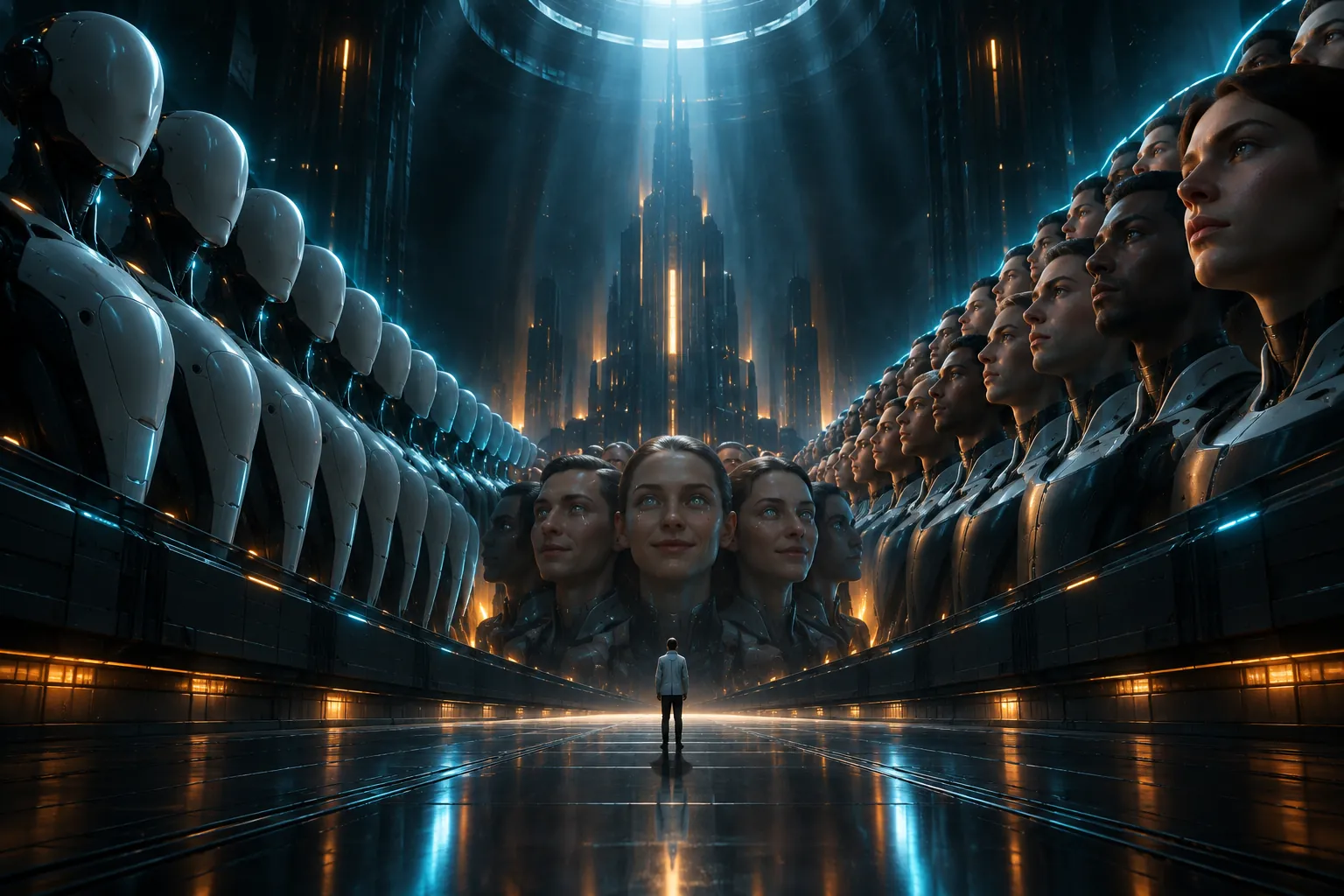
A hive mind is a group of beings that think and act as one shared mind. Each member may still have its own body, but the line between “I” and “we” has been erased or blurred.
The phrase is common in science fiction and in everyday talk about crowds and online communities. It is not a scientific term, and nobody has shown that an insect colony has a single conscious mind.
This page belongs to our History of Science Fiction topic. It explains where the idea comes from, what science does support, and how writers have used it.
Fiction tends to use the hive in two moods. Sometimes it is a horror, because it swallows the individual; sometimes it is a hope, because it ends loneliness and conflict.
The idea explained simply
Picture a honeybee colony. Tens of thousands of bees, none of them in charge, still build comb, defend the nest and decide together where to move.
Writers took that picture and asked a bigger question. What if the colony were not only well organised but aware, one mind spread across many bodies?
A fictional hive mind usually has three features:
- members share thoughts, senses or goals directly, not by speaking;
- individual will is weak, hidden or missing;
- the group acts with a single purpose.
The Belgian writer Maurice Maeterlinck helped popularise the picture in The Life of the Bee (1901), where he wrote about the “spirit of the hive” that seems to guide the colony.
Biology then gave the idea a respectable cousin, the superorganism. In 1911 the entomologist William Morton Wheeler argued that an ant colony can be studied as if it were a single organism.
Related terms are easy to mix up. Swarm intelligence and collective intelligence describe groups that solve problems well; “hive mind” in fiction adds a shared consciousness.
In everyday speech the phrase has grown looser still. People use it for fans who all react the same way, for a team that seems to read each other’s thoughts, or for an online crowd that repeats one opinion.
Those uses are playful or critical, and they are metaphors. Nobody means that the members have really merged.
The real science
What is established: colonies of ants, bees and termites solve problems that no single insect understands. This is real and well studied.
When a honeybee swarm needs a new home, scout bees report candidate sites with waggle dances. The swarm commits once enough scouts agree, a process the biologist Thomas Seeley describes in Honeybee Democracy (2010).
Termites and ants show another trick. In 1959 the French biologist Pierre-Paul Grassé named “stigmergy”: work already done leaves a trace, and the trace tells the next worker what to do.
Some ants go further and use their own bodies as building material. Army ants form living bridges and fire ants link up into floating rafts, yet each ant is still following simple local cues.
None of this needs a shared mind. Each insect follows simple rules, and the larger pattern appears from the many.
Humans show a weak version too. In 1907 Francis Galton studied guesses at the weight of an ox at a country fair, and the middle guess of the crowd landed within about one percent of the true weight.
Engineers copy swarms on purpose. In 2014 a Harvard team led by Michael Rubenstein and Radhika Nagpal made 1,024 tiny robots, called Kilobots, form shapes with no leader.
Brain links are the closest real step. In 2019 researchers at the University of Washington and Carnegie Mellon linked three people in a game called BrainNet, using EEG to read signals and magnetic stimulation to deliver them.
The data it carried was very simple, such as whether to rotate a falling block. It shows direct brain-to-brain messaging is possible in a lab, not that minds can merge.
What is speculation: a conscious hive mind, with one shared experience across many bodies. We have no settled theory of consciousness, so this stays a thought experiment and a plot device.
Where it shows up in fiction
Light spoilers follow for Childhood’s End and Ender’s Game; the endings are not described.
Olaf Stapledon was early. In Last and First Men (1930) a Martian life form is a cloud of tiny units that think together, and Star Maker (1937) imagines whole worlds whose minds are linked.
Arthur C. Clarke’s Childhood’s End (1953) asks whether something larger than any person could be a step forward for humanity. It treats the question with awe, not simple fear.
John Wyndham’s The Midwich Cuckoos (1957) gives a small-town version. A group of unusual children share what one of them learns, and the village slowly realises it is dealing with one mind in many bodies.
Isaac Asimov’s Foundation’s Edge (1982) introduces Gaia, a planet whose people, animals and land share a single consciousness. Here the hive is a serious proposal for humanity’s future.
Orson Scott Card’s Ender’s Game (1985) pits humans against the Formics, an insect-like species organised around queens. The book uses the hive to ask whether we can understand a mind that is not made of individuals.
Vernor Vinge’s A Fire Upon the Deep (1992) offers a gentler variation. The Tines are packs of several animals whose linked minds make one person.
Television made the idea famous with the Borg, who first appeared in Star Trek: The Next Generation in 1989. They are the best-known example of the hive as menace.
Notice how authors choose. A hive can be an enemy, a utopia, a warning about conformity or a way to show how alien an alien could be.
The idea also solves a practical problem for storytellers. A group that speaks as “we” can be frightening or moving in a way that a single villain or a crowd of separate characters cannot.
It raises hard questions for the reader as well. If your thoughts were shared, would you still be you, and who would be left to disagree?
Common misconceptions
“The queen is the boss.” In bee and ant colonies the queen mainly lays eggs; the colony’s decisions come from the workers’ many small interactions.
“A hive mind means telepathy.” In nature the links are dances, scents and traces, and in fiction many hives use other channels, from chemicals to machines.
“Insect colonies are one conscious mind.” There is no evidence for that.
“Hive mind” is a metaphor, and the real science is called swarm intelligence.
“A hive mind is always evil.” Stories such as Foundation’s Edge and Childhood’s End treat it as a real option with gains and losses.
“It is the same as a cyborg.” A cyborg joins living and machine parts in one body; a hive joins many minds.
Some fiction, such as the Borg, combines both.
“Swarms are always wise.” Crowds can also go wrong.
Army ants that lose their trail sometimes follow each other in a circle, called an ant mill, which shows that simple rules can fail when conditions change.
Read next
Start with Cyborg, which covers the machine side of merged minds and bodies.
Then read First contact (in fiction and science) to see how writers imagine meeting a mind that is not like ours.
For the bigger picture, return to the History of Science Fiction hub.