In five minutes
Quantum entanglement is a link between two or more quantum particles, such as photons or electrons. They have to be described as one system, even when they are far apart.
Measure one particle and the result is tied to what you find when you measure the other. No ordinary cause, such as a shared instruction set at the start, can explain the pattern.
It does not let you send a message faster than light. That is the point science fiction gets wrong most often.
The idea is real. It has been measured in thousands of experiments, and the 2022 Nobel Prize in Physics went to three scientists who tested it.
It is also useful. Entanglement is the raw material of quantum cryptography and of quantum computers.
In the history of science fiction, it usually shows up as a magic telephone that connects two distant places instantly. This article separates what the physics says from what the stories borrowed.
The idea explained simply
Start with a boring example. You put one glove of a pair in each of two boxes and mail the boxes to opposite ends of the world.
When you open your box and see a left glove, you know at once that the other box holds a right glove. Nothing travelled between the boxes.
The gloves were different from the start, and you simply learned which was which.
Entanglement looks similar, but it is not the same thing. Take two particles prepared so that their spins always come out opposite.
Spin is a quantum property that, when measured, gives one of two answers, called up or down.
Quantum theory says that before you measure, neither particle has a definite spin along any direction you might choose. Only the pair has a definite property: their spins are opposite.
Now measure one particle along some direction. You get up or down, apparently at random, like a fair coin flip.
Measure the other particle along the same direction and you always get the opposite answer. Choose a different direction and the match follows that direction, as if the pair had agreed on every possible direction in advance.
The gloves cannot do that. A glove has one fixed handedness, but a particle seems to have no fixed answer for every question until you ask.
This is the strange part, and it is why physicists spent decades arguing about it.
The real science
The story begins in 1935. Albert Einstein, Boris Podolsky and Nathan Rosen published a short paper arguing that quantum theory must be incomplete.
Their point was that if the theory is right, a measurement here seems to fix a result there. They concluded that the particles must carry hidden instructions the theory leaves out.
In the same year Erwin Schrödinger gave the effect its name. He wrote in German of Verschränkung, which became "entanglement" in English.
Einstein disliked the consequences. In a 1947 letter to Max Born he called it "spooky action at a distance", a phrase that has stuck to the subject ever since.
For nearly thirty years this looked like a matter of taste. Then, in 1964, the Northern Irish physicist John Stewart Bell found a way to test it.
Bell proved that any theory based on local hidden instructions must obey a limit on how strongly distant measurements can match. Quantum theory predicts that the limit can be broken.
The question could now be settled by experiment.
The experiments came in steps. John Clauser and Stuart Freedman ran an early test in 1972, and Alain Aspect and his team improved it in the early 1980s by changing the measurement settings while the photons were in flight.
Early tests had loopholes that a determined sceptic could use, such as detectors that missed too many photons. In 2015 several groups, including one at Delft in the Netherlands, closed the main loopholes in a single experiment.
The limit was broken.
The 2022 Nobel Prize in Physics went to Alain Aspect, John Clauser and Anton Zeilinger for this line of work.
What the results show is solid. No theory of fixed, local, pre-set answers can match nature.
What they mean is still debated.
Some physicists give up the idea that a measurement has a single outcome, which leads to the many-worlds reading. Others accept a kind of nonlocal connection.
These are interpretations of the same mathematics, and experiments cannot yet separate them.
Why it cannot carry a message
Here is the part that matters for fiction. Suppose Alice measures her particle and Bob measures his, far away.
Alice's result is random. Whatever she chooses to measure, Bob sees an equally random stream of ups and downs when he looks at his particle alone.
The match only appears when Alice and Bob compare their records. That comparison needs a normal signal, such as a phone call or a radio message, which cannot beat light.
Physicists call this the no-communication theorem. Entanglement creates correlations, not controllable signals.
What it is used for
Quantum key distribution uses entangled pairs to share an encryption key. If someone listens in, the correlations change in a way the two users can detect.
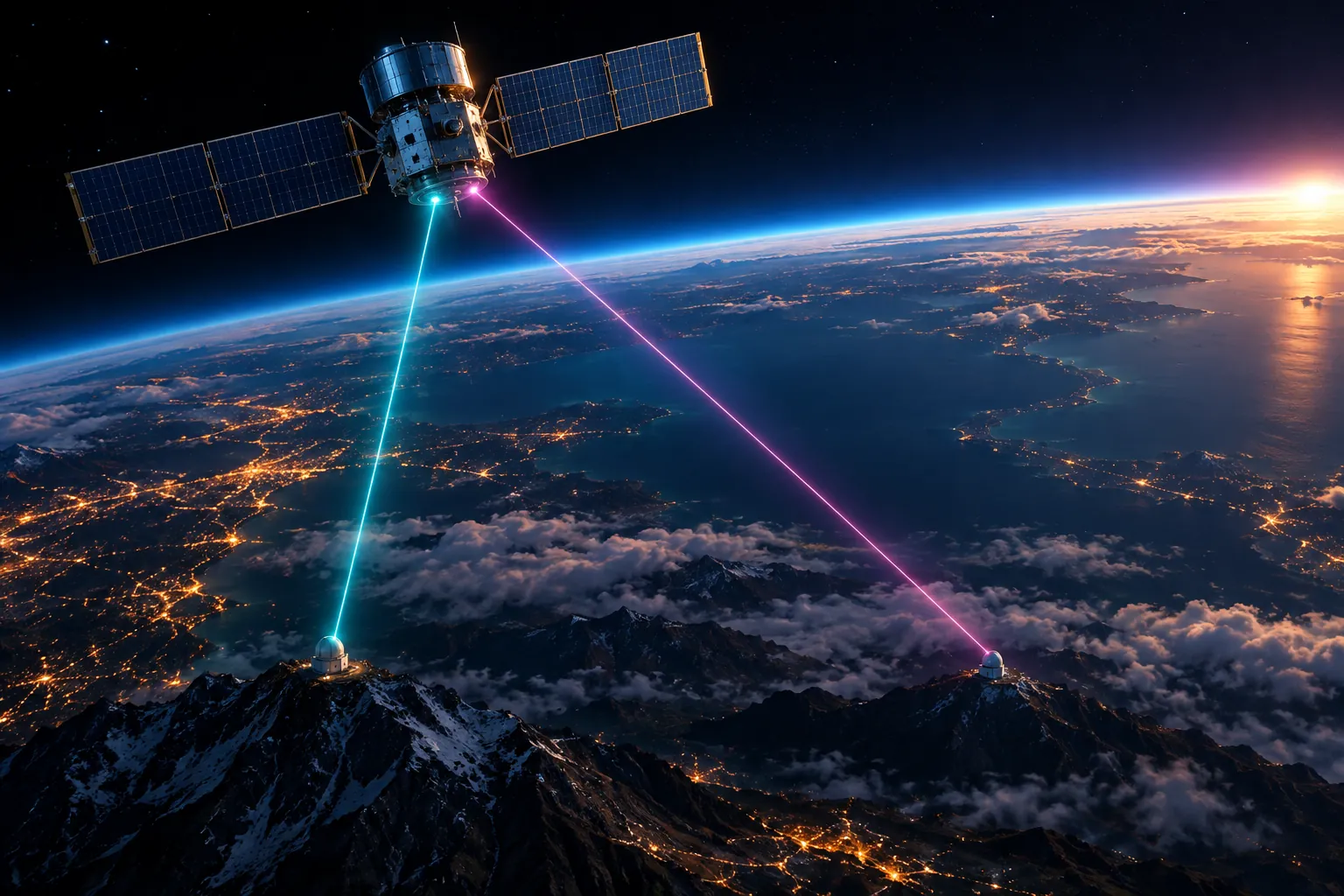
In 2017 a team using the Chinese satellite Micius distributed entangled photons to ground stations about 1,200 kilometres apart. It was a milestone for secure communication.
Quantum teleportation was proposed in 1993 and first demonstrated in the late 1990s. It transfers the state of a particle to another one using entanglement plus an ordinary message.
No matter moves, and the original state is destroyed in the process.
Quantum computers also use entanglement among their qubits. It is one reason they can solve certain problems in ways ordinary computers cannot.
Where it shows up in fiction
The most famous instant-communication device in the genre is the ansible, invented by Ursula K. Le Guin. It appears in her early novels and in The Dispossessed (1974), and Le Guin based it on an invented principle of simultaneity rather than on entanglement itself.
Later writers borrowed the name and the idea. In Orson Scott Card's Ender's Game, instant communication across star systems is part of how the war is run.
Liu Cixin's The Three-Body Problem uses entanglement more directly. In the novel, the sophons, tiny machines made from unfolded particles, are linked to their home world so that they can report back with no delay.
This is a clear case of fiction stretching a real idea. The book gives the sophons technology far beyond ours, and the link works because the author says it does.
Plenty of films and television series use the same trick. A distant colony calls home with no lag, and a character explains that the particles are "entangled".
The story pays off, but the physics does not. If entanglement alone could carry messages, relativity would allow signals to travel backwards in time under some conditions, which is why writers who care about consistency invent a new principle instead.
Common misconceptions
"Entanglement sends messages instantly." It does not.
The results are random until compared, and the comparison travels no faster than light.
"One particle tells the other what to do." The experiments rule out simple stories of pre-set instructions, but they do not show that a signal passes between the particles.
Physicists are careful to say only that the correlations exist.
"It only works for tiny particles." Photons, electrons and atoms have all been entangled.
In 2021 a team entangled two microscopic vibrating drums, although keeping such a state intact gets harder as objects get bigger.
"Entanglement links everything in the universe." In practice entanglement is fragile.
Contact with heat or air quickly spreads it into the environment, a process called decoherence, and the effect fades.
"Quantum teleportation moves objects." It moves a quantum state and needs an ordinary message to finish the job.
Nobody has teleported a person, and the physics does not offer a route to it.
"Consciousness causes it." There is no evidence for this.
A measurement here means any interaction that records the result, and a detector does that as well as an observer does.
Read next
Multiverse: the many-worlds reading is one proposed way to understand what entanglement means, and it shows where physics and fiction meet.
Simulation hypothesis: another big idea in which the strange rules of quantum physics become a clue, or a plot device, about what reality is.
History of science fiction: the wider story of how ideas like instant communication moved from physics papers into novels.