In five minutes: what is a wormhole?
A wormhole is a theoretical tunnel through spacetime that would join two distant regions, and in some versions two different moments in time. Picture an ant on a sheet of paper. To reach a spot on the far side of the sheet, it has to crawl across the page. Now fold the paper so the two spots almost touch, and join them with a short tube. The trip becomes tiny. A wormhole is that tube, except that the paper is space itself.
Two things are true at the same time. General relativity, Einstein's theory of gravity, allows wormhole-shaped solutions on paper. And no one has ever observed a wormhole or found a way to build one. Keep both facts in mind and the rest of this page falls into place. If you want to see how the idea travelled through the genre, it sits inside our History of Science Fiction.
The idea: space that bends and connects
General relativity says that mass and energy bend spacetime, and that bending is what we feel as gravity. Bending can, in principle, take odd shapes. A wormhole would have two openings, called mouths, joined by a narrow passage called the throat. Step into one mouth and you would leave through the other, perhaps light-years away, without crossing the space in between.
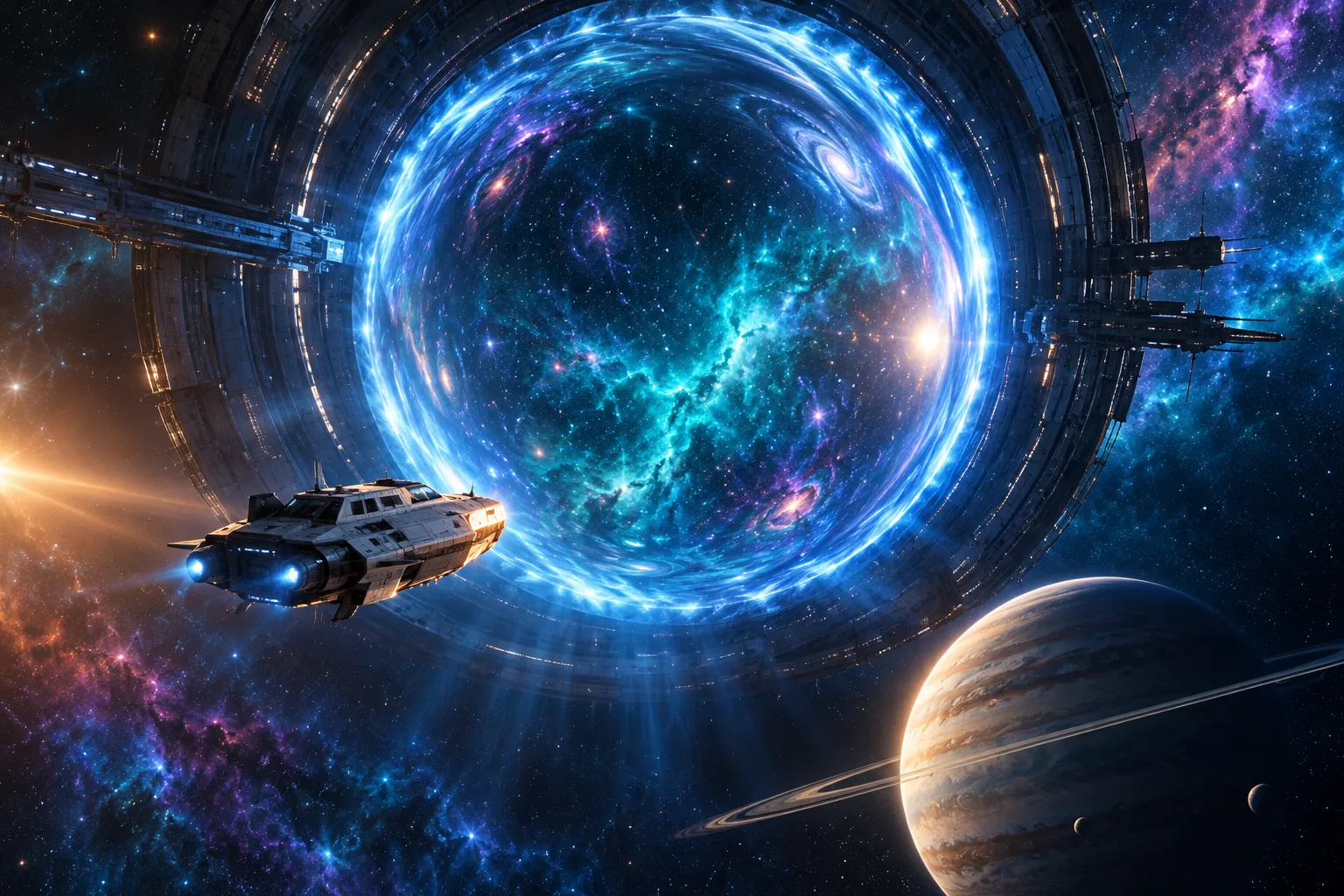
The mouths would not look like doors in a wall. Each would look like a ball. Because light bends around it, the ball would show the sky as seen from the other end, stretched and warped like a view through a glass sphere.
Physicists often draw a wormhole as a curved surface with two funnels joined at their narrow ends. This is an embedding diagram. It is a teaching aid that squeezes three-dimensional space onto a two-dimensional picture. It does not mean there is a hidden extra direction you could point to.
Where the idea came from
The first hints are older than the name. In 1916 the Austrian physicist Ludwig Flamm studied the geometry of the simplest black hole solution and saw that it could be read as two regions of space joined together. In 1935 Albert Einstein and Nathan Rosen used a similar geometry in a paper that tried to model elementary particles as smooth bridges in space. These "Einstein–Rosen bridges" were never meant as a way to travel.
The word "wormhole" came from the American physicist John Archibald Wheeler, who used it in the late 1950s while thinking about the structure of space at the tiniest scales. The picture is a worm that tunnels through an apple. To the worm, the tunnel is a shortcut from one side of the fruit to the other.
In 1962 Wheeler and Robert Fuller showed a problem. The bridge in the simplest black hole solution pinches off so quickly that not even a ray of light can get across before it closes. So the bridge is in the equations, but nothing can use it.
The real science: what is known and what is guessed
What is established: general relativity has passed every test we have given it, and its equations do allow wormhole geometries. What is speculation: that any wormhole exists in nature, or could ever be made.
The modern version of the question began with fiction. In the mid-1980s Carl Sagan was writing the novel Contact and wanted a way for his characters to cross the galaxy that did not break physics too badly. He asked the physicist Kip Thorne. Thorne and his student Michael Morris worked it out and published the result in 1988 in the American Journal of Physics. Their wormhole was a design for a passage that a traveller could survive.
The catch is what holds the throat open. Ordinary matter makes gravity pull inward, and that would make the throat collapse. To keep it open you need what physicists call exotic matter, which has negative energy density and pushes outward. Nobody has found a lump of such material.
Negative energy is not pure fantasy, though. The Casimir effect, measured in laboratories, shows that the energy between two uncharged metal plates placed very close together is slightly lower than the energy of empty space outside. But the amounts are minuscule and exist only in tiny gaps. No known method collects enough negative energy to hold open a throat wide enough for a ship. Stability is a second problem: a small disturbance might make the throat collapse.
Newer work looks at quantum effects. In 2013 Juan Maldacena and Leonard Susskind suggested a bold idea known as ER=EPR: two entangled particles might be linked by an extremely small wormhole. It is a proposal in theoretical physics and has not been tested. In 2017 Ping Gao, Daniel Jafferis and Aron Wall showed that, in a particular mathematical setting, quantum effects can make a wormhole traversable. In 2022 a team using a Google quantum processor reported a simulation of wormhole-like behaviour in a small model system, published in Nature. It was a calculation on a quantum computer, not a tunnel in space, and other physicists debated how far its meaning reaches.
The bottom line: no wormhole has been observed, and no known technology could make one.
Wormholes and time travel
If a wormhole could be traversed, it might also allow travel in time. In 1988 Michael Morris, Kip Thorne and Ulvi Yurtsever described how this could work. Move one mouth at very high speed while the other stays put, and the two ends would no longer agree on the time. Enter one and you could come out in the past.
That raises the familiar paradoxes about changing history. In 1992 Stephen Hawking proposed the chronology protection conjecture, the idea that the laws of physics somehow stop such time machines from forming. It has not been proved, and it has not been disproved. For now, time-travel wormholes are a thought experiment used to test the theory.
Where it shows up in fiction
Writers took to the wormhole because it solves a plot problem: how to get across the galaxy in the time a story allows. In Carl Sagan's novel Contact (1985), a message from space comes with plans for a machine, and the travellers use a chain of tunnels through space to cross vast distances. The book was the reason Thorne did the calculation above.
Joe Haldeman's The Forever War (1974) uses a related idea: ships jump between stars through collapsed stars, and every journey costs the soldiers years back home. The mouth of a shortcut and the price of using it are both part of the drama. Readers of Arthur C. Clarke's 2001: A Space Odyssey often compare the book's Star Gate to a wormhole, although the story itself is more mysterious about how it works.
On film, Interstellar (2014) is the best-known example. Kip Thorne advised on the science, and the film shows its wormhole as a sphere that holds a distorted view of another part of the sky, which matches what the equations predict.
Another way to beat distance, which skips the tunnel and moves the ship through bent space instead, is covered in warp drive.
Common misconceptions
- "A black hole is a wormhole." No. A real black hole made by a collapsing star has no known exit. The bridge in the simplest mathematical solution closes too fast to cross.
- "An Einstein–Rosen bridge is a travel route." It was a model of a particle, and later work showed that nothing can pass through it.
- "Astronomers have seen one." They have not. Images of black holes, like the 2019 image of the one in galaxy M87, show black holes, not wormholes.
- "A wormhole is faster than light." Light still moves at its normal speed everywhere inside. The wormhole makes the path shorter, which is a different thing.
- "Google built a wormhole." The 2022 experiment simulated wormhole-like behaviour on a quantum chip. No tunnel was opened in space.
Read next
- Warp drive: another way to cross the stars quickly, by moving space around the ship instead of tunnelling through it.
- Multiverse: the idea of many universes, which writers sometimes link to the far end of a wormhole.
- History of Science Fiction: how ideas like this moved from physics papers into stories.