In five minutes
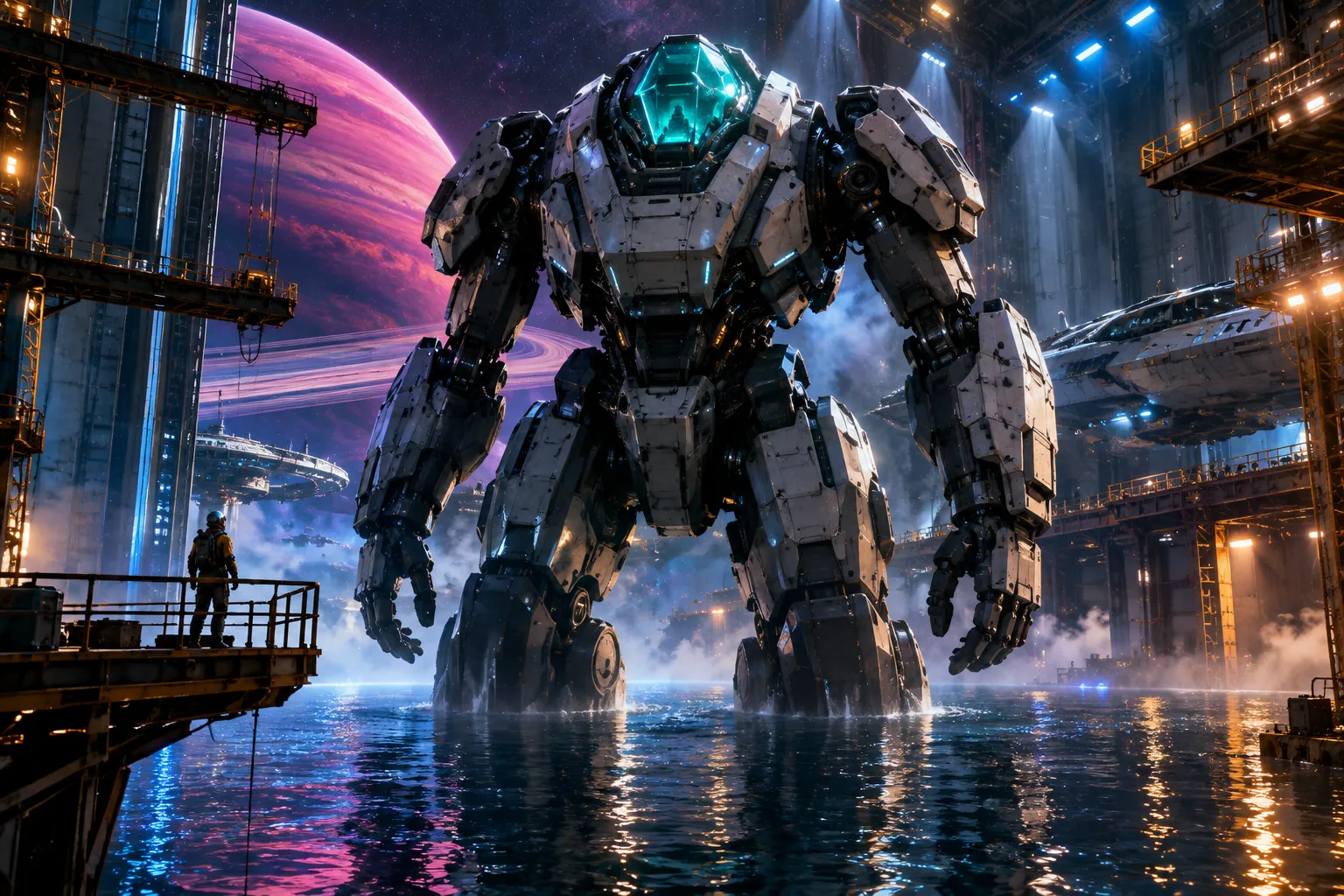
Mecha are machines that look and move like giant robots, and the word also names the genre of stories built around them. It comes from the Japanese メカ, a short form of “mechanical”. When people ask what mecha is, the short answer is this: a story where a person and a huge machine are tied together, and the machine is as much a character as the pilot.
The genre began in Japan in the 1950s and 1960s and grew into several flavours. In some stories the robot is a hero with a name and a signature attack. In others it is a weapon of war, built in a factory, repaired in a hangar and flown by ordinary soldiers. In a third kind it is a mirror for a lonely teenager who has to climb inside it.
Mecha is also an engineering idea. Real companies have built walking machines that carry a rider, and real exoskeletons help workers lift heavy loads. None of them look like the robots on screen, but they share the same question: how do you put human control into something far stronger than a human?
Where mecha came from
The root is the robot itself. The word “robot” comes from Karel Čapek's 1920 play R.U.R., and Japanese manga artists in the postwar years took the idea and made it their own. In 1956 Mitsuteru Yokoyama began the manga Tetsujin 28-go, about a huge steel robot steered by a boy with a remote control. The anime followed in 1963 and reached English-speaking viewers as Gigantor.
The next step came in 1972, when Go Nagai's Mazinger Z put the pilot inside the machine. Kōji Kabuto sits in a small craft that docks into the robot's head, so the hero is no longer holding a remote. He is wearing the giant. Most later mecha stories keep that picture: a cockpit, a pilot and a body ten or twenty times taller than a person.
Sunrise's Mobile Suit Gundam, from 1979, changed the tone again. The director Yoshiyuki Tomino set the robots inside a long war, with supply problems, rival armies and soldiers who die. Bandai began selling plastic model kits of the series in 1980, called Gunpla, and the hobby is still huge today.
Super robots and real robots
Fans sort mecha into two broad families. A super robot story, like Mazinger Z, treats the machine as a one-of-a-kind champion. It may be powered by a secret metal or a strange technology, and it fights a new monster each week. The mood is bold and heroic, and nobody asks where the spare parts come from.
A real robot story, like Mobile Suit Gundam, treats the machine as military equipment. There are many of them, they need maintenance and ammunition, and a cheap mass-produced model can beat a famous one if the pilot is clever. The word “real” does not mean realistic physics. It means the world around the robot behaves like a world with logistics and politics.
Later series mix the two. Super Dimension Fortress Macross (1982) gave us fighters that transform between jet, half-robot and robot forms, set in a story about music and first contact. Hideaki Anno's Neon Genesis Evangelion (1995) used its giant machines to explore fear, family and the pressure placed on young pilots, and it changed what viewers expected the genre to be about.
The real science: can a giant robot walk?
The honest answer is that a walking giant is very hard to build, and the reason is simple geometry. This is the square-cube law. If you make a body ten times taller in every direction, its weight grows about a thousand times, but the cross-section of its legs grows only about a hundred times. Each square centimetre of leg has to carry ten times more load. A scaled-up human would break its own bones.
Engineers can get around this with strong frames, hydraulics and careful balance, but there are costs. A large machine needs a big power source, and batteries are heavy. It has to place each foot on firm ground, because a step of tens of tonnes can sink into soft earth. A fall from a great height would wreck it. A pilot's cockpit high up on a swaying body would also shake the pilot badly with every step.
Still, people have tried. A Japanese company, Suidobashi Heavy Industry, showed a four-metre piloted robot called Kuratas in 2012. A South Korean company, Hankook Mirae Technology, presented Method-2 in 2016, a rider-carrying walker about four metres tall that could take slow steps. In Yokohama, a full-size 18-metre Gundam opened in 2020 as a moving attraction, held up by a fixed frame. These are demonstrations, not practical vehicles, but they show how much the dream still pulls.
Working machines: exoskeletons, rescue and construction
The most useful descendants of mecha are smaller than the movie versions. A powered exoskeleton is a wearable frame with motors that adds strength or supports the body. Companies such as Sarcos have built suits for industrial lifting, and Cyberdyne's HAL suit in Japan is used in rehabilitation, helping people with weak muscles to stand and walk.
On work sites, the line between a robot and a machine is thin. Japan has developed dual-arm heavy machinery that can cut, grip and lift with two hands, which makes it useful for disaster response and demolition. Many such machines are operated by a person at a distance, which echoes Tetsujin 28-go more than Mazinger Z, and keeps the operator out of danger.
The film Aliens (1986) pictured a cargo-handling exoskeleton, the power loader, years before real ones appeared. This is the quiet lesson of the genre: the most believable mecha is not a giant warrior but a tool that makes one human far more capable.
Where it shows up in fiction
Anime and manga are the home of the genre. Besides the series above, Mobile Suit Gundam has spawned dozens of sequels, and Neon Genesis Evangelion has been rebuilt as a film series. Guillermo del Toro's film Pacific Rim (2013) brought the idea to a Western blockbuster, with huge machines piloted by two people whose minds are linked.
Games carry the genre too. The tabletop game BattleTech started in 1984, FromSoftware's Armored Core began in 1997 and Titanfall arrived in 2014, mixing a pilot on foot with a giant machine. Mecha also meets other science fiction topics: a human fused to a machine echoes the cyborg, and a robot that takes orders raises the questions behind the Three Laws of Robotics.
Common misconceptions
“Mecha means any robot.” Not quite. In English, mecha usually means a large, piloted or remotely operated robot from the Japanese tradition. A small household robot or a factory arm is not usually called mecha.
“Giant robots are the same as Transformers.” They overlap in fans' minds, but the genre as discussed here grew from Japanese series about pilots and their machines, while a talking robot that is itself a living character is a different tradition.
“Real mecha already exist.” Real piloted walkers exist only as slow demonstrations. Real exoskeletons are much closer to daily use, but they are tools worn on the body, not warships.
Read next
Cyborg: if the idea of a person joined to a machine caught your interest, this explains where that idea came from and how medicine already uses it.
Three Laws of Robotics: it shows how fiction has tried to make robots safe, and why the rules never quite work.