In five minutes: what is Europa?
Europa is the smallest of the four big moons that circle Jupiter. It is about 3,122 kilometres across, a little smaller than Earth's Moon, and its surface is a shell of water ice. Galileo Galilei spotted it in January 1610, and it was later named after Europa, a princess from Greek myth.
It matters today because of what is probably underneath. Most planetary scientists think a global ocean of salty water lies below the ice, holding roughly twice as much water as all of Earth's oceans put together. Water is the first thing life needs, so Europa is one of the best places to ask whether anything could be alive beyond Earth. Nobody has seen that ocean directly, and nobody has found life. The rest of this page separates what has been measured from what is still a good guess. For the wider family of worlds, see Jupiter's moons.
The real science: what we know about Europa
A young, cracked shell of ice
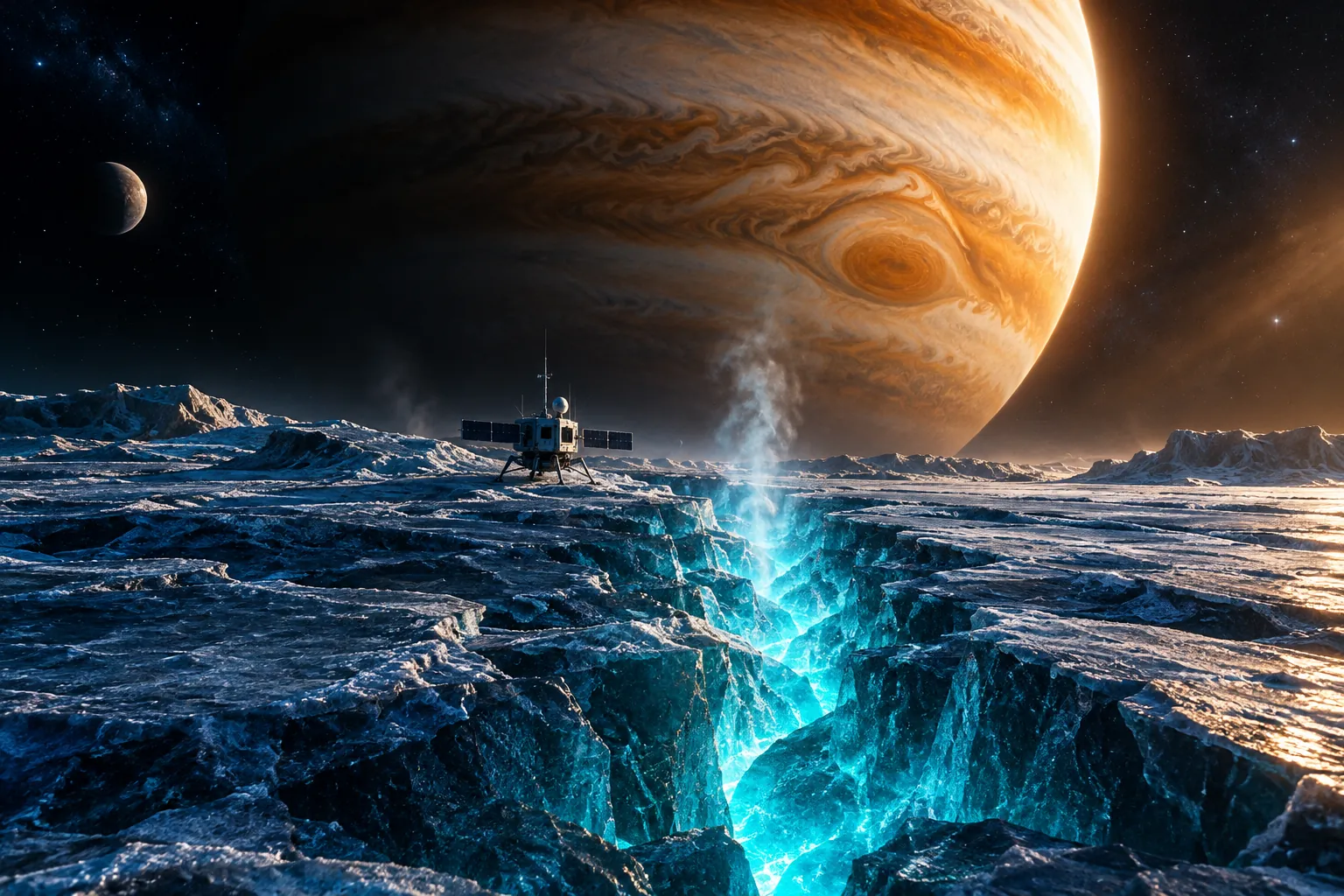
Europa's surface is bright, smooth and crossed by long dark cracks called lineae. It has very few impact craters, and that is the clue that the surface is young. Estimates put its age at around 40 to 90 million years, a blink in the history of the Solar System. Something keeps resurfacing it. In some places the ice looks broken into blocks that drifted apart and froze back together. This is called chaos terrain, and Conamara Chaos is the best-known patch. The surface is bitterly cold, about minus 160 °C at the equator.
Why scientists think there is an ocean
The strongest evidence came from NASA's Galileo orbiter, which studied the Jupiter system from 1995 to 2003. Its magnetometer saw Jupiter's magnetic field being disturbed around Europa in a way that fits a layer of salty, electrically conductive liquid under the ice. The young, fractured surface fits the same picture. This is evidence by inference, not a photograph of waves.
How thick the ice is remains an open question. Estimates run from roughly 15 to 30 kilometres, and the ocean below could be tens of kilometres deep, perhaps more than 100. These numbers come from models and are still debated. NASA's Juno spacecraft flew past Europa in September 2022 at a distance of roughly 350 kilometres, and its data have been used to estimate an ice thickness of about 29 kilometres, give or take about 10, in the region it sampled.
Where the heat comes from
Europa is far from the Sun, so sunlight cannot keep water liquid there. The heat comes from Jupiter's gravity. Europa's orbit is slightly oval, and it is locked in a rhythm with two neighbours: while Ganymede orbits once, Europa orbits twice and Io four times. This steady tugging stops the orbit from becoming a perfect circle, so Jupiter squeezes and stretches Europa like a rubber ball. The flexing creates friction and warms the inside. This is called tidal heating, and the same process drives the volcanoes of Io.
Plumes, oxygen and carbon dioxide
Between 2012 and 2016, Hubble Space Telescope observations hinted at water vapour rising from near Europa's south pole, and a fresh look at old Galileo data later pointed the same way. The plumes are not confirmed, and research teams still disagree about them. In 2023 the James Webb Space Telescope found carbon dioxide on the surface in a region called Tara Regio, and it may have come from inside the moon. Juno data analysed in 2024 suggested that the surface makes oxygen much more slowly than earlier estimates, about 12 kilograms per second. Each result changes the picture a little, and none has settled it.
Could life exist on Europa?
Scientists usually list three needs for life as we know it: liquid water, a source of energy, and chemical building blocks such as carbon, nitrogen, phosphorus and sulfur. Europa seems to offer the first. Tidal heating is a possible source of the second. If the ocean floor is warm, rocky and chemically active, it could resemble the hydrothermal vents on Earth's seabed, where living communities thrive without any sunlight. The third need is the big unknown, because we do not yet know what is dissolved in Europa's ocean.
There are obstacles too. The ice is thick, so any life would sit beneath many kilometres of it. Jupiter's radiation belts pound the surface, which makes the top layer hostile. That radiation also breaks water apart into oxygen and other chemicals, which could in principle sink into the ocean and feed living things, but nobody knows how well the ice lets that happen.
The honest answer to "could life exist on Europa?" is that conditions look promising and nothing is proven. Scientists call Europa potentially habitable, which is different from inhabited. No spacecraft so far carries instruments built to detect life there.
What comes next: Europa Clipper and JUICE
NASA's Europa Clipper launched on 14 October 2024 on a Falcon Heavy rocket. It uses gravity assists from Mars (March 2025) and Earth (planned for December 2026) to reach Jupiter in April 2030. From there it will make about 49 close flybys of Europa, some as low as 25 kilometres above the ice. It will measure the thickness of the ice, look for the ocean beneath it, study the surface chemistry and map the geology, and it will help decide where a future lander might go. Clipper is built to judge whether Europa is habitable, not to find living things.
The European Space Agency's JUICE probe, launched in April 2023, will reach Jupiter in 2031. Its main target is Ganymede, but it will also make two flybys of Europa.
Where it shows up in fiction
Europa's best-known role in fiction comes from Arthur C. Clarke. In his novel 2010: Odyssey Two (1982), the sequel to 2001: A Space Odyssey, humans discover life on Europa, and a mysterious message warns them not to land there. Europa plays no real part in the story of the first book, so start with 2001 and read the sequel after. The 2013 film Europa Report imagines a crewed mission to the moon's ocean. Many other stories borrow the same idea: a hidden sea beneath a frozen shell.
Common misconceptions
- "Scientists have found an ocean on Europa." They have strong indirect evidence, mainly magnetic data and surface features. No spacecraft has sampled or seen the water itself.
- "Life has been found on Europa." It has not. Europa is a promising place to look, nothing more yet.
- "Europa's water plumes are proven." They are a hint from telescope data and re-analysed spacecraft readings, and they are still debated.
- "You could walk on Europa and dig down to the sea." The ice may be many kilometres thick, and the radiation near the surface would be dangerous to people within hours. No landing is planned.
- "Europa is as big as Earth." It is slightly smaller than our Moon, though its ocean may hold more water than Earth's.
Read next
- Europa Clipper: the mission that will make dozens of flybys to test the ocean idea.
- Jupiter's moons: how Europa compares with Io, Ganymede and Callisto.
- 2001: A Space Odyssey: the novel that started the series in which Europa plays its famous part.