In five minutes
Jupiter's moons are a family of more than 90 known worlds, led by four large ones that Galileo Galilei saw in January 1610: Io, Europa, Ganymede and Callisto. They behave like a miniature solar system. Io is the most volcanic body known, Europa hides a salty ocean under its ice, Ganymede is the largest moon in the solar system, and Callisto is an ancient, cratered ball of ice and rock.
All four orbit inside Jupiter's radiation belts, some of the harshest radiation any spacecraft has to cross. A radio signal needs roughly 33 to 54 minutes to travel between Earth and Jupiter. And Io, the innermost of the four, shapes the radio bursts that Jupiter sends out. This page takes each of these in turn. It belongs to our history of science fiction, because these worlds have fed writers' imaginations ever since Galileo's telescope.
The four Galilean moons
On the nights of 7 to 13 January 1610, Galileo noticed small points of light that changed place beside Jupiter from night to night. They were moons circling another planet, strong evidence that not everything goes around the Earth. The German astronomer Simon Marius claimed to have seen them at about the same time, and the names we use today are the ones he proposed. With steady binoculars you can still see them as a short line of dots beside Jupiter.
Io
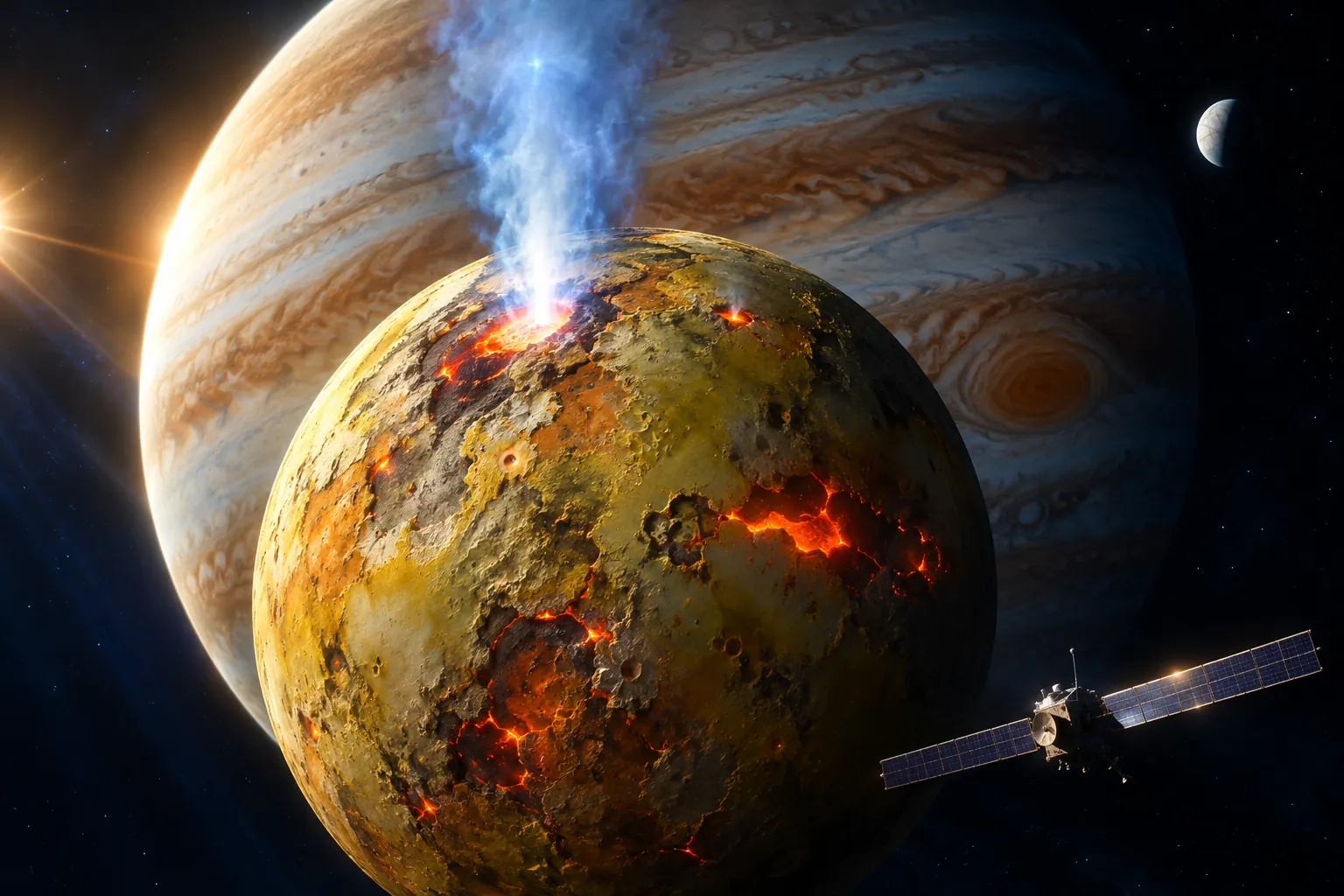
Io is about 3,643 km across, a little larger than our Moon, and circles Jupiter every 1.77 days. Jupiter's gravity, together with tugs from Europa and Ganymede, keeps squeezing and flexing it. The friction heats the interior and powers more than 400 active volcanoes, including huge lava lakes such as Loki Patera. Voyager 1 photographed an eruption plume in March 1979, the first active volcano ever seen beyond Earth.
Europa
Europa is 3,122 km across, a little smaller than our Moon, and wrapped in a shell of water ice. Magnetic measurements by the Galileo spacecraft point to a salty ocean beneath it, perhaps holding about twice as much water as all of Earth's oceans. Nobody has seen that ocean directly. It is the main reason Europa is a top target in the search for places where life could exist.
Ganymede
Ganymede is 5,268 km across. It is the largest moon in the solar system and wider than the planet Mercury, although it has only about 45 percent of Mercury's mass because it is made of ice and rock. It is the only moon known to produce its own magnetic field, and the evidence points to a buried salty ocean. The Juno spacecraft passed within about 1,000 km on 7 June 2021, the first close look in more than twenty years.
Callisto
Callisto is 4,821 km across and the outermost of the four, about 1.88 million km from Jupiter, with an orbit of 16.7 days. Its surface is among the most heavily cratered in the solar system and has changed little for billions of years. It lies outside the worst of the radiation, so mission planners and authors often choose it as the safest place for a human base. A deep ocean may exist there, but the evidence is weaker than for Europa and Ganymede.
The inner three are locked in a rhythm called the Laplace resonance: while Ganymede goes round once, Europa goes round twice and Io four times. This keeps their orbits slightly stretched, which helps feed Io's volcanoes and warm Europa. Callisto is not part of the pattern.
Jupiter's radiation belts
Jupiter has the strongest magnetic field of any planet. It traps electrons and ions and accelerates them to huge energies, forming radiation belts far more intense than Earth's Van Allen belts. Io feeds them: its volcanoes release roughly a tonne of material every second, and part of it is ionised and caught by the field. Pioneer 10 made the first measurements in December 1973.
The closer a moon is to Jupiter, the worse the dose. Europa's surface is commonly estimated to receive several sieverts per day, a level dangerous to a human within a day. Io is worse, Ganymede gets much less, and Callisto very little. Spacecraft cope through design. Juno keeps its most sensitive electronics inside a titanium vault with walls about 1 cm thick and a mass of roughly 200 kg. Europa Clipper will not orbit Europa at all. It will make nearly 50 close flybys and spend most of its time farther out, where the dose is lower.
How long light takes from Earth to Jupiter
Radio waves travel at the speed of light, about 299,792 km per second. Depending on where both planets are in their orbits, Jupiter is between about 588 million km and 968 million km from Earth. Divide one by the other and a signal takes about 33 minutes one way at the closest approach and about 54 minutes at the farthest. At the average distance of about 5.2 astronomical units it is around 43 minutes. A question and its answer therefore take between roughly 65 and 108 minutes.
That is why nobody steers a Jupiter probe with a joystick. Engineers send commands hours or days ahead, and the spacecraft carries them out on its own. Jupiter's moons also gave us the first evidence that light has a finite speed. In 1676 the Danish astronomer Ole Rømer noticed that Io disappeared into Jupiter's shadow later than predicted when Earth was farther from Jupiter. His number was rough, but the idea was right.
Io and Jupiter's radio bursts
In 1955 the American radio astronomers Bernard Burke and Kenneth Franklin picked up strange bursts of noise at about 22 MHz and traced them to Jupiter. The waves are called decametric radio emission because their wavelength is around ten metres. In 1964 Edward Bigg showed that the bursts depend on where Io is in its orbit.
The reason is that Io moves through Jupiter's magnetic field like a generator. It drives an electric current of millions of amperes along the field lines down to Jupiter's polar regions. Electrons there radiate radio waves in a beam, and the beam sweeps past Earth like a lighthouse. Amateurs with a simple antenna tuned near 20 MHz can hear these bursts, and NASA's Radio JOVE project helps students do exactly that.
The real science: Juno and what comes next
Some of this is well established. The sizes and orbits of the four moons, the volcanoes of Io and the magnetic field of Ganymede are measured. A hidden ocean on Europa is strongly supported, though never seen directly. Life on any of these moons is speculation: no one has found any sign of it.
The Galileo orbiter reached Jupiter in December 1995 and ended in September 2003 when it was steered into Jupiter's atmosphere on purpose, to keep Europa free of contamination. Juno launched in August 2011 and entered orbit in July 2016. It was built to study Jupiter itself, but in its extended mission it flew past Ganymede in 2021, Europa in September 2022 and Io in December 2023 and February 2024. Europa Clipper launched on 14 October 2024 and is due at Jupiter in April 2030. The European Space Agency's JUICE launched in April 2023 and should arrive in July 2031, to study Ganymede, Europa and Callisto.
Where it shows up in fiction
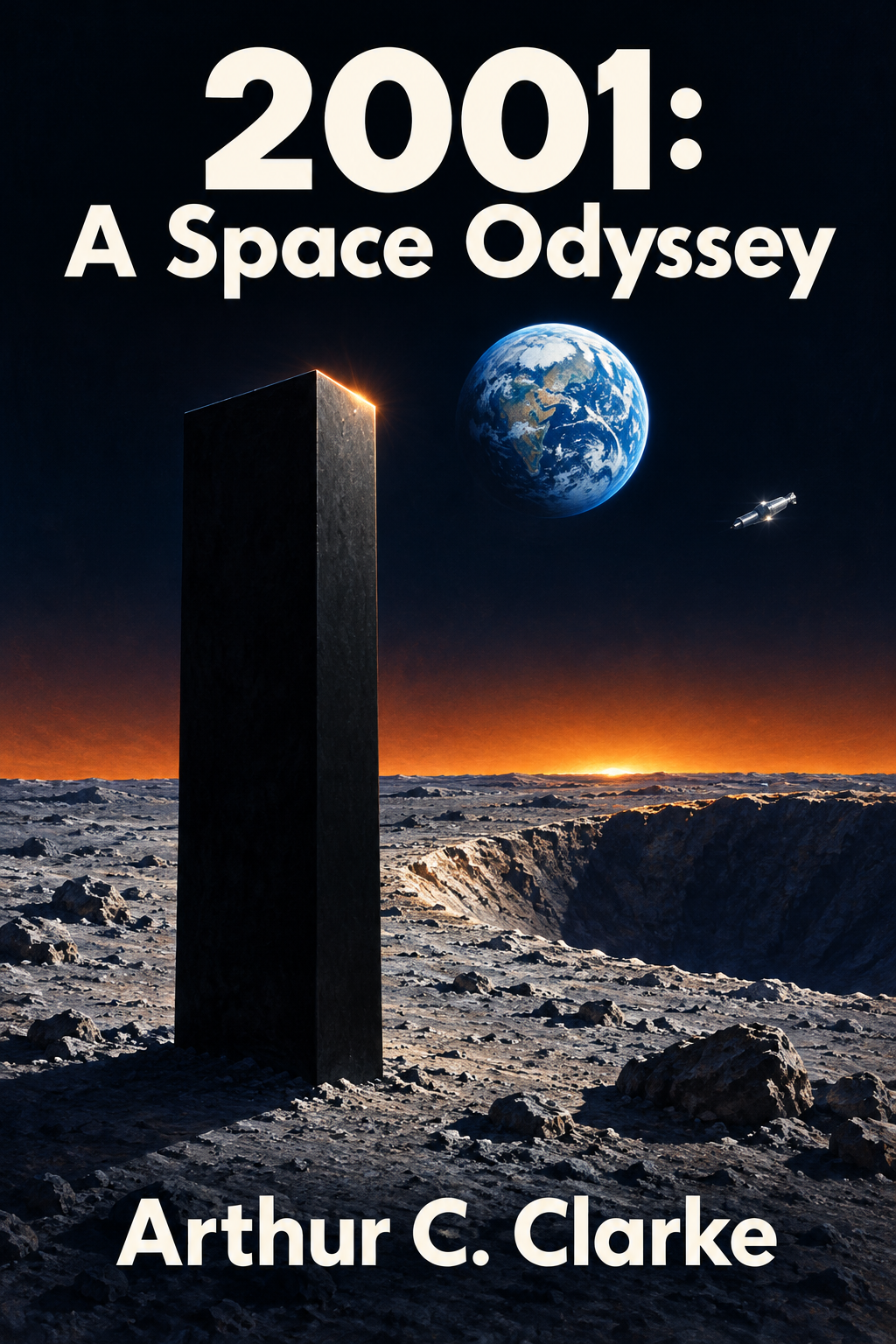
In Arthur C. Clarke's 2001: A Space Odyssey, the journey leads to the outer solar system, and the film places it at Jupiter. Clarke's sequel 2010: Odyssey Two (1982) puts Europa at the centre, with life under its ice. Spoiler note: that book also turns Jupiter into a small star. In James S. A. Corey's The Expanse, Ganymede is a farming world that feeds the outer colonies, which makes it a political prize.
Common misconceptions
- "Jupiter has four moons." It has four large ones, and more than 90 known in total. Most of the rest are only a few kilometres across.
- "Jupiter almost became a star." It would need about 80 times its mass to fuse hydrogen. Clarke's star in 2010 is fiction.
- "We know Europa has an ocean full of life." The ocean is likely, and life is an open question.
- "Ganymede is bigger than a planet." It is wider than Mercury but far lighter, and it orbits Jupiter, so it is a moon.
Read next
- Io: the volcanic moon in more detail.
- Europa: the ice shell, the ocean and the Clipper mission.
- Ganymede: the largest moon and its magnetic field.
- Callisto: the ancient, cratered outer moon.
- 2001: A Space Odyssey: Clarke's novel of a journey to the outer planets.