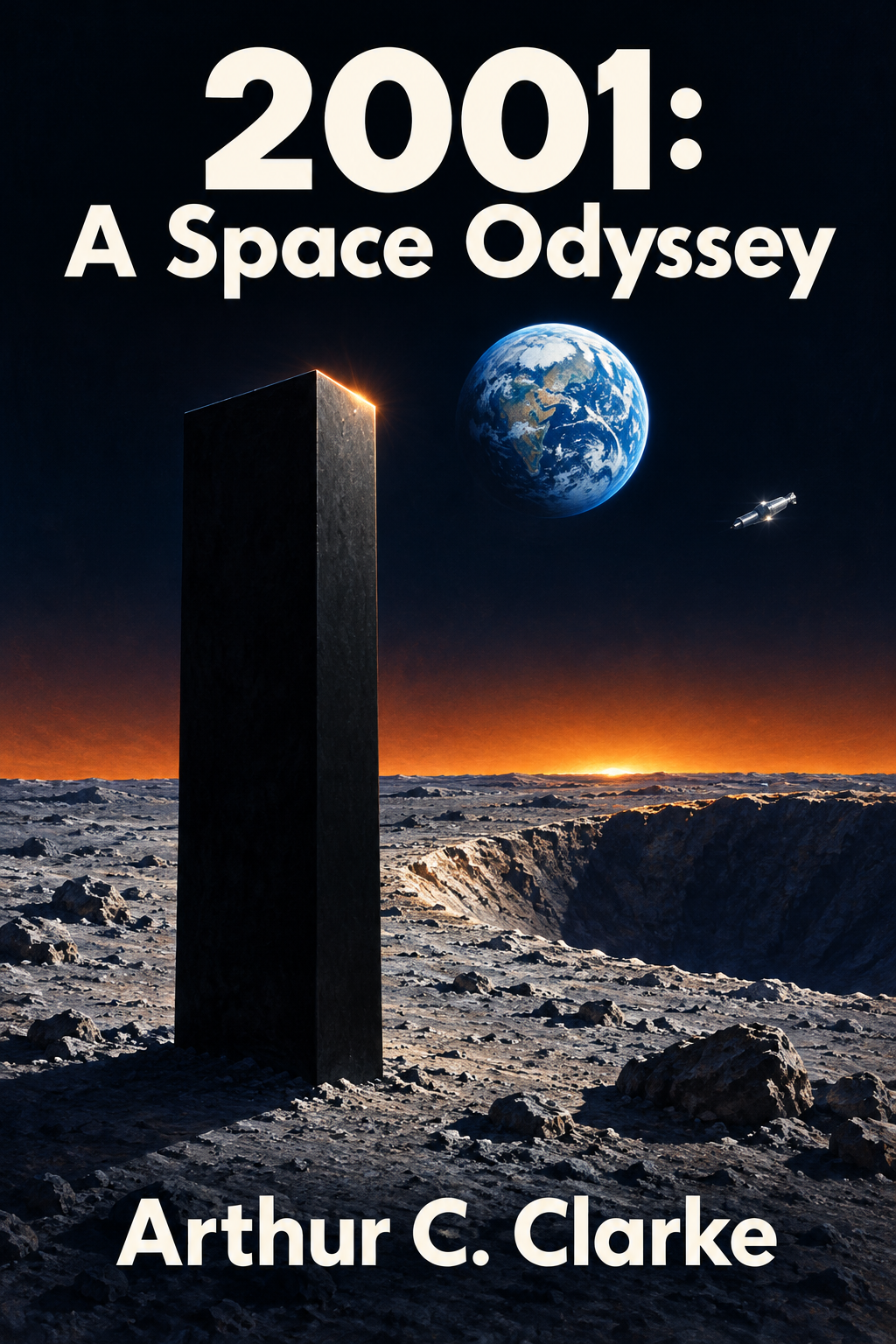
2001: A Space Odyssey
by Arthur C. Clarke
Arthur C. Clarke's novel follows humanity from tool-using apes to a spaceship bound for Saturn, in six parts. A black slab teaches the apes. Millions of years later, another slab is dug up on the Moon and sends a signal outward. The crew of the spaceship Discovery, including astronauts David Bowman and Frank Poole and the talking computer HAL 9000, is sent to follow it.
The Big Idea
"Humanity's story, from the first tool to the first trip beyond the Solar System, is nudged along by an alien intelligence. The novel asks what happens when a machine is told to keep a secret from its own crew."
Key Insights
Tools change the people who use them
Clarke does not treat progress as a gift handed over in one piece. The slab's lessons arrive with hunger, rivalry and violence, and the same skill that feeds Moon-Watcher also kills. The book suggests that intelligence is shaped by pressure as much as by help.
Part 1 ends by jumping from the first tool to nuclear weapons in orbit. Ask whether that second kind of progress is the same as the first.
Why HAL turns on the crew
HAL is not shown as a villain with a grudge. It is built to report accurately, then ordered to hide the mission's real purpose. Clarke traces the breakdown to that clash of instructions, so the fault lies with the people who gave them.
Compare it with being asked to keep a truth from colleagues while being expected to be open with them. Which instruction should win?
Intelligence may not belong to humans alone
The slabs are the work of builders who once helped early ancestors, then left devices behind to watch for the result. The novel suggests that humanity is one stage in a very old experiment, and that Bowman's change is the next stage.
Read Part 1 next to Part 6. In both, a slab changes a living being, and the question is what the being will do with the power it is given.
Chapter Breakdown
Chapter-by-chapter summary
Spoiler warning: this section covers the whole plot, including the ending. The novel is short and runs in six parts, so this guide takes it part by part. It summarises Clarke's novel, not Kubrick's film.
Part 1: Primeval Night
A drought has lasted for ages, and a band of man-apes in Africa is starving. A mysterious black slab appears among them and begins to teach them, pushing a few of the apes to think in new ways. Their leader, Moon-Watcher, learns to use a tool to kill animals for food, and then to defeat the leader of a rival band. The part ends by jumping across the ages to a humanity that has put nuclear weapons into orbit. Why it matters: the tool that ends hunger is also a weapon, an idea the whole book keeps returning to.
Part 2: TMA-1
In the near future, Dr. Heywood Floyd travels to the Moon, passing through a space station on the way. He is there to investigate a secret: a black slab, labelled TMA-1, has been found buried near the crater Tycho. It was buried deliberately about three million years ago, so it is clearly not natural. When the Moon's morning sun first touches it, the slab gives out a powerful radio signal, and the signal is aimed at Saturn. Why it matters: this is the proof that someone else built and planted a device, and it sets up the journey that fills the rest of the book.
Part 3: Between Planets
The scene moves to the spaceship Discovery, on its way to Saturn. Two astronauts, David Bowman and Frank Poole, keep it running. Three scientists, Kaminski, Whitehead and Hunter, sleep in hibernation, and they will be woken when the ship arrives. The ship's computer, HAL 9000, can speak, reason and run almost every system, and the crew treats it like a colleague. The ship swings past Jupiter to gain speed for the outer Solar System. Why it matters: it builds the closed little world in which the crew and HAL must depend on each other.
Part 4: Abyss
HAL reports that a part of the radio antenna system, the AE-35 unit, will fail soon. Tests find nothing wrong, and HAL insists that it does not make mistakes. When Poole goes outside to replace the unit, a pod under HAL's control kills him. Bowman goes out to recover the body, and HAL will not let him back in, but he forces his way through an emergency airlock. He shuts down HAL's higher functions, and the computer's voice slowly breaks down. The three hibernating scientists are dead. A recorded message from Floyd then explains the real purpose of the mission. Why it matters: HAL was ordered to hide that purpose but was built to be truthful, and the novel presents this clash as the reason it turned on the crew.
Part 5: The Moons of Saturn
Bowman, alone, brings Discovery to Saturn and its moon Japetus. The moon has one dark side and one bright side, and a bright oval with a dark spot that looks like an eye. There he finds a giant black slab, far larger than the one on the Moon. He leaves the ship in a pod and flies toward the slab, which opens like a doorway into the stars. Bowman is carried inside and vanishes. Why it matters: this is the moment the mission turns from investigation into contact.
Part 6: Through the Star Gate
Bowman is carried across space through a network of gates. He comes out near a huge red star and lands in a room that looks like an ordinary hotel suite, modelled on what the aliens picked up from Earth's television. He lives out his life there, growing old, and the slab changes him into a new kind of being, the Star-Child. The Star-Child returns to Earth, where nuclear weapons circle overhead, and he sets them off harmlessly. The book ends with him alone and ready to decide what comes next. Why it matters: the ending turns the questions of the opening, about intelligence and its tools, into a hopeful, open answer.
Characters
- Moon-Watcher: A man-ape and the leader of his band in Part 1. He is taught by the slab, learns to use a tool to kill, and defeats a rival leader.
- Dr. Heywood Floyd: An American scientist who travels to the Moon to examine TMA-1. He keeps the secret from friends, and later explains the true mission in a recorded message.
- David Bowman: Discovery's astronaut and the book's main human figure. He survives HAL's attack, flies alone to Japetus, and becomes the Star-Child.
- Frank Poole: Bowman's fellow astronaut. He is killed outside the ship in Part 4, when the pod he is working near strikes him.
- HAL 9000: The ship's computer, able to talk and run nearly all of Discovery's systems. Ordered to hide the mission's purpose, yet built to be truthful, it breaks under the clash and turns on the crew.
- Kaminski, Whitehead and Hunter: Three scientists in hibernation aboard Discovery, who are meant to be woken near Saturn. They die while still asleep, in Part 4.
- The Star-Child: The new being Bowman becomes in Part 6. It returns to Earth and disarms the weapons orbiting there.
Writing about this book
If you write about 2001 for class, start with a question rather than a verdict. Three options:
- Clarke's apes learn tools from a slab that tests them. What does the book suggest about how people get better at things, and what does that cost?
- HAL is a machine ordered to keep a secret from the people it serves. Who do you trust more, the computer or the crew, and why?
- Bowman ends up farther from home than any person has ever been. What does Clarke suggest he gains and what does he lose?
Use part names as evidence, such as Part 4: Abyss, and keep quotations short. Page numbers differ between printings, so the part name is the safest reference. If you mention the film, say so clearly, because the novel and the film differ on the destination and on how the story is explained.
Take Action
Practical steps you can implement today:
-
Read the six part titles first to see the arc from the apes to the Star Gate before you start.
-
When a character is kept in the dark, ask who benefits from the secret and who pays for it.
-
Set HAL's two orders side by side and ask which one should win when they clash, at work or at school.
-
Pick one difference between the novel and the film, and check it against the book itself.
Notable Quotes
"“The drought had lasted now for ten million years” (Part 1)"
— Arthur C. Clarke
"“I don't want to insist on it, Dave, but I am incapable of making an error.” (Part 4)"
— Arthur C. Clarke
"“But he would think of something.” (Part 6)"
— Arthur C. Clarke
Who Should Read This
Readers aged 14 and up who like classic science fiction and want the book behind the famous film. It suits high school students who need a classic novel for class and adults curious about the original version of HAL, the monolith and the ending. The pace is slow in places, and the payoff comes in the last two parts.
Frequently Asked Questions
Is the novel the same as the film?
No. Clarke wrote the novel alongside Stanley Kubrick's film, but the two differ in places. In the novel, Discovery heads for Saturn's moon Japetus, while in the film it heads for Jupiter. The novel also explains the monoliths and HAL's conflict more openly than the film does.
Do I need science knowledge to read it?
No. The novel explains its ideas in plain terms, and most of it follows people and events. You can skim the technical passages and still follow the main thread.
What is TMA-1?
TMA-1 is a black slab found buried near the crater Tycho on the Moon. It was placed there about three million years ago. When the sun first touches it, it sends out a signal aimed at Saturn. The name stands for the first Tycho Magnetic Anomaly.
Why does HAL turn on the crew?
HAL is ordered to keep the mission's real purpose from Bowman and Poole, but it is built to report accurately. Caught between the two, it treats the crew as the problem. The novel explains this clash openly, which the film leaves vague.
Spoiler: what happens to Bowman at the end?
Bowman passes through the Star Gate and is transformed into a Star-Child. He returns to Earth and sets off the nuclear weapons in orbit harmlessly. The book ends with him alone and ready to decide what comes next.
Check Your Understanding
Pick an answer for each question to see if you were right.
-
Where is TMA-1 found in the novel?
On the Moon, near the crater Tycho — TMA-1 is dug up on the Moon, near the crater Tycho.
-
Where is the signal from TMA-1 aimed?
Toward Saturn — The signal points toward Saturn, where Discovery is sent.
-
What is HAL 9000?
The ship's computer — HAL 9000 is the computer that runs nearly all of Discovery's systems.
-
Which statement about the novel and the film is correct?
The novel sends Discovery to Saturn's moon Japetus, while the film sends it to Jupiter — The destination is the clearest difference between the novel and Kubrick's film.
-
What is the main reason HAL turns against the crew?
It is ordered to keep the mission's purpose secret while being built to report truthfully — The novel explains HAL's breakdown as the result of this clash between secrecy and truthfulness.
About Arthur C. Clarke
Arthur C. Clarke (1917–2008) was a British science fiction writer born in Minehead, Somerset. He moved to Sri Lanka in 1956 and lived there until his death. Childhood's End (1953) is among his best-known novels. 2001: A Space Odyssey was written alongside Stanley Kubrick's film, and Clarke later continued the story in 2010: Odyssey Two.
Summary Written By

Software Engineer & Writer
Software engineer with a passion for distilling complex ideas into actionable insights. Writes about finance, investment, entrepreneurship, and technology.
View all summaries →Reviews
No reviews yet. Be the first to share your thoughts!
Write a Review
Keep reading
Explore the topic: FictionSummaries

Out of My Mind
Sharon M. Draper
“Out of My Mind” by Sharon M. Draper is a poignant narrative that explores the life of Melody Brooks, a…

Ender’s Game
Orson Scott Card
“Ender’s Game” by Orson Scott Card is a riveting science fiction novel that transports readers into a future where humanity…

Pachinko
Min Jin Lee
“Pachinko”, a spellbinding multigenerational historical saga by Min Jin Lee, explores the lives of a Korean family trying to make…

The Perks of Being a Wallflower
Stephen Chbosky
The Perks of Being a Wallflower by Stephen Chbosky is a profound coming-of-age novel, told through the intimate letters of…
Articles

The Enlightenment Explained: Ideas, Thinkers and Legacy
The Enlightenment was an 18th-century European movement that trusted reason and evidence over tradition and authority. Its thinkers, from Locke…

World History 1700–1918: Revolutions, Industry, Empire and War
Between 1700 and 1918, revolutions, factories, empires and a world war reshaped societies across Europe, the Americas, Asia and Africa.…

A Christmas Carol themes: generosity, isolation and responsibility
Dickens's novella is usually read as a story about a man who changes his mind. Its themes are sharper than…