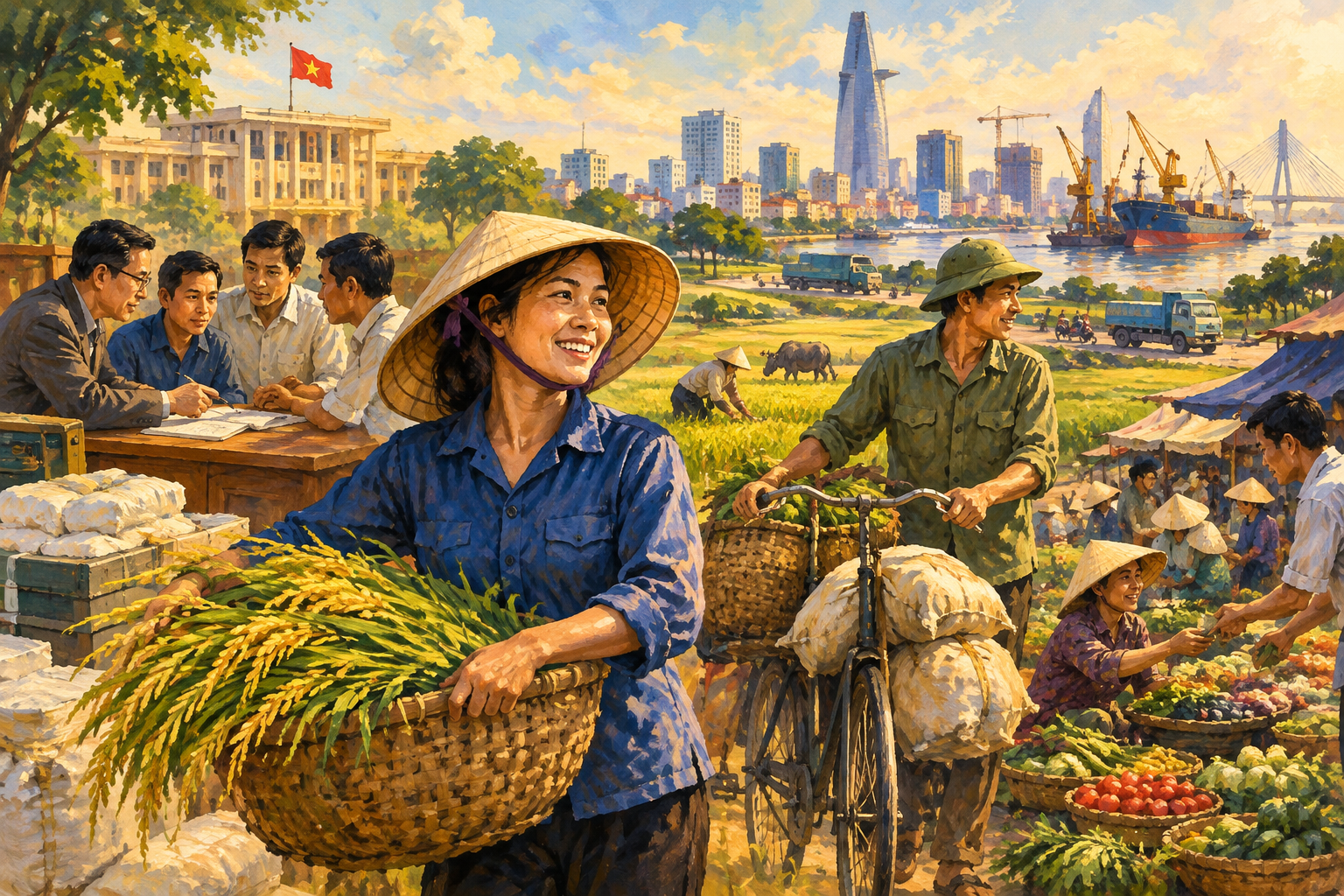
Đổi Mới in five minutes
Đổi Mới means “renovation.” Vietnam’s Communist Party launched the policy at its Sixth National Congress in December 1986, when shortages, weak production and rapid inflation had exposed deep problems in the planned economy. The reforms gave households and businesses more room to make economic decisions, loosened controls over prices and welcomed foreign investment.
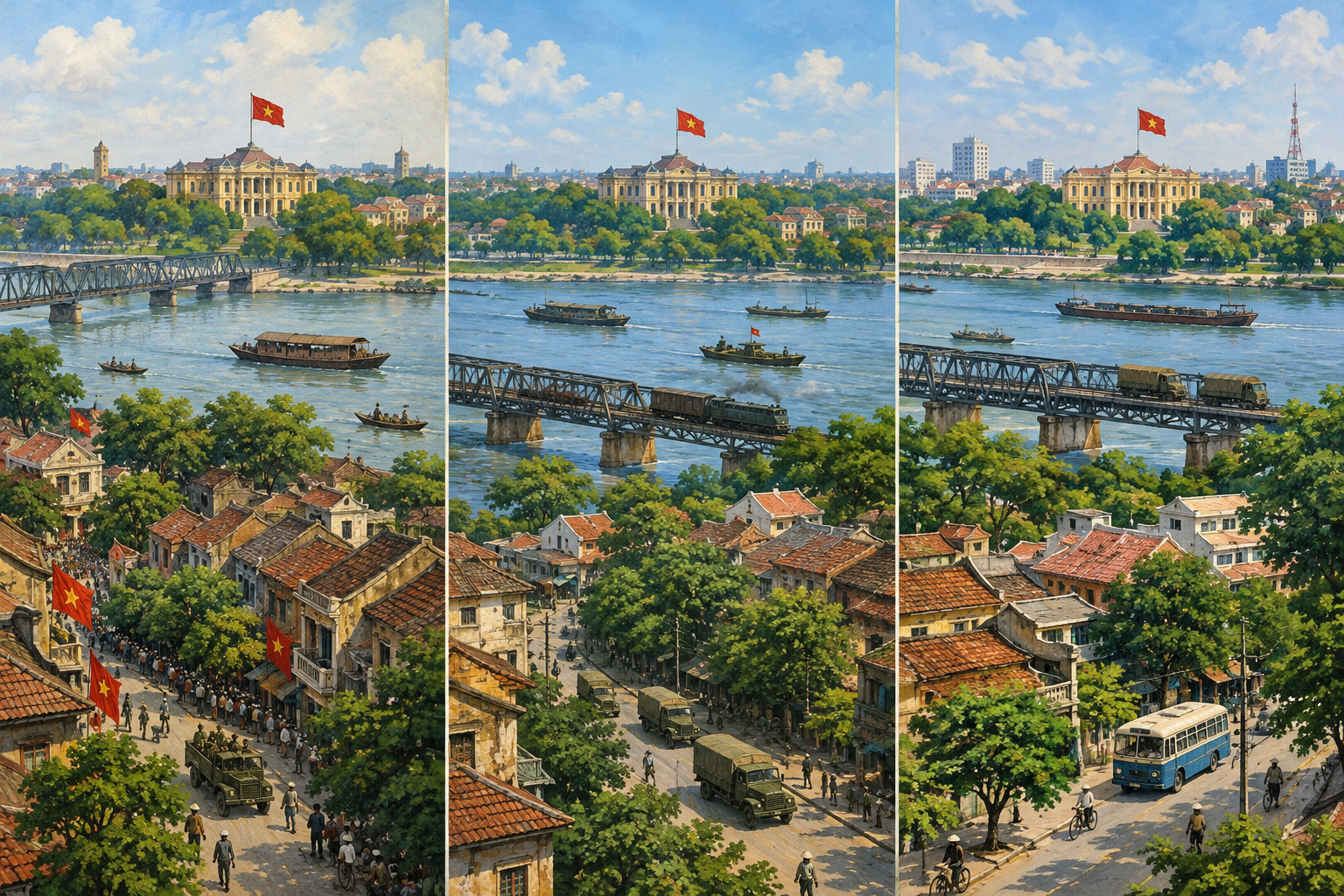
The change came after the long wars described in our guide to the Vietnam War and the reunification of the country. It was a gradual process, not a single law passed in 1986. Some experiments began earlier, while major measures followed in 1988 and 1989. The party retained its leading political role, and the state continued to shape the economy.
By 1995, Vietnam had joined the Association of Southeast Asian Nations, or ASEAN, and normalized diplomatic relations with the United States. These milestones were part of a wider diplomatic opening, although neither should be treated as an automatic result of one economic policy.
Why did Vietnam launch the reforms?
After the country was reunified in 1976, the government sought to organize production through socialist planning. State agencies set targets and controlled many prices; agricultural production was organized in cooperatives, and state enterprises occupied a central place in industry. Officials hoped to direct scarce resources toward reconstruction and development after decades of conflict.
Yet the war’s damage was only one part of the problem. The planning system struggled to match what farms and factories produced with what people needed. Controls and procurement rules could leave producers with little reason to produce more, while goods remained scarce. Rapid inflation made everyday transactions and household budgets harder to manage.
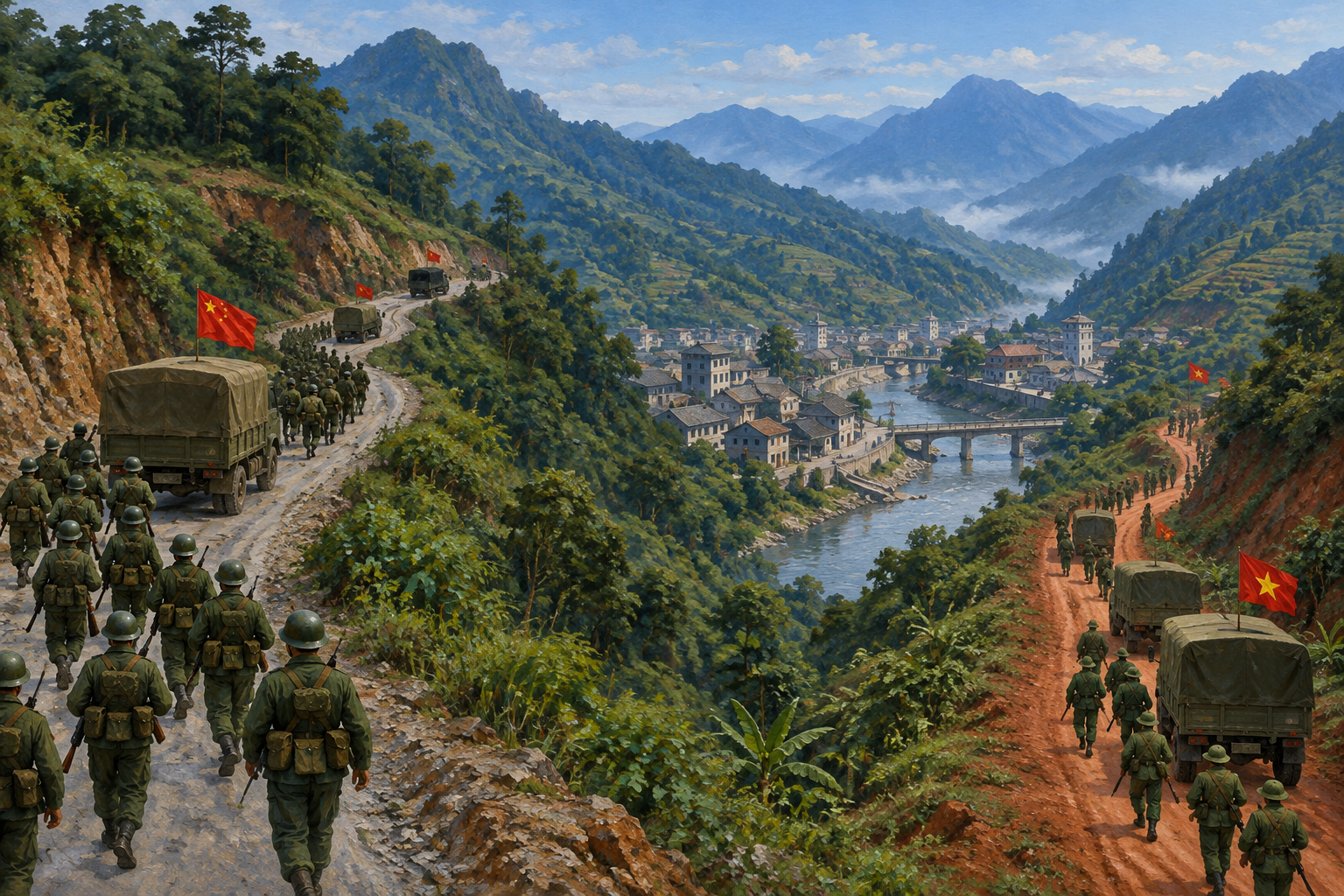
Vietnam also faced a difficult external environment. The conflict in Cambodia and the 1979 war with China strained resources and relations with neighbors. Dependence on support from the Soviet bloc made the economy vulnerable as that support weakened. Domestic hardship gave party leaders a reason to reconsider how a socialist economy could be run.
Reform did not begin from a blank page in December 1986. Earlier experiments had given some farms and enterprises limited room to work outside strict planning. The congress made renovation a national direction; subsequent decisions turned that direction into changes people could experience.
What changed under Đổi Mới?
Farming changed first. Reforms gave farm households a larger role in deciding production and selling output. In 1988, a major agricultural decision strengthened household farming. A 1993 land law clarified long-term land-use rights. Land remained under state management rather than becoming unrestricted private property, but more secure use rights and the ability to sell produce gave farmers stronger reasons to invest and grow more.
Rice illustrates the change. Vietnam moved from food shortages and imports toward becoming a major rice exporter. Better incentives helped, although the result also depended on farmers’ work, infrastructure and other conditions. A policy announcement alone did not fill the granaries.
Prices and enterprise rules changed. By 1989, most controlled prices had been removed, allowing prices to respond more to supply and demand. Private economic activity gained legal space, and state enterprises faced changes in subsidies and operating rules. The government still intervened and retained important state-owned enterprises; a market economy did not mean the disappearance of the state.
The country opened to the world. A foreign investment law in 1987 helped establish a framework for outside capital. Trade and investment reforms made it easier for Vietnam to connect production with customers and firms abroad. Foreign investment could bring capital, equipment and access to export markets, while also making the economy more exposed to international demand.
These changes were linked. A farmer with more control over output needed a way to sell it; a business responding to prices needed access to inputs and customers. Reforming one rule could achieve more when other rules changed too. The process also created difficult adjustments for workers and enterprises accustomed to state support.
A market price sends a signal to buyers and sellers, but it can also make basic goods harder to afford when prices rise. For a household, the same reform could therefore offer new opportunities to earn income and create new uncertainty about the cost of living. For an enterprise, reduced support meant a stronger reason to meet demand, but also a harder adjustment if it could not cover its costs. These effects help explain why reform is best understood as a change in everyday choices as well as government policy.
The distinction between ownership and use is equally useful in understanding land reform. A farmer who has a more secure right to use land can plan beyond the next harvest, even though the land has not become unrestricted private property. Whether that incentive translates into higher production also depends on access to credit, transport and buyers. The interaction of these conditions makes the results of reform more complex than a simple switch from planning to markets.
Results, limits and diplomatic opening
Market-oriented reforms contributed to rising production, growth and a substantial reduction in poverty over the following decades. The International Monetary Fund reports that Vietnam’s poverty rate fell from almost 60 percent in 1993 to 14 percent in 2014 using the measure cited in its account. Those figures describe a long period of change; they should not be read as the effect of one decision alone.
Growth did not reach everyone equally. Differences between regions and between households remained, and changes in state enterprises could bring job losses. Expanding manufacturing and trade also raised questions about working conditions and environmental pressure. Economic gains are real, but they do not answer every question about who benefits and at what cost.
Political authority followed a different path from economic organization. The Communist Party retained its leading role. Allowing market transactions and foreign investment did not establish a multiparty political system. This distinction is essential when comparing Vietnam’s economic reforms with political changes elsewhere at the end of the Cold War.
Vietnam’s external relations also changed over time. Its withdrawal from Cambodia in 1989 and the 1991 settlement of the Cambodian conflict helped create conditions for better regional relations. In 1995, Vietnam joined ASEAN and the United States and Vietnam normalized diplomatic relations. These events complemented the economic opening, but they also depended on diplomacy and security decisions beyond Đổi Mới itself.
What exams ask
For world history, connect four points: reunification in 1976; Đổi Mới at the Sixth Party Congress in 1986; the introduction of market mechanisms while Communist Party leadership continued; and ASEAN membership and US diplomatic normalization in 1995. Keep the 1986 launch separate from the reforms enacted over the following years.
A useful comparison is China’s reform and opening. Both countries introduced market-oriented changes under Communist Party leadership, but they began at different times and had different national circumstances. Do not assume that market reform automatically means an end to socialism or to one-party rule.
Questions may also ask why the reforms mattered. Link the initial economic crisis to measures such as household farming, price liberalization and foreign investment, then distinguish those measures from later outcomes such as export growth and poverty reduction. For an AP-style explanation, show how domestic policy and international integration interacted without claiming that either had only one cause.
Read next
Vietnam’s reunification in 1976 explains the political starting point for the postwar economy.
The Sino-Vietnamese War of 1979 places Vietnam’s economic difficulties alongside its regional security problems.
The history of Vietnam puts renovation and the country’s international opening in a longer historical context.