Vietnam History in Five Minutes
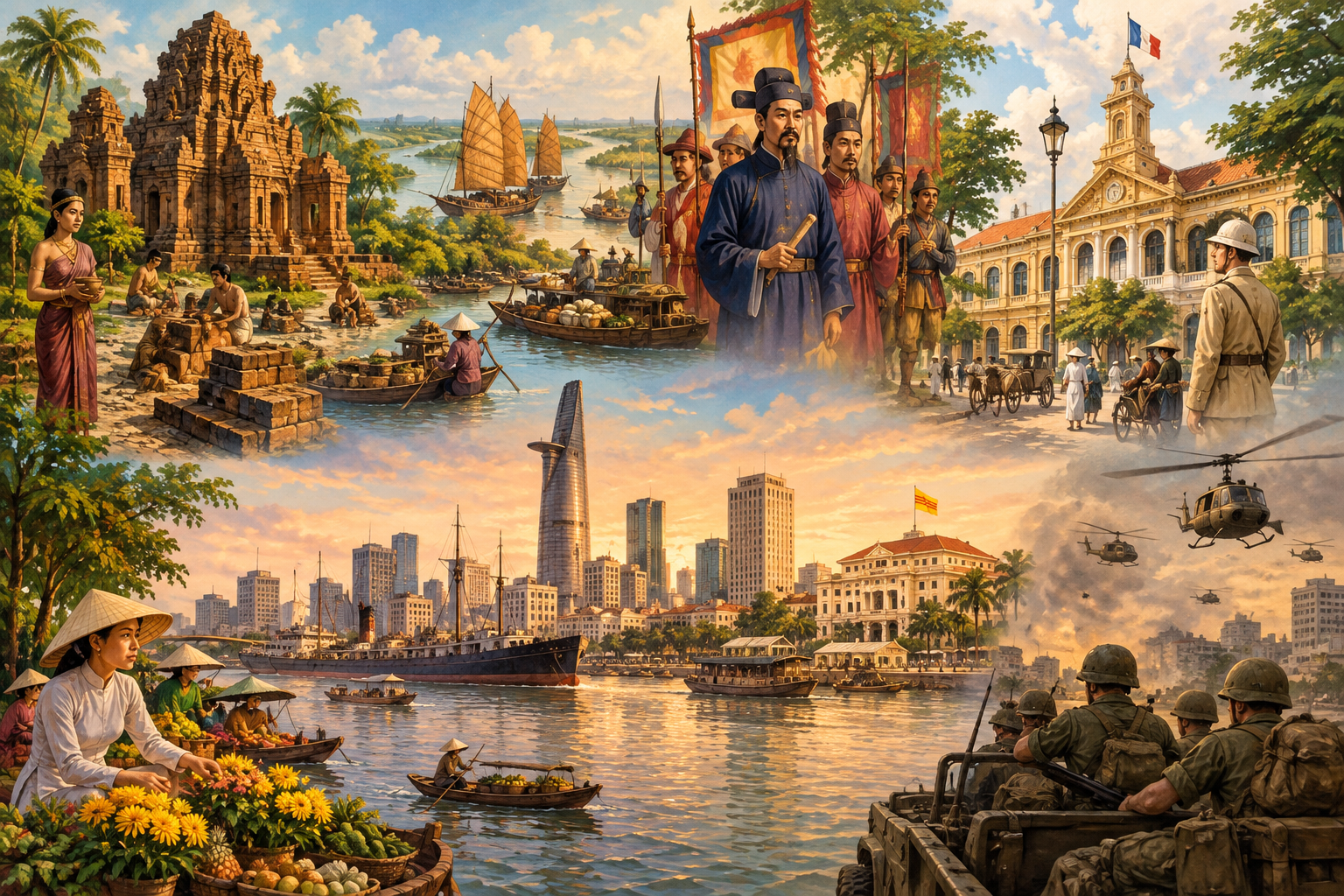
Vietnam history is the story of communities building states in mainland Southeast Asia, adapting influences from powerful neighbours, and repeatedly reshaping who governs the country. The story begins in the Red River delta, where archaeological evidence such as Đông Sơn bronze drums points to a rich early culture. Later Vietnamese states developed within a world strongly influenced by China, yet built their own dynasties, institutions and historical traditions. For the wider context, see the World History 1700–1918 hub.
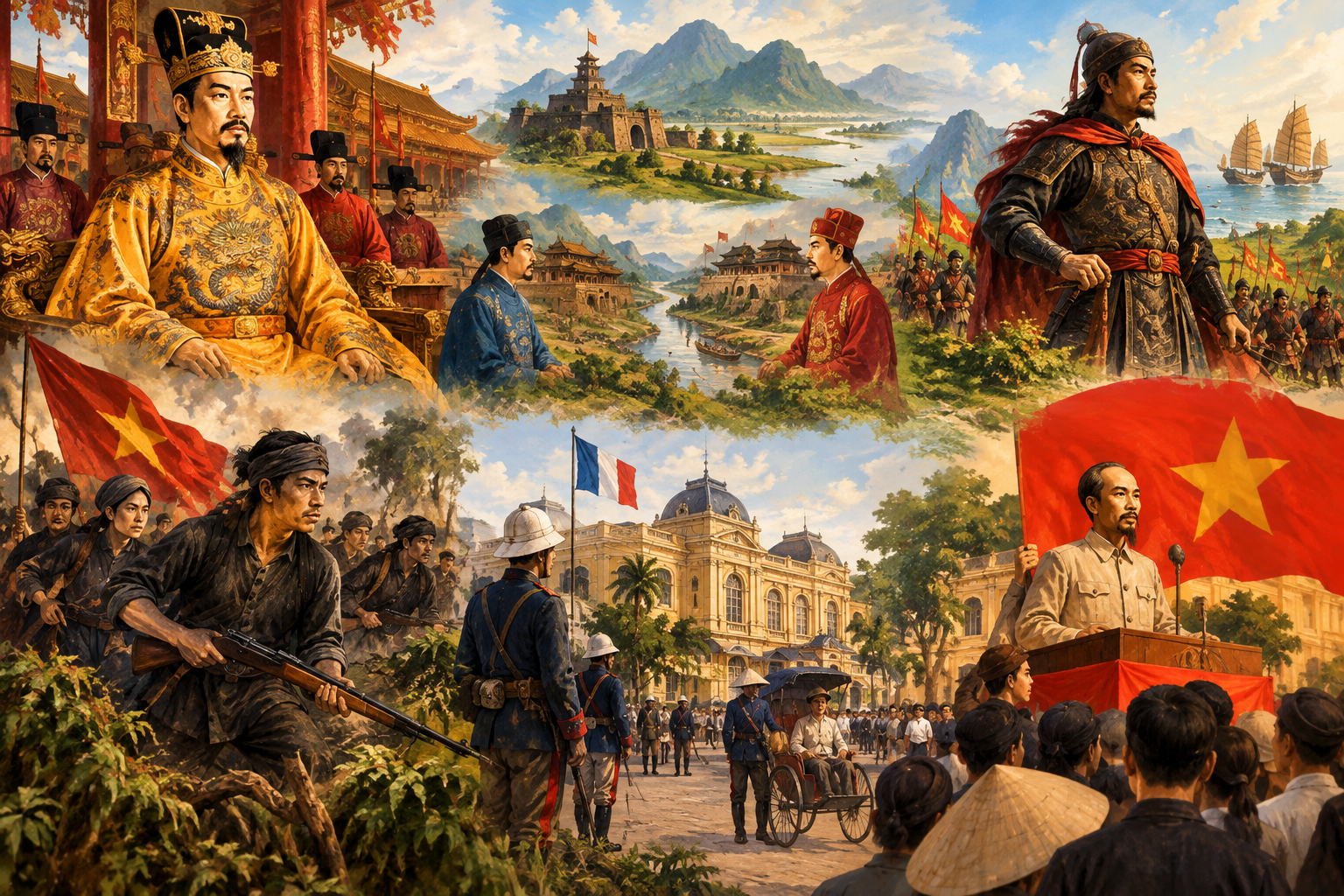
For more than a thousand years, northern Vietnam was governed by Chinese dynasties and administrations, with periods of revolt and local autonomy. The Trưng Sisters’ uprising in 40 CE became a lasting symbol of resistance, though the historical record comes largely from later accounts. In 938, Ngô Quyền’s forces defeated a Chinese fleet at the Bạch Đằng River, a turning point commonly used to mark the restoration of durable independence.
Independent rulers established successive dynasties, including the Lý, Trần and Lê. Their courts borrowed and adapted elements of Chinese government and Confucian learning while developing institutions for Đại Việt. Across centuries, the state’s territory expanded southward through conflict, settlement and diplomacy, changing relations with the Cham polities and Khmer lands. This history was not a simple march toward a modern nation: borders, rulers and political identities changed over time.
The Nguyễn dynasty, established in 1802, governed a unified realm when French intervention began in the mid-nineteenth century. By the late 1800s, France had imposed colonial rule and incorporated Vietnam into French Indochina. Colonial administration, economic change and unequal power helped reshape society and encouraged varied nationalist and revolutionary movements.
In 1945, amid Japan’s surrender and the collapse of colonial authority, Hồ Chí Minh declared independence for the Democratic Republic of Vietnam. France’s attempt to restore control led to the First Indochina War, ending in French defeat at Điện Biên Phủ in 1954. The Geneva settlement provided for a temporary military division near the 17th parallel and called for elections intended to reunify the country; those elections did not take place.
Rival governments and outside powers became involved in the conflict that followed, known internationally as the Vietnam War and in Vietnam as the war against the United States. The war ended with the capture of Saigon on 30 April 1975. The country was formally reunified in 1976 as the Socialist Republic of Vietnam. After years of hardship, the government launched Đổi Mới reforms in 1986, opening the economy to market mechanisms while retaining one-party rule.
The best way to understand this timeline is to hold two ideas together: Vietnam’s history was shaped by foreign rule and war, but also by local political choices, social change and regional connections. The dynasties-and-colonial-rule overview and the Vietnam War guide below trace two major chapters in greater detail.
Early states and centuries of Chinese rule
Stories of the Hùng kings and the early kingdom of Văn Lang belong to Vietnam’s foundational traditions. They are important to cultural memory, but the details are difficult to verify as straightforward political history. Archaeology offers firmer evidence of complex societies in the region, including the Đông Sơn culture, known for distinctive bronze drums and metalworking. These communities formed part of a wider Southeast Asian world linked by rivers, coasts and exchange.
From the second century BCE, Chinese imperial power expanded into the region. Over the centuries, periods of direct administration alternated with rebellions and local rule. Chinese institutions, writing and political thought had a profound influence, but influence did not erase local identities or the recurring effort to govern from local centres. The Trưng Sisters, Trưng Trắc and Trưng Nhị, led a revolt in 40 CE that briefly established their authority. Their story has been remembered in later centuries as an emblem of resistance, even as historians must separate the surviving evidence from later legends.
In 938, Ngô Quyền defeated a Southern Han fleet at the Bạch Đằng River, using stakes placed in the riverbed as the tide changed, according to traditional accounts. This victory allowed a lasting independent political order to emerge. The early dynasties that followed were not uninterrupted or all-powerful, but they created a foundation for courts and states that could claim authority over the north and, in time, wider areas.
Dynasties, Đại Việt and a changing south
The Lý dynasty moved its capital to Thăng Long, present-day Hanoi, in 1010. The Trần dynasty later defended the kingdom against Mongol-led invasions in the thirteenth century. These courts developed administration, law, education and military organisation while drawing on forms of governance also used in China. In 1054, the state adopted the name Đại Việt, a name that remained important across later dynastic periods.
Dynastic power was contested. The Ming dynasty of China occupied the country from 1407 to 1427. The Lam Sơn uprising, associated with Lê Lợi, drove out Ming rule, and a new Lê dynasty consolidated its authority from 1428. Over subsequent centuries, rival rulers and civil conflict divided political control. The Trịnh and Nguyễn families governed different regions for long periods, while the Tây Sơn movement overturned established powers in the late eighteenth century. Nguyễn Ánh defeated the Tây Sơn and founded the Nguyễn dynasty in 1802.
Vietnam’s southward territorial expansion took place over many generations. Vietnamese settlement and rule moved into regions where Cham polities had long been established and where Khmer political influence was also significant. The process involved war, migration, trade and changing alliances; it brought profound consequences for the people and states already living there. The country’s present shape should therefore be understood as the result of historical change, rather than treated as an ancient, unchanging boundary.
French colonial rule and independence movements
French military intervention began in 1858, and control was extended in stages. France made Cochinchina in the south a colony and established protectorates over Annam and Tonkin. In 1887, these territories became part of French Indochina, alongside Cambodia; Laos joined the federation later. Vietnam remained culturally and politically diverse under colonial rule, while administration, taxation, land ownership and export-oriented economic policies changed many people’s lives.
Opposition to colonialism took different forms. Some movements sought to restore dynastic authority; others pursued reform, republican politics or revolutionary independence. Workers, peasants, students and intellectuals did not share one motivation or one strategy. In 1940, Japan occupied French Indochina while the Vichy French administration initially remained in place. In March 1945, Japan removed the French administration. After Japan surrendered later that year, the Việt Minh, a nationalist-led coalition with communist leadership, took power in Hanoi. On 2 September 1945, Hồ Chí Minh declared the Democratic Republic of Vietnam.
France attempted to re-establish control, and fighting escalated into the First Indochina War. The defeat of French forces at Điện Biên Phủ in May 1954 helped bring the war to a close. The Geneva settlement of July 1954 created a temporary military demarcation near the 17th parallel and envisaged elections for reunification. Political disputes and international involvement prevented those elections from taking place. The division became the setting for a longer and more internationalised war.
Division, war, reunification and reform
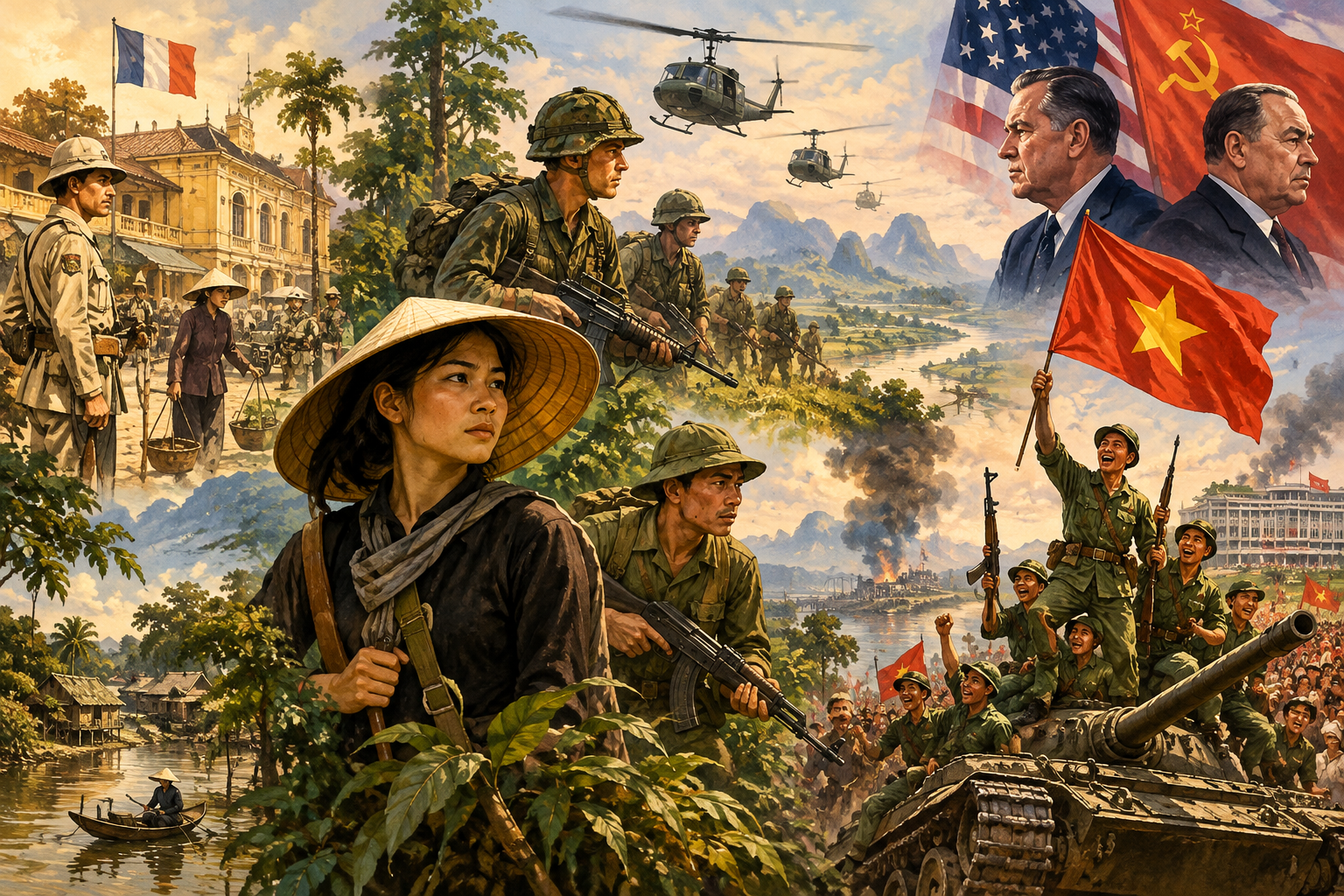
After 1954, the Democratic Republic of Vietnam governed in the north and the Republic of Vietnam in the south. The conflict grew out of competing political projects and the divided country, and became entangled with the Cold War. North Vietnamese forces and the National Liberation Front fought the South Vietnamese government and its allies, including the United States. The war brought extensive destruction and civilian suffering. It is best understood through the experiences and decisions of Vietnamese people on all sides, as well as the foreign governments that intervened.
The Paris Peace Accords were signed in January 1973, but fighting continued. On 30 April 1975, North Vietnamese forces entered Saigon, ending the Republic of Vietnam. The state was formally reunified in July 1976, and Saigon was renamed Hồ Chí Minh City. Reunification did not immediately resolve the country’s economic and social difficulties. Vietnam faced reconstruction, displacement and isolation, along with conflicts beyond its borders.
In 1986, the Communist Party adopted Đổi Mới, a programme of economic renovation. Reforms expanded the role of markets, encouraged private enterprise and opened the country to foreign investment, while the political system remained under one-party leadership. The changes contributed to rapid economic transformation and reshaped daily life. They also connect the longer history of state-building to contemporary Vietnam.
What exams ask
For a world history exam, connect dates to shifts in political control rather than memorising them as a bare list. The key sequence is Chinese rule and the 938 Bạch Đằng victory; the growth of Đại Việt under dynasties; French conquest and the formation of Indochina; independence in 1945; the 1954 settlement and division; the end of war in 1975 and formal reunification in 1976; and Đổi Mới from 1986.
Be precise about the 1954 Geneva settlement: the division near the 17th parallel was described as temporary, and the planned reunification elections did not occur. Also distinguish the end of the war in 1975 from formal reunification in 1976. A strong answer explains causes and consequences: colonial rule helped create new political movements; the 1954 division intensified conflict amid Cold War intervention; and postwar economic pressures contributed to the 1986 reforms.
Read next
For the dynastic period and French rule, continue with Vietnam’s Dynasties and French Rule, which follows political change from 1428 to 1945. For the post-1954 conflict, read The Vietnam War Explained, focused on when it happened, why it began and who fought. For a regional perspective, Saigon and Southern Vietnam traces the city and its changing political setting.