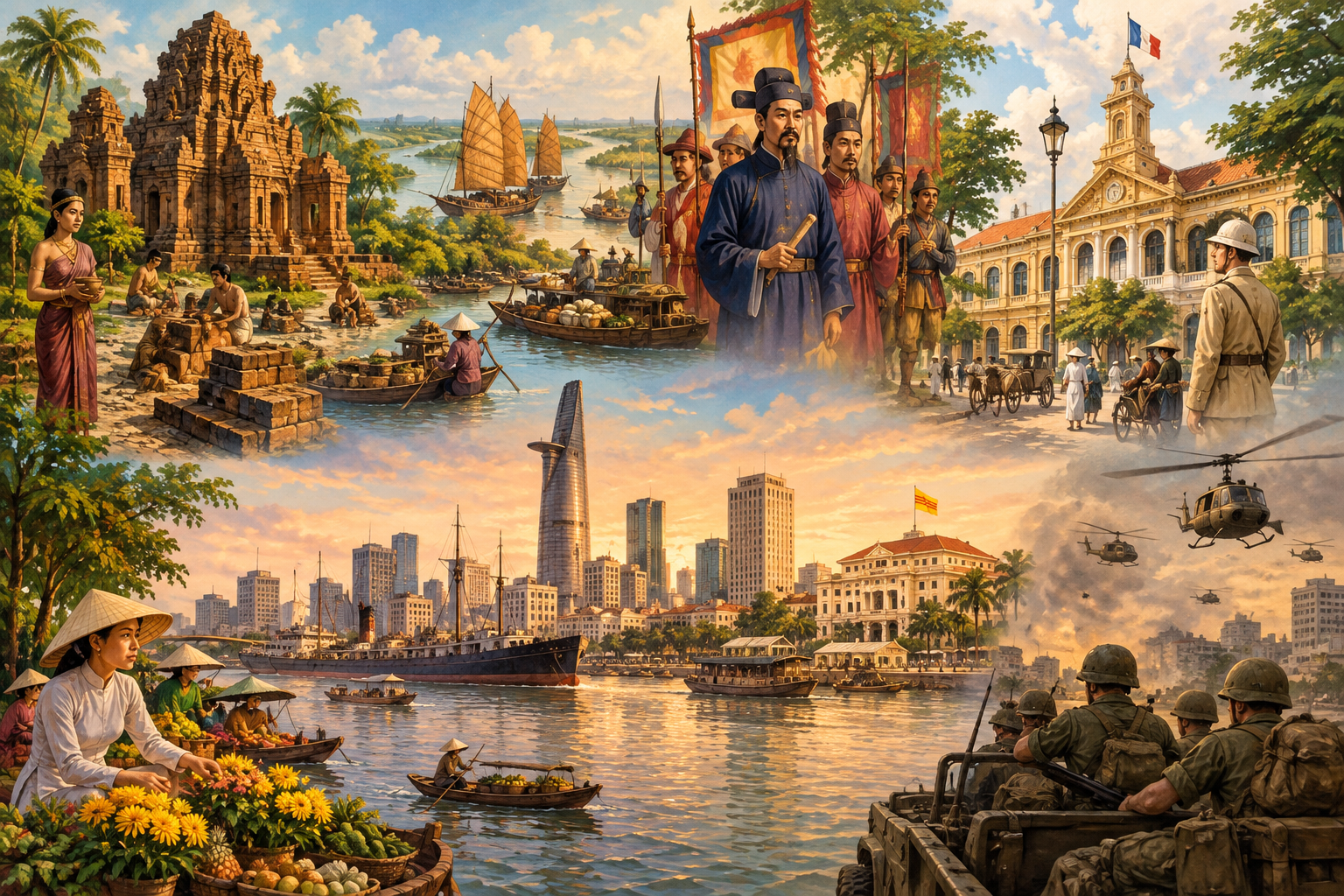
Saigon history in five minutes
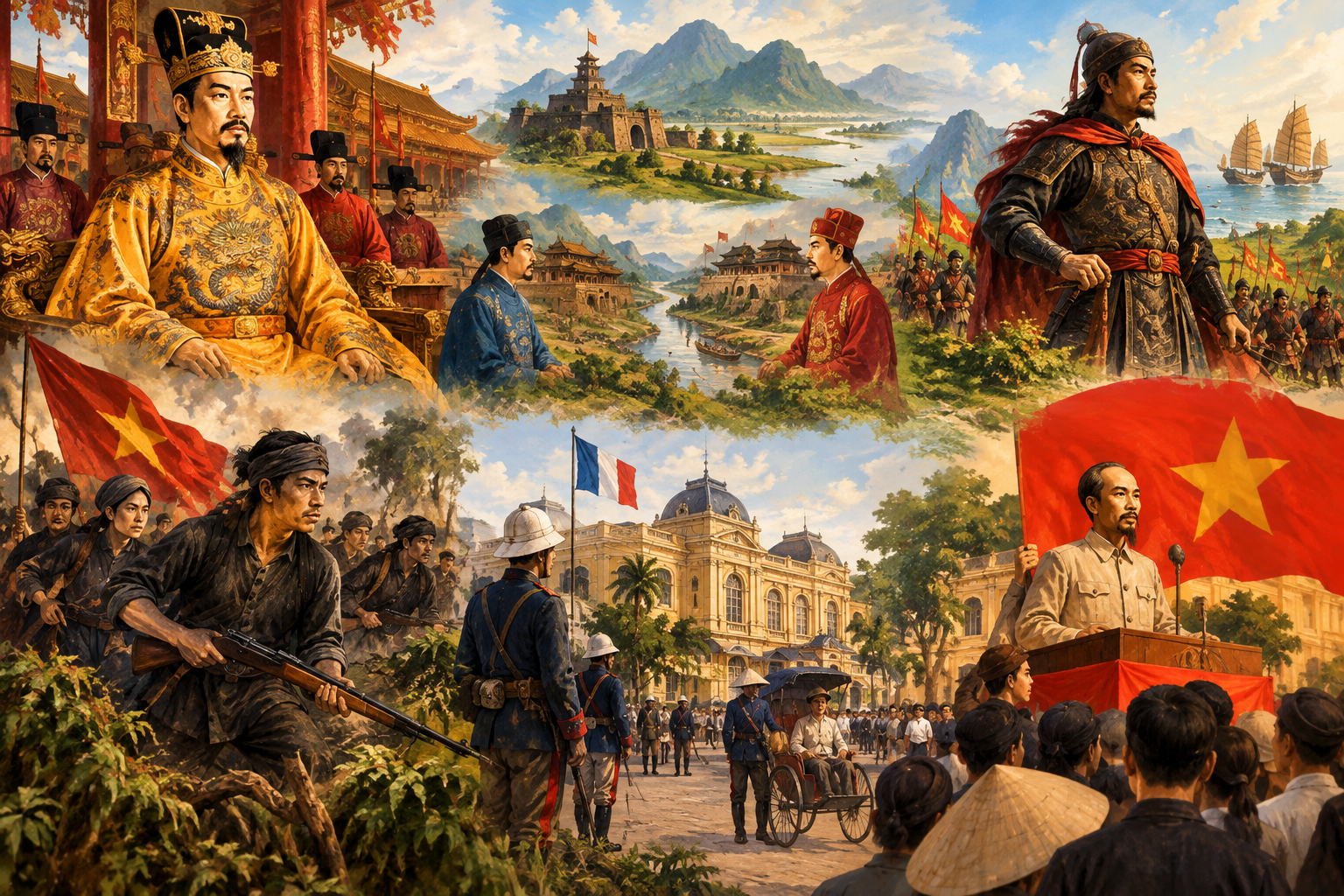
Saigon’s history is not a straight line from one city name to another. It is a regional story shaped by waterways, migration, competing political powers, colonial rule, and war. The Mekong Delta had trading communities long before Saigon became an important settlement. From the seventeenth century, Nguyễn influence expanded southward. French forces occupied Saigon in 1859, and the city later became the capital of the Republic of Vietnam, often called South Vietnam. On 30 April 1975, that government surrendered as northern forces entered the city. In July 1976, the unified country’s National Assembly named it Ho Chi Minh City.
“Saigon” can refer to different things depending on the period and speaker: the historic city, the former capital, or the central urban area within today’s larger municipality. Ho Chi Minh City is the official name. “Saigon” remains common in historical writing and everyday speech. For the national story, start with Vietnam’s history of dynasties, empire, and war, then follow the city’s changing role within it.
Before Saigon: the Mekong Delta and Óc Eo
The Mekong Delta’s history reaches back far beyond the modern city. At Óc Eo, in today’s An Giang province, archaeologists have found evidence of a settlement and trading center linked to the wider networks of early Southeast Asia. The site is associated with Funan, a polity known partly through Chinese accounts and archaeological research. UNESCO describes the Óc Eo–Ba Thê area as part of trade routes connecting Southeast Asia with regions farther west and north during the early centuries CE.
Óc Eo was not an earlier version of Saigon: it lies far from the modern city. Its importance is regional. The waterways and coast supported farming, travel, and commerce, linking communities across the delta and beyond. The people, borders, and political structures of ancient Funan remain subjects of historical study, so a single modern map cannot neatly capture them.
In later centuries, Khmer communities and political influence extended across parts of the delta. The area around present-day Saigon was known in Khmer as Prey Nokor. Over time, Cham, Khmer, Vietnamese, and Chinese histories overlapped through settlement, commerce, and political change. This was not a simple sequence in which one population disappeared and another replaced it. Different communities continued to shape the region.
Gia Định and a growing southern center
From the seventeenth century, Vietnamese migration and Nguyễn political influence moved south into areas where Khmer communities already lived. In 1698, Nguyễn Hữu Cảnh established an administrative structure for the Nguyễn lords in the Gia Định region. The date is often used as a milestone in Saigon’s civic history, but it marks an administrative development, not the beginning of human settlement there.
Saigon and nearby Chợ Lớn grew as administrative and commercial centers. Chợ Lớn became home to many Chinese residents and merchants. Rivers and ports connected the urban settlements to rice-growing areas and routes through the delta. These links helped make the south economically significant even when the Nguyễn dynasty, founded in 1802, governed from Huế. Saigon was not the imperial capital, but it became an important southern hub.
The Tây Sơn rebellion disrupted Nguyễn power in the late eighteenth century. Nguyễn Ánh, later Emperor Gia Long, used southern bases as he rebuilt his position. After founding the Nguyễn dynasty in 1802, he ruled from Huế while the southern region remained a vital part of the kingdom. The city’s influence came from its position in a productive and connected delta as much as from its role in government.
French conquest and colonial rule
French forces attacked Đà Nẵng in 1858 and captured Saigon in 1859. Under the 1862 Treaty of Saigon, the Nguyễn court ceded three eastern provinces to France. Further agreements extended French control. In 1887, France formed the Union of French Indochina, initially joining its colonies and protectorates in Vietnam and Cambodia; Laos joined later. Southern Vietnam was administered as the colony of Cochinchina, a colonial-era political label rather than an unchanging name for the region.
Saigon became a center of French colonial administration. The port, roads, railways, offices, and European-style buildings altered the city’s layout. The city also grew through the work and commerce of Vietnamese and Chinese residents. These changes took place under unequal colonial power: political authority rested with the colonial government, and economic policy served imperial interests. Residents responded in different ways, adapting to institutions, building businesses and communities, negotiating with authorities, or resisting colonial rule.
During the Second World War, Japan occupied Indochina while French colonial officials initially remained in place. In March 1945, Japanese forces removed the French administration. After Japan’s surrender, the Việt Minh declared independence in Hanoi, and fighting resumed as France sought to restore its position. France’s defeat at Điện Biên Phủ in May 1954 was followed by the Geneva Conference and agreements on a temporary military regrouping line near the seventeenth parallel. The agreements did not establish a permanent international border.
Saigon as capital, 1954–1975
Separate governments emerged in the north and south. In 1955, the State of Vietnam became the Republic of Vietnam, with Saigon as its capital. The Democratic Republic of Vietnam governed in the north. The country’s division remained contested, and the promised nationwide political settlement did not take place. The conflict grew into a prolonged war involving Vietnamese forces and major foreign powers.
Saigon expanded as the southern government’s administrative center and as a destination for people displaced by conflict. Residents did not share one political position: some supported the government or worked with its institutions, some opposed it, and many concentrated on daily life. The city’s public spaces, neighborhoods, and institutions reflected the pressures of war as well as its commercial life.
The 1968 Tet Offensive brought fighting into Saigon and other cities. Although the offensive did not produce a lasting military occupation of the city, it challenged public expectations about the course of the war. In the years that followed, combat continued across the country while negotiations and shifts in foreign involvement shaped the conflict.
On 30 April 1975, northern forces and the Provisional Revolutionary Government entered Saigon, and the Republic of Vietnam surrendered. English-language accounts commonly call the event the Fall of Saigon; official Vietnamese commemorations often emphasize liberation and reunification. The names reflect different political memories of the same turning point. The end of the Republic of Vietnam’s government did not erase the experiences of the millions who had lived through the conflict or the consequences of displacement and political change.
Why Saigon became Ho Chi Minh City
After reunification, the National Assembly changed the city’s official name on 2 July 1976, honoring revolutionary leader Hồ Chí Minh. The change came after the Republic of Vietnam had surrendered and the country was formally reunified. “Ho Chi Minh City” is now the municipality’s official name. “Saigon” continues to be used for the historic city and, in common speech, for the central urban area.
The origin of the word “Saigon” is disputed. Several explanations circulate, but none should be presented as a settled meaning. The names also carry historical associations: “Saigon” can point to a particular period or memory, while “Ho Chi Minh City” reflects the official name adopted after reunification. Understanding the region means recognizing that names can change with political power and public memory.
What exams ask
For an AP-style history question, connect local turning points to larger processes. The Óc Eo evidence points to early regional trade; the 1698 Gia Định administration marks Nguyễn expansion; the French conquest illustrates nineteenth-century imperialism; and the period from 1954 to 1975 shows how Vietnam’s division became a prolonged international conflict. Keep dates and political labels distinct: Cochinchina was a French colonial unit, while the Republic of Vietnam was the southern state from 1955 to 1975. The military regrouping line near the seventeenth parallel in 1954 was not intended as a permanent national border.
Read next
Vietnam’s dynasties and French rule explains the longer political background. Read The Vietnam War to follow the conflict from 1955 to 1975. The Fall of Saigon examines the events of 30 April 1975, while Funan and Óc Eo explores the delta’s older history.