In five minutes: Vietnam’s dynasties and French rule
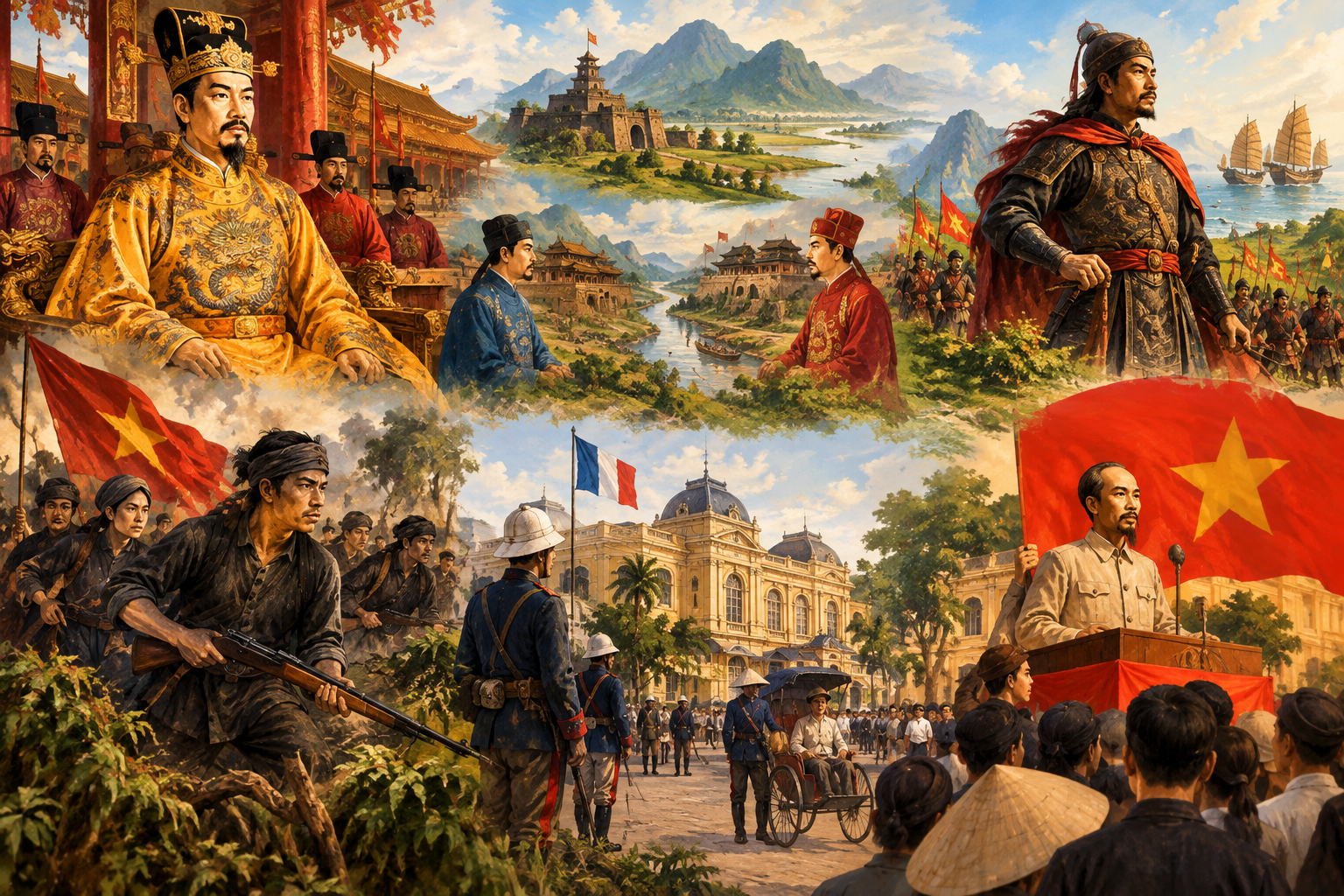
Vietnam’s history from 1428 to 1945 runs from the restoration of the Le dynasty to the end of the Nguyen monarchy and the declaration of the Democratic Republic of Vietnam. Across those five centuries, rulers built and rebuilt a state, expanded its territory southward, and faced changing pressures from neighboring powers and European empires. French conquest transformed the political system, while Japan’s wartime occupation weakened French control and opened the way to competing claims of independence in 1945.
In 1428, Le Loi established the Later Le dynasty after defeating Ming forces and ending a period of Chinese occupation. The court governed Dai Viet through an increasingly organized bureaucracy. Royal authority later weakened, and powerful Trinh and Nguyen families ruled rival regions in the name of Le emperors. In the late eighteenth century, the Tay Son movement overturned that political order. Nguyen Anh defeated the Tay Son and founded the Nguyen dynasty in 1802, bringing much of the country under one court again.
France began its military intervention in 1858 and gradually established control. By the late 1880s, Vietnam had been divided into Cochinchina, a colony in the south, and the protectorates of Annam in the center and Tonkin in the north. The Nguyen emperors remained on the throne in parts of the country, but French officials held decisive authority. In 1887, France joined these territories with Cambodia in French Indochina; Laos later joined the union.
During World War II, Japan occupied Indochina while French administrators initially continued to govern under Japanese supervision. On 9 March 1945, Japanese forces removed the French administration. Two days later, Emperor Bao Dai declared the independence of the Empire of Vietnam, a Japanese-backed wartime government. This was distinct from the Viet Minh’s later revolution and declaration. After Japan surrendered in August, the Viet Minh-led August Revolution took power in major cities. Bao Dai abdicated, and on 2 September Ho Chi Minh declared the Democratic Republic of Vietnam. That declaration made a new claim to independence; it did not immediately settle who would govern Vietnam.
This period connects to the wider history of Vietnam’s dynasties, empire, and war. The political changes of 1945 also set the stage for the Vietnam War and later conflicts in the region.
Key facts
- Period: 1428–1945, from the Later Le dynasty’s establishment to the end of Nguyen imperial rule.
- Early state: The Later Le court ruled Dai Viet after Le Loi’s victory over Ming rule.
- Last dynasty: The Nguyen dynasty unified the country under a central court in 1802 and ended in 1945.
- French control: France’s conquest unfolded from 1858 into the 1880s; Vietnam was organized as Cochinchina, Annam, and Tonkin.
- 9 March 1945: Japan’s coup removed the French administration.
- 11 March 1945: Bao Dai declared the independence of the Empire of Vietnam, a Japanese-backed wartime government.
- 2 September 1945: Ho Chi Minh proclaimed the Democratic Republic of Vietnam’s independence after the August Revolution.
From the Le dynasty to a divided realm
The Le restoration began after a prolonged struggle against Ming rule. Le Loi, a leader of the Lam Son uprising, became emperor in 1428. The restored court called its realm Dai Viet and worked to strengthen central government. Officials were selected through examinations based on Confucian learning, and administrative districts extended the court’s reach. Under early Le rulers, especially Le Thanh Tong, the government developed legal and bureaucratic institutions that influenced later dynasties.
The fifteenth-century state also expanded south. In 1471, Le forces defeated Champa’s major political center, a turning point in the long movement of Vietnamese settlement and authority into lands that are now central and southern Vietnam. This was not an empty-land process: it altered the political map and affected Cham communities and other peoples already living in the region. Later migrations and conflict extended Vietnamese rule farther south. State growth and its effects on local communities belong in the same account.
Over time, the Le emperors’ authority weakened. From the sixteenth century, the Trinh family exercised power in the north, while the Nguyen lords governed the south. Both claimed to serve the Le court, but the country was divided in practice. Rival rulers fought long wars, competed for trade and territory, and built separate administrative and military systems. The divide shaped political life for generations, even as people and goods continued to move across the regions.
The Tay Son uprising began in 1771 amid economic hardship and resentment of established rulers. Its leaders defeated the Trinh and Nguyen lords and brought down the Le dynasty. The movement briefly reunited much of the country. In 1789, its best-known ruler, Quang Trung, defeated a Qing army that had entered northern Vietnam. The Tay Son order did not last: Nguyen Anh, a surviving member of the southern Nguyen family, defeated the movement and founded a new dynasty. These shifts show how difficult it was to hold a unified state together.
The Nguyen dynasty and French conquest
Nguyen Anh took the throne as Emperor Gia Long in 1802. He established the Nguyen dynasty and set its capital at Hue, in central Vietnam. The new court brought north and south under a single monarchy after decades of war. Its administration drew on Chinese political and scholarly traditions, including a Confucian bureaucracy and examinations for officials. The court also sought to map, tax, and govern a long territory with distinct regional histories.
The name of the country changed during this period. Gia Long’s government used Vietnam in 1804, and his successor Minh Mang later used Dai Nam. Names and borders reflected the court’s effort to define the state. The dynasty also faced limits: local conditions varied, communications were difficult, and central reforms could provoke resistance. Contact with foreign traders and missionaries added pressure.
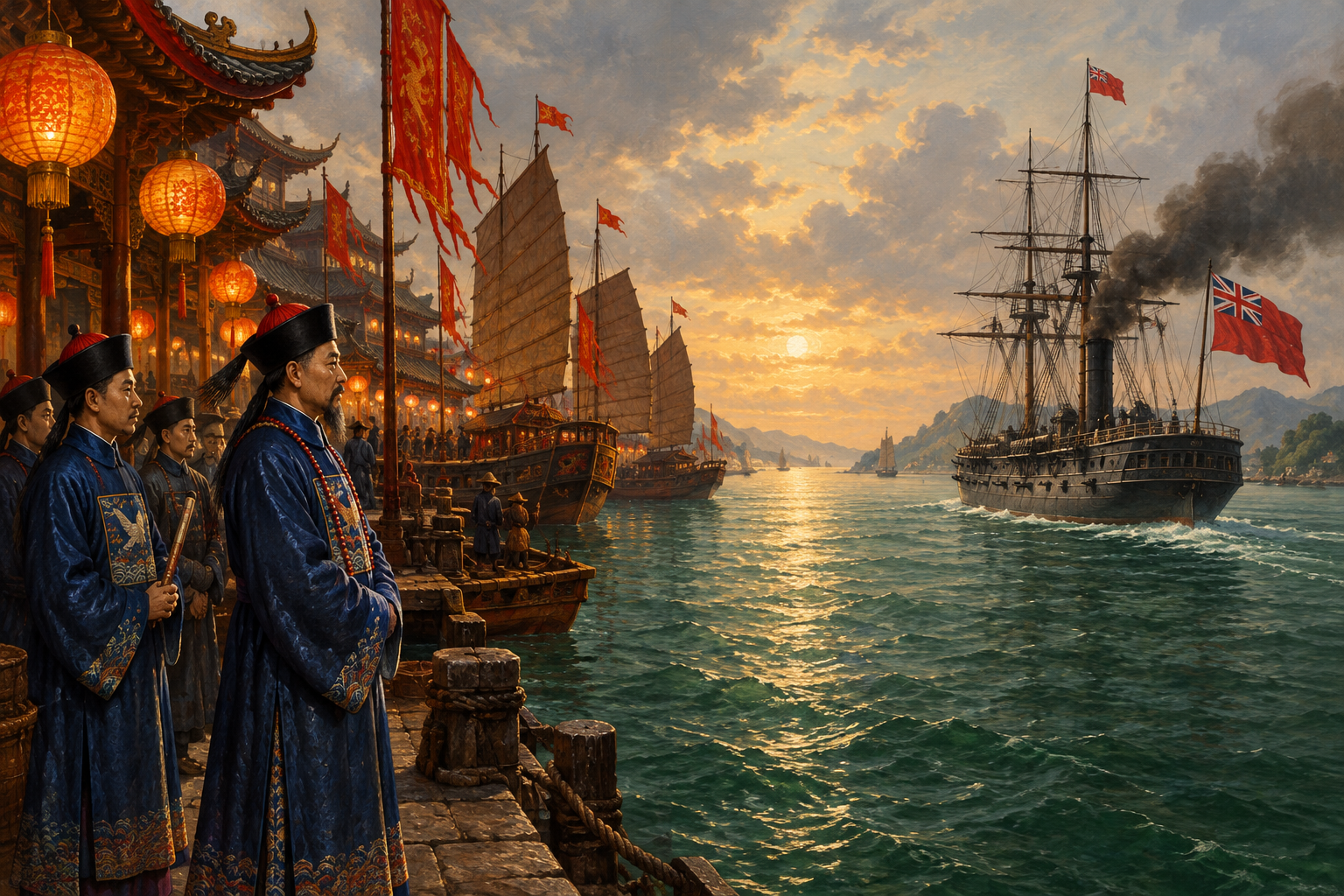
Emperor Tu Duc, who ruled from 1847 to 1883, faced rising French intervention. France presented military action partly as a response to restrictions and persecution affecting Catholic missionaries and converts, while pursuing wider strategic and commercial interests. French and Spanish forces attacked Da Nang in 1858, then shifted operations south. In 1862, the Nguyen court ceded three southern provinces to France; further concessions followed. The gradual loss of territory weakened the court and narrowed its choices.
French officials did not replace every existing institution at once. They extended control through treaties and military occupation, treating Vietnam’s regions differently. In the south, France ruled Cochinchina as a colony. In central Annam and northern Tonkin, it imposed protectorates, where the emperor and court continued in a reduced role. This distinction matters: French domination covered Vietnam, but the regions did not all have the same legal status or form of administration.
Colonial rule and resistance
French pressure intensified in 1883 and 1884, when treaties placed Annam and Tonkin under French protection and restricted the court’s independence. Resistance followed. The Can Vuong movement, launched in the name of restoring the king, drew support from court loyalists and local leaders. It continued in different forms into the 1890s. It was not one unified national organization, but it showed that the loss of sovereignty was contested across the country.
In 1887, France established the Indochinese Union, joining Cochinchina, Annam, Tonkin, and Cambodia under a colonial framework. Laos was added in 1899. Hanoi became an important administrative center. French rule reorganized taxation, transport, land use, education, and commerce to serve colonial priorities. Railways, ports, and plantations linked parts of the economy more closely to international markets, while many Vietnamese faced taxes, forced labor, land pressure, and unequal access to political power.
Colonialism also changed public life in complicated ways. French-language schools and new print networks helped some Vietnamese access European political ideas, while the romanized Vietnamese writing system, quốc ngữ, spread more widely. Vietnamese teachers, officials, writers, and activists used these tools for purposes that could differ from the colonial government’s goals. Some sought to reform the monarchy; others argued for a republic or national independence. Their ideas and strategies were diverse.
Nguyen emperors continued to reign in Annam and Tonkin under close French supervision. Several resisted limits on their authority. Emperor Ham Nghi joined the Can Vuong cause and was captured and exiled. Later, Thanh Thai and Duy Tan were also removed and sent into exile. These episodes show the gap between royal ceremony and political power: the court survived, but French authorities could remove rulers who challenged their control.
World War II, revolution, and two declarations
World War II changed the balance of power without immediately bringing independence. Japan entered northern French Indochina in 1940 and extended its military presence across the region. French colonial officials continued to administer the territory under Japanese oversight until Japan’s coup of 9 March 1945 removed them. On 11 March, Bao Dai declared the independence of the Empire of Vietnam. It was a Japanese-backed wartime government, formed under the conditions of Japan’s military dominance. This declaration was not the Viet Minh’s declaration later that year.
The Viet Minh, an independence movement led by Ho Chi Minh, had organized against French colonialism and Japanese occupation. Japan’s surrender in August 1945 created a brief and uncertain political opening. The Viet Minh and other groups moved to take control in major cities; these events became known as the August Revolution. Bao Dai abdicated in late August. On 2 September, Ho Chi Minh proclaimed the Democratic Republic of Vietnam in Hanoi.
The two declarations expressed different political projects. Bao Dai’s March declaration concerned the Empire of Vietnam, which Japan had sponsored after removing French authority. The September declaration came from Ho Chi Minh and the Viet Minh after Japan’s surrender and the August Revolution. It marked the new republic’s claim to independence, but did not settle Vietnam’s political future. French forces sought to return, and conflict soon resumed. The Nguyen dynasty’s end and the September declaration close this page’s time span, not the history of foreign intervention or armed struggle.
What exams ask
For world history, organize this period around three connected changes: state-building, colonial expansion, and independence movements. The Later Le dynasty restored a Vietnamese court after Ming rule; the Trinh–Nguyen division and Tay Son uprising show how internal power shifted; and the Nguyen dynasty reunited the country in 1802. Then trace how French conquest turned the court into a subordinate institution and divided Vietnam into Cochinchina, Annam, and Tonkin.
A useful short answer should distinguish dates and outcomes. France began its attack in 1858; French control expanded through the 1860s and 1880s; the Indochinese Union was formed in 1887. Japan occupied Indochina during World War II, then removed the French administration in March 1945. Bao Dai declared the Empire of Vietnam independent on 11 March. After Japan surrendered, the August Revolution brought the Viet Minh to power in major cities, and Ho Chi Minh proclaimed the Democratic Republic of Vietnam on 2 September. Do not treat the two declarations as one event or say that September’s declaration immediately secured uncontested independence.
For a strong essay, connect domestic and international causes. French imperial ambition mattered, but so did the Nguyen court’s political choices, regional divisions, local resistance, and the growth of Vietnamese reform and nationalist movements. Explain the different legal arrangements in the south and the center and north. Finally, show how World War II weakened colonial authority and created an opening that Vietnamese revolutionaries tried to use. This approach makes the period a chain of political changes rather than a list of rulers.
Read next
For the wider national story, continue with The History of Vietnam: Dynasties, Empire and War, the parent hub for this topic. To see how the independence struggle developed into a later Cold War conflict, read The Vietnam War Explained. For a regional perspective on the country’s south, see Saigon and Southern Vietnam. To compare Vietnam’s nineteenth-century pressures with a neighboring empire’s response to foreign powers, read Qing China, Japan and the West.