In five minutes
Imperialism is the policy of a state extending its power over other territories and peoples. Sometimes that means owning colonies outright. Sometimes it means keeping a weaker country nominally independent while controlling its trade, loans or foreign affairs. Historians use the word most often for the period from the 1870s to 1914, when Britain, France, Germany, Russia, the United States, Belgium, Italy and Japan competed for land and markets across Africa, Asia and the Pacific.
In short, imperialism was about power and profit. Industrial economies wanted raw materials and buyers. Governments wanted naval bases, trade routes and national prestige. Many leaders also believed in a 'civilising mission', an idea that justified ruling people they saw as less developed. The result was a world in which a handful of states governed a large share of the planet. This topic sits within our World History 1700–1918 guide.
What imperialism means
Historians often separate formal empire, where a state rules a territory directly, from informal empire, where it controls another country through treaties, loans, trade rights or the threat of force. British India was a formal colony. China after the Opium Wars is a classic example of informal control: foreign powers gained treaty ports where their citizens could be tried in their own consular courts.
The words colonialism and imperialism are often used interchangeably. Many historians use colonialism for the rule of one particular territory and imperialism for the wider policy that produced it.
Why imperialism happened
There was no single cause. Historians usually sort the reasons into economic, strategic and political or ideological groups.
Economic reasons
Factories in Europe and the United States needed cotton, rubber, copper and palm oil, and they wanted buyers for the goods they made. Investors looked for safe places to lend money and build railways and mines. In 1902, the English economist J. A. Hobson argued that weak spending by ordinary people at home pushed nations to seek markets and investment abroad. In 1916, Vladimir Lenin linked imperialism to giant banks and monopoly companies. Historians still debate how far economics explains expansion, since many colonies cost their rulers more than they returned.
Strategic reasons
Naval powers needed coaling stations and bases along the sea routes to their colonies. The Suez Canal, opened in 1869, cut the sea route from Europe to India and East Asia. Britain occupied Egypt in 1882, and the canal became one of its most closely guarded assets. Strategy also tended to snowball: taking one territory meant defending the next.
Political and ideological reasons
Governments measured their standing by the colonies they held. Rivals copied one another, so when France or Germany claimed land, Britain often wanted to match it. Social Darwinism, the idea that human societies follow the same rule of survival of the fittest, was used to argue that some peoples were naturally superior. Rudyard Kipling's 1899 poem 'The White Man's Burden' is a well-known example of the sense of duty and civilisation that was widely praised in Europe and the United States at the time.
What happened
The scramble for Africa
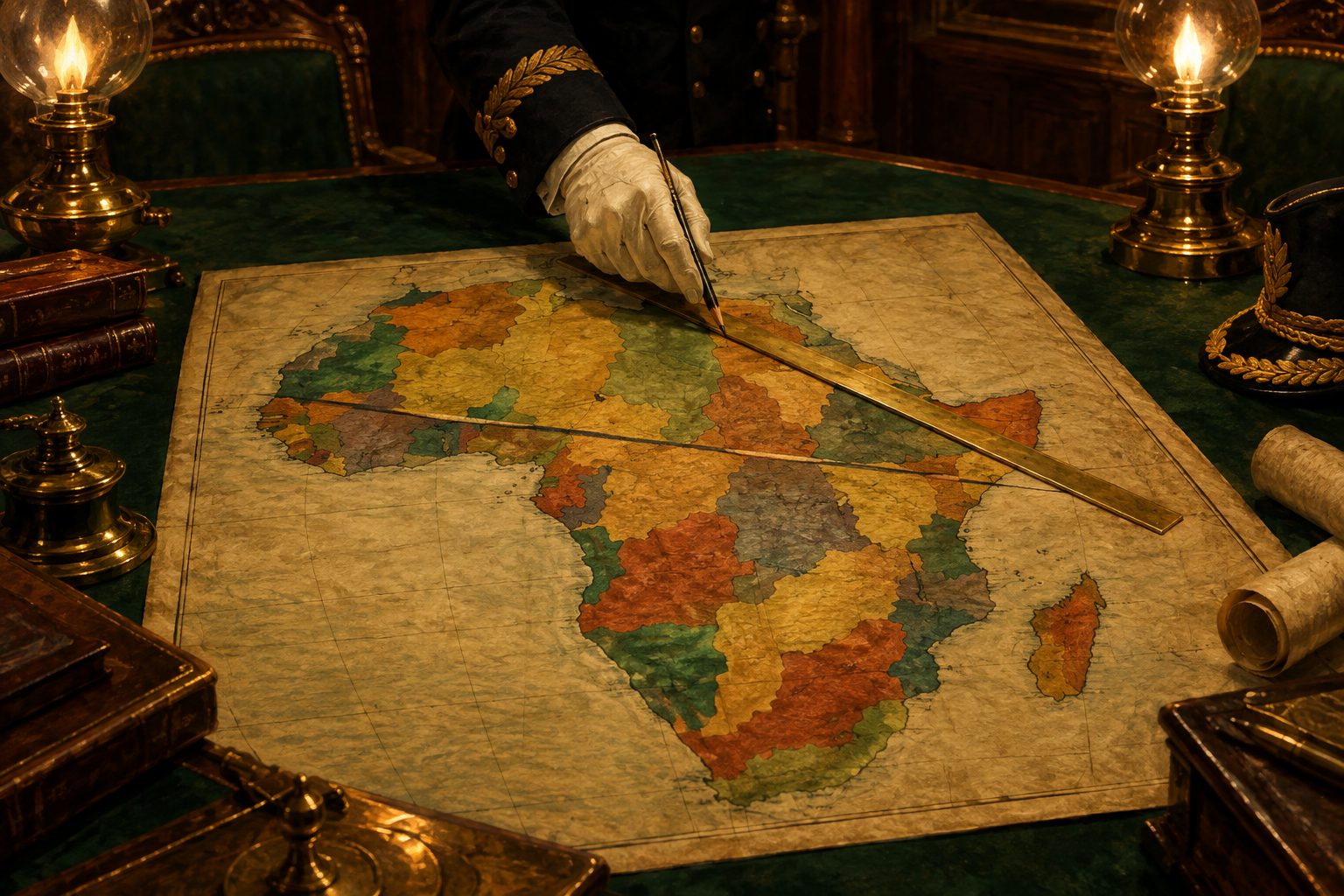
In 1884 and 1885, delegates from European states, the United States and the Ottoman Empire met in Berlin to set rules for claiming African land. No African rulers attended. The conference did not divide the continent in one meeting, but it agreed that a claim needed effective occupation to be valid. Over the next three decades, European powers pushed inland at speed. By 1914, about 90 percent of Africa was under European rule. Ethiopia and Liberia were the main exceptions. Ethiopia defeated Italy at the Battle of Adwa in 1896 and kept its independence until Italy occupied it from 1936 to 1941.
Borders were often drawn with little regard for language, religion or existing kingdoms. Many borders on the map today trace back to these decisions.
The worst cases involved violence. In the Congo Free State, which King Leopold II of Belgium ran as his personal possession from 1885 to 1908, forced labour for rubber collection caused a catastrophic loss of life. Most historians estimate that the population fell by millions, although estimates vary widely. In German South West Africa, the colonial war against the Herero and Nama peoples from 1904 to 1908 killed tens of thousands of people, and most historians now describe it as genocide.
China and Asia
Britain fought China twice in the mid-nineteenth century, from 1839 to 1842 and from 1856 to 1860. The first war grew out of a dispute over the opium trade, and the second centred on expanding trading rights. The Treaty of Nanjing in 1842 gave Britain Hong Kong Island and opened several ports. Over time China lost control of its customs tariffs in treaty ports, and foreign residents there were judged in their own courts.
The United States preferred a different tool. In 1899 it asked the powers to keep China open to equal trade, the so-called Open Door policy, without holding any formal colony there itself. This shows that influence over trade could be as valuable to a power as owning territory.
In India, a major rebellion in 1857 led the British government to end the East India Company's rule and govern directly from 1858. The British Crown ruled India until independence in 1947.
Japan was itself an imperial power. After opening to foreign trade in the 1850s, it modernised rapidly. It took Taiwan after the Sino-Japanese War of 1894 to 1895, annexed Korea in 1910, and invaded Manchuria in 1931. Japan's story shows that imperialism was not only a Western project.
The United States joined in too. After the Spanish–American War of 1898 it took the Philippines, Guam and Puerto Rico, and it annexed Hawaii that same year.
What it left behind
- Borders and states. Colonial boundaries were inherited by many independent countries after 1945, sometimes joining groups that had little in common and splitting others.
- Uneven economies. Many colonies were pushed to grow crops or mine minerals for export, which tied their economies to foreign buyers.
- Rivalry and war. Competition over colonies, including the Moroccan crises of 1905 and 1911, added to the tensions that led to the First World War in 1914.
- Resistance and independence. Colonised peoples organised political parties, protests and armed struggles. The Indian National Congress was founded in 1885, and Mahatma Gandhi led the non-cooperation movement in 1920. In 1960, seventeen African countries became independent.
Historians still argue about how much of today's inequality traces back to imperial rule. Most agree that the effects were deep and uneven, and that the people living under colonial rule had little say in the decisions that shaped their lives.
What exams ask
History exams usually ask you to explain causes, give examples and judge effects. Name the economic, strategic and ideological causes separately. Compare imperialism with older empires such as Rome, which also ruled distant lands, but industrial economies and scientific racism shaped the later version. Link the late-nineteenth-century rivalries to the First World War. Specific dates and places strengthen any answer: 1884 for Berlin, 1858 for India, 1910 for Korea.
Read next
For the British side of the story, read The Victorian Era (1837–1901), which covers the empire at home and abroad. For the Chinese perspective, read Qing China, Japan and the West (1793–1912), which explains the treaty system and the pressures it created.