In five minutes
The Vienna System was the order that Europe's great powers built after the Napoleonic wars. At its centre was the Concert of Europe, a habit of regular meetings in which Austria, Britain, Prussia and Russia agreed to talk and act together to keep the peace. France joined them in 1818. The guiding idea was legitimacy: old ruling families should keep or regain their thrones, and revolutions should be stopped before they spread across borders.
The system held for about three decades. No general war between the great powers broke out until the Crimean War began in 1853. After that, revolutions in Europe and a conflict in the east slowly pulled it apart. In short, the Concert of Europe was a diplomatic habit rather than a formal organisation, and it worked only as long as the big states still wanted the same kind of order.
Where the system came from
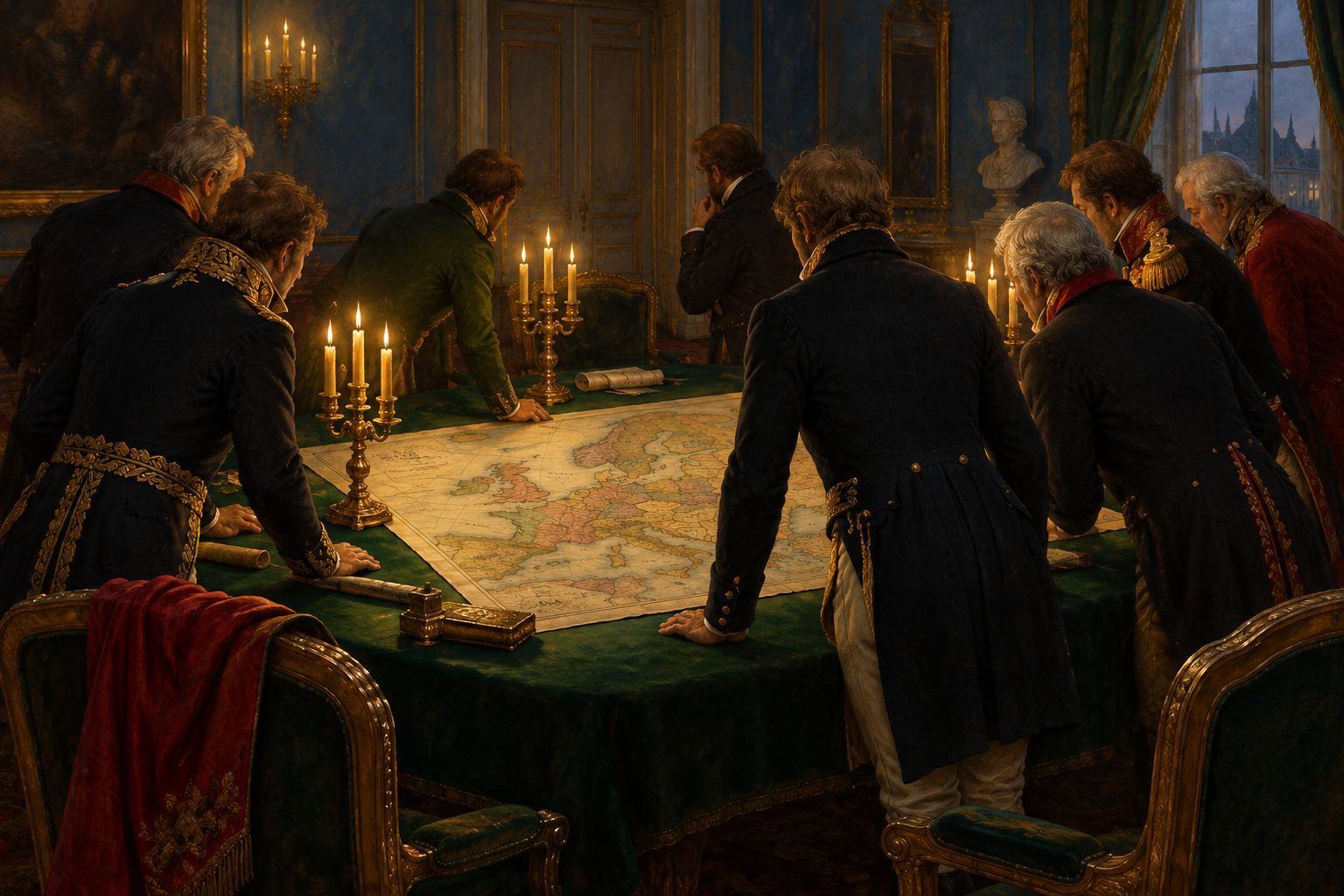
From 1792 onwards, revolutionary France and then Napoleon Bonaparte's empire reshaped the map of Europe. Napoleon abdicated in April 1814 and was sent to the island of Elba. The victorious powers then gathered in Vienna to decide what the continent would look like next. That meeting was the Congress of Vienna. Klemens von Metternich, the Austrian foreign minister, was its leading figure, and its final act was signed on 9 June 1815.
Europe had been reshaped by two decades of upheaval. The French Revolution had spread ideas about citizenship and national sovereignty, and Napoleon's conquests had dissolved old states and redrawn borders across Germany and Italy. When the victors met, their task was to decide which dynasties would return, which territories would change hands, and how to stop France from threatening its neighbours again.
Nine days after the final act was signed, Napoleon was defeated at Waterloo. He had escaped from Elba earlier that year and returned to power for a short time, a period known as the Hundred Days. For the wider background, see the Napoleonic Era hub.
The delegates were not trying to invent a new kind of order. They wanted stability after two decades of almost continuous war. Their answer rested on three ideas: a balance of power among the big states, the rights of old dynasties, and suspicion of liberal constitutions and nationalist movements, which they blamed for the upheavals of the previous years. Many of them had lived through the French Revolution and the wars that followed, and they were wary of anything that might start the cycle again.
How the Concert of Europe worked
The Concert was never a formal organisation. It had no headquarters, no permanent secretariat and no written constitution. It was a habit of diplomacy, built on agreements made in 1815 and 1818 and on the meetings held between them. The powers usually called these meetings themselves, and the agenda depended on whichever crisis seemed most urgent at the time. Each power was expected to consult the others before acting in ways that affected the whole continent. The system worked only when the powers shared information and agreed on the timing of joint action. When they disagreed, as they often did, the Concert could do little.
Three developments shaped the system:
- The Holy Alliance, signed in September 1815 by Russia, Austria and Prussia, promised that rulers would govern by Christian principles. In practice its effect was mostly symbolic.
- The Quadruple Alliance, signed in November 1815 by Britain, Austria, Prussia and Russia, bound the four powers to guard against any renewed threat from France and to meet at regular intervals.
- At Aix-la-Chapelle in 1818, France was readmitted, and the arrangement became a five-power alliance.
The powers also accepted a sense of collective responsibility. If a revolution in one state might spread to others, they treated it as a shared problem. This willingness to intervene in another state's internal affairs was the sharpest break from earlier balance-of-power politics, which had mainly been concerned with territory and the distribution of power. Under the Concert, the great powers claimed a right to judge how other states were governed.
The congresses of 1818 to 1822
The Concert met in a series of congresses, and each one tested the powers' unity. At Aix-la-Chapelle, the Allied occupation of France came to an end. At Troppau in 1820, Austria, Prussia and Russia declared that states whose governments had been overthrown by revolution could be brought back into line, by force if necessary. Britain refused to sign that principle. Each meeting produced written protocols and circulars. Read in order, they show a change of mood. At first the powers spoke of a shared European order. By Verona, they were debating which states they were prepared to police.
At Laibach in 1821, the congress approved sending Austrian troops into Naples, and they crushed the revolt there. At Verona in 1822, the powers discussed Spain. France was given backing to intervene, which it did in 1823 to restore the absolute rule of King Ferdinand VII. Verona was the last major congress of the system.
Britain was the key exception. It had helped found the system, but it did not accept the idea that the great powers should police revolutions across Europe. Its refusal to back the Spanish intervention showed how far the consensus had narrowed. Even so, for more than three decades the system kept most great-power wars away, and that is why many historians still treat it as a real, if conservative, success.
Why the system broke down
The Concert was built to stop revolutions, but it could not stop nationalism or the ambitions of individual states. Several crises exposed the cracks.
- Greece (from 1821): The Greek revolt against the Ottoman Empire divided the powers, because Russia and Austria had different interests in the Balkans. Britain, France and Russia later acted together to back Greek independence.
- 1830: The July Revolution in France overthrew Charles X, and Belgium broke away from the Netherlands. A London conference handled the Belgian question, which showed that diplomacy could still work under strain.
- 1848: Revolutions spread across Europe, including Vienna. In March 1848 Metternich resigned and left the city for England, and the principle of restoring the old order lost much of its authority.
- 1853 to 1856: Russia went to war with the Ottoman Empire, and Britain and France joined on the Ottoman side. Austria stayed neutral and pressed Russia to leave the Danubian principalities, a move that Russia resented. The Treaty of Paris in 1856 ended the war. Many historians see this conflict as a turning point, after which joint great-power diplomacy no longer worked as it had before.
Nationalism proved the hardest force to contain. Peoples who shared a language or a history increasingly wanted their own states or constitutions, and the Concert had little to offer them. The powers saw these movements as threats to order, but suppressing them did not make them disappear.
The fall was gradual rather than sudden. The disputes of the 1820s, the uprisings of the 1830s and the disorder of the 1840s piled up over time, and by the mid-1850s the Concert no longer worked as a shared approach.
Historians also disagree about when the system ended. Some point to the 1848 revolutions and others to the Crimean War. Your answer depends on how you define the end, so it helps to give a reason for the date you choose.
What exams ask
Exams usually test three things: why the system was formed, what its main principles were and why it weakened. A strong answer names legitimacy, the balance of power and intervention, then links the 1848 revolutions and the Crimean War to the decline. For a comparison, the League of Nations after 1920 also tried to manage the great powers, but it had a permanent secretariat and a standing council, which the Concert never had.
Two mistakes are common. First, do not treat the Vienna System as a single treaty, since it was a set of agreements and meetings. Second, do not credit Metternich alone. Tsar Alexander I of Russia and British ministers were also central, and the system depended on their consensus.
Read next
Start with The Congress of Vienna (1814–1815) to see how the settlement was negotiated. Then read Metternich: Architect of Conservative Europe for the statesman who guided the system, and Who Was Napoleon Bonaparte? for the background that made it necessary.