In five minutes
How tall was Napoleon? About 1.69 metres, or roughly 5 feet 7 inches.
That puts him within the range of French conscripts of his era. The reputation for being tiny comes from two places: a mix-up between French and English units in the records, and the caricatures produced in Britain during the wars with France.
This article takes the questions one at a time: where the measurements come from, why the units matter, and how the cartoons and comparisons shaped the picture. For the wider story, see The Napoleonic Era (1799–1815), the hub for this topic.
Because the record is an approximation, the best answer is a range of about 1.68 to 1.70 metres. The sources differ on small details, but they agree on the overall picture.
Napoleon's height: where the 1821 record comes from
Napoleon died on the island of Saint Helena in May 1821. Britain had held him there under guard since 1815, and the height figures come from measurements made after his death.
Two accounts are the usual starting points. The first is a French-unit figure of 5 pieds, 2 pouces and 4 lignes, taken from the top of the head to the heel.
It is attributed to the memoirs of Marchand, Napoleon's valet, and converts to about 1.686 metres. The second is 5 feet 7 inches in English units, about 1.70 metres, attributed to Andrew Darling, an English upholsterer.
Both figures reached a wider readership through a note in the Revue de l'Institut Napoléon (no. 89, October 1963, pp. 178–179). The note is credited to Marcel Dunan, but its measurement passage is a letter from Colonel Raugel, who concludes that Napoleon's height was not less than 1.686 metres.
The note is now on the Fondation Napoléon website.
Thierry Lentz returned to the question in a July 2018 explainer. Lentz gives the height as five feet, two inches and three lines, and converts it to 1,686 metres.
Raugel's letter has four lines, so the two texts differ in a small detail. Lentz does not name Marchand, Darling or Dunan in his article, so the two accounts should be read separately.
Neither difference changes the rounded answer.
This article relies on those two explainers and the 1963 note. We have not checked the original papers, so read the figures as the best available reading of the record rather than a precise measurement.
Why French units change the answer
A French pied and an English foot have similar names but different lengths. One French foot is about 32.5 centimetres; one English foot is about 30.5 centimetres.
Read “5 feet 2 inches” as English units and the result is about 1.58 metres, roughly 11 centimetres short of the converted French figure. A single misreading is enough to turn an ordinary height into a short one.
Converting an old record changes its notation. It does not produce a new measurement of a body.
A converted figure also carries whatever precision the original record had, however many decimal places it shows.
How the tiny image took hold
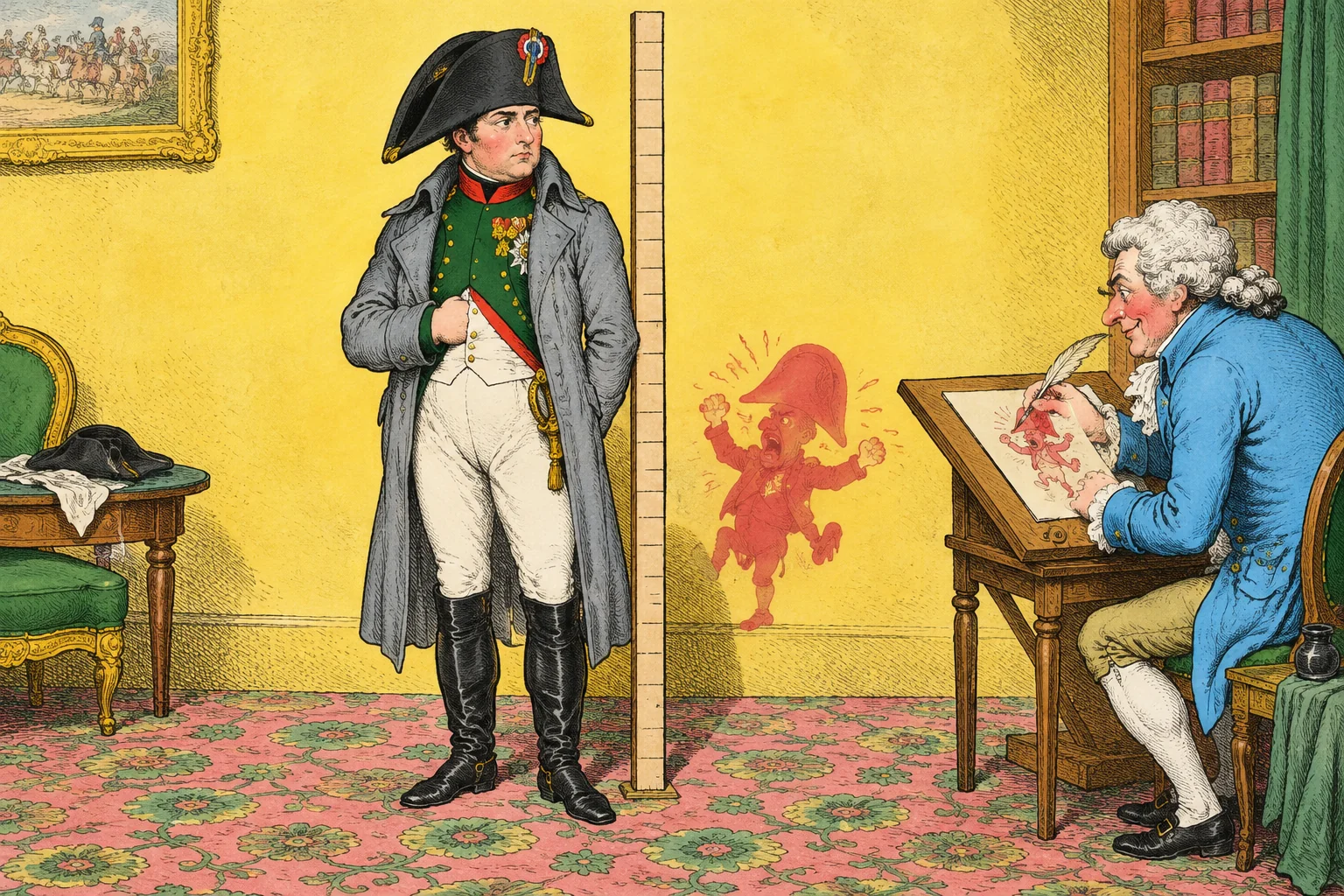
During the wars, British printmakers produced a steady stream of cartoons about Napoleon, and James Gillray was among the most influential. The National Portrait Gallery's catalogue dates the earliest appearance of the “Little Boney” figure to 1 January 1803, in a print titled German-nonchalence; or, the vexation of little Boney.
A caricature is designed to persuade and to amuse, and exaggeration is part of its method. “The Plumb-pudding in Danger”, a hand-coloured etching published on 26 February 1805, shows Pitt and Napoleon at a table, each carving a globe that has become a steaming pudding.
The National Portrait Gallery describes it as a satire on Napoleon's January 1805 overtures for reconciliation with Britain. Exaggerated bodies in such a print cannot serve as a measurement.
Once an image is repeated in print and retold, it starts to feel like a fact. That is how a satirical figure becomes a supposed record.
Standing next to giants
The grenadiers of the Imperial Guard were tall. Lentz notes that they were never less than 1.76 metres.
In paintings that place Napoleon among them, he looks smaller than he was. Such pictures distort the impression, and a group of guardsmen is not a sample of the population.
A nickname, not a measurement
Lentz reports that Napoleon's soldiers nicknamed him “le petit caporal” (spelled “corporal” in his article) or “le petit tondu”. The article does not explain what either name meant.
A nickname is not a measurement, and it cannot be turned into a number of centimetres.
Compared with whom?
Lentz places French infantry conscripts of the period at 1.65 to 1.69 metres, and puts the average Frenchman at around 1.60 metres. Against those figures, Napoleon's 1.69 metres sits near the top of the conscript range and above the average Frenchman.
Measured that way, he was not short for his time. He looks short beside a modern crowd because the comparison group is different.
The comparison group matters. Conscripts are not all European men, and a modern average is not an early-nineteenth-century one.
Name the group before you compare two numbers.
The “Napoleon complex” label
The “Napoleon complex” is a popular label for the idea that short men act aggressively to make up for their size. It describes a stereotype, not a documented fact about Napoleon himself.
The label tells you more about how the myth spread than about his personality, so it should not be used as evidence about him.
A height figure cannot explain his military decisions or his character. Treat any claim that his size drove his choices as a separate question that needs its own evidence.
How to check a height claim
Imagine you find two figures in different sources: 5 feet 2 inches in one, 5 feet 7 inches in another. This is a hypothetical example written for FiveMinRead, not a documented dispute.
A simple check goes like this:
- Find out whom the figure is attributed to, and whether the page cites an original record or another writer's summary.
- Check the units: French or English, and whether a conversion has already been applied.
- Note the date and conditions if the source gives them. Leave a gap if it does not.
- Keep the measurement separate from nicknames, cartoons and paintings.
If one figure is in French units and converts to about 1.69 metres, the gap may come from the unit alone. If a real gap remains, record it rather than averaging it away.
What exam-style questions ask
Questions about the Napoleonic era often test how historians read sources. Height is a useful case study because the real question is who produced the record, in which units, and for what purpose.
Expect to separate a measurement from propaganda, or to explain how caricature shaped later memory.
Read next
Each of these pages takes another step through the same era.
- The Napoleon Complex: Where the Term Comes From: a closer look at the phrase used to describe short men.
- Napoleon Bonaparte Quotes and Their Context: his words, read against the events around them.
- Who Was Napoleon Bonaparte?: the outline of his life, from Corsica to his lasting legacy.