Napoleon's tomb in five minutes
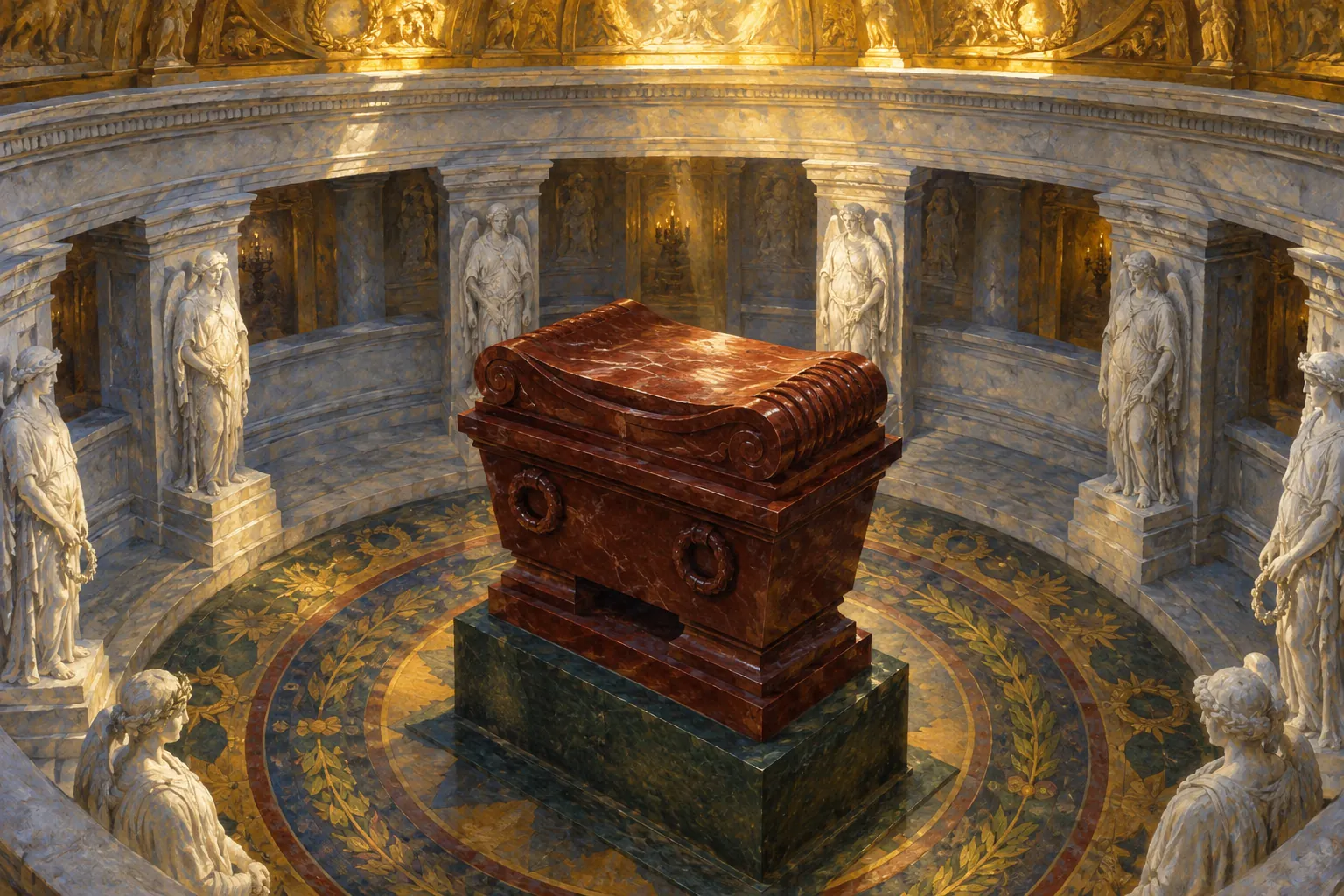
Napoleon's tomb is a single huge block of dark red quartzite in the crypt of Les Invalides, the old soldiers' hospital in Paris. It sits directly under the gilded dome of the Dôme des Invalides, in a round pit that visitors look down into from a gallery above. Napoleon died on the island of Saint Helena on 5 May 1821 and was first buried there. His remains reached Paris in December 1840, and the finished tomb was opened in 1861.
If you only need the quick answers: the tomb is in the 7th arrondissement of Paris, inside the church of the Dôme at Les Invalides. The sarcophagus is red quartzite, and the body inside lies in six nested coffins. The story belongs to the aftermath of the Napoleonic Era (1799–1815), when France had to decide how to remember a ruler it had both adored and exhausted.
Why Napoleon was first buried on Saint Helena
After his defeat at Waterloo in June 1815 and his second abdication, Napoleon surrendered to the British. They sent him to Saint Helena, a small island in the South Atlantic, thousands of kilometres from Europe. He lived at Longwood House with a few companions and a British garrison watching over him. He died there on 5 May 1821, aged 51. The doctors who examined him pointed to a stomach disease, most likely cancer.
He was buried on 9 May 1821 with military honours in a quiet spot known as the Geranium Valley, under willow trees. The grave had no name on it. The British governor, Hudson Lowe, would not allow the simple word “Napoleon”, and Napoleon's companions would not accept “Bonaparte”. So the stone stayed blank.
In his will Napoleon had written that he wanted his ashes to lie on the banks of the Seine, among the French people he had loved so much. For almost twenty years that wish could not be met. The restored Bourbon kings had no wish to see the emperor's body come home, and Britain held the island.
How the Napoleonic legend grew
Napoleon's memory did not fade after his death. Emmanuel de Las Cases, one of the companions who shared his exile, published the Mémorial de Sainte-Hélène in 1823, built from conversations with the fallen emperor. It showed Napoleon as an heir to the ideals of the Revolution and as a prisoner suffering on a distant rock. The book was widely read, and it helped turn a defeated ruler into a figure of both glory and sympathy.
By the 1830s, French writers, painters and songwriters were feeding the same mood. In 1836 the Arc de Triomphe, begun under Napoleon to honour his armies, was finally completed, and the funeral procession of 1840 would pass beneath it. When the July Monarchy looked for a way to win over the public, the Napoleonic legend was ready to use.
The return of the ashes, 1840
The mood changed under the July Monarchy. King Louis-Philippe came to power in 1830 and needed popular support. Many French people were turning Napoleon into a legend of glory, and memoirs and songs fed that feeling. In May 1840 the government of Adolphe Thiers asked parliament to bring the body home, and funds were voted. Britain agreed.
The king's son, the Prince de Joinville, commanded the frigate La Belle Poule on the mission. The ship reached Saint Helena in early October. The grave was opened on 15 October 1840, and the coffin was found intact. Those present reported that the body was in surprisingly good condition. The ship sailed on 18 October and reached Cherbourg on 30 November. The coffin then travelled up the Seine by boat.
On 15 December 1840 it came into Paris. A funeral car passed under the Arc de Triomphe and down the Champs-Élysées to Les Invalides, in bitter cold, with large crowds along the route. Louis-Philippe received the coffin in the church. This event is called the “Retour des cendres”, the return of the ashes. Because the tomb was not yet ready, the coffin waited in the chapel of Saint-Jérôme.
Building the tomb
Les Invalides itself is older than Napoleon. Louis XIV founded it in 1670 as a home and hospital for wounded soldiers. The domed church was designed by Jules Hardouin-Mansart and completed in 1706. Using this royal building for the emperor's tomb was a deliberate message: Napoleon was now part of the nation's military memory.
The architect Louis Visconti was chosen to design the tomb. His idea was to dig an open circular crypt directly under the dome, so that the tomb is seen from above and not hidden away in a side chapel. The sarcophagus was cut from red quartzite from Karelia, in what was then the Russian Empire, and rests on a base of green granite. Visconti died in 1853, before the work was done. The project continued under Napoleon III, the emperor's nephew, whose Second Empire made the tomb a symbol of the family's return to power. On 2 April 1861 the coffin was moved into the sarcophagus.
What you see today
Visitors walk around the gallery and look down into the crypt. Around the sarcophagus stand twelve marble Victory statues by the sculptor James Pradier. The floor is a mosaic with laurel wreaths and the names of Napoleon's campaigns. Over the entrance to the crypt are words taken from his will, saying that he wished his ashes to rest beside the Seine among the French people he had loved.
The body lies inside six coffins, one inside another: tinplate, mahogany, two of lead, ebony and oak. At the entrance to the crypt are the tombs of two of his generals, Duroc and Bertrand, who stayed loyal to him.
What the tomb says about memory
The design of the tomb carries a message. Visitors do not look up at the emperor on a high platform. They look down into a pit at the centre of a church built for soldiers, so Napoleon appears as a commander resting among his men. Many visitors lower their heads without thinking about it.
The tomb was also not made in one moment. Between his burial on Saint Helena in 1821 and the final placing of the coffin in 1861, France passed through the Restoration, the July Monarchy, a republic and the Second Empire. Each regime gave the memory of Napoleon a slightly different meaning. When you stand at the gallery rail, it helps to think of the stone and also of those forty years of changing politics behind it.
Who else is buried at Les Invalides
Napoleon is not alone. His son, Napoleon II, known as “L'Aiglon” (the Eaglet), died in Austria in 1832. His remains were brought to Les Invalides in December 1940, during the German occupation, one hundred years after his father's return. Napoleon's brothers Joseph and Jérôme are buried in the complex. Other great soldiers of France rest here too, including Marshal Turenne, the military engineer Vauban, and, from the twentieth century, Marshal Foch. The site also holds the Musée de l'Armée, which explains French military history.
What exams ask
- Date and place: the return of the ashes was in December 1840, under King Louis-Philippe of the July Monarchy.
- Why then: the government wanted to use the popular Napoleonic legend to gain support. AP-style questions often ask how memory and propaganda shape political legitimacy.
- Link to Napoleon III: the nephew who became emperor in 1852 finished the tomb in 1861 and used the family name to build his authority.
- Compare: Napoleon was exiled and buried by his enemies, then honoured by the government that followed. The change shows how a country's view of its past can shift.
Read next
- Who Was Napoleon Bonaparte? gives the life story of the man in the tomb, from Corsica to exile.
- Effects of the Napoleonic Wars shows what his wars changed across Europe.
- Napoleon III: The Second Empire explains the nephew who finished the tomb and ruled France.