In five minutes
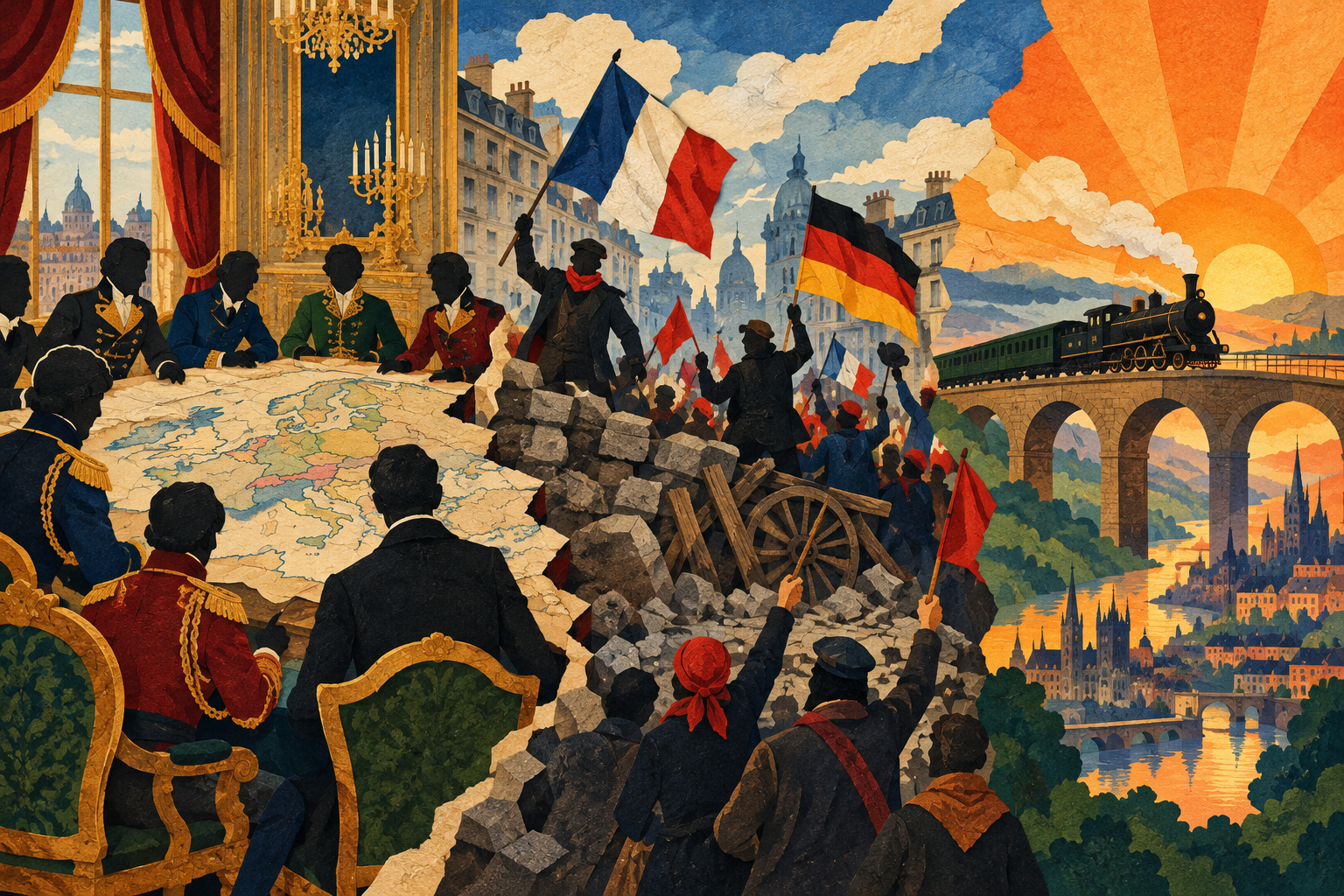
The story of 19th-century Europe is the story of an order built to stop change, and of how change won anyway. In 1815 the great powers met in Vienna to make sure no new Napoleon could rise. By 1871 Italy was one kingdom, Germany was one empire, and the idea that people who share a language and a history should rule themselves had become the strongest force in European politics.
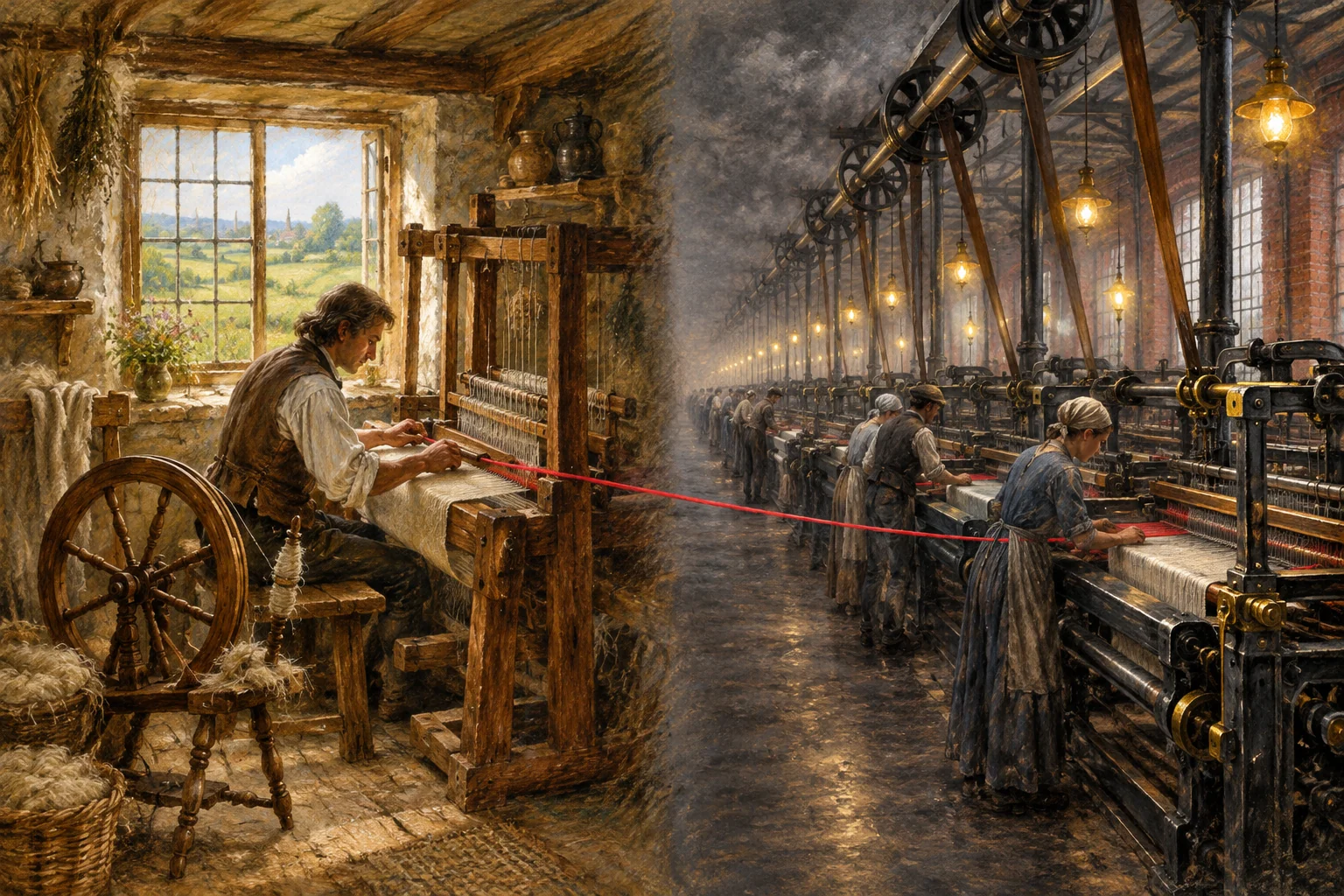
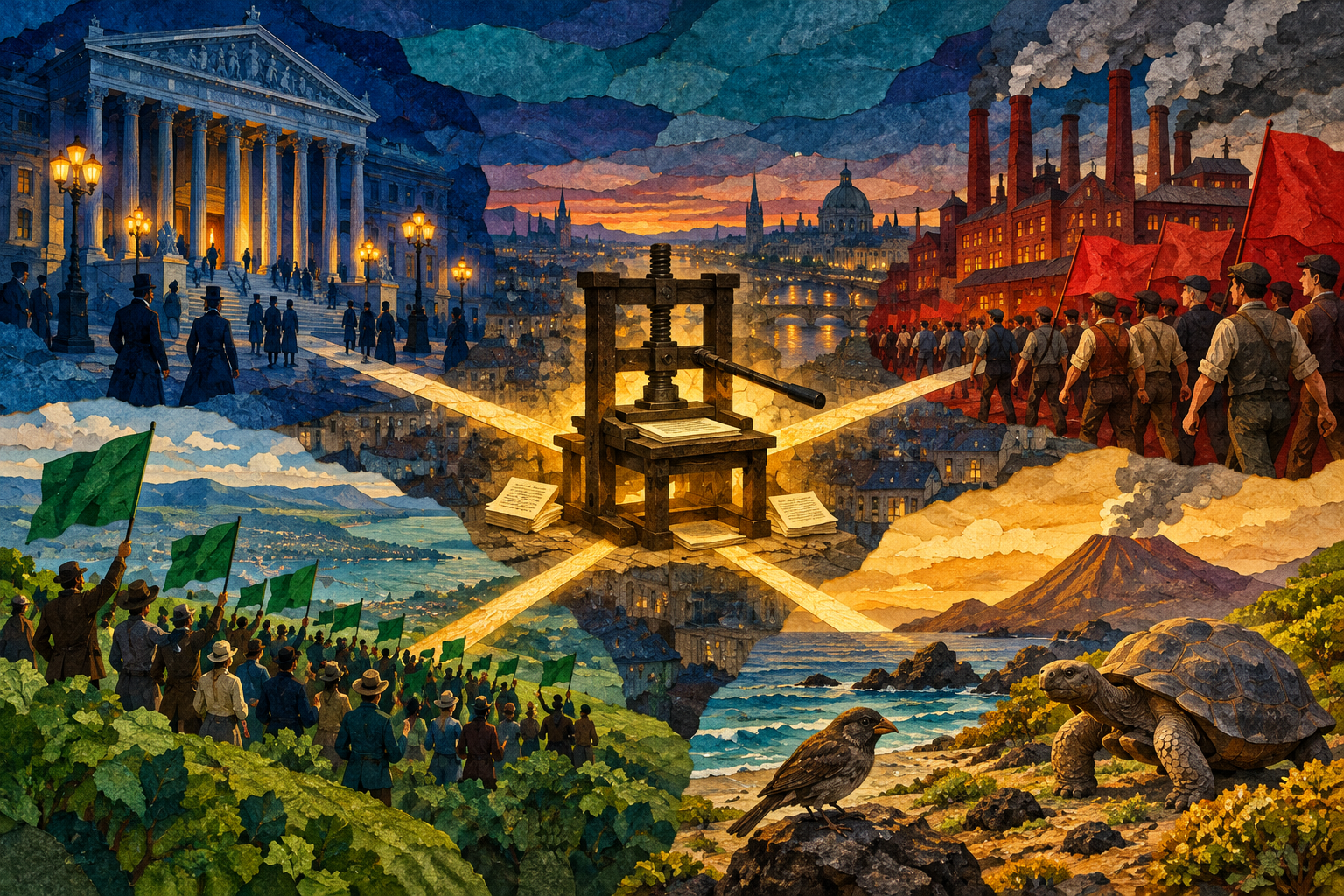
Three threads run through the whole century. Liberalism asked for constitutions, elected parliaments and equality before the law. Nationalism asked that each people live in a state of its own. Industrialisation moved families into cities, created a working class and gave governments railways and weapons to act on big ideas. Most exam questions on this period come back to how these three pulled against each other.
This page is the hub for the topic, and each section points to more detail. For the wider picture from 1700 to 1918, see the parent hub, World History 1700–1918.
1815: the Congress of Vienna and the Concert of Europe
After Napoleon's fall, diplomats met in Vienna from September 1814 to June 1815. Klemens von Metternich of Austria led the conservative side. Lord Castlereagh spoke for Britain and Tsar Alexander I for Russia. Talleyrand, representing defeated France, still won his country a seat at the table. They worked from three ideas: legitimacy, meaning the return of the old ruling families; balance of power, meaning no single state strong enough to dominate; and containment of France.
The practical results were clear. A German Confederation of 39 states replaced the old Holy Roman Empire, which had ended in 1806. Belgium was joined to the Netherlands, Russia took most of Poland under its tsar, and Austria held Lombardy and Venetia in northern Italy. Russia, Austria and Prussia signed the Holy Alliance to defend monarchy, and the four main victors agreed to meet again when crises came. That habit of consultation is called the Concert of Europe. It helped keep the great powers from fighting one another until the Crimean War of 1853.
The weakness was plain too. The settlement ignored liberal and national feeling, so many Poles, Italians, Germans and Belgians lived under rulers they had not chosen. It was held up by censorship and police, such as the Carlsbad Decrees of 1819, which tightened control of German universities and newspapers.
1820–1848: cracks in the system
The first challenges came on the edges. Revolts in Spain and Naples in 1820 were put down by foreign armies, and the Decembrist officers' revolt in Russia in December 1825 was crushed within a day. Greece was different. The Greek War of Independence began in 1821. In 1827 Britain, France and Russia destroyed an Ottoman-Egyptian fleet at Navarino, and Greek independence was confirmed in 1830.
Then 1830 shook the centre. In July, Parisians rose against Charles X, and Louis-Philippe took the throne as a more liberal king. In August, Belgians rose against Dutch rule and won independence, which the Netherlands finally accepted in 1839. A Polish uprising against Russia was crushed in 1831. Britain avoided revolution by reform: the Great Reform Act of 1832 widened the vote.
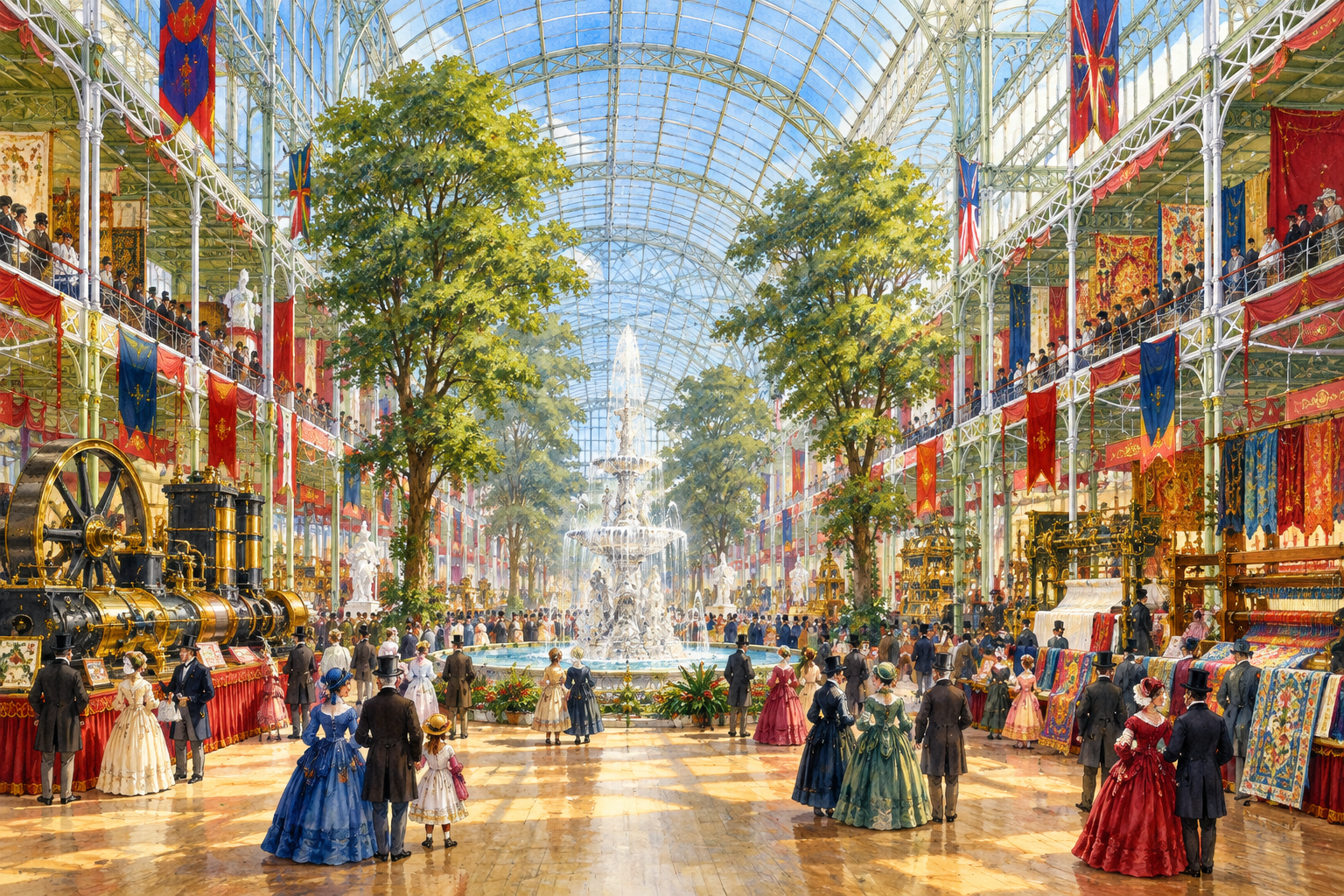
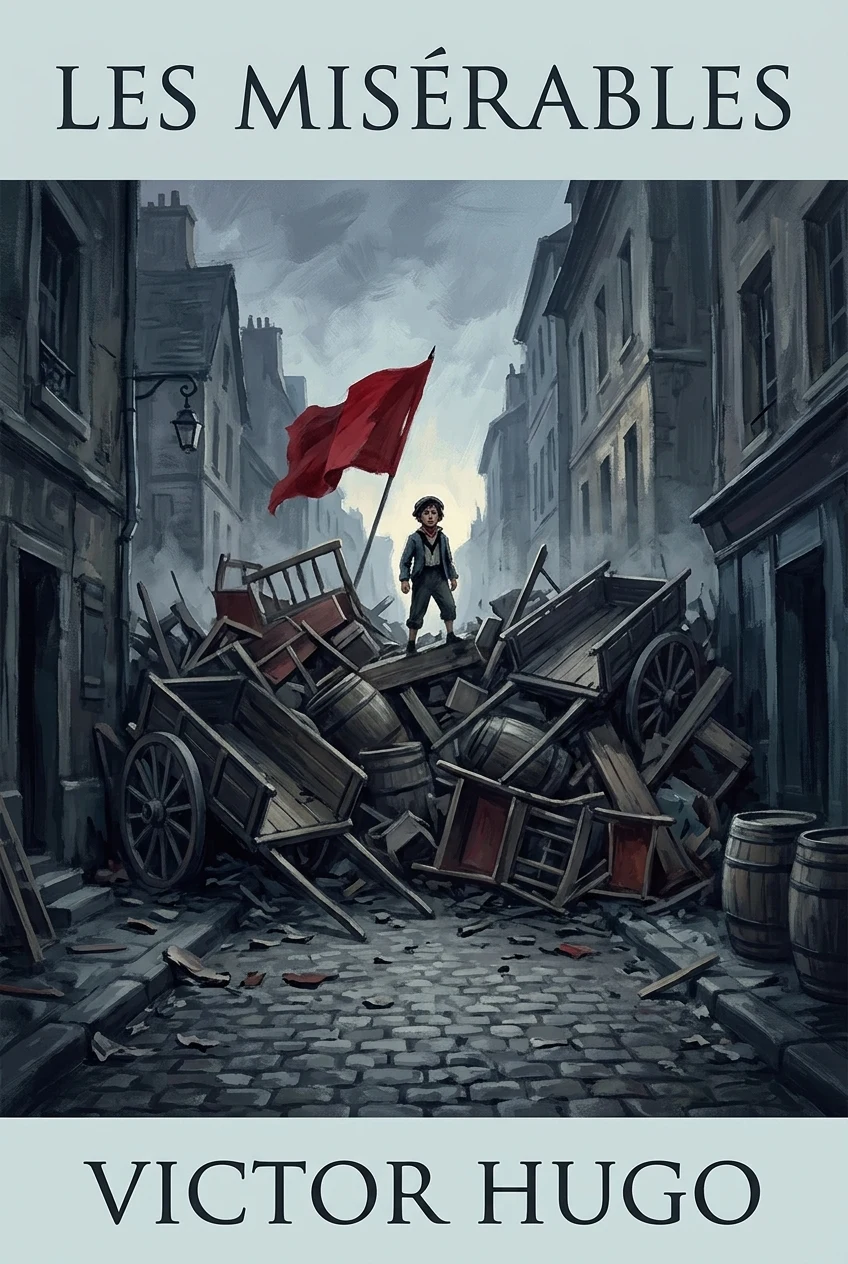
The economy was changing Europe more quietly. The Liverpool and Manchester Railway opened in 1830, and in 1834 Prussia led the German states into the Zollverein, a customs union that created economic unity before political unity. For the engine behind these changes, read The Industrial Revolution: What It Was and Why It Mattered. For this world in fiction, Les Misérables begins in 1815 and builds to the failed Paris uprising of June 1832.
1848: the Spring of Nations
Bad harvests, high food prices and unemployment in 1846–47 met the anger of liberals and nationalists. Revolution broke out in Palermo in January 1848 and in Paris in February, where Louis-Philippe abdicated and a republic was declared. In March, crowds rose in Vienna and Berlin, and Metternich resigned and fled. Hungarians led by Lajos Kossuth demanded self-government, Milan and Venice rose against Austria, and a parliament met at Frankfurt in May to write a constitution for a united Germany.
By 1849 most of it had failed. Armies stayed loyal to their rulers. The revolutionaries split over class, since liberals feared radical workers, and over nationality, since Hungarians, Czechs, Croats and Germans in the Habsburg lands made rival claims. Austria crushed Hungary in 1849 with Russian help. In April 1849 King Frederick William IV of Prussia refused the imperial crown offered by the Frankfurt Parliament. In France, Louis-Napoleon Bonaparte was elected president in December 1848 and became Emperor Napoleon III in 1852.
Not everything was lost. Serfdom ended in the Habsburg lands, and several states kept constitutions. The lesson many drew was that nationalism needed armies and diplomacy, not only speeches.
1850s–1871: unification by statecraft and war
The Crimean War of 1853–56 broke the old cooperation between Russia and Austria, which opened space for change. Defeat also pushed Alexander II to free Russia's serfs in 1861.
Italy
Count Cavour, prime minister of Piedmont-Sardinia, modernised his kingdom and allied with Napoleon III against Austria in 1859. After the battles of Magenta and Solferino, Lombardy joined Piedmont. In 1860 Giuseppe Garibaldi sailed to Sicily with about a thousand volunteers, conquered the south and handed it to King Victor Emmanuel II. The Kingdom of Italy was proclaimed in March 1861. Venetia joined in 1866 and Rome in 1870.
Germany
Otto von Bismarck became Prussia's minister-president in 1862 and chose war over debate. Prussia beat Denmark in 1864 and Austria in 1866 at Königgrätz, then formed the North German Confederation in 1867 without Austria. The defeated Habsburgs reorganised as Austria-Hungary in 1867. In 1870 a dispute over the Spanish throne led to the Franco-Prussian War. Napoleon III was captured at Sedan in September, and the German Empire was proclaimed at Versailles on 18 January 1871 with Wilhelm I as emperor. France lost Alsace and part of Lorraine and paid an indemnity of five billion francs. Paris then lived through the Commune of March to May 1871, and the Third Republic followed.
Industry and society
Britain industrialised first, then Belgium, France and Germany. After about 1870 steel, chemicals and electricity favoured Germany and the United States. Cities grew, factory workers organised in trade unions, and socialism spread; Marx and Engels published the Communist Manifesto in 1848. Britain's own path, with a widening vote and a long reign, is covered in The Victorian Era (1837–1901).
1871–1914: great powers and alliances
After 1871 Bismarck wanted a peaceful Europe in which France stayed isolated. He built the League of the Three Emperors in 1873, hosted the Congress of Berlin in 1878, and signed the Dual Alliance with Austria-Hungary in 1879 and the Triple Alliance with Italy in 1882. The powers also divided Africa at the Berlin Conference of 1884–85. After Bismarck left office in 1890, Russia and France allied in the 1890s, Britain agreed the Entente Cordiale with France in 1904 and an agreement with Russia in 1907. Europe now stood in two blocs. In the Balkans, the same nationalism that had built Italy and Germany pulled Ottoman and Habsburg lands apart, and that tension led to 1914.
What exams ask
- The principles of the Congress of Vienna: legitimacy, balance of power, containment of France.
- Why 1830 partly succeeded (Belgium, Greece, France) while 1848 mostly failed.
- Why the Frankfurt Parliament failed, and the choice between a Germany with Austria and one led by Prussia.
- Compare Cavour's methods (diplomacy, alliances) with Bismarck's (war, military power).
- Significance, AP-style: nationalism both built nation-states and destabilised multinational empires.
Read next
- World History 1700–1918: the parent hub that places Europe among revolutions, empires and war.
- The Industrial Revolution: the economic change underneath the politics.
- The Victorian Era (1837–1901): Britain's reforms and empire.
- Les Misérables: Victor Hugo's novel of France from 1815 to 1832.