In five minutes: the ideas that shaped the 19th century
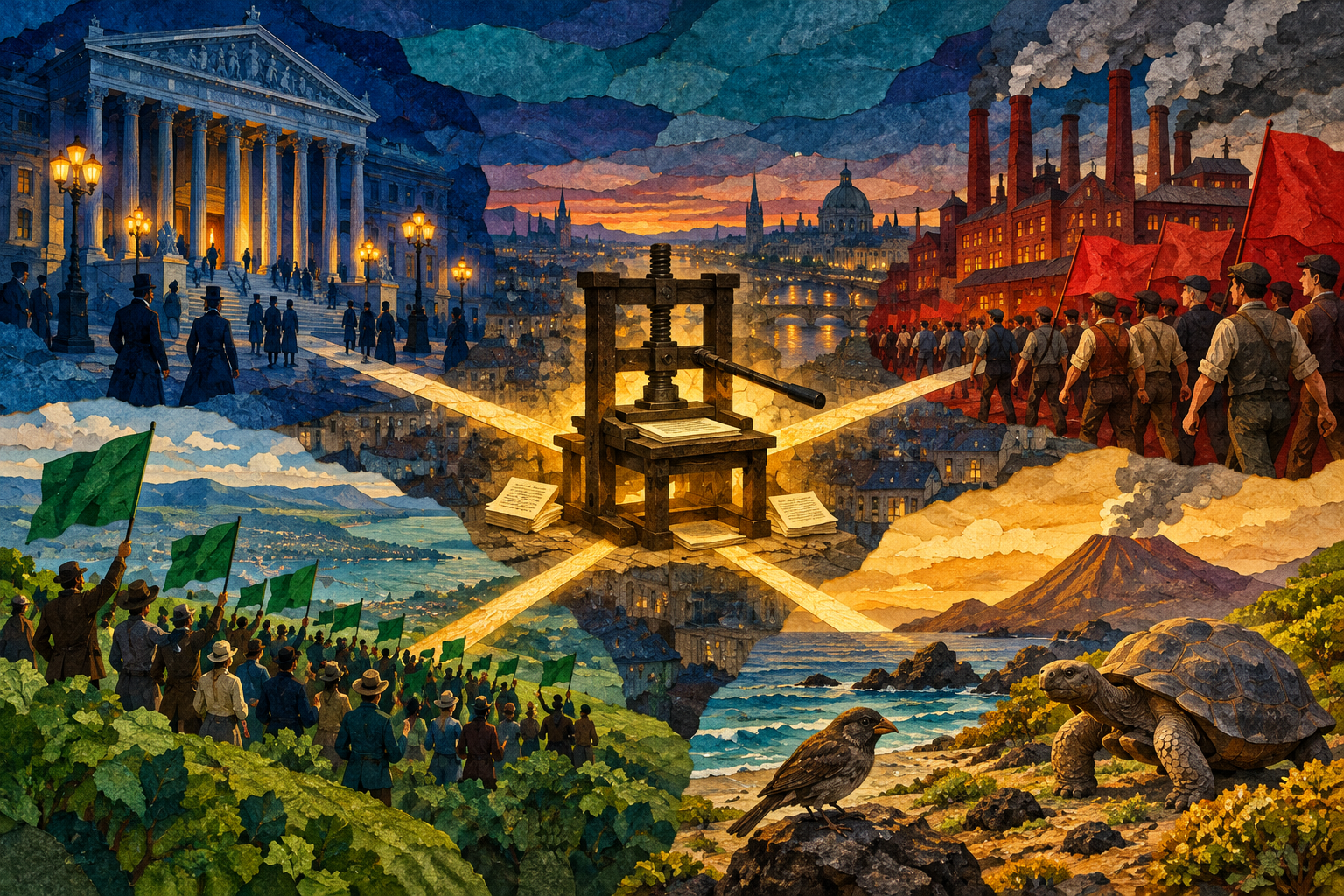
Four ideas did most of the work of remaking the world between 1815 and 1914: liberalism, socialism, nationalism and the theory of evolution. Liberalism said power must be limited by law and individual rights. Socialism said a free market alone leaves most people poor and powerless. Nationalism said that peoples who share a language and a history should govern themselves. Darwin's theory said that all living things, humans included, have a long natural history. This page explains the ideas themselves. The events they shaped are told in our wider guide, World History 1700–1918: Revolutions, Industry, Empire and War.
Why the 1800s needed new ideas
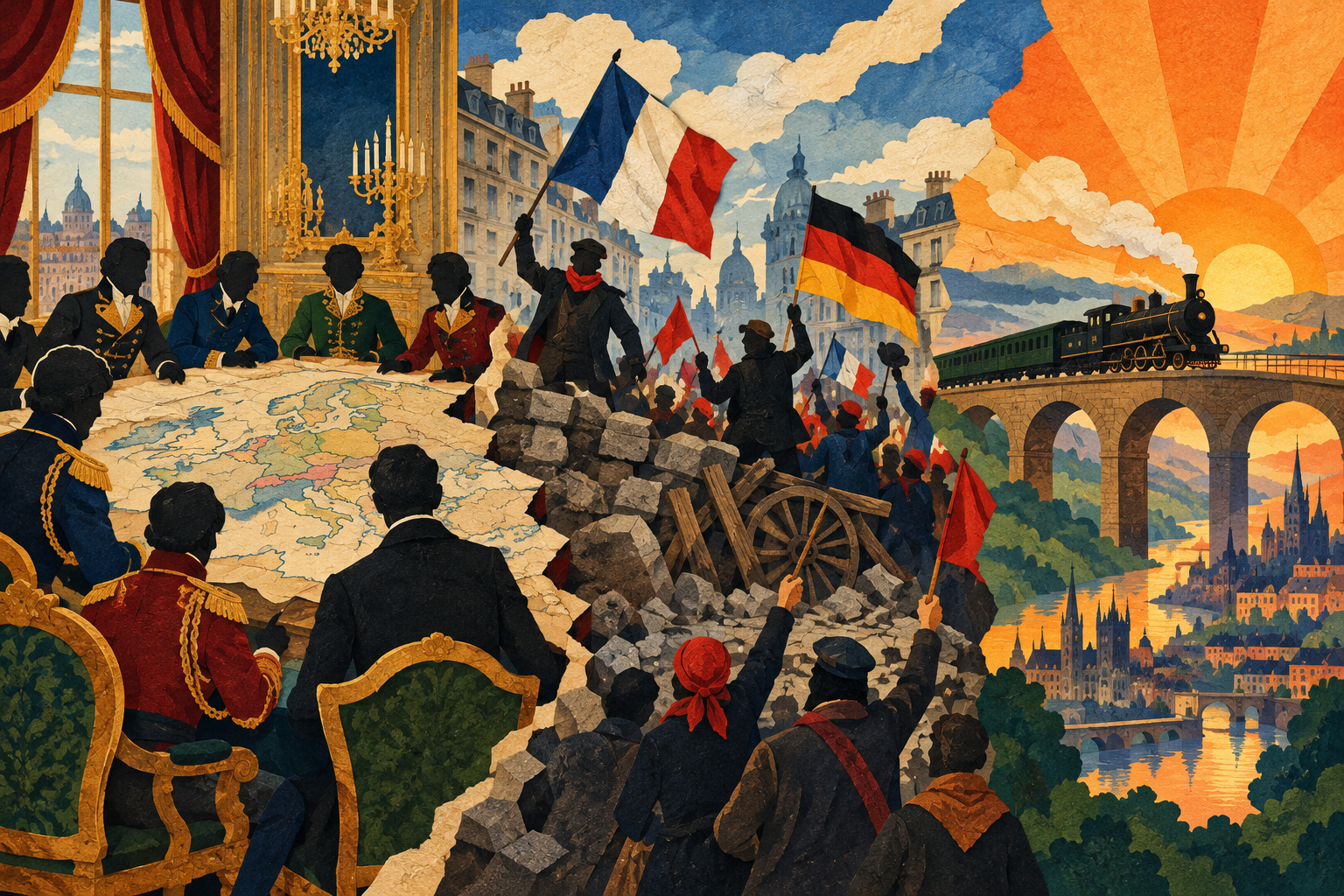
Two shocks set the stage. The French Revolution (1789) and Napoleon's wars showed that kings could fall and that ordinary people could be soldiers, voters and citizens. Then the Industrial Revolution moved workers into crowded factory towns and created a new class of owners and wage earners.
When the great powers met at the Congress of Vienna in 1814–1815, they tried to restore the old order under conservative leaders such as Austria's Klemens von Metternich. But the old order had no answer to the new questions: who should rule, who should own the new wealth, and what holds a nation together? Each of the four ideas below is an answer.
Liberalism: limit power, protect the individual
Liberals wanted written constitutions, elected parliaments, free speech, a free press and protection of property. In economics they backed free trade and open markets, building on Adam Smith (1776) and David Ricardo. In Britain, Jeremy Bentham's utilitarianism offered a simple test for any law: does it increase the happiness of the greatest number? His follower John Stuart Mill went further in On Liberty (1859), arguing that society may restrict a person's freedom only to prevent harm to others. Mill also argued for women's equality in The Subjection of Women (1869).
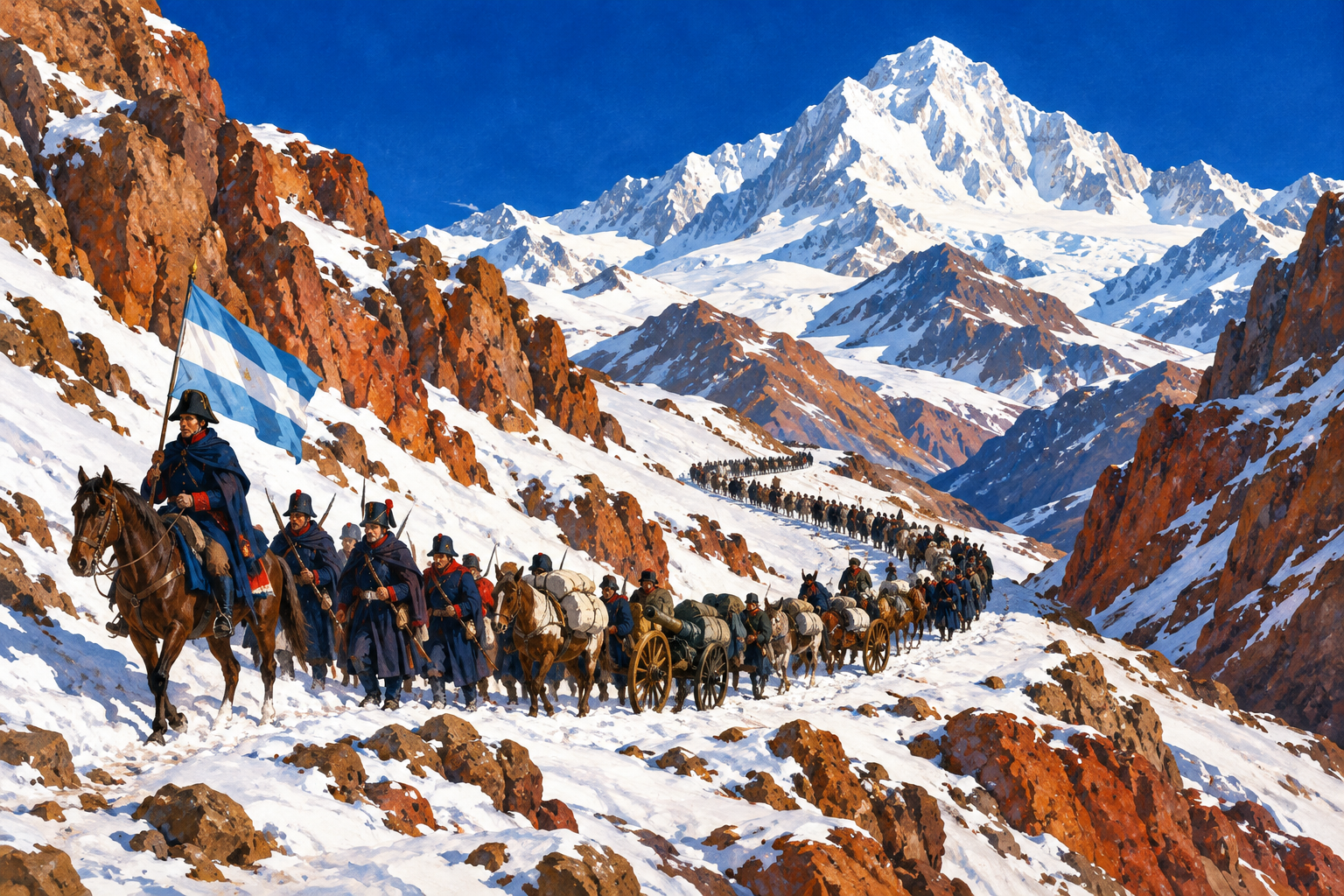
Early liberalism was not the same as democracy. Many liberals wanted the vote limited to men with property. Britain's Great Reform Act of 1832 widened the electorate but still left most men without a vote, and the Corn Laws were repealed in 1846 as a victory for free trade. Across the Atlantic, liberal and national ideals fed the independence movements described in Latin American Independence (1791–1826). Over the century, liberal pressure slowly brought the vote, schooling and civil rights to more people.
Socialism: the economy is a political question
Socialism grew out of the harsh side of industrial life: long hours, child labour, low pay and slum housing. Early thinkers such as Henri de Saint-Simon, Charles Fourier and the mill owner Robert Owen proposed planned, co-operative communities. Friedrich Engels later labelled them “utopian”.
Karl Marx and Engels took a different path. In The Communist Manifesto (1848) they argued that history is driven by conflict between classes, and that capitalism had created a working class, the proletariat, that would one day take control of production. Marx's Capital, volume one (1867), analysed how profit comes from workers' labour.
Socialism did not mean only revolution. The International Working Men's Association, the First International, was founded in London in 1864. The Paris Commune of 1871 was a radical city government that was crushed after about ten weeks. In Germany, socialists built a mass party through elections even while Otto von Bismarck's anti-socialist laws (1878–1890) tried to suppress them. By 1900 socialists were arguing over whether reform or revolution was the way forward, while anarchists such as Pierre-Joseph Proudhon and Mikhail Bakunin rejected the state altogether.
Nationalism: a people should rule itself
Nationalism held that the natural unit of politics is the nation, a people bound by language, history and culture. Thinkers such as Johann Gottfried von Herder stressed the value of each people's language and folk traditions. Napoleon's conquests helped spread the feeling: people who were invaded often responded by defining themselves as a nation, as Johann Gottlieb Fichte did in his Addresses to the German Nation (1807–1808).
Nationalism could be liberal or aggressive. In 1831 Giuseppe Mazzini founded Young Italy, hoping for an Italian republic. In the end, Italy was unified under the kingdom of Piedmont-Sardinia: the Kingdom of Italy was proclaimed in 1861 and Rome joined in 1870. Germany was united under Prussia, and the German Empire was proclaimed at Versailles on 18 January 1871. Greeks won independence from Ottoman rule in a war that began in 1821.
For multi-ethnic empires such as Austria's and the Ottoman Empire, nationalism was a threat that could tear the state apart. It also inspired movements such as Zionism, whose first congress met in Basel in 1897. By the late century, nationalism was feeding rivalry between the great powers, one of the background causes of the war that began in 1914.
Darwin: a new story of life
On 24 November 1859 Charles Darwin published On the Origin of Species. Its core idea is natural selection: living things vary, more are born than can survive, and the traits that help an animal survive and breed are passed on, so species change over time. Alfred Russel Wallace had reached a similar idea independently, and the two men's work was presented together in 1858. Darwin's The Descent of Man (1871) applied the idea to humans.
The theory unsettled readers who took the Bible's account of creation literally. It also gave scientists a unifying framework for biology, helped by Charles Lyell's Principles of Geology (1830–1833), which had already shown that Earth is very old. Evolution then leaked into politics. Herbert Spencer, who coined “survival of the fittest” in 1864, and others applied the idea of a struggle for survival to human societies. This “social Darwinism” was used to defend inequality, to justify empire and to support racist theories. Darwin's science did not require those conclusions, and many people rejected them then and now.
How the ideas collided
The ideas often overlapped and often fought. Liberals and nationalists usually stood together in the revolutions of 1848, sometimes called the “Springtime of Peoples”, when uprisings spread through France, the German states, the Austrian Empire and Italy. That same year the Manifesto appeared. Middle-class liberals frightened by working-class demands sometimes sided with conservative rulers, and most of the uprisings failed in the short run.
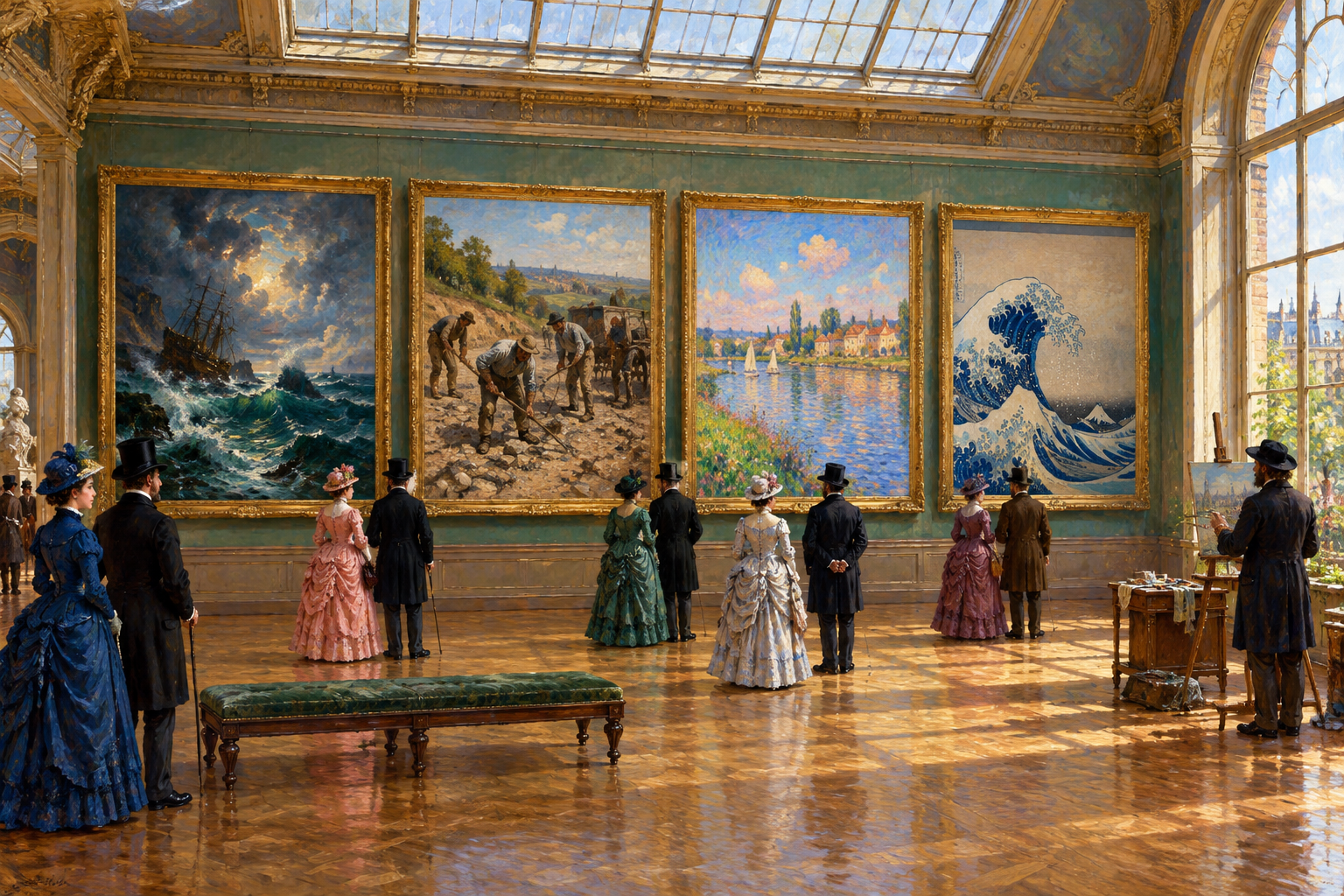
In the following decades, governments learned to harness nationalism, as Bismarck did. Socialist parties and trade unions used the vote that liberals had helped win. Evolution gave imperial powers a vocabulary of “progress” and “civilising”, which sat badly with the liberal belief in equal rights. For how the mood of the era shows up in painting, music and literature, read 19th-Century Art and Culture: From Romanticism to the Belle Époque.
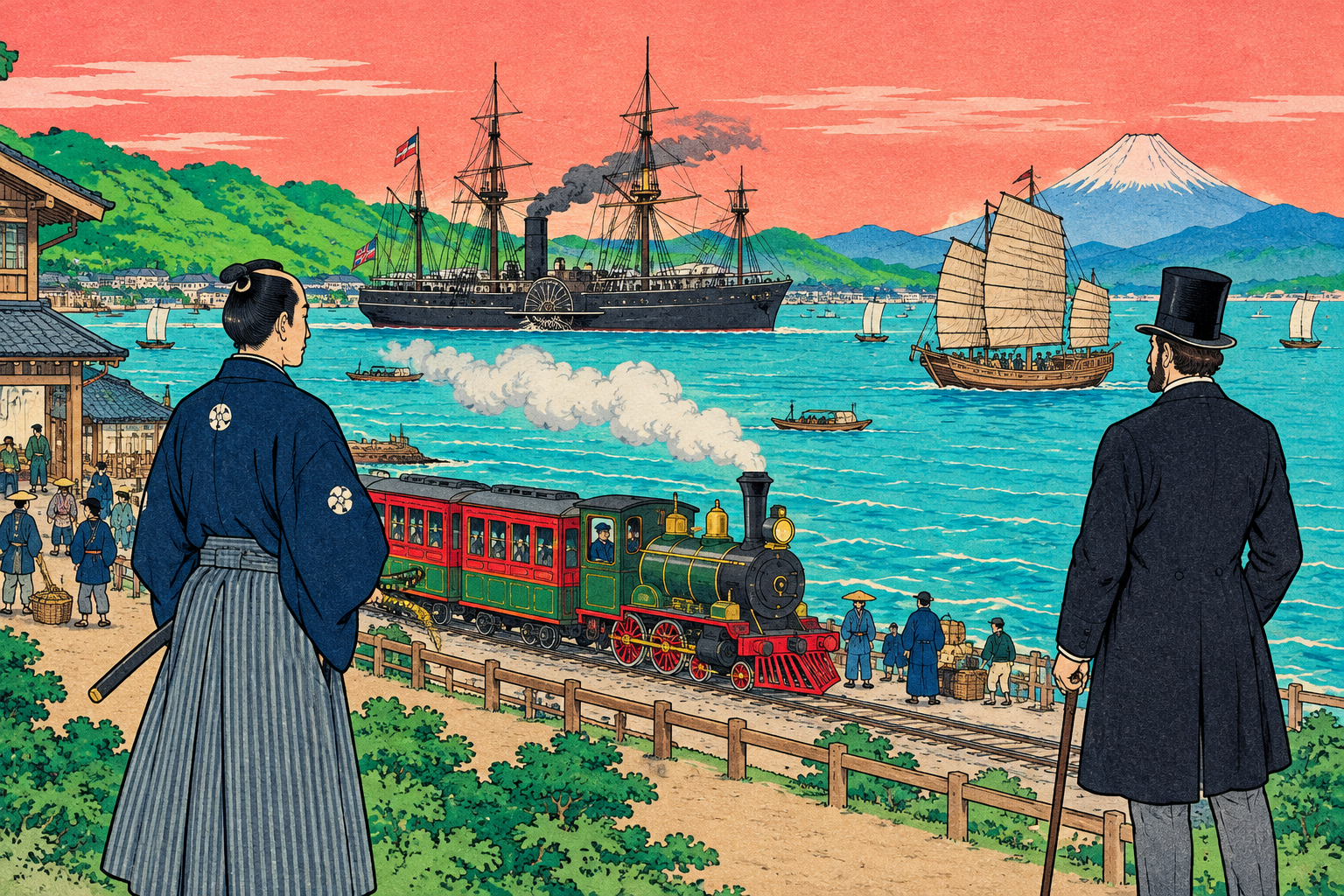
These ideas did not stay in Europe. Latin American independence leaders, Meiji reformers in Japan and anti-colonial thinkers in Asia and Africa borrowed and reshaped liberal, nationalist and socialist ideas, often turning them against the very empires that had exported them.
What exams ask
AP-style questions usually ask for significance and comparison. These are the points that come up most.
- Match each idea to its text and date: the Manifesto (1848), On Liberty and the Origin of Species (both 1859), and Capital (1867).
- Explain causes: industrialisation created demand for socialism, and the Napoleonic wars stirred nationalism.
- Compare liberalism and socialism: individual liberty and markets against collective ownership and equality.
- Compare the unification of Italy (1861) and Germany (1871): Piedmont and Cavour against Prussia and Bismarck.
- Evaluate social Darwinism as a political use of a scientific theory, and name the policies it was used to defend.
Read next
Latin American Independence (1791–1826) shows liberal and national ideas turning into real revolutions in the Americas.
19th-Century Art and Culture: From Romanticism to the Belle Époque shows how the same ideas and anxieties appear in the arts.
World History 1700–1918: Revolutions, Industry, Empire and War places all of these ideas in the timeline of events.