In five minutes: 19th-century art and culture
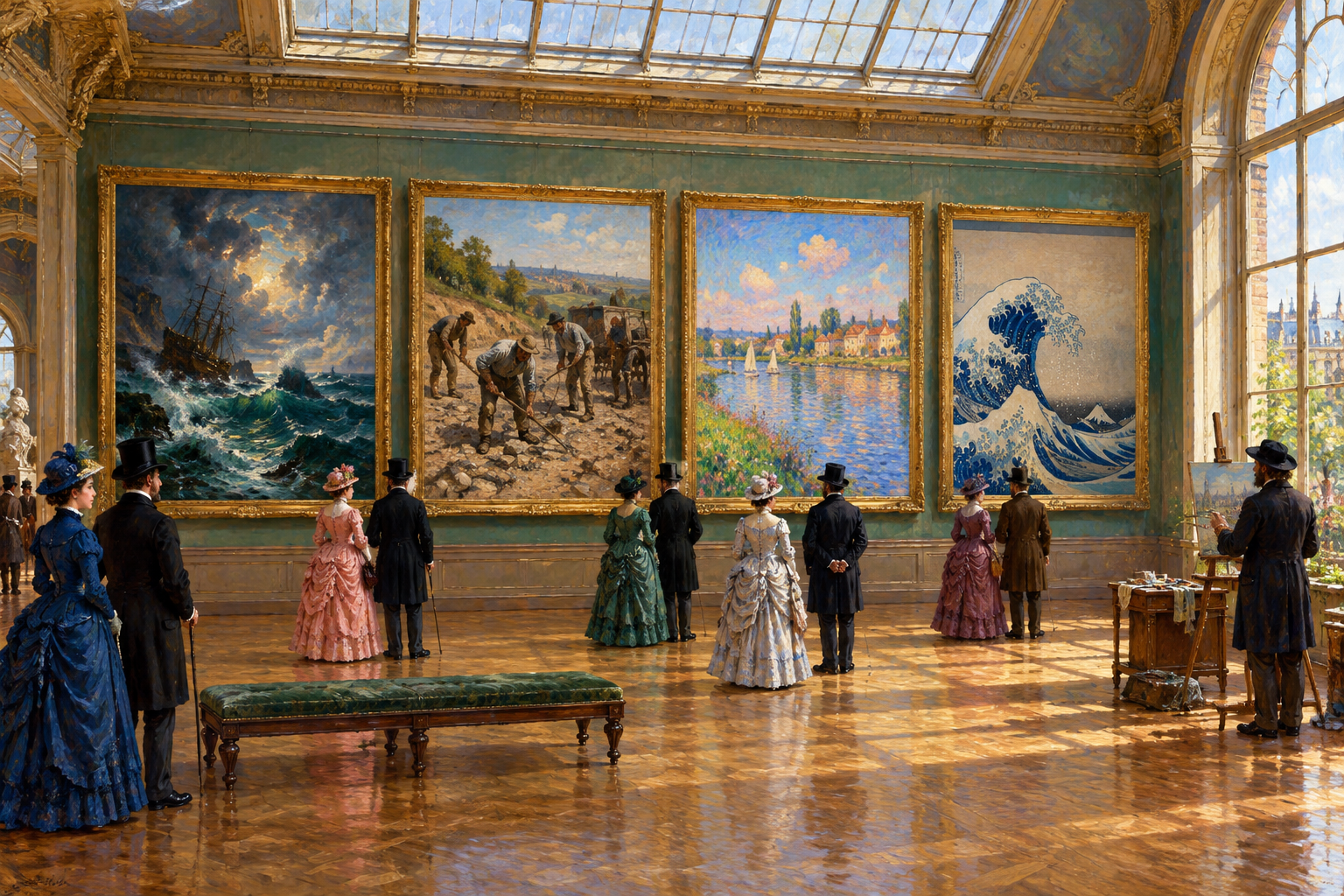
Nineteenth-century art is the story of art leaving the palace and the academy. Around 1800, most leading painters worked for kings, churches and state exhibitions, and the most respected subjects were history, myth and religion. By 1900, painters were selling to dealers and middle-class collectors, painting fields, cafés and railway stations, and arguing in public about what art was for.
Four forces drove the change. Revolutions between 1789 and 1848 made politics a subject for artists. Industry created a new middle class with money to spend and cities full of new scenes. Technology gave painters paint in metal tubes (patented in 1841) and gave everyone photography (announced in 1839). Finally, trade and empire brought Japanese prints and other objects from outside Europe into view.
This page belongs to the World History 1700–1918 series and is the hub for its Culture and Arts topic. For the thinking behind the pictures, read Ideas That Shaped the 19th Century.
Neoclassicism and Romanticism (about 1780–1850)
The first big current is Neoclassicism. Jacques-Louis David's Oath of the Horatii (1784) shows Roman citizens putting duty before family, with sharp lines and a calm, stage-like composition. David later became Napoleon's painter.
Romanticism pushed back. It valued feeling over reason, and nature, danger and the individual over order. Francisco Goya's The Third of May 1808 (painted 1814) shows Spanish civilians facing a French firing squad, and the victim at the centre is a frightened man, not a hero. Théodore Géricault's The Raft of the Medusa (1819) turned a real shipwreck of 1816 into a huge, scandalous canvas. Eugène Delacroix's Liberty Leading the People (1830) was a response to the July Revolution of the same year. In Britain, J. M. W. Turner and John Constable painted weather and light, and in Germany Caspar David Friedrich painted lone figures in front of vast landscapes.
The mood reached music and poetry too. Beethoven's Ninth Symphony was first performed in 1824, and Lord Byron's poems made the restless Romantic hero famous across Europe.
Realism (about 1840–1870)
After the revolutions of 1848, many painters chose the real world over idealised heroes. Gustave Courbet's The Stone Breakers (1849) shows two roadside labourers at close to life size, a scale that had been kept for history painting. In 1855 Courbet held his own show next to the Paris World's Fair and called it the Pavilion of Realism. Jean-François Millet's The Gleaners (1857) honoured poor women picking up leftover grain, and Honoré Daumier used newspaper cartoons to attack politicians.
Novels did the same. Gustave Flaubert's Madame Bovary (1857) and the novels of Charles Dickens looked closely at ordinary lives. Meanwhile, Louis Daguerre's photographic process was announced in 1839, and photography slowly took over the job of recording faces and places exactly. Painters began to look for what a camera could not give: the impression of light, mood and the act of seeing itself.
Japonisme: how Japan changed European art
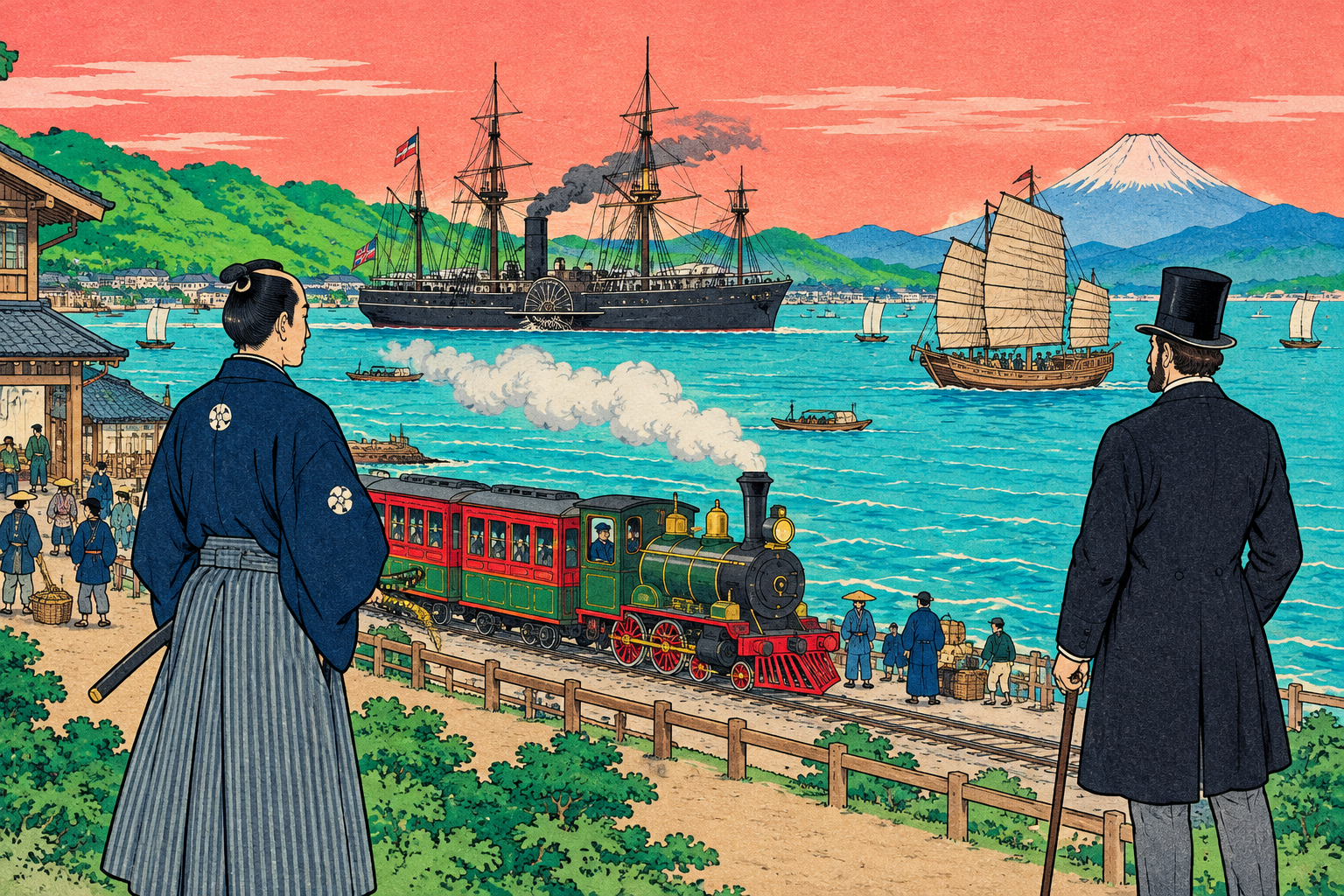
Japan's ports opened to Western trade after 1854, and Japanese woodblock prints and crafts reached Europe in growing numbers. Japan also took part in the Paris World's Fair of 1867. Bold cropping, flat areas of colour and strong outlines looked fresh to painters raised on Western perspective and shading. This craze is called Japonisme. Claude Monet collected prints, Vincent van Gogh copied works by Utagawa Hiroshige in oil in 1887, and James McNeill Whistler borrowed Japanese compositions. Katsushika Hokusai's The Great Wave off Kanagawa (about 1831) is still one of the world's best-known images.
Influence also flowed the other way. After the Meiji era began in 1868, Japan studied Western oil painting. In 1876 the government opened the Technical Fine Arts School in Tokyo, taught partly by Italian instructors. Kuroda Seiki, who studied in Paris from 1884 and returned in 1893, brought home the bright outdoor light of the French school. The 19th century was a time when East and West learned from each other.
Impressionism (1870s–1880s)
The path to Impressionism ran through the Salon, the official art show in Paris. In 1863 so many works were rejected that Emperor Napoleon III allowed a Salon des Refusés, where Édouard Manet's Luncheon on the Grass caused an uproar.
In April 1874, Monet, Pierre-Auguste Renoir, Camille Pissarro, Edgar Degas, Berthe Morisot, Alfred Sisley and others held their own exhibition in Paris, in rooms that had been the photographer Nadar's studio. A critic mocked Monet's Impression, Sunrise (1872), and the name "Impressionists" stuck. The group held eight exhibitions, the last in 1886. The American painter Mary Cassatt joined from 1879.
Their method was simple to describe. Paint outdoors, use short visible brushstrokes, and record the colour you see under changing light, not the colour you know an object to be. To catch that change, Monet painted the same haystacks and the same cathedral again and again at different hours and seasons.
Post-Impressionism and the fin de siècle (1880s–1900)
After Impressionism, painters went in separate directions, and historians group them as Post-Impressionists. Georges Seurat built A Sunday Afternoon on the Island of La Grande Jatte (1884–1886) from small dots of colour. Paul Cézanne rebuilt nature from basic forms such as cylinders and spheres, an idea later developers of Cubism admired. Van Gogh painted The Starry Night in 1889 while staying at a hospital in Saint-Rémy, and Paul Gauguin moved to Tahiti in 1891 and painted with bold, flat colour. Edvard Munch made the first version of The Scream in 1893.
In design, Art Nouveau spread in the 1890s with its flowing plant-like curves. The Eiffel Tower, finished for the Paris World's Fair of 1889, showed that iron and glass could be a new kind of beauty.
Beyond painting: buildings, music and museums
The Crystal Palace, built of iron and glass for the Great Exhibition in London in 1851, showed what industry could build. Public museums grew: the Louvre opened as a public museum in 1793, and the Metropolitan Museum of Art in New York was founded in 1870. In music, Frédéric Chopin, Giuseppe Verdi and Richard Wagner shaped the century, and Wagner's four-part Ring cycle was first performed in full at Bayreuth in 1876.
Why it matters: the Belle Époque and the road to 1914
"Belle Époque" (beautiful era) is the name later given to the years from about the 1890s to 1914, especially in France. It was a time of cafés, posters, world's fairs and new art. But rivalries between the great powers were hardening too, and in 1914 the world went to war. Read how that ended the age in World War I (1914–1918). In art, the next generation, including the Cubists, learned from Cézanne and Van Gogh and moved further away from painting things as they look.
What exams ask
AP-style questions usually ask you to link a work to its movement and its context. Use this checklist:
- Neoclassicism: David, order and Roman duty, linked to the Revolution and Napoleon.
- Romanticism: Goya, Géricault, Delacroix, Turner; emotion, nature and politics.
- Realism: Courbet, Millet; ordinary workers shown at serious scale after 1848.
- Impressionism: Monet, Renoir, Degas, Morisot; light, outdoor work, independent exhibitions from 1874.
- Post-Impressionism: Cézanne, Van Gogh, Gauguin, Seurat; personal vision after Impressionism.
- Context: photography, paint tubes, the middle-class art market, world's fairs and Japonisme.
A good answer explains cause and effect: for example, photography reduced the need for exact likeness, which helped push painters toward impression and expression.
Read next
- World History 1700–1918: the full timeline of revolutions, industry, empire and war that surrounds these artists.
- Ideas That Shaped the 19th Century: liberalism, socialism, nationalism and Darwin, the ideas behind Romanticism and Realism.
- World War I (1914–1918): how the confident Belle Époque ended.