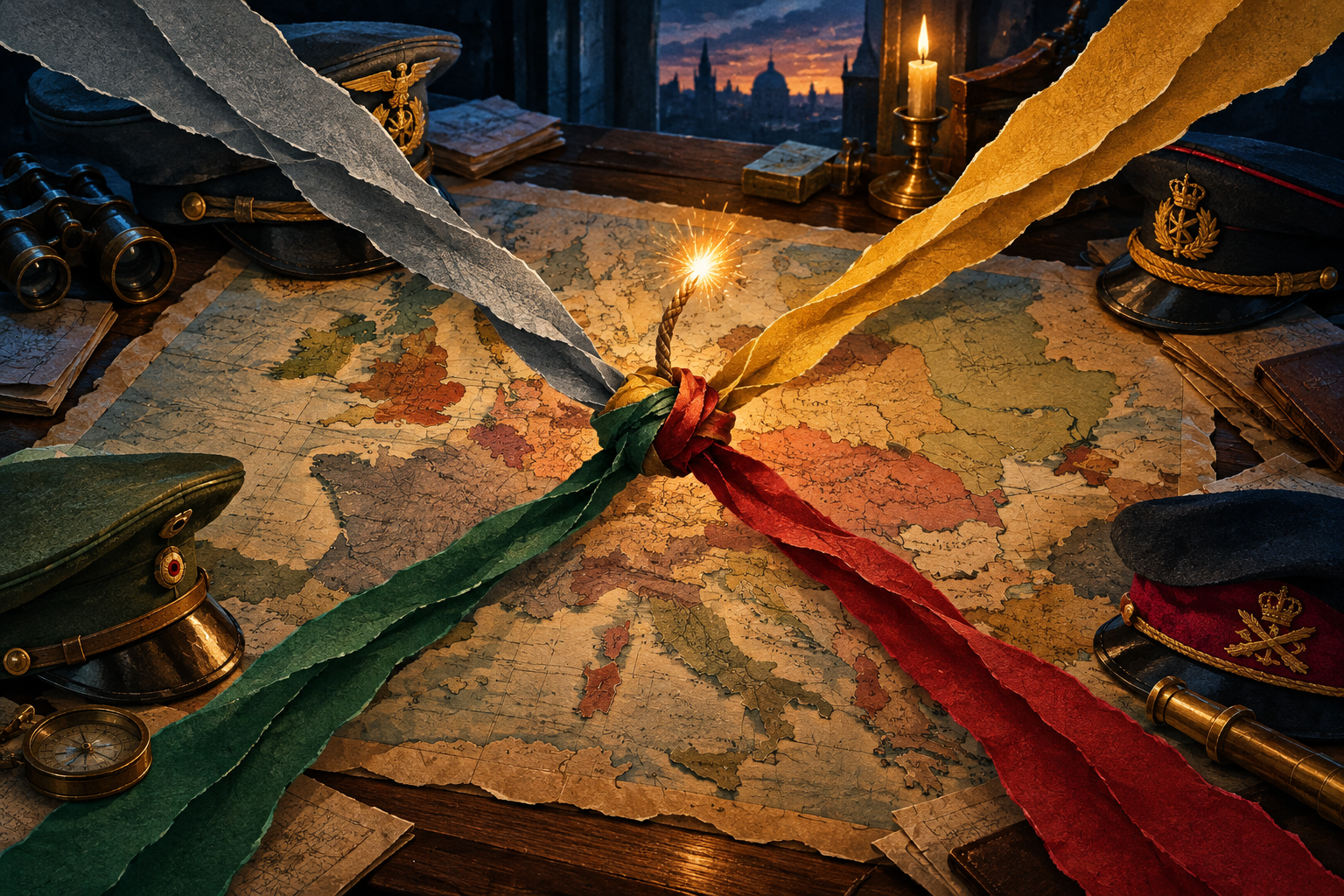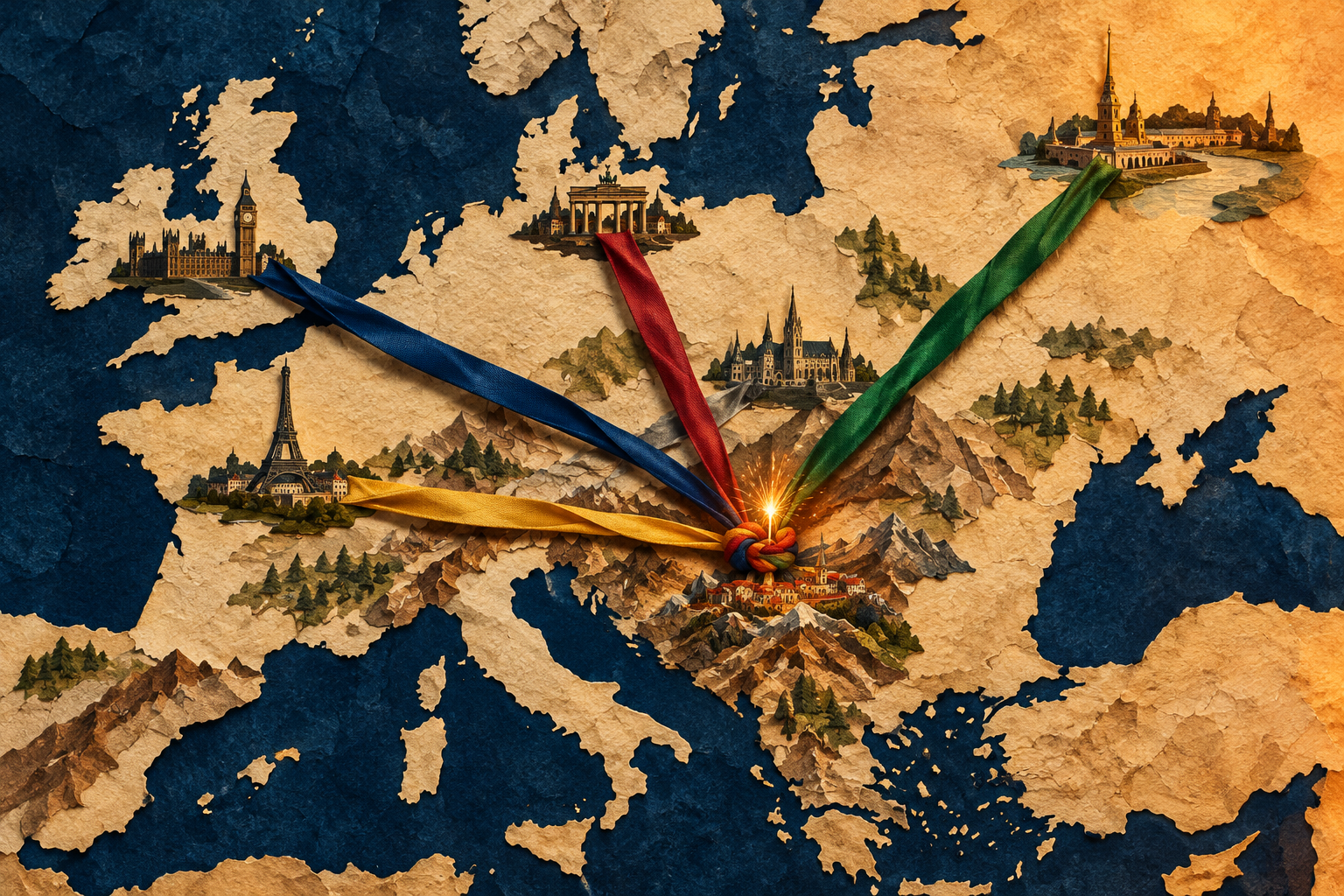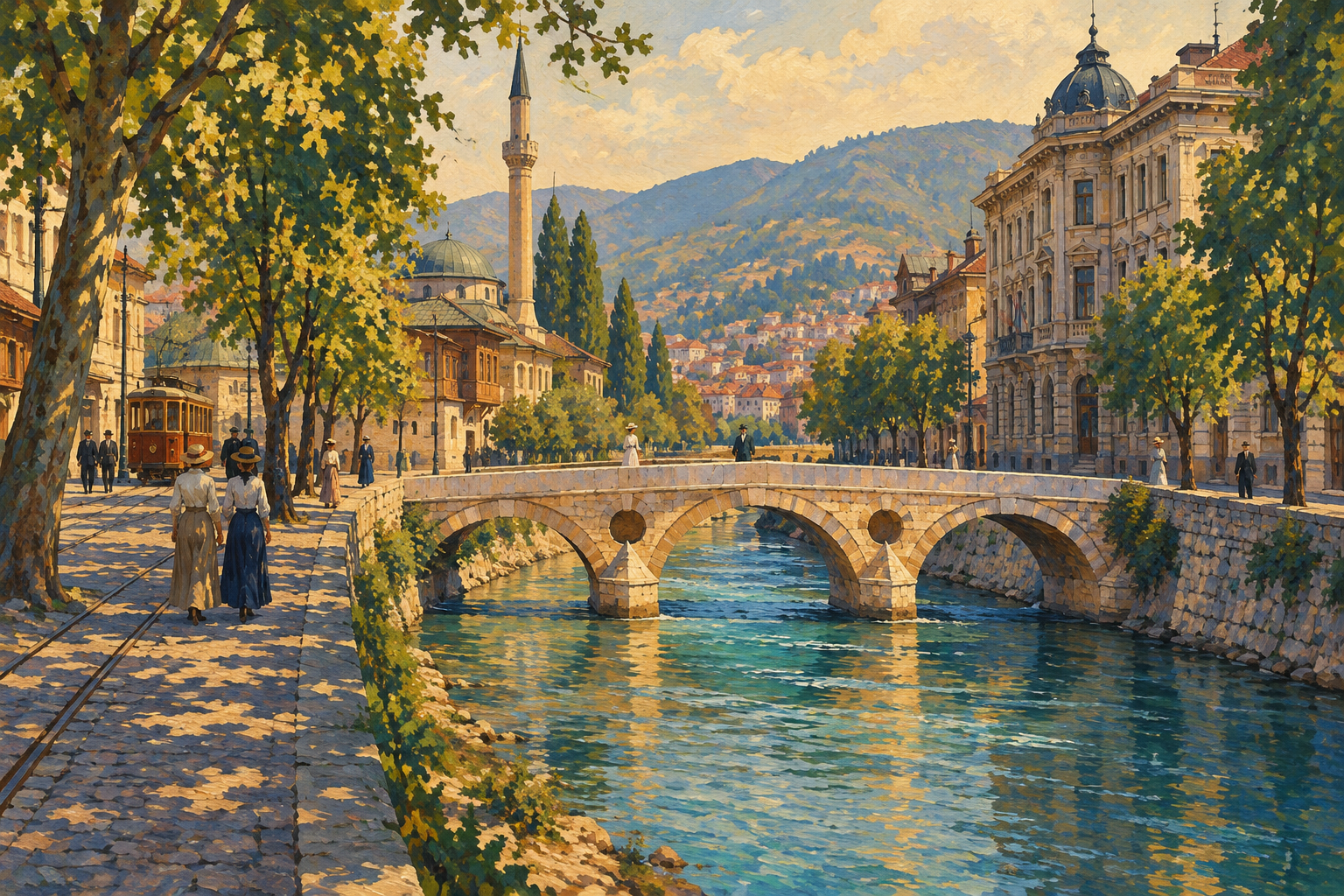
How did WWI start? The spark was the murder of Archduke Franz Ferdinand and his wife in Sarajevo on 28 June 1914. What turned that murder into a European war was the July Crisis, a month of ultimatums, mobilisations and declarations that pulled most of the great powers in by early August.
This article belongs to our topic on World War I (1914–1918): Causes, Course and Consequences, so read that hub for the wider story.
In five minutes
Austria-Hungary declared war on Serbia after the Sarajevo murders, but the alliances and military timetables of the other powers turned a regional quarrel into a European war within about a week. By 4 August, Germany was at war with Russia and France, and Britain had declared war on Germany.
Causes: a tense, armed Europe
In 1914 Europe was split into two loose camps. Germany and Austria-Hungary were allies, and so were France and Russia. Britain had friendly agreements with France and Russia but no formal alliance with either.
The Balkans were the most dangerous fault line. After the Balkan Wars of 1912 and 1913, Serbia had grown in size and confidence. Austria-Hungary ruled many South Slav subjects and feared that Serbian nationalism would stir unrest inside its own borders.
Secret networks added to the danger. The young men who carried out the Sarajevo attack had received bombs, pistols and training from a secret group, the Black Hand, whose members included officers in the Serbian army. Vienna came to see the Serbian government as responsible for the plot.
Militarism made the situation worse. Armies had detailed mobilisation timetables, and Germany’s war plan, the Schlieffen Plan, depended on a fast strike through neutral Belgium to defeat France before turning east against Russia. Once one power began mobilising, the others felt they had to follow, because waiting could mean losing the race.
How did WWI start? The July Crisis, day by day
28 June. Gavrilo Princip, a young Bosnian Serb nationalist, shot Franz Ferdinand and his wife Sophie in Sarajevo. An earlier bomb attack that morning had failed. After the couple visited the wounded in hospital, the car’s driver took a wrong turn and stopped close to Princip, who was standing nearby.
Early July. Vienna believed the Serbian government was behind the plot and sought Berlin’s view. Kaiser Wilhelm II gave Austria-Hungary what became known as the “blank cheque”, a promise of German support whatever Vienna chose to do.
23 July. Austria-Hungary sent Serbia an ultimatum with ten demands and a 48-hour deadline. One demand would have let Austrian officials take part in the investigation on Serbian soil. The terms were written so that Serbia would find them hard to accept.
25 July. Serbia accepted most of the demands but rejected the one on Austrian officials. Vienna called the reply inadequate and broke off diplomatic relations. The same day, Russia began preparing its army for mobilisation against Austria-Hungary.
26 July. Britain’s foreign secretary, Sir Edward Grey, proposed a conference of Britain, France, Germany and Italy to calm the crisis. Germany refused.
28 July. Austria-Hungary declared war on Serbia. Belgrade was shelled the next day.
30–31 July. Russia ordered general mobilisation, which meant preparing for war on every front, including against Germany. Germany gave Russia an ultimatum to stop. On 31 July, the French socialist leader Jean Jaurès, who had campaigned against war, was assassinated in Paris.
1–4 August. Germany declared war on Russia on 1 August and on France on 3 August. On 4 August, German troops entered Belgium. Britain had pledged to defend Belgian neutrality under a treaty of 1839, and it declared war on Germany that same day.
6 August. Austria-Hungary declared war on Russia. By then most of the great powers were fighting. Italy stayed out at first and joined the Allies in 1915.
Consequences: from one crisis to a world war
Within weeks, a regional dispute in the Balkans had become a war across Europe, and later reached the Middle East, Africa and Asia. On the Western Front the fighting settled into trench warfare, and the conflict lasted until November 1918.
It was also a total war, in which national industry and the mobilisation of whole societies decided how long armies could keep fighting. Estimates put military deaths at roughly 9 to 10 million, and civilians suffered heavily from hunger, disease and occupation.
The war also brought down the empires that fought in it. The Russian Empire fell in the revolutions of 1917, the German and Austro-Hungarian empires were dismantled in 1918, and the Ottoman Empire ended in 1922.
The July Crisis showed how quickly diplomacy could stop working once mobilisations and declarations began to chase each other.
Why the crisis moved so fast
Three pressures explain why a single month was enough to reach war. The first was mobilisation. Moving an army needed railways, supplies and timetables, and once it started it was hard to stop. Mobilising was also easy for a rival to read as preparation for war.
The second was time. Vienna’s ultimatum gave Serbia 48 hours, which left little room for talks. Britain’s conference idea died when Germany refused to take part.
The third was political pressure. Leaders feared looking weak in front of their own publics and their rivals. The two emperors, Wilhelm II of Germany and Nicholas II of Russia, kept exchanging telegrams in late July, and those messages show that both men still hoped to avoid war. But military plans and the pace of events moved faster than their diplomacy.
Who was responsible?
Blaming one country for the whole war is too simple a reading of the July Crisis. Each capital made choices that seemed sensible to its leaders at the time. Together, they produced a war on a scale that none of the governments had expected.
Some decisions stand out. Vienna wrote an ultimatum that Serbia would find hard to accept, then declared war. Berlin’s blank cheque gave Austria-Hungary the confidence to act. Russia’s general mobilisation made a German war on two fronts more likely, and German planners answered by treating Russia’s move as a reason to attack France at once. France backed its Russian ally.
The clearest way to read the crisis is as a series of choices, each shaped by fear of what the other side would do next.
What exams ask
Exam questions on this topic can ask students to separate the trigger from the causes and to judge how far each factor mattered. The AP-style significance is that the July Crisis shows how alliances, mobilisation plans and nationalism could turn a local crisis into a global war within days. Useful angles include:
- Why a murder in one city led to a continental war when earlier Balkan crises had not.
- How alliances and mobilisation timetables narrowed the options open to leaders.
- Why the blank cheque mattered and what it changed in Vienna’s thinking.
- Why Britain went to war over Belgium, even though it was not a formal ally of France or Russia.
In written answers, set out the sequence of events first, then explain which decision was decisive and why.
Read next
- Gavrilo Princip: The Assassin of Sarajevo: the young man who fired the shots in Sarajevo, and why he was there.
- Why Were the Balkans the “Powder Keg of Europe”?: the regional rivalries that made the Balkans so dangerous before 1914.
- What Is Militarism? How It Led to WWI: how arms races and military planning narrowed the choices leaders had in 1914.