In five minutes
The Balkans earned the nickname “powder keg of Europe” because several empires, newly independent nations and rival great powers all met in one region. A dispute there could pull in powers far away, and in 1914 it did. This page explains why the label stuck. It is one part of our World War I guide.
What the label means
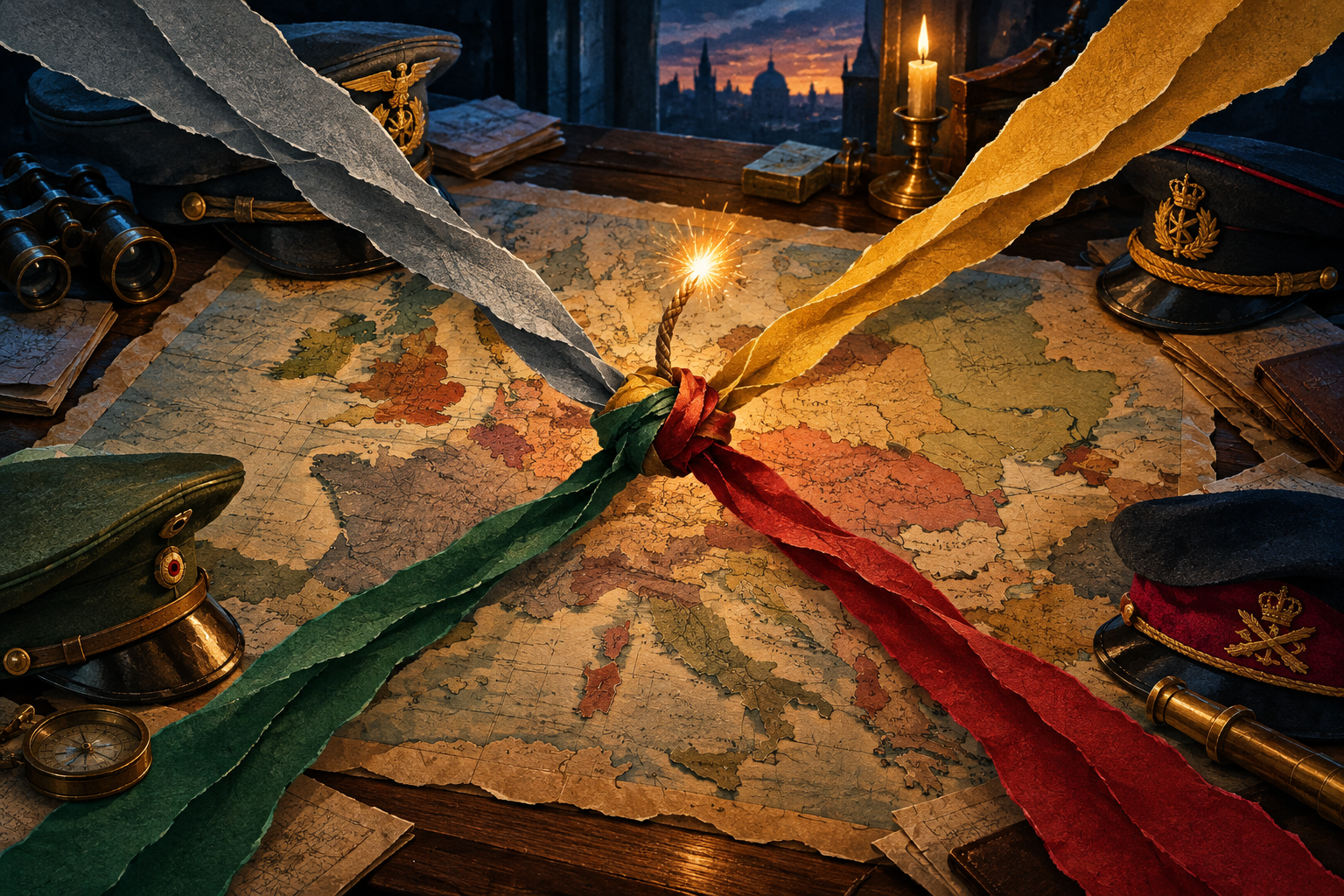
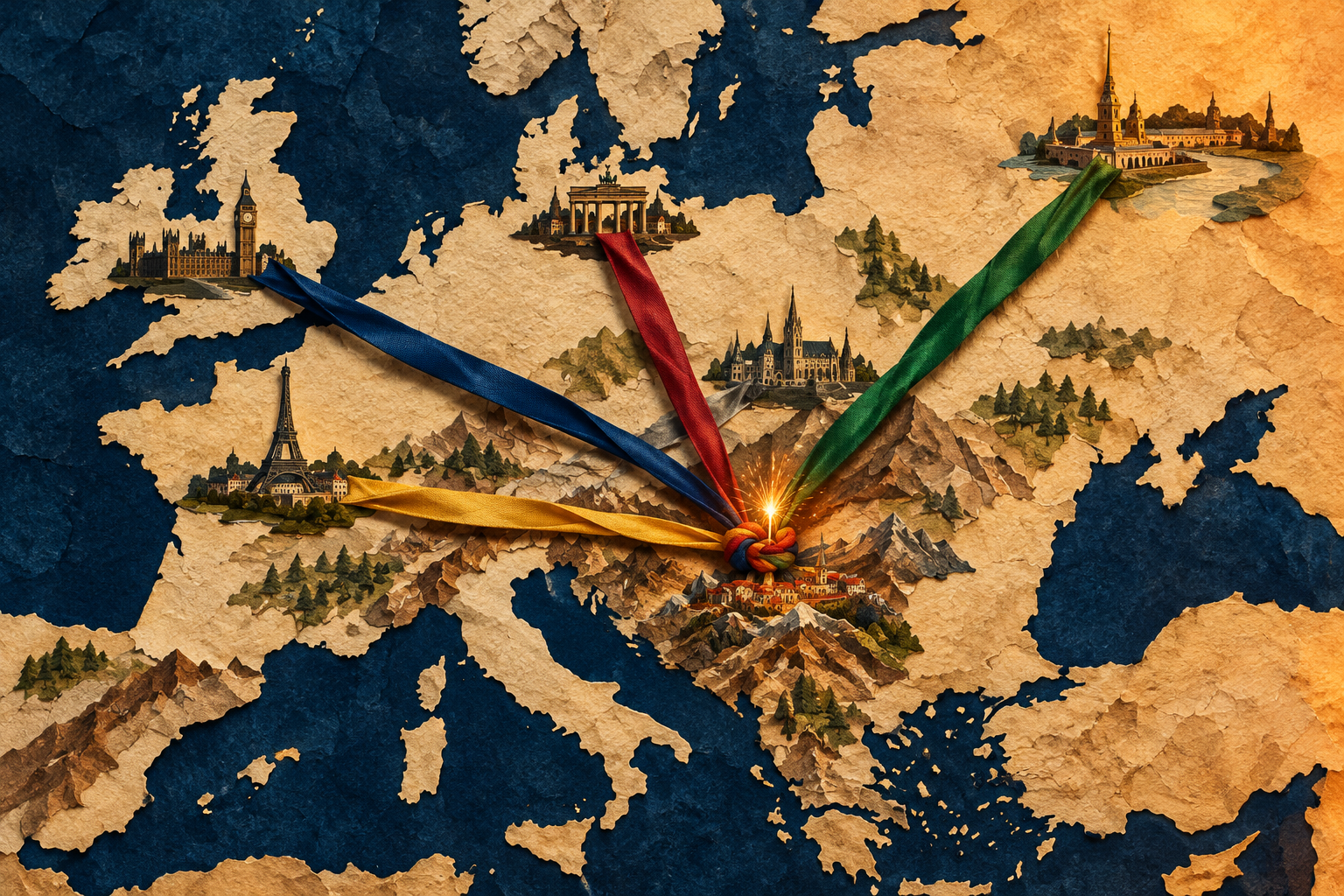
“Powder keg” is a metaphor rather than a diplomatic term. It describes a place where a small spark can cause a large explosion. In the Balkans, three things made the spark dangerous: many nationalities living side by side, the rivalry of the great powers, and alliances that promised to back them up.
Causes: why the Balkans became the powder keg of Europe
For centuries the Ottoman Empire ruled most of the Balkan Peninsula. During the 1800s, Greeks, Serbs, Bulgarians, Romanians and others won independence or self-rule, one by one. Each new state wanted land where its own people lived, and much of that land was still Ottoman or inside the empires of Austria-Hungary and Russia.
Religion and language added another layer. Orthodox Christians, Catholics and Muslims often lived in the same towns, and the peoples did not share one language or one church. Nationality, faith and local memory did not always line up, so a dispute over one village could quickly become a dispute over a whole province.
The Ottoman government still held nominal power, but it could no longer defend every province, and local rebels and outside powers filled the gaps. Austria-Hungary and Russia both wanted influence. Russia saw itself as a protector of Orthodox Slavs, while Austria-Hungary feared a strong Slav state on its southern border. Germany backed Austria-Hungary, and Britain and France were tied to Russia through the Triple Entente.
1878: the Congress of Berlin
After a war between Russia and the Ottomans, the Congress of Berlin reshaped the region in June and July 1878. It recognized the independence of Romania, Serbia and Montenegro. Austria-Hungary received the right to administer Bosnia and Herzegovina, which remained formally Ottoman. The result was a province run by one empire but still nominally tied to another, and that gap became the seed of the 1908 crisis.
1908: the annexation
In October 1908 Austria-Hungary formally annexed Bosnia and Herzegovina. The timing is often linked to the Young Turk Revolution of July 1908, which restored the Ottoman constitution and made the empire look more active. Russia asked for an international conference to discuss the change, but the idea went nowhere.
Serbia reacted most strongly. Many Serbs lived in Bosnia, and Serbian leaders hoped to unite the South Slavs. Russia backed Serbia diplomatically but was not ready for war, and Germany stood firmly behind Vienna. In March 1909 Serbia accepted the annexation. The humiliation fed Serbian nationalism and encouraged secret groups that wanted to fight Austria-Hungary.
1912–1913: the two Balkan Wars
In October 1912 Serbia, Bulgaria, Greece and Montenegro formed the Balkan League and attacked the Ottoman Empire. The First Balkan War ended most Ottoman rule in Europe. In November 1912 Albania declared independence, a move supported by Austria-Hungary and Italy, which blocked Serbia’s route to the Adriatic Sea. The League had formed partly because each member wanted its share of the Ottoman lands before the others could take it.
The allies then quarrelled over the spoils. The Treaty of London in May 1913 ended the First Balkan War, but Bulgaria felt it had been shortchanged. In late June 1913 Bulgaria attacked its former allies, Serbia and Greece, and Romania and the Ottoman Empire joined the fighting. Ottoman forces also retook Edirne (Adrianople) in July. The Treaty of Bucharest, signed on 10 August 1913, gave Serbia and Greece much of Macedonia.
The wars also created large numbers of refugees and left deep bitterness on all sides. Serbia came out much larger, and Austria-Hungary saw a stronger Serbia as a direct threat. For Vienna, the question was no longer only Bosnia but the whole balance of power in the Balkans.
June 1914: the spark in Sarajevo
On 28 June 1914, in Sarajevo, Gavrilo Princip, a young Bosnian Serb nationalist linked to a Serbian secret group, shot Archduke Franz Ferdinand, heir to the Austro-Hungarian throne, and his wife Sophie. Germany had already promised Austria-Hungary its full support in early July, a pledge often called the “blank cheque.” Vienna blamed the Serbian government and sent an ultimatum on 23 July.
Serbia accepted most of the demands but not all of them, and Austria-Hungary declared war on Serbia on 28 July. Russia began mobilizing to protect Serbia. Germany declared war on Russia on 1 August and on France on 3 August. Britain entered the war on 4 August after Germany invaded Belgium. Within five weeks of the shooting in Sarajevo, a regional crisis had become a general European war.
The alliances turned a local quarrel into a continental war. Each great power felt bound to support its partner, so one dispute pulled in the whole continent. That is what “powder keg” means here: a small spark, set off in a region where the rivals were already watching for an opening.
Consequences
By 1918 the Russian, German and Austro-Hungarian empires had collapsed, and the Ottoman Empire had shrunk sharply. In the Balkans, new states appeared, including the Kingdom of Serbs, Croats and Slovenes, which was renamed Yugoslavia in 1929. Borders drawn after the war left many groups on the wrong side of the line, and the region stayed a source of conflict through the twentieth century.
The phrase has lasted longer than the events themselves, because it describes a pattern. Each step looked limited when it happened, yet each one made the next crisis more likely. That is the story the label tells.
What exams ask
Exam questions usually connect the Balkans to the wider causes of the war, and the key idea is significance. Four points come up most often:
- Nationalism: Balkan peoples wanted their own states, and their claims often overlapped.
- Imperial rivalry: Austria-Hungary and Russia competed for influence as Ottoman power declined.
- Alliance systems: the Triple Alliance and the Triple Entente turned a regional crisis into a continental one.
- Mobilization plans: once armies began to mobilize, diplomacy had less room to work.
When you write an answer, a clear order helps. Start with the Balkan problems, move to the Ottoman decline and the rivalry of the great powers, and finish by showing how alliances turned a regional crisis into a continental war. Keep the dates straight: 1908 for the annexation, 1912–1913 for the Balkan Wars, and June 1914 for Sarajevo.
Read next
These pages show the next steps in the story:
- How Did WWI Start? The July Crisis of 1914 follows the weeks between the Sarajevo murder and the outbreak of war.
- Where Are the Balkans? Map and Countries explains which countries make up the region.
- What Is Militarism? How It Led to WWI shows how armies and war plans shaped decisions in 1914.