In five minutes
Need the Opium War date for a test? This page links four Chinese events from 1839 to 1912: the Opium War, the Taiping Rebellion, the Boxer Uprising and the 1911 Revolution. The key years are 1840, 1851, 1900 and 1911, and each one belongs to the same story: a dynasty losing its power over several decades. A date mnemonic is a short, sound-based phrase that helps you recall a year, and this page shows how to build one. For the wider context, see our modern world history study guide.
The four events are not separate stories. Each one left the Qing government weaker, poorer or more dependent on foreign powers than before. Learning the chain makes each date easier to keep, because a date attached to a cause and a result is far harder to forget than a bare number.
The Opium War: 1839 to 1842
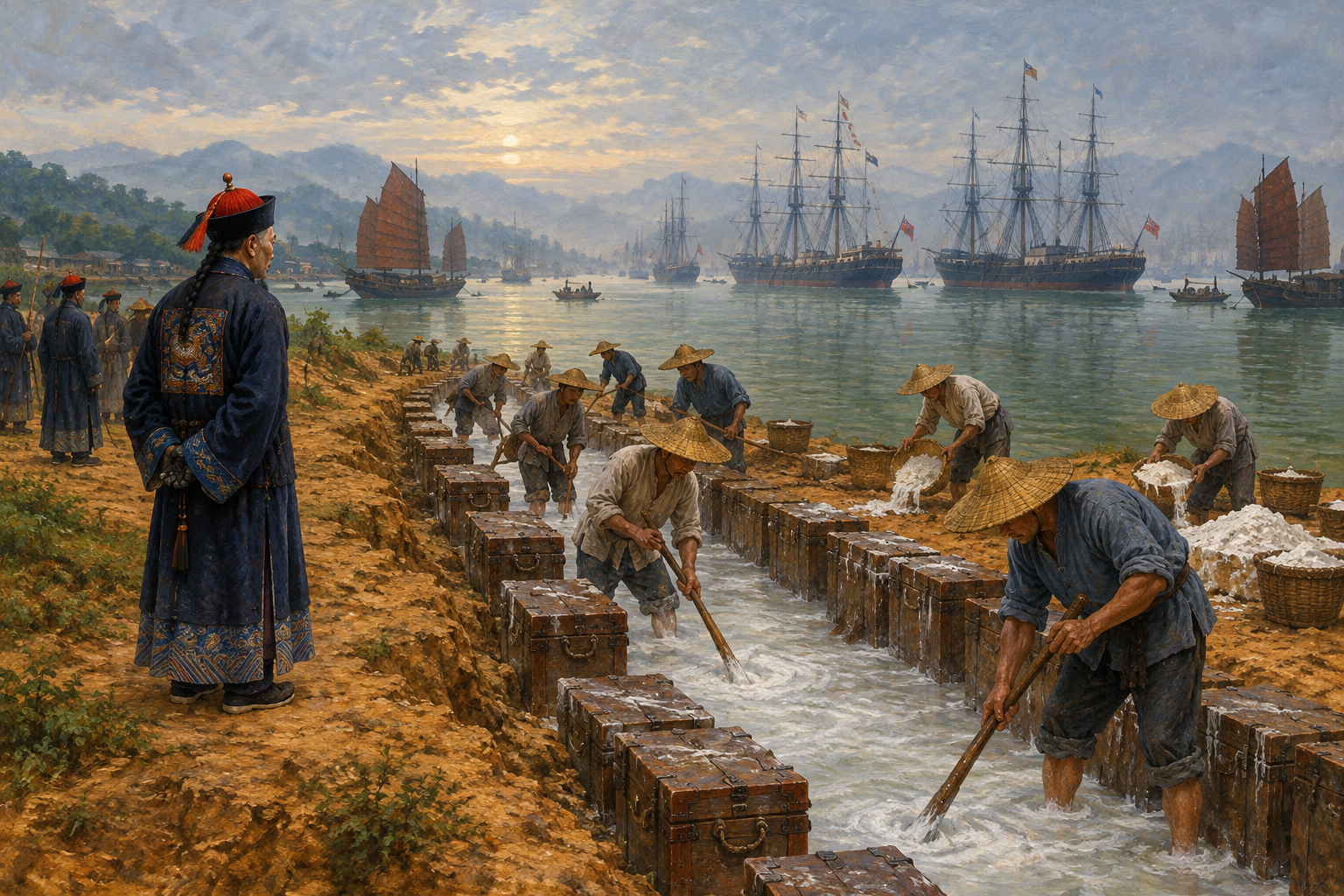
Trade between China and Britain was lopsided. Britain bought large amounts of Chinese tea and silk, and British merchants paid partly by selling opium into China. As opium use spread and silver flowed out, the Qing government tried to stop the trade. In 1839 the imperial commissioner Lin Zexu had the opium stored near Guangzhou (Canton) destroyed.
The trade was more than an economic dispute. Opium use spread through many parts of the empire, and officials worried about addiction among soldiers and ordinary families alike. The government had banned the drug for over a century, yet smuggling continued because the profits were so large. Lin Zexu's action was an attempt to end the trade by enforcing the law, and it set the stage for the conflict that followed.
Britain answered with a naval war that began in 1840. The Qing lost, and the Treaty of Nanjing was signed on 29 August 1842. China ceded Hong Kong Island to Britain, opened five treaty ports (Guangzhou, Xiamen, Fuzhou, Ningbo and Shanghai) and agreed to pay about 21 million dollars. Historians often call this kind of agreement an unequal treaty: it fixed China's tariffs and paved the way for foreigners to be judged in their own courts, a right set out more fully in an 1843 supplementary treaty.
The treaty set a pattern. Later agreements with other Western powers followed similar terms. For a student, the key point is that the settlement changed trade and legal rights, not just the map.
For exams, keep two dates: 1840, when the war began, and 1842, when the treaty ended it. The war is also known as the First Opium War.
The Taiping Rebellion: 1851 and the Qing's weakening
While the Qing were still absorbing the defeat, Hong Xiuquan, who was born in Guangdong, built a religious movement in Guangxi, the God Worshippers, around ideas he had drawn from Christian texts. In 1850 his followers rose in Jintian village in Guangxi. In early 1851 they proclaimed the Taiping Heavenly Kingdom, so 1851 is the date to remember for this event.
The Taiping took Nanjing in 1853 and made it their capital, which they renamed Tianjing. They never controlled the whole country, and internal disputes weakened them. Qing forces retook Nanjing in July 1864, and the Taiping state collapsed. The rebellion lasted more than a decade and caused enormous suffering, with millions of deaths by most estimates. For exams, the scale of the disaster matters more than any single figure.
The Qing relied on regional armies raised by provincial leaders to fight the rebels. That shift gave local power holders more influence, and it left its mark on Qing politics afterwards.
The Boxer Uprising: 1900 and the Boxer Protocol
The Boxer Uprising grew in Shandong from 1899. Its fighters opposed foreign influence and Christian missions, and they attacked missionaries and Chinese Christians. In 1900 the movement reached Beijing. The foreign legations there came under siege, and in June the Qing court declared war on the foreign powers.
In August, an Eight-Nation Alliance of troops from Britain, the United States, France, Germany, Russia, Japan, Italy and Austria-Hungary entered Beijing and ended the siege. The Boxer Protocol, signed in September 1901, required China to pay a large indemnity over many years and allowed foreign troops to be stationed in key places, including Beijing. Remember 1900 for the uprising and 1901 for the settlement.
The 1911 Revolution: from Wuchang to the Republic
The immediate trigger was a dispute over railways. In May 1911 the Qing government announced that major railway lines built with private money would come under state control. Investors and local elites, especially in Sichuan, protested. The government's response in Sichuan made it look weak, and within months the anger had helped set off the Wuchang uprising.
On 10 October 1911, an uprising in Wuchang, in central China, began a wave of declarations of independence in other provinces, and the Qing could not contain it. On 1 January 1912, delegates in Nanjing founded the Republic of China and chose Sun Yat-sen as provisional president. In February 1912 the young emperor Puyi abdicated, ending imperial rule. Yuan Shikai, a powerful general, then took over as provisional president.
The revolution is called Xinhai, after the name of the year 1911 in the traditional cycle of years.
How the four events connect
Looking at the chain helps place each year:
- 1840 to 1842: a defeat by Britain exposes the Qing's weakness and opens treaty ports.
- 1851 to 1864: a rebellion spreads across the south and centre, and the Qing rely on regional armies.
- 1900 to 1901: a violent uprising brings foreign troops to Beijing and a heavy settlement.
- 1911 to 1912: an uprising in Wuchang leads to the end of the Qing and the founding of the republic.
Each event also changed who held real power. After 1842, foreign merchants gained access to new ports. After 1864, regional armies had a larger voice in Qing affairs. After 1901, the indemnity and foreign troops limited what the court could do. After 1912, the imperial court no longer ruled at all.
What exams ask
Date questions usually take one of two forms: put events in order, or match a cause with its effect. Expect questions such as which treaty opened Shanghai, what the Boxer Protocol required, or why the Qing lost control after 1911. A strong answer names the event, the year and the result in one sentence. For AP-style essays, the key skill is continuity and change: show how each event changed what the Qing could still do, not just what happened.
Read each question closely. Does it ask for the year a war began, the year it ended, or the year of its result? Many wrong answers come from choosing a neighbouring year that belongs to a related event, such as 1901 when the question is about the uprising of 1900.
How to build your own date mnemonic
Japanese students call a date mnemonic a goroawase. The method works in any language: turn the digits into sounds, then join those sounds into a short phrase linked to the event.
- Split the year into its digits. For 1840, that is 1, 8, 4 and 0.
- Pick a word for each digit that sounds like it. In Japanese, the common readings are useful: 1 can be いち or い, and 4 can be し or よ.
- Join the words into a short phrase that also says something about the event.
- Test yourself: say the event, then recall the year.
A well-known example is 「いい国つくろう鎌倉幕府」 for 1192, which reads as a natural sentence: 'let's build a good country, the Kamakura shogunate'. The phrase is easy to recall because it sounds natural. Keep your own mnemonics short: if a phrase is harder to remember than the date, it has failed.
A good mnemonic is personal. Two learners can build different phrases for the same year, and both can work as long as the phrase is clear to the person who wrote it. Write the phrase on a card, test yourself the next day and again a week later. Repeated recall tends to work better than one long study session.
Read next
- Date Mnemonics: Industrial Revolution and 19th-Century Europe compares the same decades in Europe.
- Date Mnemonics: India and Imperialism shows how empire reached South Asia in the same era.
- The 19th Century: World Events Timeline (1801–1900) places these years in a global sequence.