In five minutes
The Treaty of Nanking was signed on 29 August 1842 and ended the First Opium War between Britain and China's Qing dynasty. Britain gained Hong Kong Island, five Chinese ports opened to British trade, and China agreed to pay 21 million silver dollars. It is widely seen as the first of China's so-called unequal treaties with a Western power, and its effects shaped Chinese foreign relations for the next hundred years.
The treaty is part of our Qing China, Japan and the West (1793–1912) series, and it is a good starting point for anyone new to that period. This guide follows the story in order: why the war began, how the fighting ended in a treaty signed on a warship, what the terms said, and what followed. If you only have a few minutes, the key facts box and the list of terms cover the essentials.
Why the war started
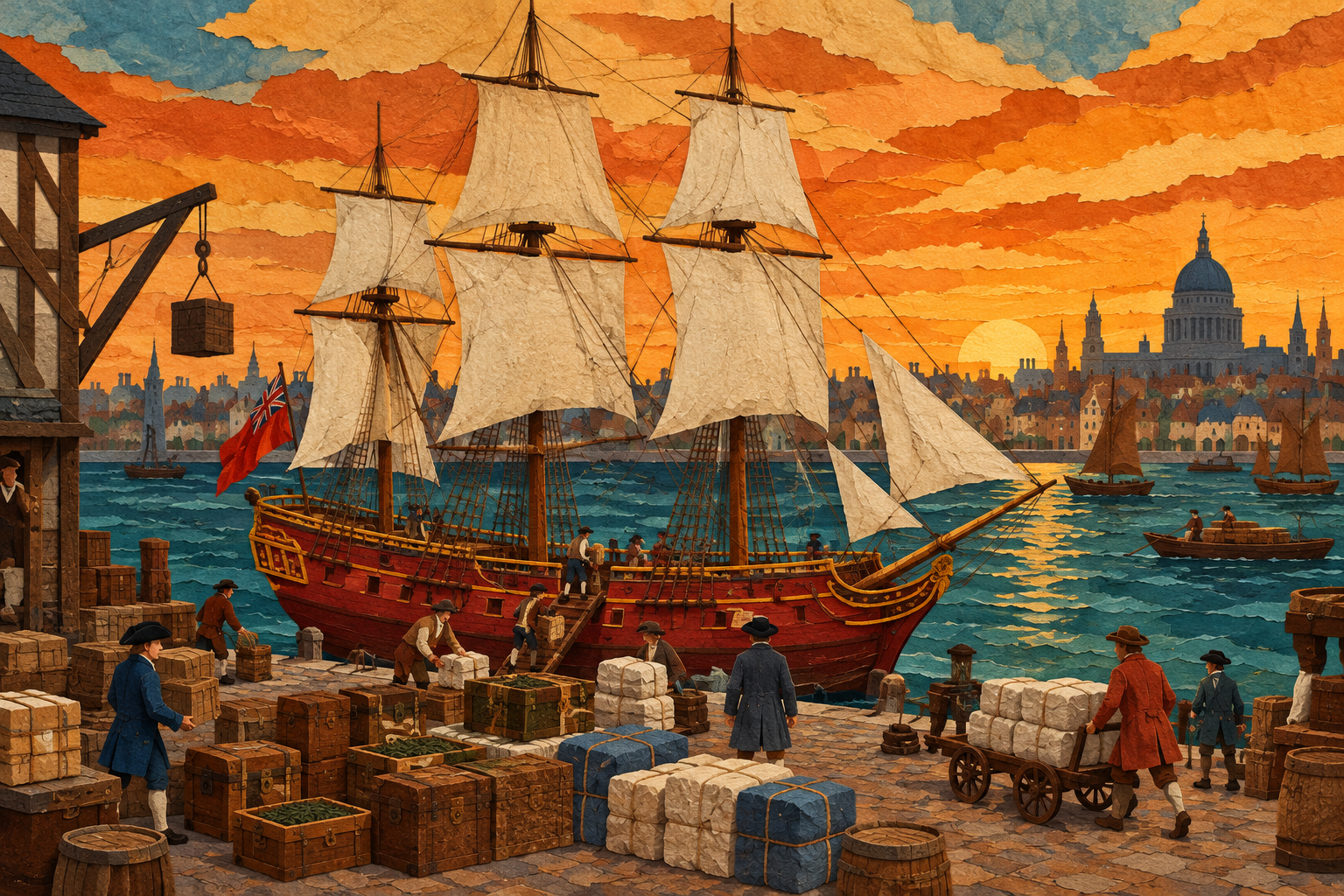
The conflict grew out of trade. Britain bought large quantities of Chinese tea, silk and porcelain, but China wanted few British goods in return, so most of the payment was made in silver. Foreign merchants were largely confined to the Thirteen Factories, a small district of Canton, and their dealings ran through a group of licensed Chinese merchants known as the Cohong. Foreign traders had little room to deal freely with buyers.
Opium grown in British India changed that balance. It was sold illegally in China, and the money paid for it flowed out of the country as silver. Silver shortages and the spread of addiction became serious problems for the Qing government, which banned the drug. In 1839 the imperial commissioner Lin Zexu arrived at Canton, demanded that foreign merchants hand over their opium and had it destroyed at Humen, mixing it with salt and lime.
Britain saw the destruction as an attack on its merchants and their property. London demanded compensation and secure trade, and sent warships. The First Opium War began that year, and the early fighting took place mostly at sea and along the coast of South China.
From war to treaty
British forces won one engagement after another. In January 1841 the two sides' representatives reached a preliminary arrangement, and British forces took Hong Kong Island. Neither government accepted the arrangement, so the fighting went on. In 1842 the war moved north along the coast and up the Yangtze River, where British ships could reach far inland.
On 21 July 1842 British forces took Zhenjiang, where the Grand Canal meets the Yangtze. The canal carried grain north to Beijing, the capital, and losing control of that route put the Qing court under heavy pressure. British demands included the cession of Hong Kong Island, the opening of ports and a large indemnity, and the Qing negotiators had to decide how far they could give way. Negotiation became the more realistic path than continued war.
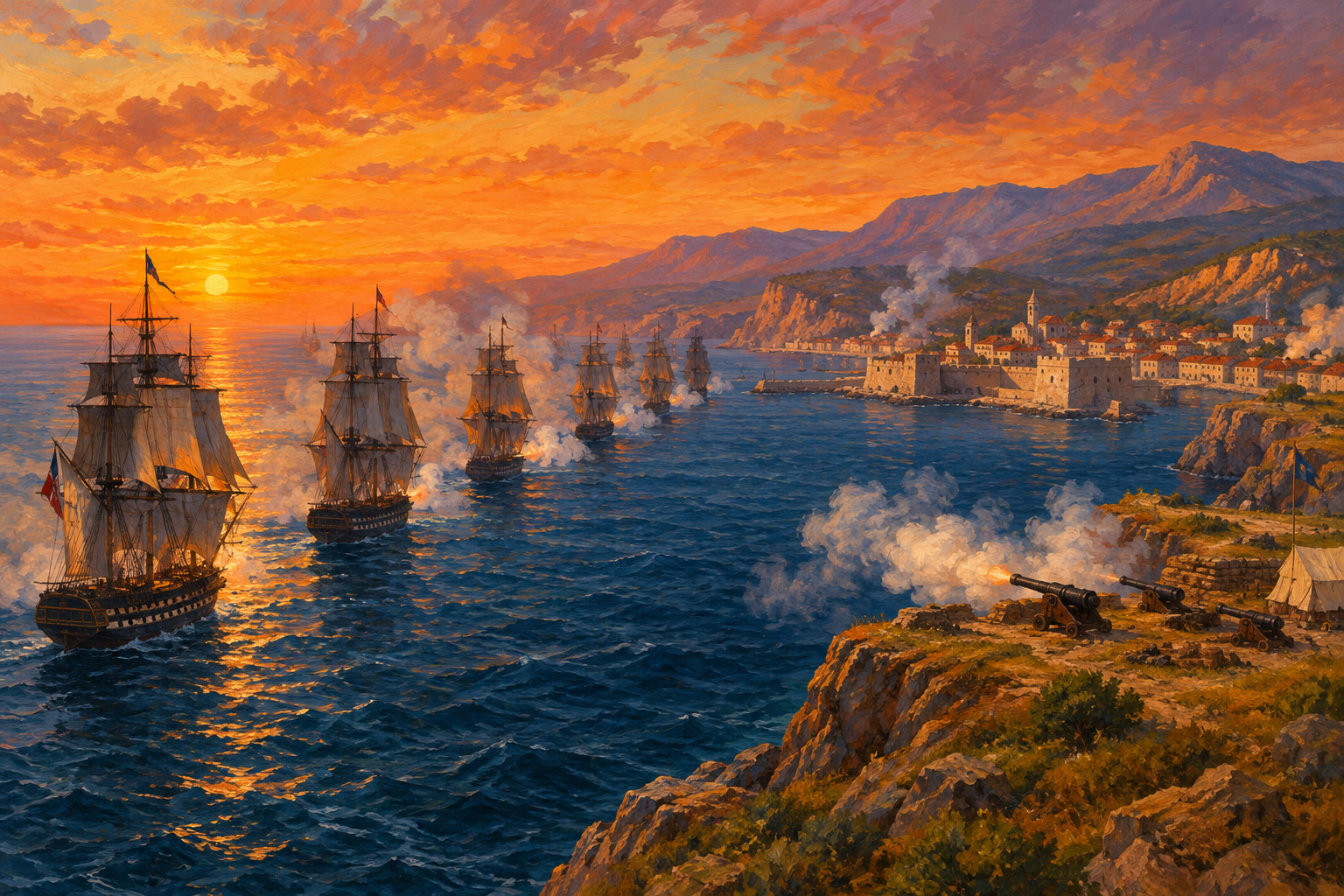
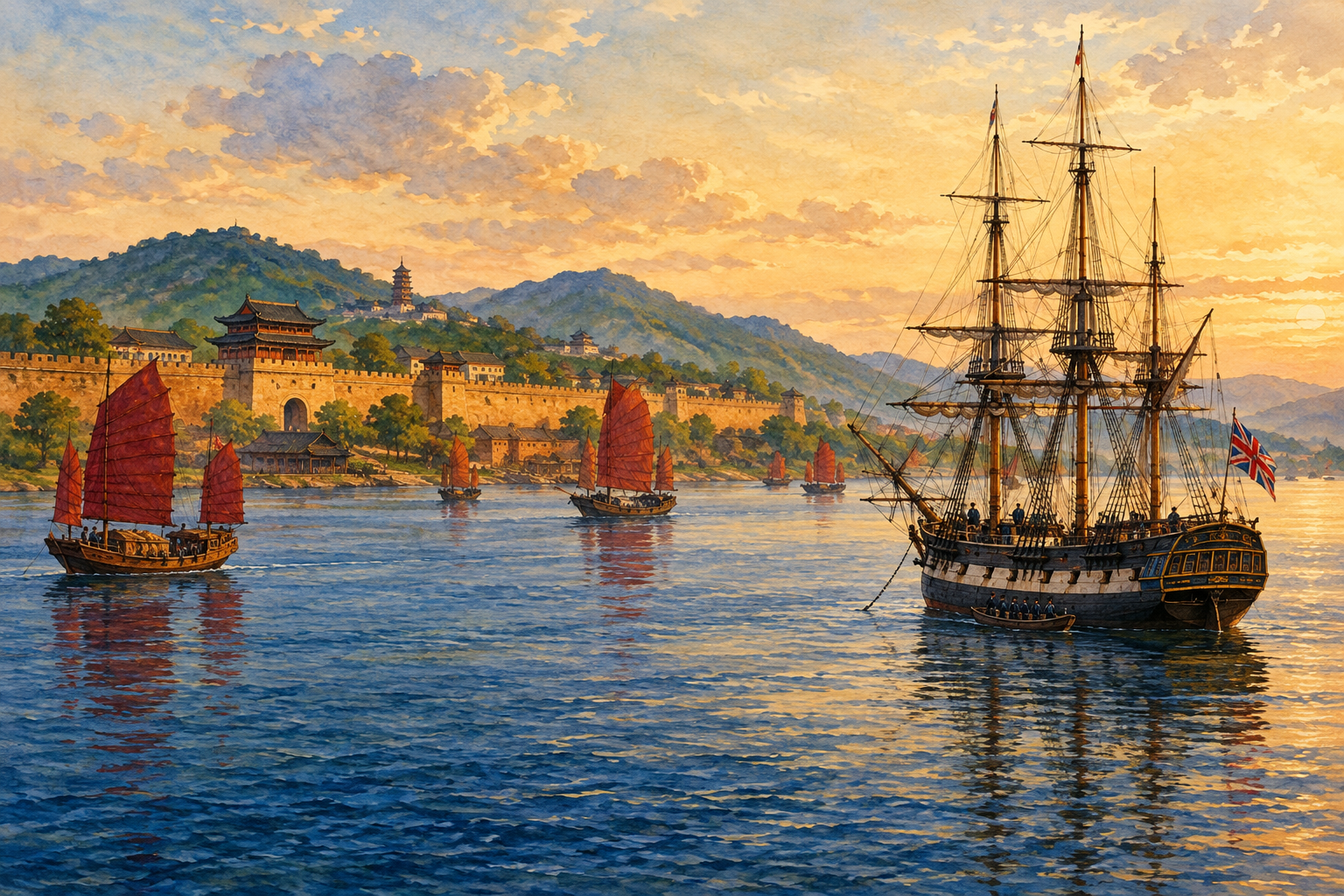
The treaty was signed on 29 August 1842 aboard HMS Cornwallis, a British warship anchored on the Yangtze off Nanjing, which the British called Nanking. Henry Pottinger led the British side. Qiying, Yilibu and Niu Jian represented the Qing court. The talks took place under the pressure of British warships near the city, and the document has thirteen articles.
Ratification took a few months more. The Daoguang Emperor ratified the treaty on 27 October 1842, and Queen Victoria ratified it on 28 December 1842. The two sides exchanged ratifications in Hong Kong on 26 June 1843, and that is the date the treaty took effect.
What the treaty said
The treaty is short, but each clause had a lasting effect. The main terms were these:
- Hong Kong Island was ceded to Britain in perpetuity. The treaty gave the reason: British traders needed a harbour where they could repair their ships and keep stores.
- Five treaty ports opened to British trade and residence: Canton (Guangzhou), Amoy (Xiamen), Foochow (Fuzhou), Ningpo (Ningbo) and Shanghai. Britain could appoint consuls at each of them.
- The Cohong system at Canton was abolished, ending the monopoly that licensed merchants had held over foreign trade.
- Tariffs at the treaty ports were to be fixed by agreement between the two governments rather than set by China alone.
- An indemnity of 21 million silver dollars: 6 million for the opium surrendered, 3 million for debts that Chinese merchants owed to British merchants, and 12 million for the costs of the war. The sum was to be paid in instalments over three years.
Sources differ on the total. The three heads above add up to 21 million dollars, but some accounts add a separate 6 million for the ransom of Canton and give 27 million. Anyone quoting the figure should say which total they mean.
The treaty did not mention the opium trade itself. Opium was legalised only later, under the Treaty of Tianjin in 1858.
Hong Kong was a small island off Canton with a sheltered harbour. For Britain it offered a base that it could run directly, something the Canton trading arrangements had never allowed. That base is why many people today remember the treaty mainly for Hong Kong.
Two points stand out. First, the treaty turned foreign trade from a privilege granted at one port into a right set by written agreement. Second, the terms were set under military pressure, which is why historians read the document as the product of force rather than negotiation between equals.
Aftermath and why it matters
The treaty did not settle everything. In October 1843 a supplementary treaty signed at Humen, known to the British as the Treaty of the Bogue, added terms that critics later called the core of the unequal system. British subjects accused of crimes in China would be tried under British law, a principle known as extraterritoriality. Britain also gained most-favoured-nation status, so any concession China gave to another power would also apply to Britain.
In 1844 the United States and France signed similar treaties with the Qing. Hong Kong developed into a major trading and banking hub, and Shanghai grew rapidly as a foreign settlement until it became the largest of the five ports. In 1860 the Convention of Peking, which ended the Second Opium War, added part of the Kowloon peninsula to British territory.
Historians usually highlight four effects. The first is the change in trade. Foreign merchants could now live and trade in several cities, and the power of the Cohong fell. The second is the loss of control over tariffs and jurisdiction, which later treaties extended. The third is Hong Kong itself, a British colony that served as Britain's base for trade in East Asia for more than 150 years. The fourth is precedent. The 1843 and 1844 treaties repeated its pattern, so later negotiations started from its terms rather than from a blank page.
In China the treaty has long been remembered as the start of a period of humiliation. The loss of Hong Kong and the large indemnity became a symbol of national weakness, and school history lessons still give it a central place. Some historians also point out that the Qing court had little realistic option to keep fighting at that point, which helps explain why it accepted terms it disliked.
Japan watched these events closely. News of the Qing defeat alarmed the Tokugawa shogunate, which in 1842 eased its order to drive away foreign ships and allowed them to be supplied with water and fuel. Our article How the Opium War Changed Japan explains that link in more detail.
What exams ask
Exam questions usually focus on causes, terms and significance.
- Causes: the trade imbalance, opium smuggling and the outflow of silver, and Lin Zexu's destruction of the opium, which gave Britain its immediate reason for war.
- Terms: the cession of Hong Kong Island, the five ports, the end of the Cohong system and the 21 million silver dollar indemnity. Keep cession and opening separate in your answer, because they are different kinds of change.
- Significance: the treaty is the starting point of the unequal treaty system in China, and its tariff and jurisdiction terms were repeated in later agreements.
When a question asks why the treaty is called unequal, cover both sides. China accepted ports, an indemnity and an end to the Cohong, while Britain gained territory and the right to appoint consuls. Naming both sides usually gives a balanced answer.
For comparison questions, set the treaty beside the Treaty of Kanagawa of 1854, which opened Japanese ports to the United States. Both show how East Asian states were pressed to open their ports, but the Kanagawa treaty followed Commodore Perry's naval visit rather than a war in China.
Read next
- The First Opium War (1839–1842) covers the battles and diplomacy that led to the treaty.
- The Second Opium War (Arrow War, 1856–1860) shows how the unequal treaties were pushed further.
- How the Opium War Changed Japan explains why a war in China mattered in Edo-era Japan.