0% • 9 min left

What Is Impressionism?

October 30, 2026
Impressionism is a 19th-century French painting movement. Painters such as Claude Monet, Pierre-Auguste Renoir and Berthe Morisot worked outdoors, painted quick impressions of light and everyday Paris, and first showed together as a group in 1874, outside the official Salon.
What Is Impressionism?

Key facts

When
1860s to 1886; first group show in 1874
Where
Paris, France
Key people
Monet, Renoir, Degas, Morisot, Pissarro, Sisley, Cassatt
Key work
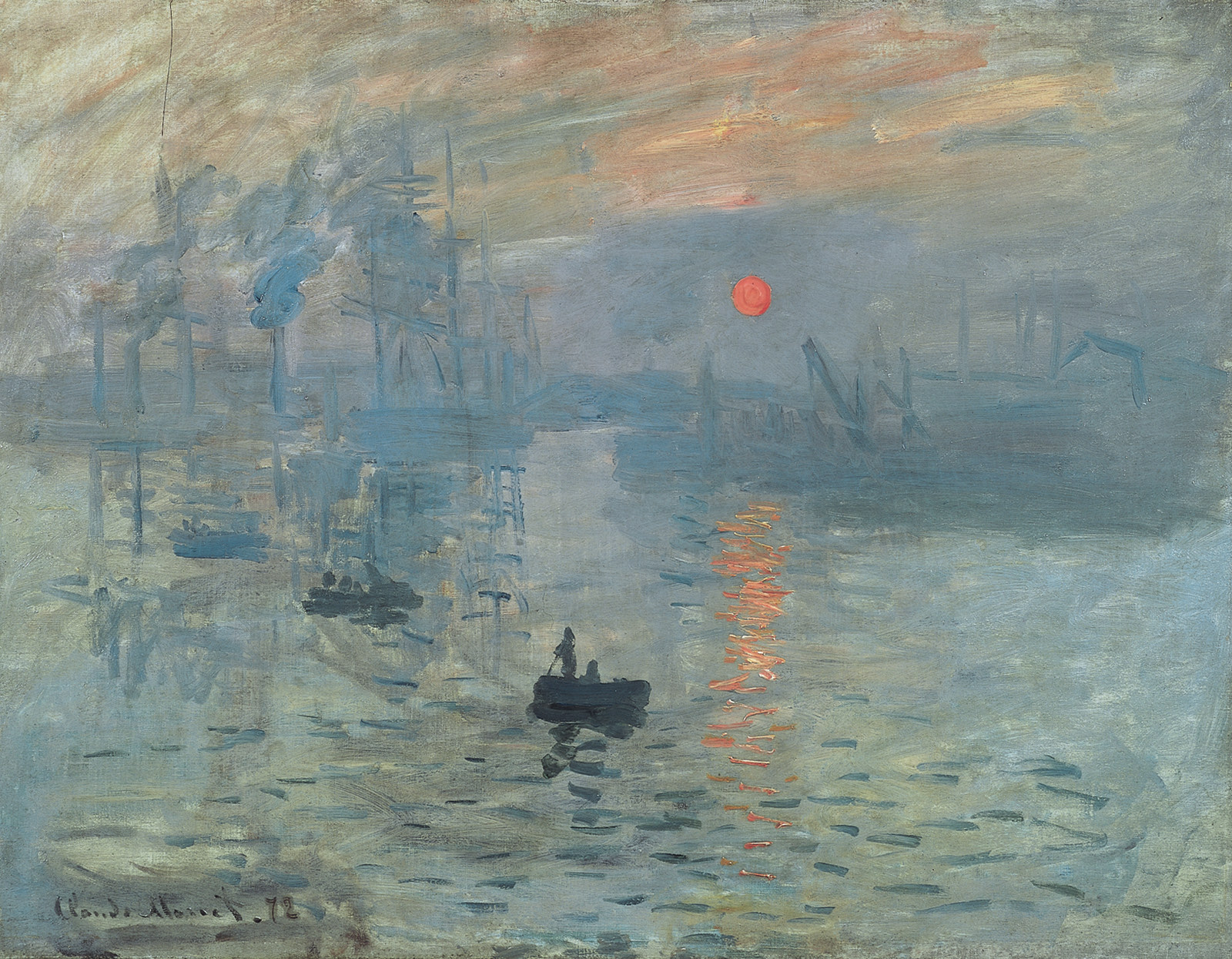
Monet, Impression, Sunrise (1872)
Name origin
A mocking review by Louis Leroy, 25 April 1874
Last group show
1886, eighth exhibition

Timeline

Tap a step for details. Arrow keys move between steps.

  1. 1856 (traditional date)

    Félix Bracquemond comes across the Hokusai Manga sketchbook

    According to a well-known account, the printmaker found a copy of Hokusai’s sketchbook at his printer’s workshop in Paris. The story is repeated often, but its details come from later retellings, so treat it as tradition rather than documented fact. It is usually given as the starting point of Japonisme in France.

  2. 1863, 15 May

    The Salon des Refusés opens in Paris

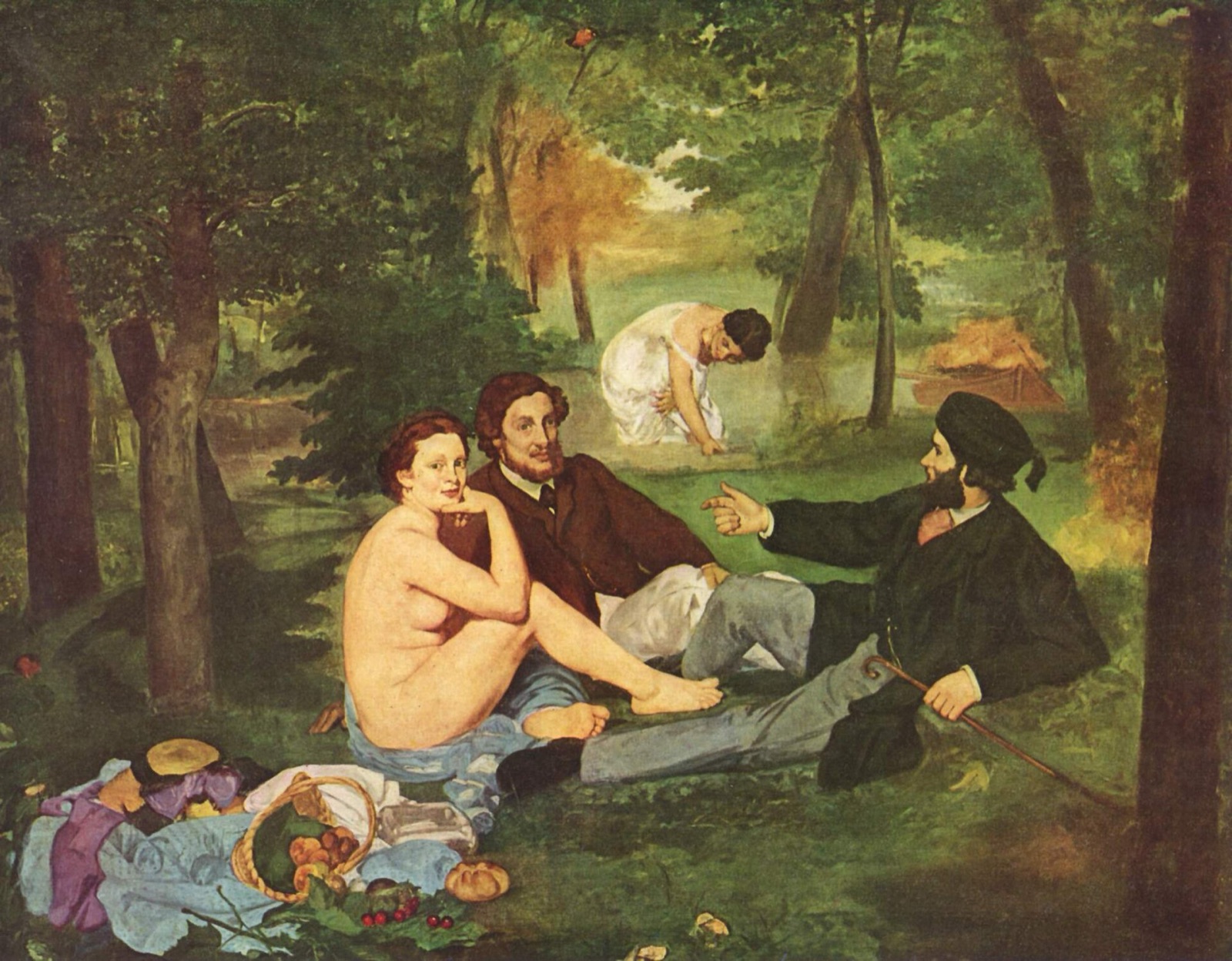
    Manet's picnic painting, rejected by the official Salon of 1863
    Édouard Manet, public domain, via Wikimedia Commons

    Napoleon III ordered a show of works the official Salon jury had rejected. Of more than 5,000 paintings submitted that year, about 2,200 were refused. Manet showed Le Déjeuner sur l'herbe under the title Le Bain, and it drew both laughter and outrage.

  3. 1870

    France goes to war with Prussia and the painters scatter

    The Franco-Prussian War began in July 1870, and Paris was under siege by the autumn. Monet reached London in mid-September, and Pissarro joined relatives in south London in December. Pissarro’s house at Louveciennes had been used as stables by Prussian troops.

    Also in 1870:More from 1870

  4. 1872

    Monet paints Impression, Sunrise at Le Havre

    The painting shows the port of Le Havre at dawn, with small boats in the mist and a low orange sun. Monet showed it at the 1874 exhibition, where Leroy’s mockery of its title gave the group its name.

  5. 1873, December

    The painters form a co-operative society of artists

    Monet, Renoir, Pissarro, Sisley, Cézanne, Morisot and Degas were among the members. The society aimed to show work without the official Salon jury and led directly to the 1874 exhibition.

  6. 1874, 15 April

    The first group exhibition opens at 35 boulevard des Capucines

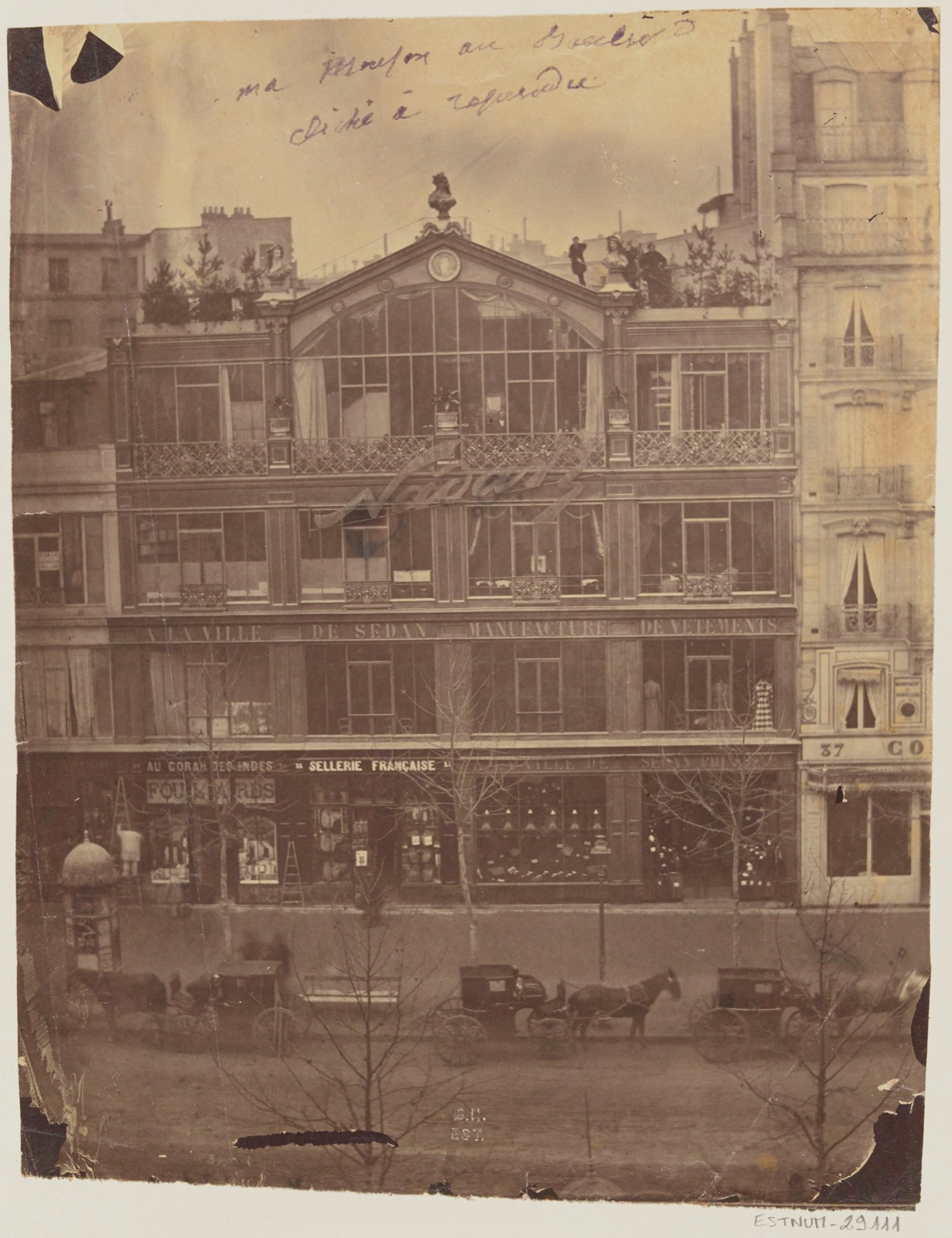
    Photograph of the facade of Nadar's studio at 35 boulevard des Capucines, Paris
    Nadar, public domain, via Wikimedia Commons

    It opens in the former studio of the photographer Nadar and runs until 15 May. About 30 artists take part, with roughly 165 works, though some counts are higher. The reaction in the press is mixed.

    Also in 1874:More from 1874

  7. 1874, 15 April to 15 May

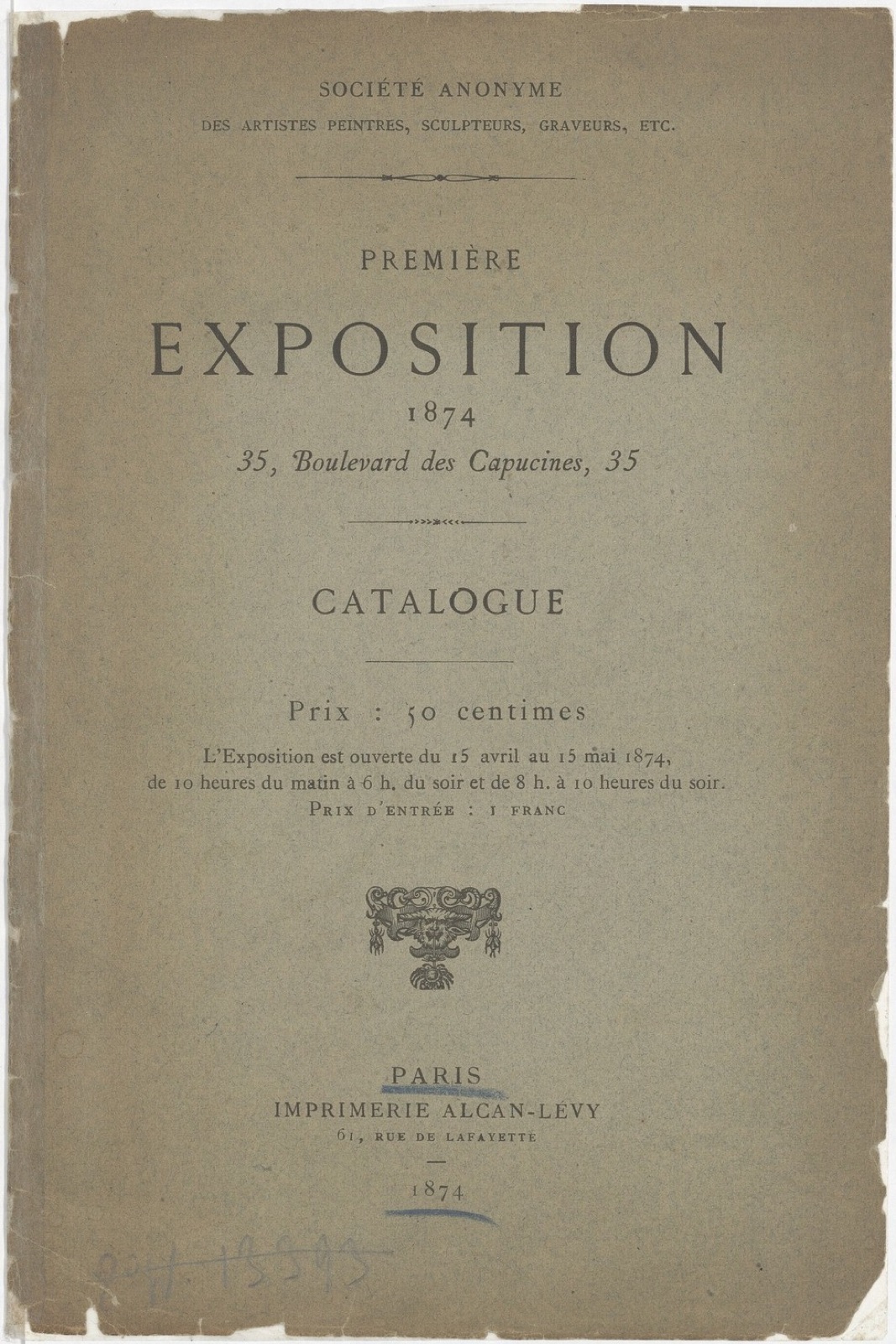
    A printed catalogue records the works on show

    Printed catalogue page for the first exhibition of the Société Anonyme at 35 boulevard des Capucines
    Imprimerie Alcan-Levy, public domain, via Wikimedia Commons

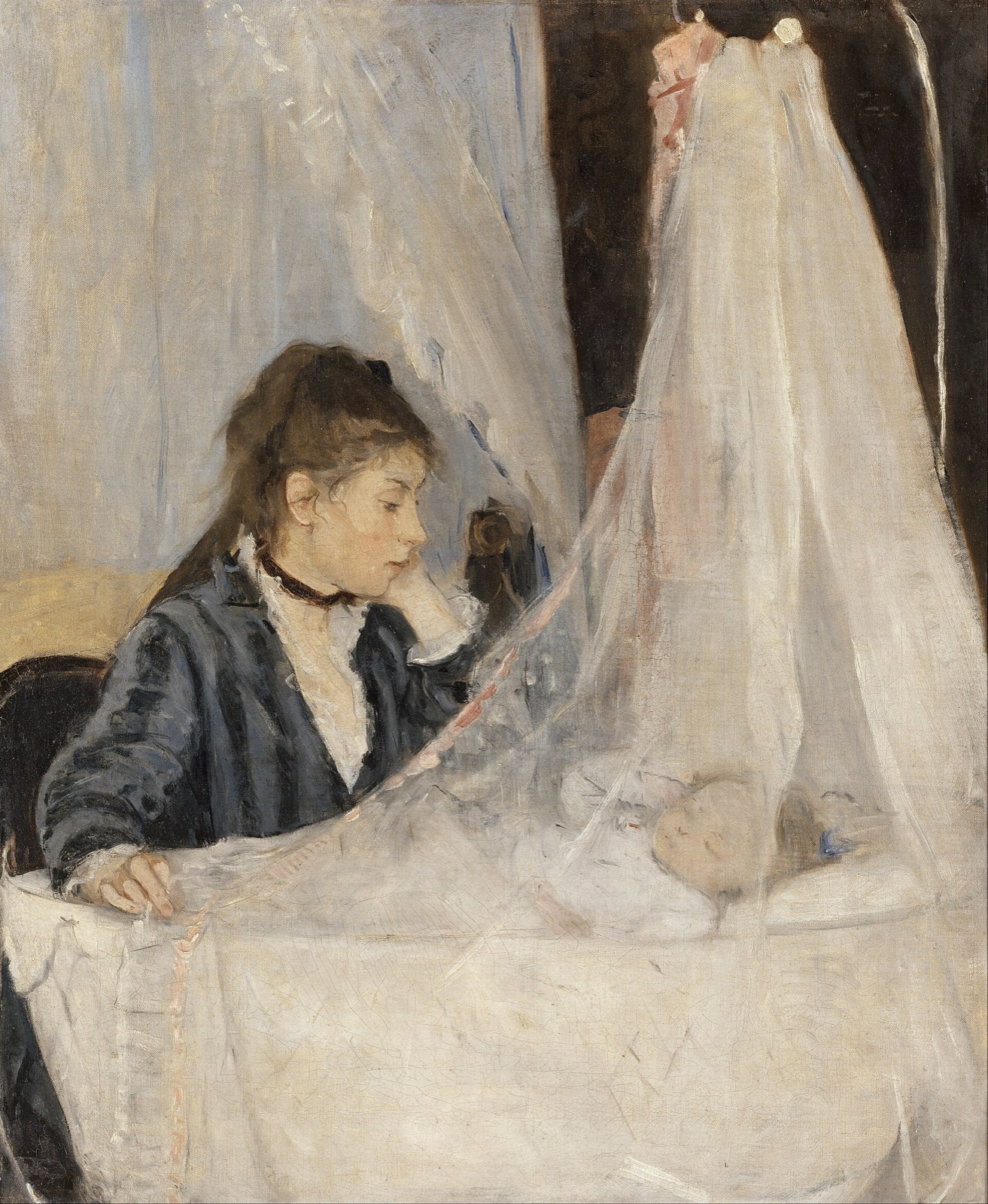
    The exhibition had its own printed catalogue. Berthe Morisot’s The Cradle (1872) was among the works, and critics received it kindly, but it did not sell.

  8. 1874, 25 April

    Louis Leroy’s satirical review appears in Le Charivari

    Leroy wrote a mocking conversation that used the title of Monet’s Impression, Sunrise to ridicule the whole group. The word “impressionists” was meant as an insult, but the label outlasted the joke.

  9. 1877

    The third group exhibition includes Renoir’s dance hall scene

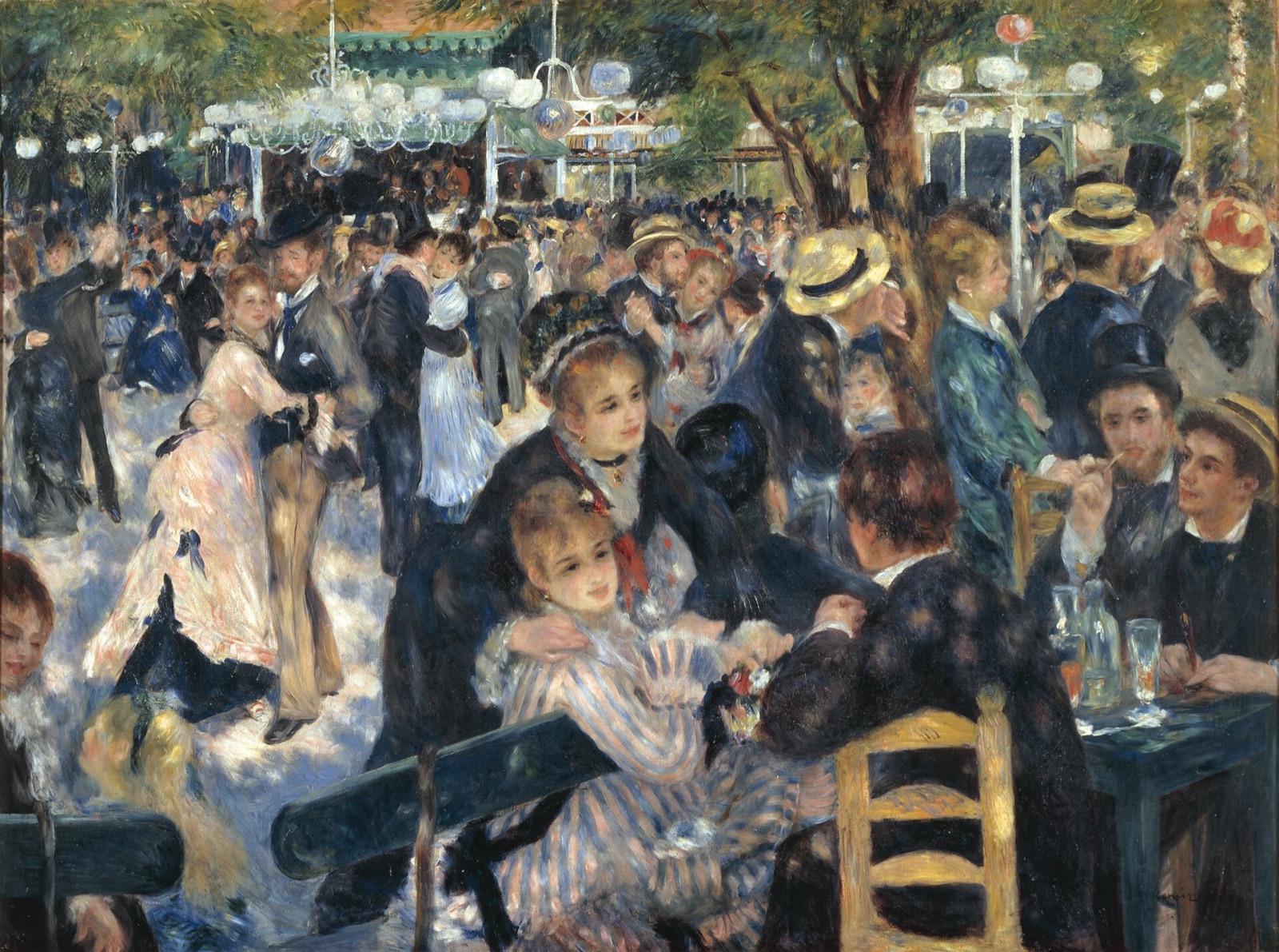
    Renoir painted Bal du moulin de la Galette in Montmartre in 1876, and it was shown at the 1877 exhibition. Dappled sunlight falls across a Sunday crowd in the open-air dance hall.

  10. 1879

    Mary Cassatt starts exhibiting with the group

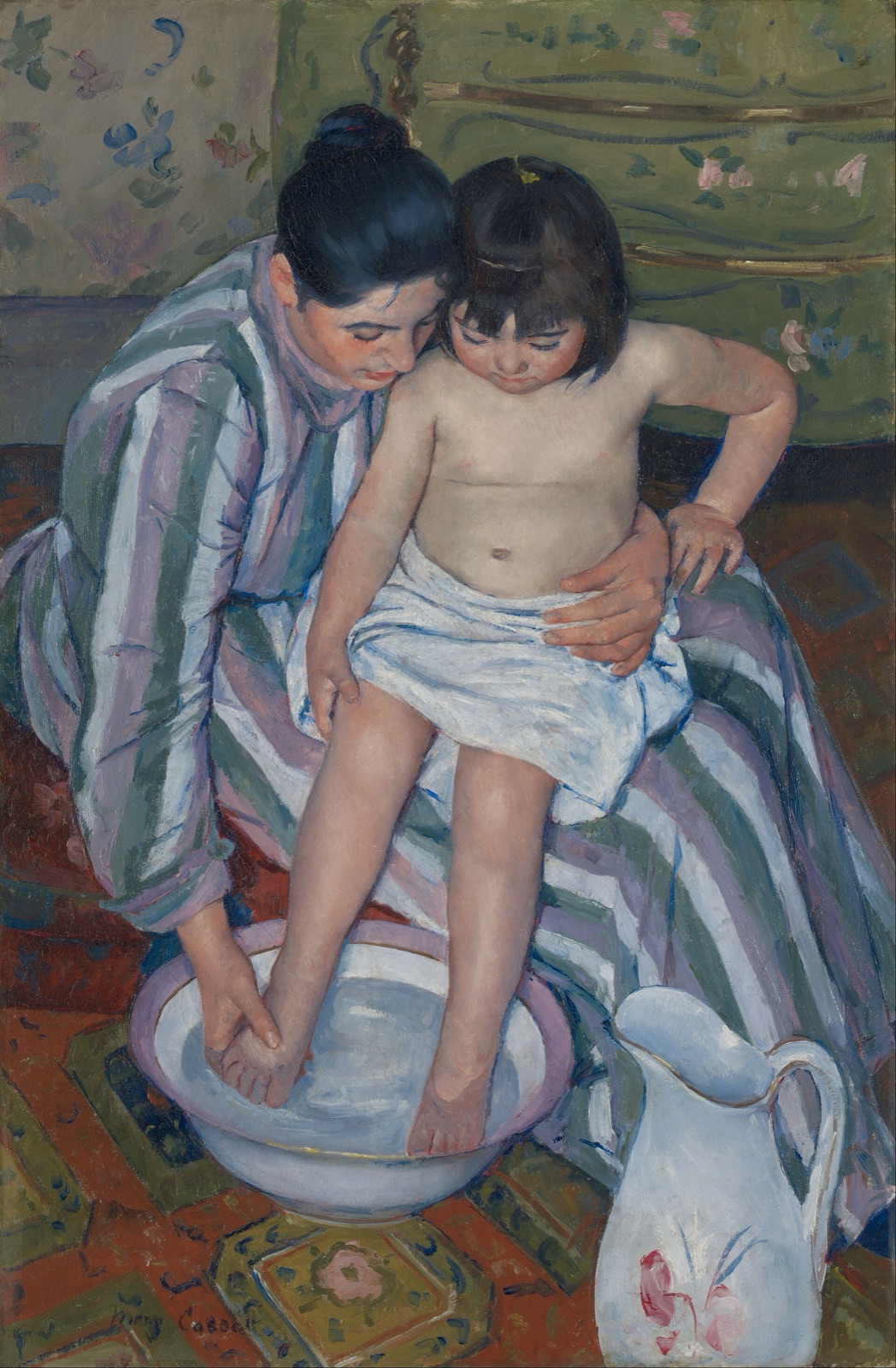
    Degas brought the American painter into the group, and she exhibited with the Impressionists from this year. Her later work, such as The Child’s Bath (1893), is often discussed in relation to Japanese prints.

    Also in 1879:More from 1879

  11. 1886, May

    The eighth and last group exhibition opens

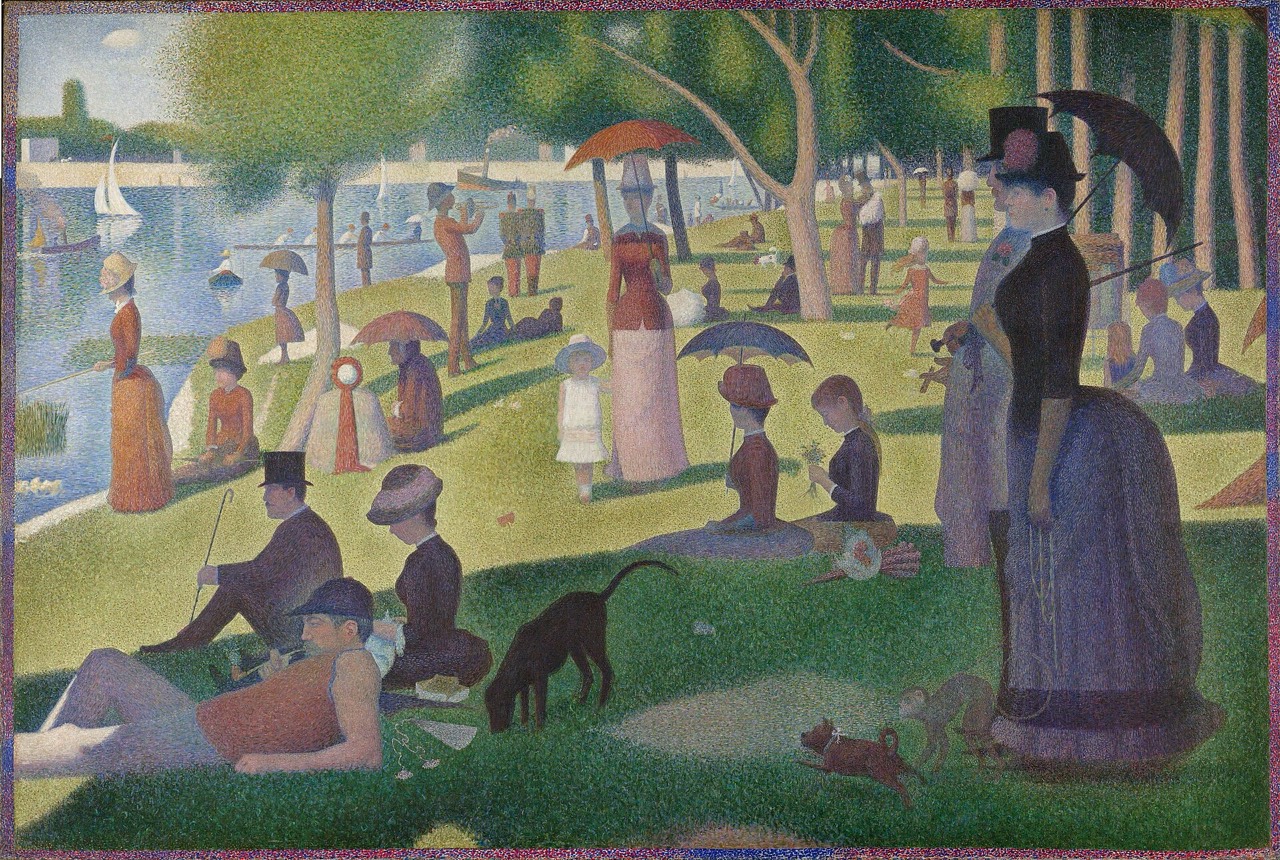
    Seurat's pointillist painting of Parisians relaxing on the island of La Grande Jatte
    Georges Seurat, public domain, via Wikimedia Commons

    Georges Seurat and Paul Signac, who painted with small dots of colour, took part, and the group split over whom to invite. Seurat’s A Sunday Afternoon on the Island of La Grande Jatte was among the centrepieces.

  12. 1910

    Roger Fry’s Manet and the Post-Impressionists opens in London

    The show at the Grafton Galleries introduced Cézanne, Van Gogh, Gauguin and Matisse to British audiences. The term Post-Impressionism spread from here, although who first used it is still debated.

Maps

Tap a map to zoom

  • Detailed 1876 street plan of Paris divided into its twenty arrondissements

    Auguste Logerot’s 1876 plan of Paris, in its twenty arrondissements.

    Auguste Logerot, public domain, via Wikimedia Commons

  • Plan of Paris and its surroundings in 1870 showing the city's fortifications

    Paris and its surroundings in 1870, with the city’s fortifications, the year the Franco-Prussian War began.

    Publisher: L. Prang & Co, public domain, via Wikimedia Commons

  • Road map of the environs of Paris from the Seine valley west of the city

    An undated 19th-century road map of the Paris region, showing the Seine valley west of the city where several Impressionists painted.

    Bibliothèque nationale de France, public domain, via Wikimedia Commons

The impressionism movement took shape in Paris in the 1860s and 1870s. Its painters left the studio for the open air, worked fast with bright colour and visible brushstrokes, and chose modern life as their subject: cafés, boulevards, river banks and dance halls. The name began as an insult, and the painters ended up using it.

So what is impressionism in one line? It is a group of Paris painters who tried to record how light and colour looked at one moment, rather than producing a polished studio scene. This article covers where the movement started, how the first group show worked, why the name stuck, how Japanese prints shaped it and what came next. It also belongs to our 19th-century art and culture series.

What is impressionism? The short answer

Impressionism is less a formal style than a loose circle of painters, centred on Claude Monet, Pierre-Auguste Renoir, Edgar Degas, Berthe Morisot, Camille Pissarro and Alfred Sisley. They shared working habits: painting outdoors when possible, keeping colours bright and letting the brushwork show. They also chose ordinary modern subjects over the classical and historical scenes that the official art world still rewarded.

Their public identity came mostly from their exhibitions. Between 1874 and 1886 the group staged eight shows in Paris, each with a different mix of artists.

Where it began: the Salon and the 1863 rejections

In the 1860s a painter’s reputation depended largely on whether a jury accepted a work for the annual Salon. In 1863 the jury rejected Édouard Manet’s Le Déjeuner sur l'herbe, a picnic scene with a nude woman seated among clothed men. Napoleon III then ordered a second show of the rejected works, the Salon des Refusés, which opened in Paris on 15 May 1863. Of more than 5,000 paintings submitted that year, about 2,200 were refused.

Manet showed his picnic painting there under the title Le Bain, and it drew both laughter and outrage. He never exhibited with the group that became the Impressionists, but younger painters saw in his flat light and modern subjects a model worth following. Several of them had met in the early 1860s in the studio of the Swiss-born teacher Charles Gleyre, where Monet, Renoir, Sisley and Frédéric Bazille were students, and they began painting outdoors together.

The outdoor habit had earlier roots in the Barbizon painters, who worked around the Fontainebleau forest; see our article on Millet and the Barbizon School. Romanticism, the movement before them, favoured emotion and drama, and What Is Romanticism? explains that background.

Paris as the subject

The city they painted was changing fast. Wide boulevards and new parks were reshaping its streets, and the 1876 plan below divides Paris into twenty arrondissements. Renoir’s dance hall stood on the hill of Montmartre in the north, while the first group show was held on the boulevard des Capucines in the centre. The map makes clear that these were two different parts of one city.
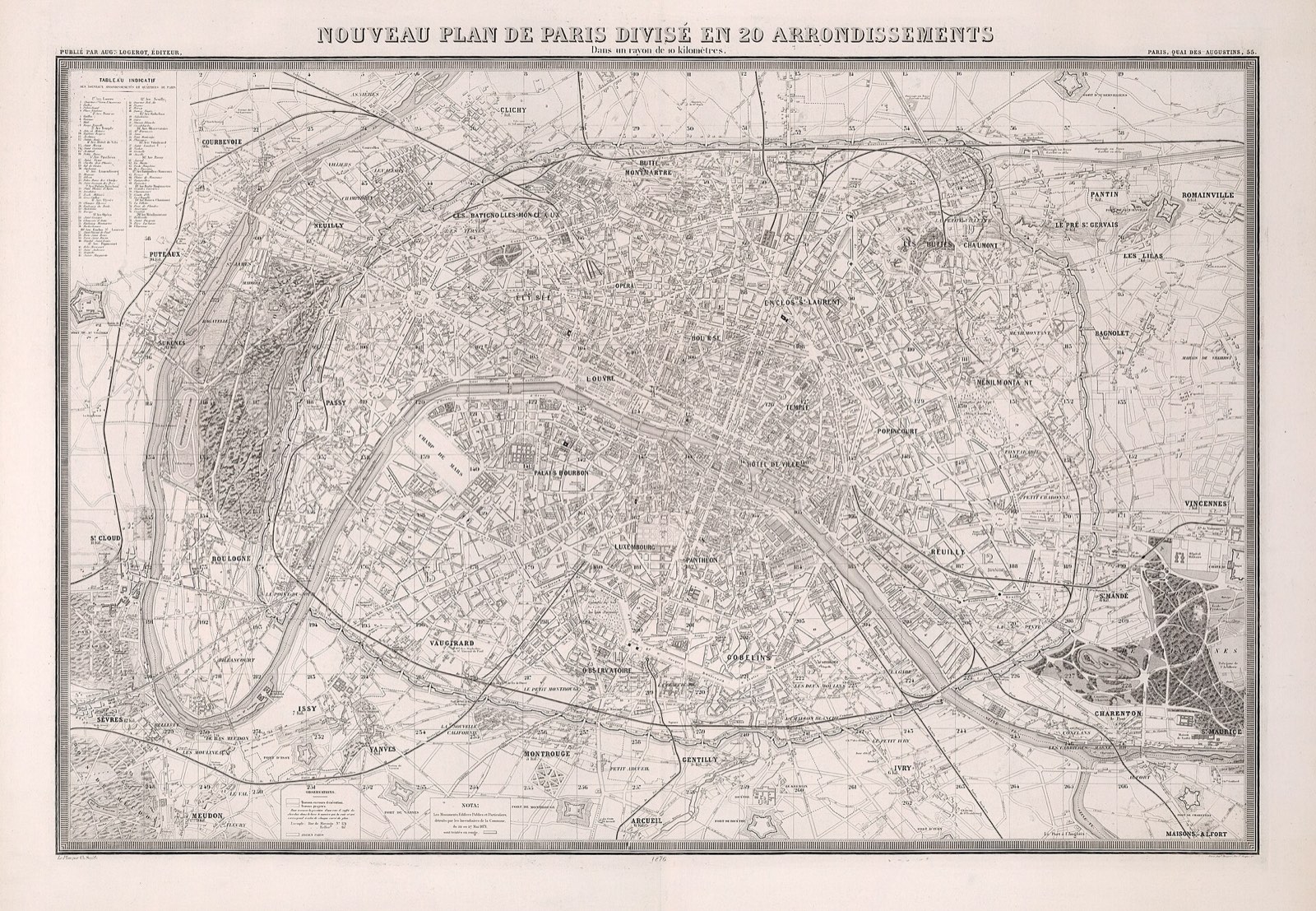
Detailed 1876 street plan of Paris divided into its twenty arrondissements
Auguste Logerot’s 1876 plan of Paris, in its twenty arrondissements. Auguste Logerot, public domain, via Wikimedia Commons

War, exile and a new artists’ society

In July 1870 France went to war with Prussia. Paris was under siege by the autumn, and several painters left France. Monet reached London in mid-September 1870, and Pissarro joined relatives in south London in December. Pissarro’s house at Louveciennes, west of Paris, had been used as stables by Prussian troops. In London Monet painted only about six views of the parks and the Thames, but he also met fellow exiles, including the painter James Tissot.
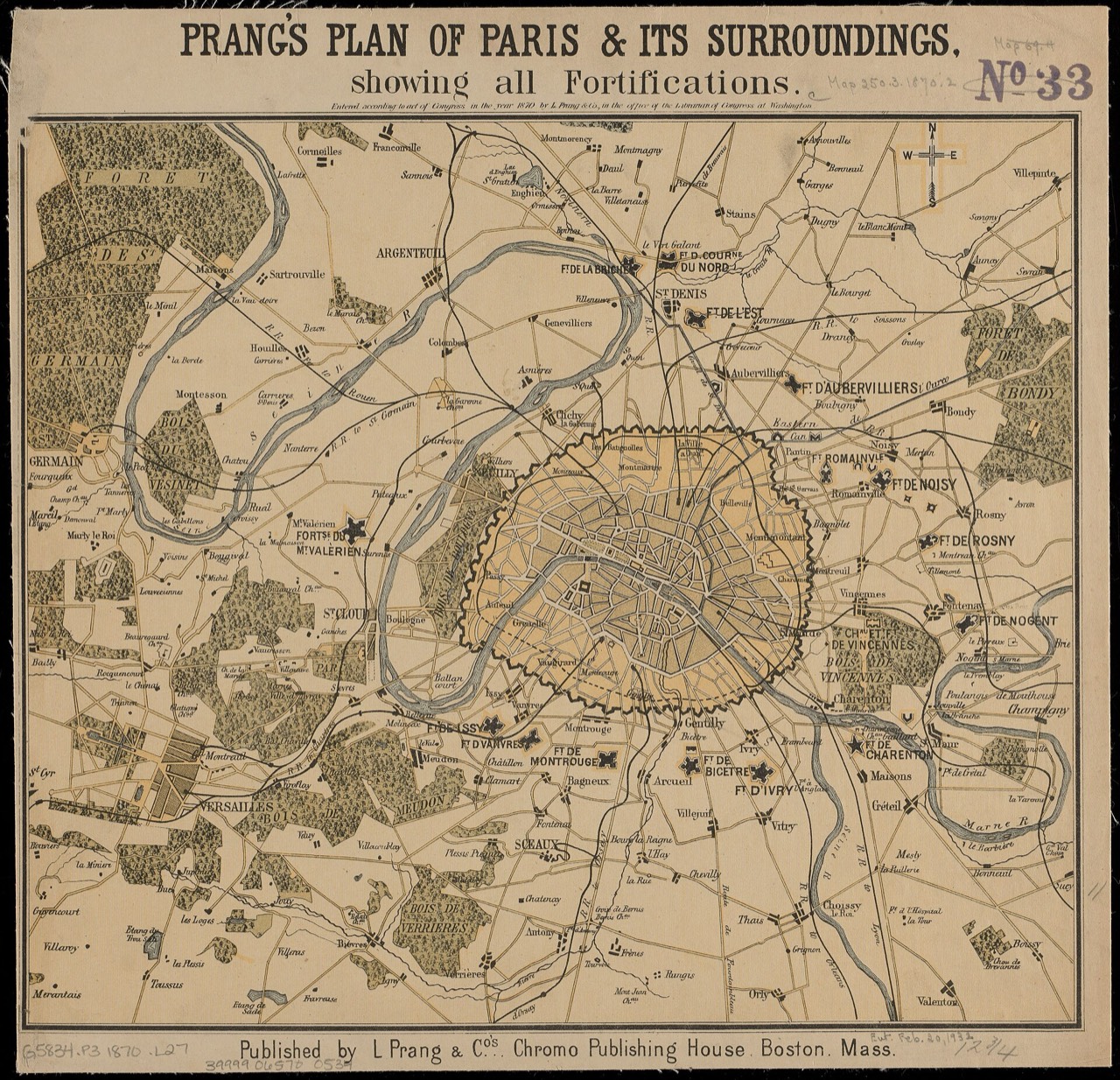
Plan of Paris and its surroundings in 1870 showing the city's fortifications
Paris and its surroundings in 1870, with the city’s fortifications, the year the Franco-Prussian War began. Publisher: L. Prang & Co, public domain, via Wikimedia Commons

In December 1873 the painters set up a co-operative society of artists so that they could show their work without the official jury. Monet, Renoir, Pissarro, Sisley, Cézanne, Morisot and Degas were among its members. The society led directly to the first group exhibition in 1874.

The first group show, 1874

The first exhibition opened on 15 April 1874 on the upper floor of 35 boulevard des Capucines, the former studio of the photographer Nadar, and ran until 15 May. About 30 artists took part, with roughly 165 works; some counts are higher, so treat that figure as an estimate. Press reaction was mixed, and the most famous review was openly mocking.

Berthe Morisot’s The Cradle (1872), which shows her sister Edma watching a sleeping baby, was among the works. Critics received it kindly, but it did not sell.

The name that came from a joke

On 25 April 1874 the critic Louis Leroy published a satirical piece in Le Charivari, a Paris humour paper. He wrote it as a mocking conversation and used the title of Monet’s Impression, Sunrise to make fun of the whole group. Calling the painters “impressionists” was meant as an insult, a suggestion that they had recorded a passing impression rather than finished a picture.

The joke outlived its author’s intention. The label stuck, and within a few years the painters themselves were using it. Today it names a whole way of painting, not just one show, and the most famous example of that style carries the title that was used to mock it.

How they painted: light, colour and modern life

Impressionist painting rests on three habits. First, the artists often worked outdoors and tried to catch the light before it changed. Second, they avoided black and dark brown for shadows and used colour instead. Third, they treated ordinary subjects as worth serious attention: a boat on the water, a crowd at a dance hall, a street under floodwater.

The brushwork carries part of the message. Impressionists left strokes visible rather than blending them into a smooth surface. Up close the canvas can look rough, but from a distance the strokes gather into the shimmer of water, leaves or sky. Renoir’s Bal du moulin de la Galette (1876), shown at the group’s 1877 exhibition, does this with dancers, friends and dappled sunlight. Photography, which was spreading at the same time, is often linked to the cropped, off-centre views in such paintings, but the painters worked in colour and brushwork, not in the camera’s grey tones.

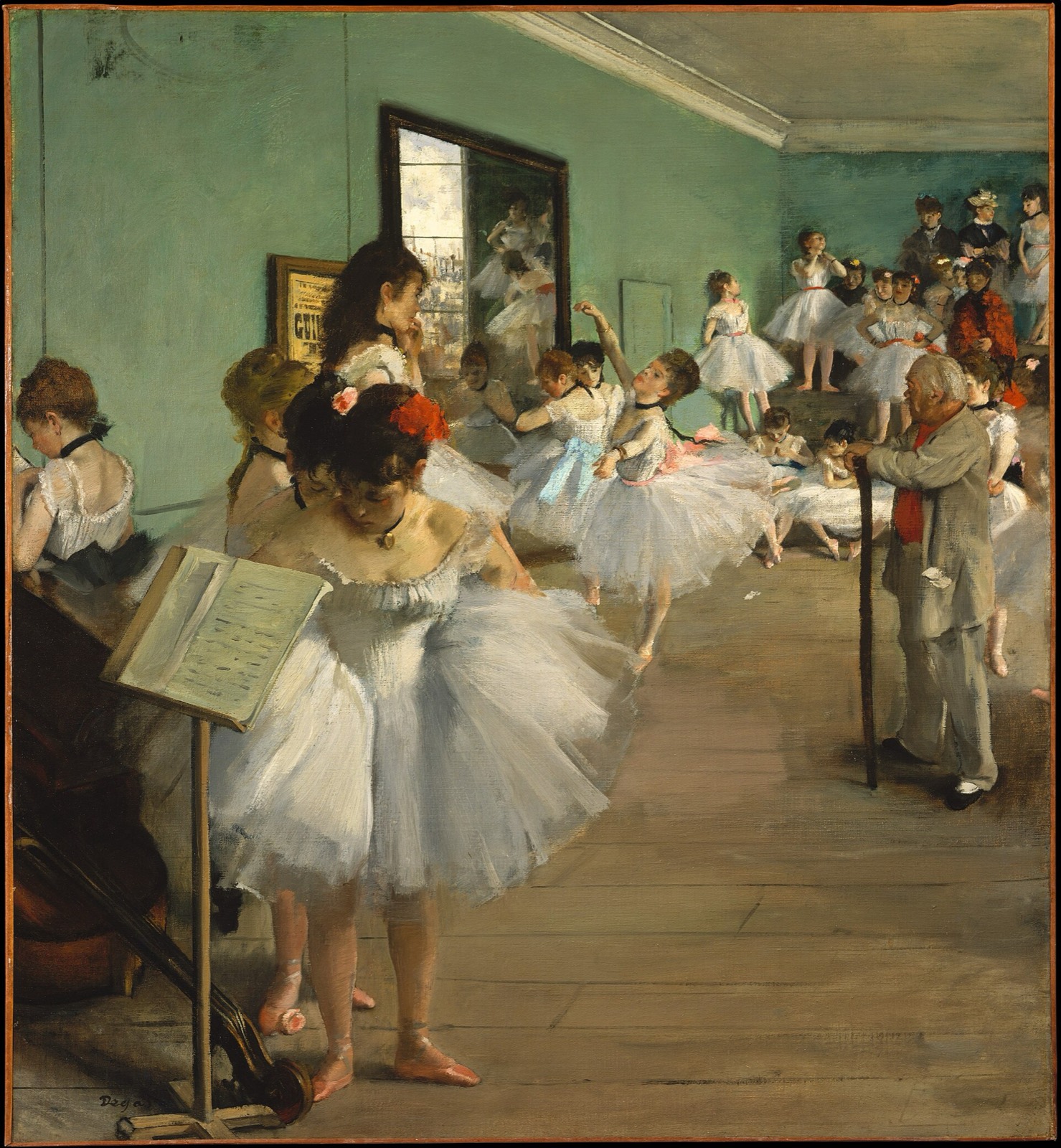
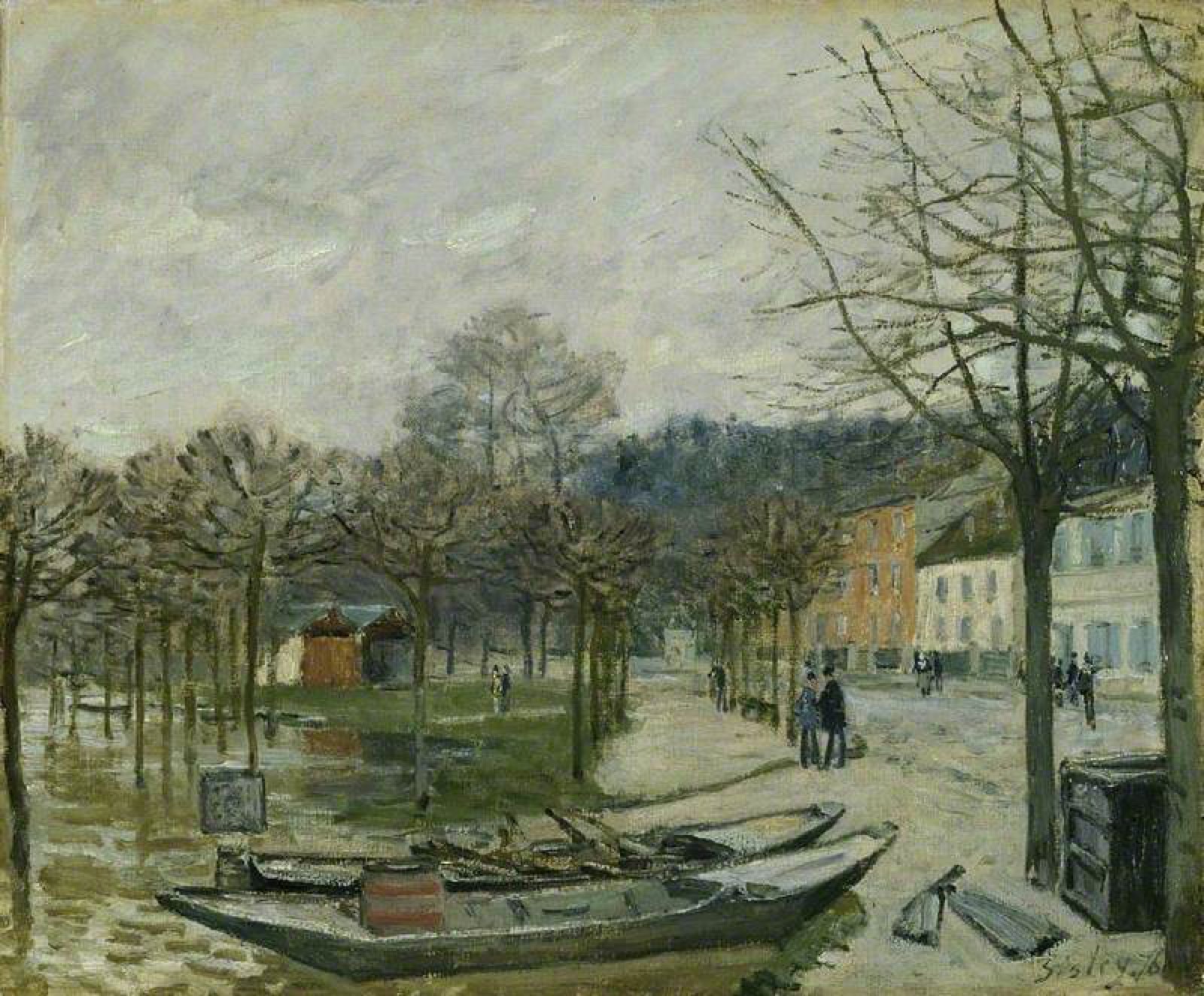
Edgar Degas painted ballet pupils and their teacher in a rehearsal room of the old Paris Opéra, a scene dated 1874. Alfred Sisley’s The Flood at Port-Marly (1876) shows a street west of Paris under water, with a tavern standing in the flood beneath a grey sky. These paintings show present-day city and river life rather than historical episodes.
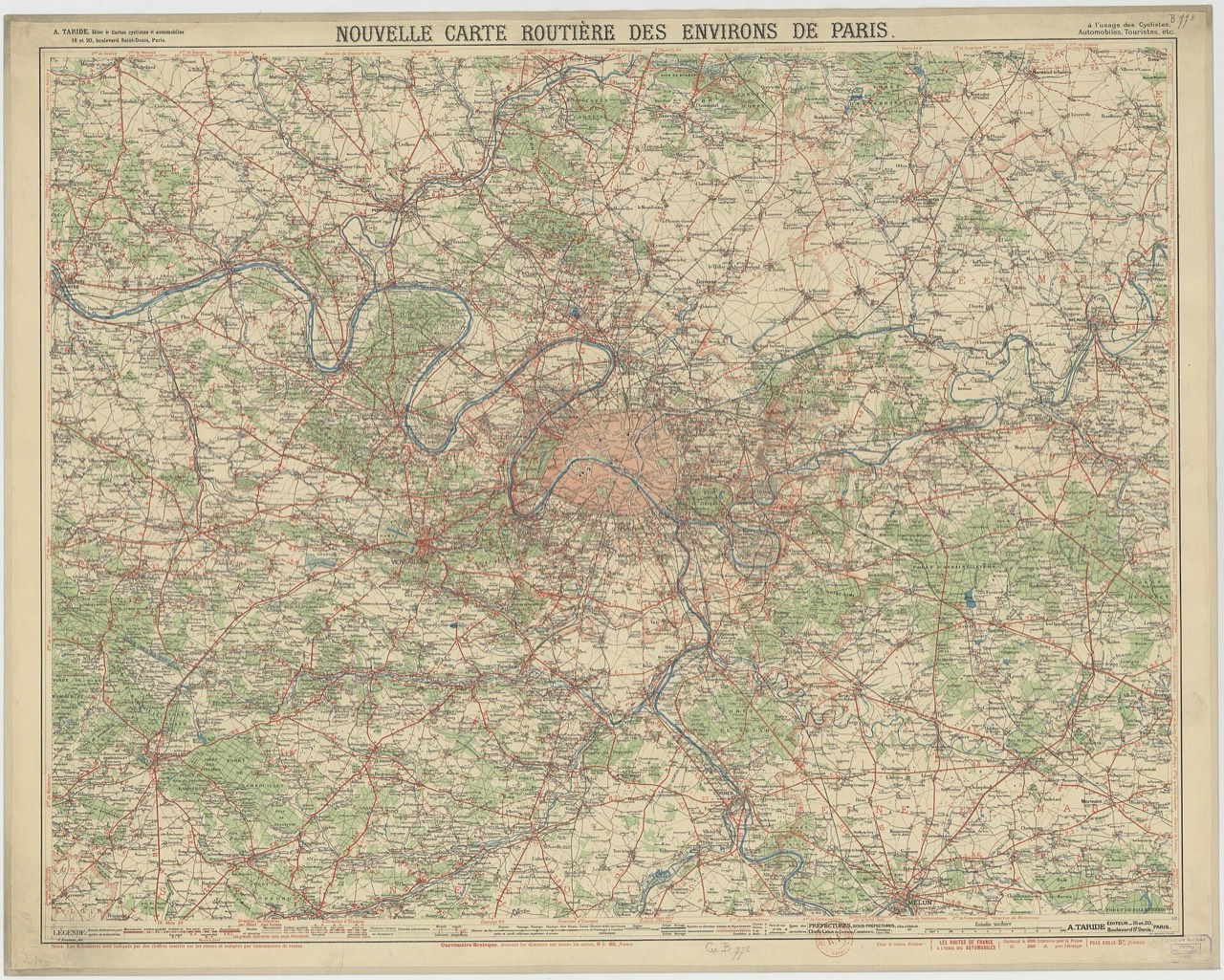
Road map of the environs of Paris from the Seine valley west of the city
An undated 19th-century road map of the Paris region, showing the Seine valley west of the city where several Impressionists painted. Bibliothèque nationale de France, public domain, via Wikimedia Commons

Several painters worked along the Seine west of Paris, in villages such as Argenteuil and Port-Marly, which is why a regional road map is useful for placing their scenes.

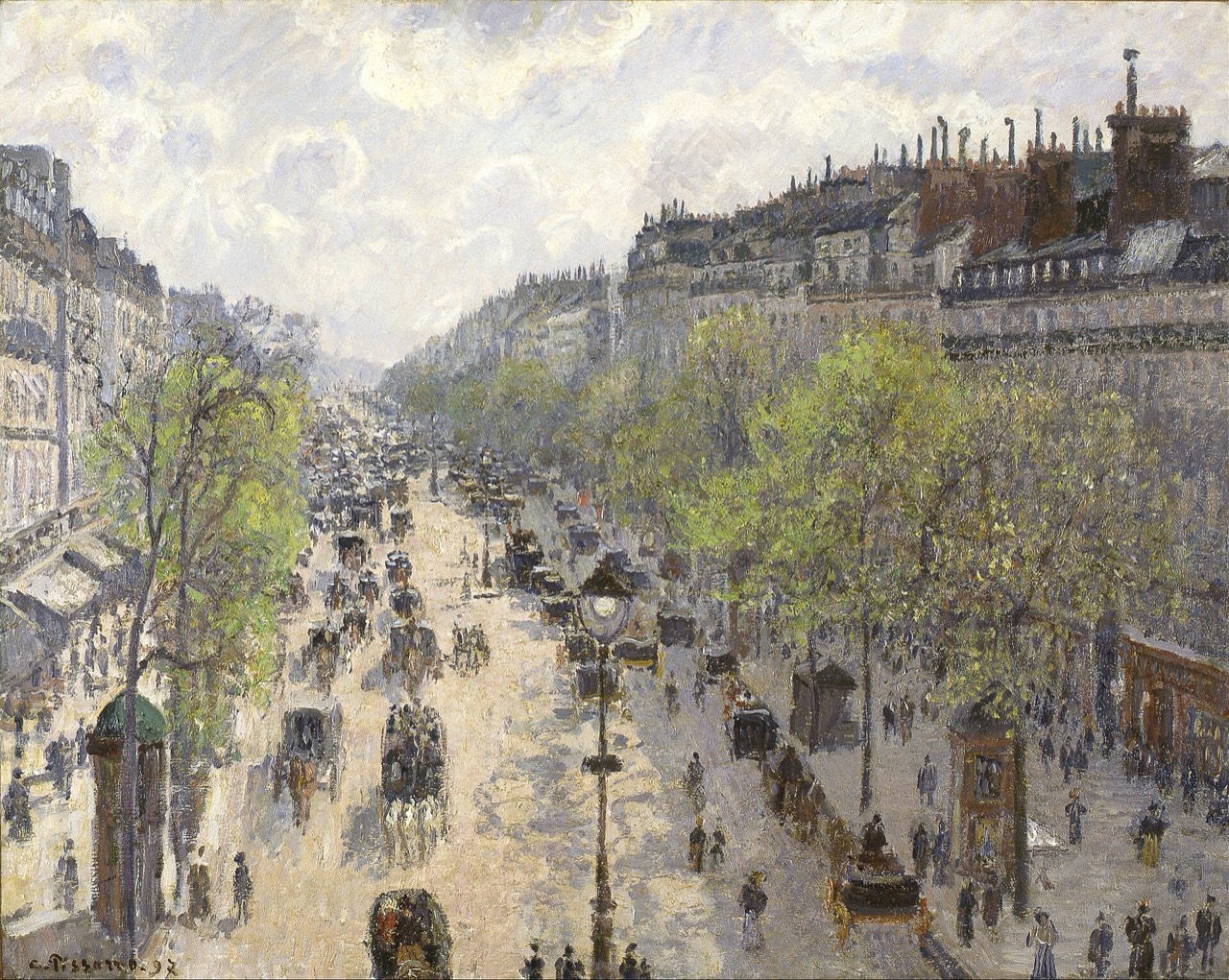
The approach lasted well beyond the 1870s. Camille Pissarro’s Boulevard Montmartre, Spring is dated 1897, more than twenty years after the first show. Mary Cassatt’s The Child’s Bath is dated 1893. The style was not confined to a single moment.

Impressionism artists: Morisot and Cassatt

Berthe Morisot showed in seven of the eight group exhibitions, which made her one of the most consistent members. Her paintings often focus on women and children at home, and The Cradle is now in the Musée d’Orsay in Paris.

Mary Cassatt was an American painter who worked in Paris. Degas brought her into the group, and she exhibited with the Impressionists from 1879. The Child’s Bath shows a mother holding a child over a basin, seen from above. Art historians often point to Japanese prints in its flattened space and asymmetric composition.

Japanese prints and Japonisme

From the mid-19th century, Japanese objects and prints reached Europe, and the French called the fashion for them Japonisme. A well-known starting point is the story of the printmaker Félix Bracquemond, who is said to have found a copy of the sketchbook Hokusai Manga around 1856 in his printer’s workshop. The story is told often, but its details come from later retellings, so treat it as tradition rather than documented fact.

What caught the painters’ eye was the look of ukiyo-e woodblock prints: flat areas of colour, firm outlines, bold cropping, figures cut off at the edge of the frame and high viewpoints. These offered a different way to build a picture from the Western tradition of a centred, deep stage.

Two examples help. Hiroshige’s Sudden Shower over Shin-Ōhashi Bridge and Atake (1857) shows a rain-soaked bridge and town in a bold, flat design. Monet’s La Japonaise (1876) shows his wife, Camille, in a Japanese kimono. Both show how closely French painters were engaging with Japanese art.

Eight shows and a changing group

Between 1874 and 1886 the group held eight exhibitions. Membership changed from show to show, and the organisers disagreed about whom to invite. Pissarro showed at all eight, according to standard accounts. Renoir’s dance scene appeared at the third show in 1877, and Cassatt joined from 1879.

The eighth and final show opened in May 1886. Georges Seurat and Paul Signac, who built images from small dots of colour, took part, and the group split over whether to invite them. Seurat’s A Sunday Afternoon on the Island of La Grande Jatte was among the centrepieces, and it hung in a room that also held Pissarro’s Neo-Impressionist work.

After impressionism: Neo-Impressionism and Post-Impressionism

Seurat’s method of building images from separate dots of colour is usually called Neo-Impressionism. It pursued the impressionist interest in light through a more systematic technique. Cézanne, Van Gogh, Gauguin and Matisse went in other directions.

The term “Post-Impressionism” was popularised by the critic and painter Roger Fry. His 1910 London show Manet and the Post-Impressionists, at the Grafton Galleries, introduced Cézanne, Van Gogh, Gauguin and Matisse to British audiences. Who first used the word, and when, is still debated.

Why it matters and what exams ask

Impressionism mattered because it treated the painted moment as a valid subject. Its painters showed that a picture could be built from light, colour and brushwork, not only from careful drawing and a story. That shift opened the way to later modern painting.

History and art-history exams often ask about three things: the rejection of the official Salon and the 1863 Salon des Refusés; the choice of modern urban and leisure subjects; and the changes in colour and brushwork. Know the anchor dates too: 1863 for the refused works, 1874 for the first group show and 1886 for the last.

Read next

  • Millet and the Barbizon School: the outdoor painters who came before the Impressionists.
  • Famous Impressionist Paintings and Painters: a wider tour of the works and artists touched on here.
  • What Is Romanticism?: the emotional, dramatic art of the generation before.
Armies and units

  • Oil painting of a misty harbour at dawn with small boats and a low orange sun Work

    Impressionists

    Claude Monet, Impression, Sunrise (1872)

    Monet painted the port of Le Havre at dawn in 1872. He showed it at the 1874 exhibition, where critic Louis Leroy used its title to mock the group.

    Claude Monet, public domain, via Wikimedia Commons

  • Painting of crowds dancing and talking under trees at an open-air dance hall in Montmartre Work

    Impressionists

    Pierre-Auguste Renoir, Bal du moulin de la Galette (1876)

    Renoir painted this Sunday scene at an open-air dance hall in Montmartre in 1876. It was shown at the group's third exhibition in 1877, with dappled light falling across the crowd.

    Pierre-Auguste Renoir, public domain, via Wikimedia Commons

  • Painting of ballet dancers and their master in a rehearsal room with a mirror and a poster on the wall Work

    Impressionists

    Edgar Degas, The Dance Class (1874)

    Degas painted ballet pupils and their teacher in a rehearsal room of the old Paris Opéra. The painting is dated 1874.

    Edgar Degas, public domain, via Wikimedia Commons

  • Painting of a woman gazing at a baby asleep in a cradle draped with sheer white netting Work

    Impressionists

    Berthe Morisot, The Cradle (1872)

    Morisot painted her sister Edma watching a sleeping baby. It was shown at the first group exhibition in 1874, where critics received it kindly but it did not sell. It is now in the Musée d'Orsay.

    Berthe Morisot, public domain, via Wikimedia Commons

  • Painting of a busy Paris boulevard seen from above in spring light, with trees and carriages Work

    Impressionists

    Camille Pissarro, Boulevard Montmartre, Spring (1897)

    Painted in 1897, more than twenty years after the first group show, this view of a Paris boulevard seen from above shows Pissarro still painting the city he knew.

    Camille Pissarro, public domain, via Wikimedia Commons

  • Painting of a flooded street in Port-Marly with a tavern standing in the water under a grey sky Work

    Impressionists

    Alfred Sisley, The Flood at Port-Marly (1876)

    Sisley painted the Seine flooding the streets of Port-Marly, west of Paris, in 1876. A tavern stands in the water under a grey sky.

    Alfred Sisley, public domain, via Wikimedia Commons

  • Painting of a mother holding a small child over a basin of water, seen from above Work

    Impressionists

    Mary Cassatt, The Child's Bath (1893)

    An American painter who worked in Paris, Cassatt exhibited with the Impressionists from 1879. This 1893 scene shows a mother bathing a child, seen from above.

    Mary Cassatt, public domain, via Wikimedia Commons

  • Painting of a nude woman picnicking on the grass with two men in contemporary dress Work

    Forerunner

    Édouard Manet, Le Déjeuner sur l'herbe (1863)

    Rejected by the official Salon jury in 1863, the picnic scene was shown at the Salon des Refusés under the title Le Bain. Manet is a forerunner rather than a member, as he never exhibited with the group.

    Édouard Manet, public domain, via Wikimedia Commons

Frequently Asked Questions

What is impressionism in simple terms?

Impressionism is a 19th-century French painting movement. Its artists often worked outdoors, used bright colour and loose brushwork, and chose everyday modern scenes such as boulevards, cafés and river views. Their aim was to capture how light looked at one moment, rather than to finish a polished studio picture.

Why is it called impressionism?

The name comes from Claude Monet’s painting Impression, Sunrise (1872). When the critic Louis Leroy reviewed the group’s first exhibition in Le Charivari on 25 April 1874, he used the painting’s title to mock the painters, calling them “impressionists” as an insult. The label stuck, and the artists came to use it themselves.

Who were the main impressionist painters?

The core group included Claude Monet, Pierre-Auguste Renoir, Edgar Degas, Berthe Morisot, Camille Pissarro and Alfred Sisley. Mary Cassatt, an American, exhibited with them from 1879. Édouard Manet never showed with the group, but his earlier work encouraged the younger painters.

When did impressionism start and end?

Its roots lie in the 1860s, when the Salon jury refused Manet’s work in 1863. The first group exhibition opened in Paris in 1874, and the last of the group’s eight shows took place in 1886. Neo-Impressionism and Post-Impressionism grew out of its ideas.

How did Japanese prints influence impressionism?

Japanese woodblock prints, known as ukiyo-e, showed flat colour, firm outlines and off-centre compositions. Many French painters found these ideas useful. Monet’s La Japonaise (1876) and Cassatt’s The Child’s Bath are often discussed in this context.

Check Your Understanding

Pick an answer for each question to see if you were right.

  1. In which year did the first Impressionist group exhibition open in Paris?

  2. Which critic's review gave the group its name?

  3. What was the Salon des Refusés?

  4. Which Monet painting gave the movement its name?

  5. According to the traditional account, what did Félix Bracquemond find around 1856?

More in Culture & the Arts

See the full topic guide →
Share:

About the Writer

Alex Ng
Alex Ng

Software Engineer & Writer

Software engineer with a passion for distilling complex ideas into actionable insights. Writes about finance, investment, entrepreneurship, and technology.

Read more →

Keep reading

Explore the topic: Culture & the Arts

Articles

Summaries