In five minutes
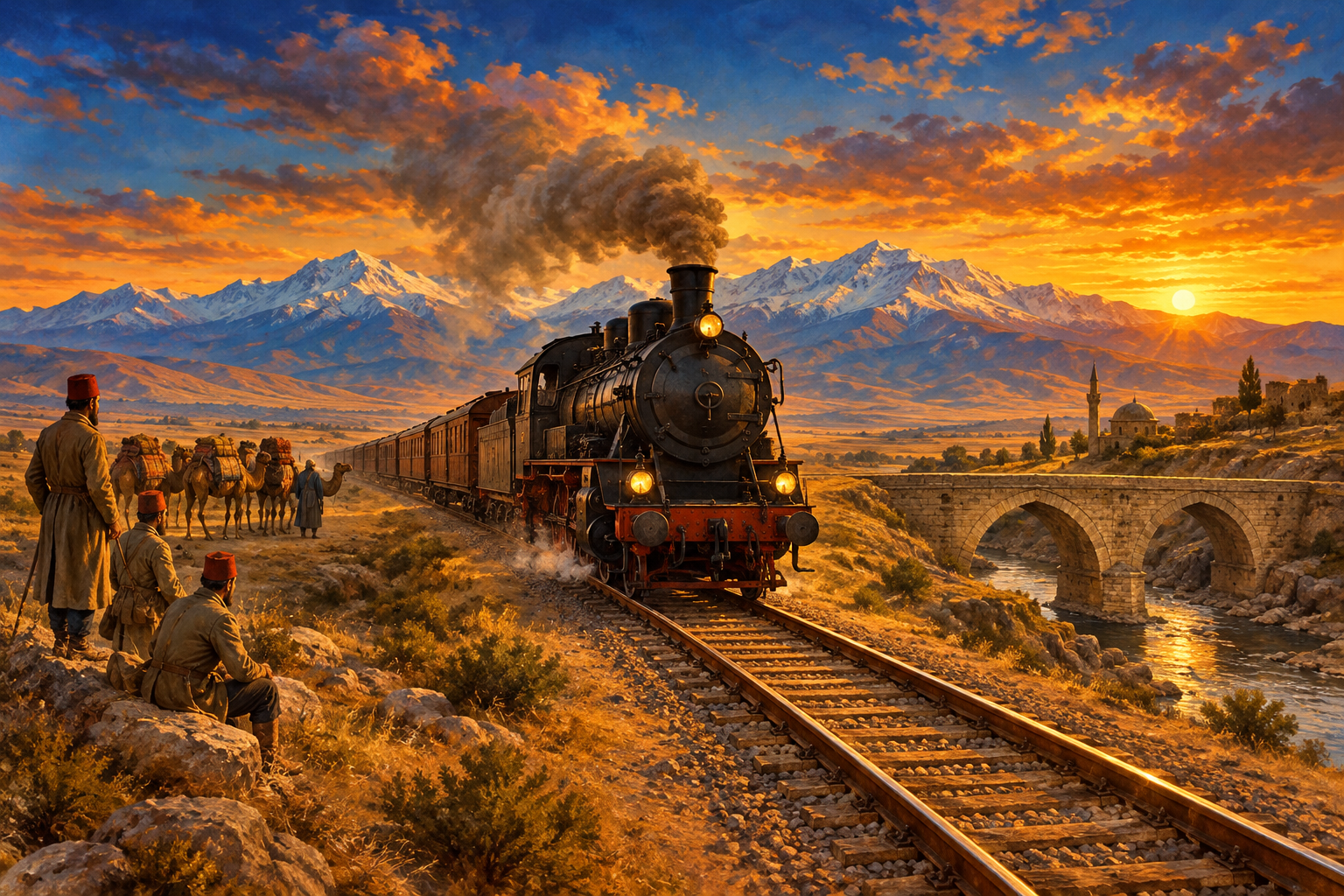
Germany's 3B policy is the nickname for Berlin's push into the Ottoman Empire and the Middle East in the years before the First World War. The name comes from the first letters of three places: Berlin, Byzantium (the old name of Istanbul, the Ottoman capital) and Baghdad. At its centre was one project, the Berlin–Baghdad railway, a line meant to carry German trade and political influence from the Bosphorus towards the Tigris.
The label is shorthand, not an official German policy document. Historians use it to describe a set of connected goals: railways, loans, trade and political influence. It is often set against Britain's own idea of linking Cape Town, Cairo and Calcutta, known as the 3C policy. For the wider background on colonial rivalry, see the imperialism overview.
The short answer is that the 3B policy added to the rivalries that led to 1914. It alarmed Britain and Russia, but it was never the single cause of the war.
Why Germany looked east
The German Empire was founded in 1871 and grew fast as an industrial power, but it had far fewer overseas colonies than Britain or France. When Wilhelm II became emperor in 1888, he pushed a more active foreign policy, known as world policy (Weltpolitik), which aimed to make Germany a power on every continent.
The Ottoman Empire, meanwhile, was short of money. Since 1881 a Public Debt Administration, with European creditors on its board, had controlled part of the state's revenue. Its rulers wanted modern railways to hold distant provinces together and to move troops and goods faster. German banks saw a market for loans, and German engineers saw construction contracts. The two interests met, and the 3B idea grew out of that meeting.
The Berlin–Baghdad railway concession
In 1888 a Deutsche Bank-led group won an Ottoman concession to build and run the Anatolian Railway, the line that ran inland from the Asian shore of Istanbul. It was an early German-financed step, but not yet the Baghdad project itself.
Over the following decade the Ottoman Ministry of Public Works received many applications for a line to Baghdad. The winning plan belonged to a group centred on Deutsche Bank. The agreement was formalised in March 1903, and the Baghdad Railway Company was created, a firm dominated by German banks.
The planned route ran from Konya through the Taurus mountains to Aleppo, then on through northern Mesopotamia to Mosul and Baghdad. The long-term aim was to reach the Persian Gulf at Basra. Accounts differ on some details of the early stages, so treat the exact years for those steps as approximate.
The 1898 visit
In autumn 1898 Wilhelm II made a state visit to the Ottoman Empire, touring Istanbul, Damascus and Jerusalem. The sultan was Abdul Hamid II. In Damascus the Kaiser spoke to Muslim audiences in friendly terms, a move that many historians read as a deliberate appeal to the sultan's Muslim subjects.
The visit warmed relations and is generally seen as helping the German case for the railway, although historians debate how much it directly delivered. It is safest to describe its effect cautiously rather than as a clear success.
That same year, Britain and France came close to war at Fashoda in Sudan. The Fashoda Incident shows how sharp colonial rivalries had become while the Baghdad project was taking shape.
Britain, Russia and the Gulf
Britain's concern was practical. A German-built line that reached the Persian Gulf would bring a rival power close to the sea routes to India and to Britain's influence in the Gulf. London used diplomacy, and its links with Gulf rulers, to make a German terminal on the Gulf difficult to achieve.
In 1913 Britain and the Ottoman Empire agreed terms that made any extension toward the Gulf depend on British agreement. In June 1914 Britain and Germany reached a London agreement on the same question, but war came before it could be carried out.
Russia had its own worries about Persia and the Caucasus. In 1907 Britain and Russia settled long-running disputes over Persia, Afghanistan and Tibet in the Anglo-Russian Convention. Together with the 1904 Anglo-French understanding and France's ties to Russia, this formed the Triple Entente. The railway was never the sole cause of these alignments, but it made the rival powers more suspicious of one another.
What happened in the end
When war broke out in August 1914, the line was still far from finished. Germany and the Ottoman Empire had signed an alliance in early August, and the Ottoman Empire entered the war on Germany's side that autumn. Both were defeated in 1918, and the Middle East was reshaped under new mandates and British and French influence.
The missing sections in Iraq were closed in 1939 and 1940. The through route was completed in July 1940, more than fifty years after the 1888 concession, and the first full journey from Istanbul to Baghdad followed within days. By then the political world the line was meant to serve had changed completely.
Did the 3B policy cause the war?
Most historians do not treat the 3B policy as the main cause of the First World War. The railway was one thread among many. It fed suspicion between Germany and Britain, France and Russia, and made the Gulf and Mesopotamia places where rivals watched each other closely. Alliances, arms races and the Balkan crises were at least as important. A fair reading is that the 3B policy added to the tension rather than setting the war in motion.
What exams ask
Exam questions often treat the 3B policy as a case study in imperialism and great-power rivalry. Strong answers cover three angles: the economic side (loans, railway concessions and access to markets), the strategic side (Britain's concern for India and the Gulf, and the 3C counter-idea), and the alliance side (the 1907 Anglo-Russian Convention and the Triple Entente).
- Know the difference between the 3B idea (Germany, from Berlin to Baghdad) and the 3C idea (Britain, from Cape Town to Calcutta through Cairo).
- Remember that the railway was financed by a German-led banking group, was still unfinished in 1914, and was completed only in 1940.
- Write that the policy contributed to rivalry rather than that it caused the war, unless the question asks for a single cause.
Read next
- Britain's 3C Policy (Cairo, Cape Town, Calcutta) shows the British side of the same rivalry.
- The Fashoda Incident (1898) explains the Anglo-French crisis of the same year.
- The Abolition of the Slave Trade and Slavery looks at another side of the nineteenth-century world of empire and trade.