French Indochina in five minutes
French Indochina was an administrative union, not a single country with a common government chosen by its inhabitants. In 1887 France joined Cochinchina, Annam, Tonkin and Cambodia under a governor-general. Laos was added in 1893. The territories correspond broadly to today’s Vietnam, Cambodia and Laos, although their colonial boundaries and internal arrangements were different from today’s national borders.
French colonization of Vietnam began before the union existed. France had established control in the south and extended it over the north and centre through military campaigns and treaties. The union made it easier to coordinate administration and finance across territories acquired at different times. For the longer history of the region, see Vietnam’s dynasties and French rule.
Colonial rule connected farms, mines and plantations to wider markets, but it also relied on unequal political power, taxes and demands for labour. Vietnamese, Cambodian and Lao people responded in different ways, including accommodation, reform, protest and armed resistance. During the Second World War, Japanese forces entered Indochina while French officials initially continued to administer it. Japan removed that administration in March 1945; independence declarations and renewed conflict followed later that year.
How the union was formed
French expansion in Vietnam took place in stages. Cochinchina in the south became a French colony. Annam in the centre and Tonkin in the north were formally protectorates, as was Cambodia. These labels mattered: a colony was directly administered as French territory, whereas a protectorate retained a local ruler or institutions under French supervision. In practice, French authorities held decisive power in both arrangements, although the machinery of rule differed.
The Sino-French War and the 1885 Treaty of Tianjin helped establish France’s position in northern Vietnam against Qing China’s competing claims. In 1887 the French government combined its Vietnamese territories and Cambodia into the Indochinese Union. Its creation did not mean that France had conquered all these places in one year, nor did it erase local opposition. Resistance to French expansion continued after the administrative union was established.
In 1893, after conflict with Siam, France extended its protectorate over Lao territories east of the Mekong and added them to the union. The Mekong became an important frontier with Siam, now Thailand. The resulting arrangement drew together regions with distinct languages, political traditions and economies. It is therefore misleading to treat the union as simply another name for Vietnam.
Government, taxes and the colonial economy
The governor-general stood at the centre of the union’s administration. Under Paul Doumer, governor-general from 1897 to 1902, French officials strengthened central finances and promoted transport projects. Local rulers and officials remained in parts of the system, but French residents and administrators could restrict their authority. The degree of direct control varied between territories and changed over time.
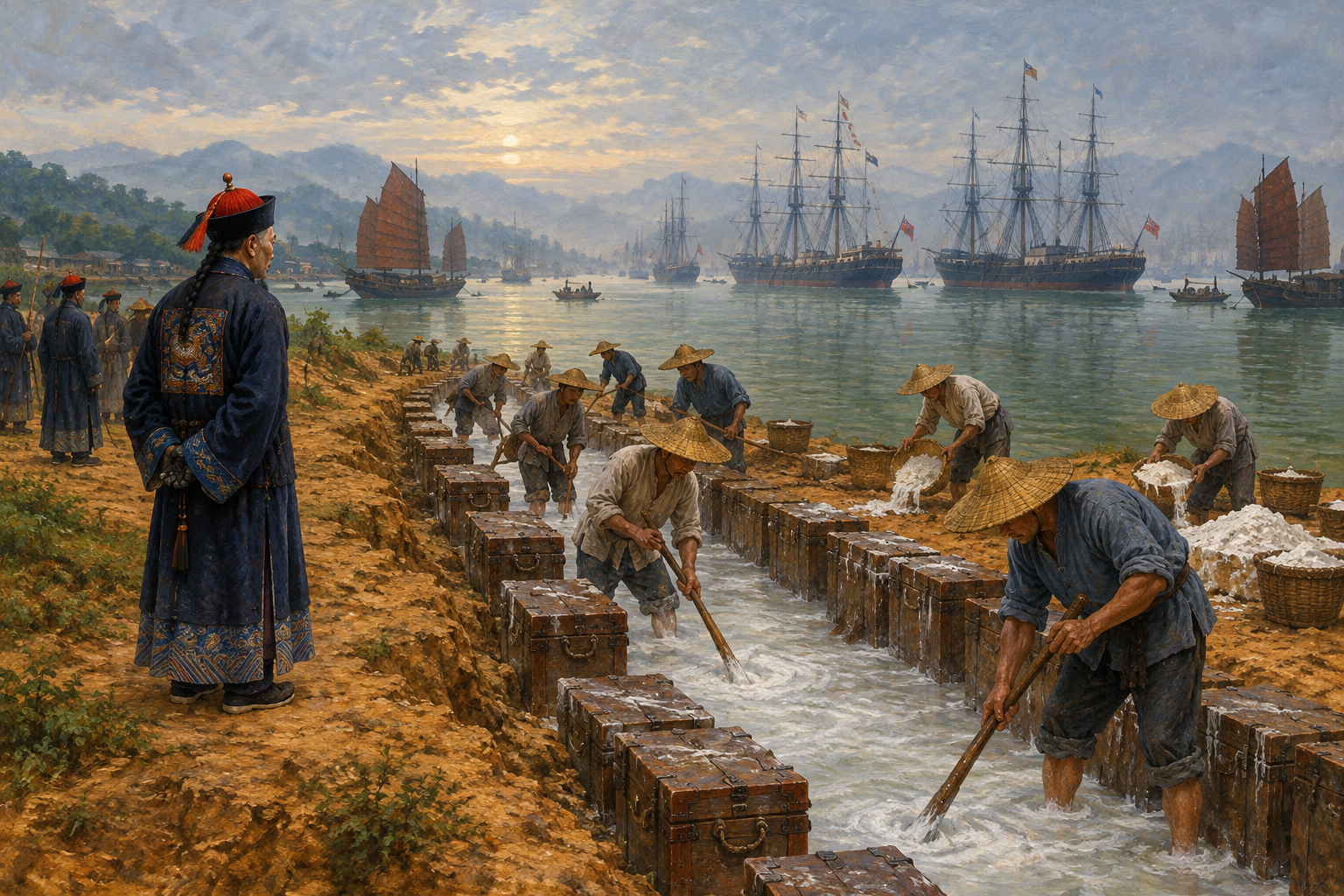
The colonial state sought revenue from the people it governed. Taxes, including personal and land taxes, and state-controlled sales of products such as salt, alcohol and opium helped finance administration. Obligations to provide labour also placed demands on communities. A family’s experience depended on its location and circumstances, but the need to meet taxes could push households toward wage work or borrowing.
Railways, roads and ports made it easier to move goods and officials. These projects also served strategic and commercial purposes: linking production areas to ports helped French businesses reach markets, and transport allowed the state to project authority. Infrastructure could be used by local people too, but its construction and financing did not give them equal control over the decisions that shaped it.
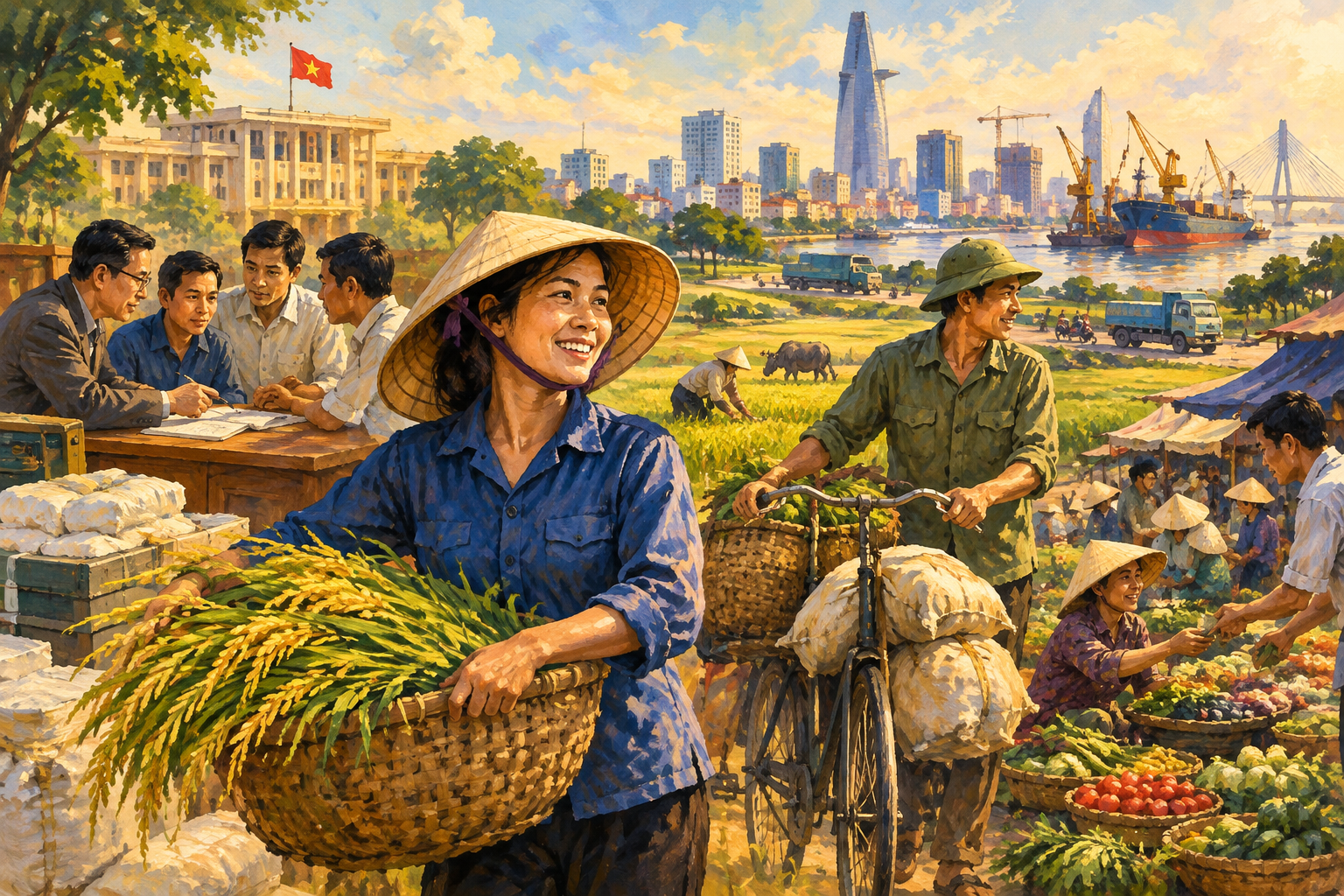
Rice from southern Vietnam was an important export. Mines and plantations supplied other commodities, while colonial businesses and the state competed for access to land, labour and profit. Economic change created new towns, jobs and educated groups, yet the distribution of land, political rights and opportunity remained unequal. Looking at both the roads and the people who paid for or worked on them gives a fuller picture than calling the period simply one of modernisation.
Rubber plantations and Phú Riềng
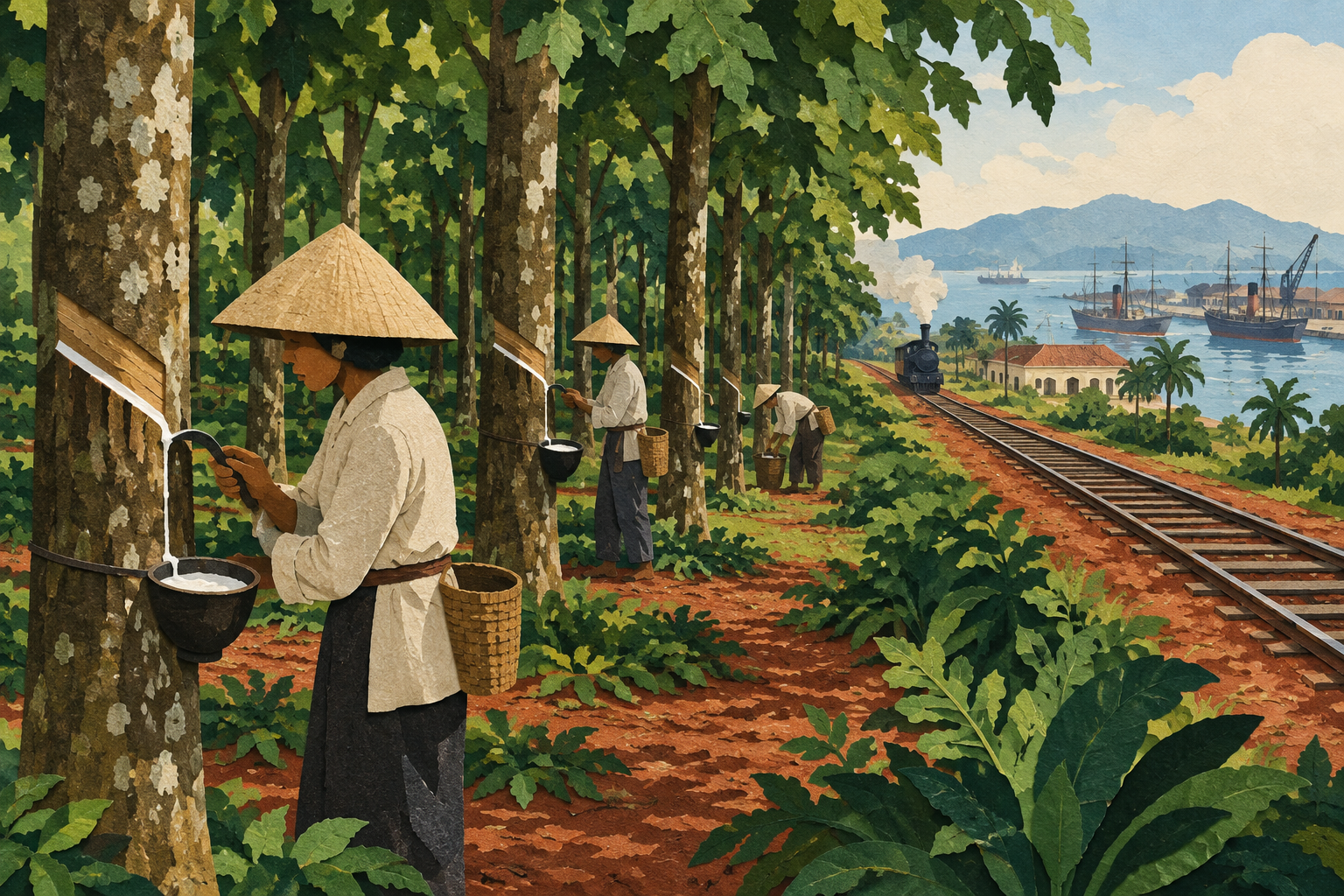
Rubber became increasingly important as demand grew for industrial products, including vehicle tyres. French companies established plantations, particularly in southern Vietnam. Michelin owned the Phú Riềng plantation, where workers tapped rubber trees and lived under demanding plantation discipline. Recruitment brought workers from other regions as well as drawing on local labour.
Plantation work exposed labourers to illness, harsh supervision and insecurity. The plantation was not only a source of export earnings: it was also a place where unequal authority could be felt in the working day. In 1930 workers at Phú Riềng went on strike. Their protest belonged to a wider wave of labour and political action during a period of economic difficulty and growing anti-colonial organisation.
The strike matters because it connects a global commodity to individual lives. A tyre manufacturer needed rubber, but the price of production was also borne by workers in Indochina. Their collective action shows that colonial subjects were not passive objects of economic policy. The authorities suppressed such challenges, and organising remained dangerous.
Resistance, occupation and the end of the union
Opposition to French rule took several forms. Some Vietnamese activists looked abroad for education and political allies; the Đông Du movement, for example, sent students to Japan. Others organised through political parties, labour movements or armed groups. These approaches did not all share the same ideas or methods, and resistance in Cambodia and Laos had its own contexts.
After France’s defeat in Europe in 1940, Japan secured a military presence in northern Indochina. In 1941 Japanese forces moved into the south as well. French colonial officials remained in office for much of this period under Japanese pressure, so the occupation did not immediately end French administration. The Japanese occupation explains this overlapping authority in more detail.
Wartime demands, disruption and crop failures contributed to a devastating famine in northern Vietnam in 1944–1945. In March 1945 Japan overthrew the French colonial administration. After Japan surrendered in August, the Việt Minh mobilised for power; Hồ Chí Minh declared Vietnam independent on 2 September 1945. French forces subsequently returned, and conflict over colonial rule and independence continued. The fall of the old administration in 1945 was therefore a turning point, not a settled end to the struggle.
What exams ask
Keep the sequence clear: the 1887 union brought together territories already under French control; Laos joined in 1893; Japanese forces entered in 1940 and expanded their presence in 1941; Japan displaced French officials in March 1945. A question may ask you to distinguish colonial administration from Japanese occupation, or a colony from a protectorate.
For an AP-style argument, connect imperial power to both economic extraction and political response. Explain how taxes, transport and plantations supported colonial rule, then use a specific example such as the Phú Riềng strike to show how people challenged it. Avoid treating every territory or every anti-colonial movement as identical.
Read next
The Sino-French War and the Treaty of Tianjin explains the conflict that preceded the union.
The Đông Du movement follows Vietnamese activists who sought education and support in Japan.
Japan in French Indochina traces the wartime occupation and the collapse of French administration.
How Southeast Asia was colonised places French rule beside other colonial systems in the region.