In five minutes
The First Indochina War was a struggle over whether Vietnam would be independent and united after Japanese occupation, or remain within a French-led colonial order. It began in 1946 between France and the Việt Minh, the independence movement led by Hồ Chí Minh, and ended in 1954 after France’s defeat at Điện Biên Phủ. The Geneva settlement halted the fighting and divided Vietnam provisionally, but it did not resolve who would govern a unified country.
For the wider setting, see The Vietnam War Explained. The First Indochina War came before that later conflict and shaped the conditions in which it developed.
Why the war began
France had ruled Indochina before the Second World War. During the war, Japan displaced French authority in stages and then took direct control in 1945. When Japan surrendered, French leaders sought to restore their position in the region. Vietnamese nationalists, however, had organized for independence. The Việt Minh had grown during the struggle against Japanese rule and drew support from people who wanted an end to colonial government.
On 2 September 1945, Hồ Chí Minh proclaimed the Democratic Republic of Vietnam in Hanoi. France did not accept full Vietnamese independence. The March 1946 preliminary agreement recognized Vietnam as a free state within the French Union, but left sovereignty and the country’s political shape unsettled. France also sought to preserve influence across Indochina, while the Việt Minh insisted that independence must mean real self-government.
Negotiations failed to bridge that gap. The status of Cochinchina, the southern part of Vietnam under direct French rule, was particularly contentious. Fighting and crises accumulated through 1946. In December, large-scale fighting in Hanoi opened the war. French forces held major cities and routes, while the Việt Minh relied on political organization, local support and mobile forces in the countryside. The conflict quickly became a long contest rather than a short campaign.
How a colonial war became international
In the early years, the Việt Minh fought a stronger opponent with limited conventional equipment. Its forces used ambushes and dispersed operations, while French forces tried to control towns, roads and strategic areas. Civilians lived amid coercion, displacement and violence. The war was fought in Vietnam, but its political stakes extended across Laos and Cambodia, which France had also governed as part of Indochina.
The international setting changed after 1949. The victory of Chinese Communist forces created a neighboring government able to support the Democratic Republic of Vietnam. China and the Soviet Union recognized Hồ Chí Minh’s government in 1950. France, meanwhile, backed the State of Vietnam under former emperor Bảo Đại as an alternative Vietnamese government. The United States increased aid to France and its associated forces, increasingly viewing the conflict through the emerging Cold War.
This did not make the war simply a proxy contest. Vietnamese goals and political choices remained central. The Việt Minh sought independence and national unity; France aimed to preserve influence and a political arrangement compatible with its Union; the State of Vietnam presented a rival claim to represent the country. Outside powers affected resources and diplomacy, but they did not erase these local stakes.
The war also changed as it spread beyond the immediate contest for towns. French officials tried to build a Vietnamese state that could claim legitimacy while remaining linked to France, whereas Việt Minh organizers sought to extend political authority and military reach into rural districts. These competing projects meant that control was not measured only by possession of a city or a road. Allegiance, administration, supply and the ability to protect or pressure local communities mattered too. For people living through the conflict, the boundaries between military operations and daily life were often blurred.
Calling the conflict a colonial war and a Cold War conflict captures two real dimensions, but each label on its own leaves something out. The colonial framework explains France’s effort to retain authority after its prewar rule; the Cold War framework explains why outside governments began to provide resources and diplomatic backing. Neither replaces the choices and aspirations of Vietnamese actors. Keeping these layers distinct helps explain why the war widened without turning into a simple contest directed entirely from abroad.
Điện Biên Phủ and the turning point
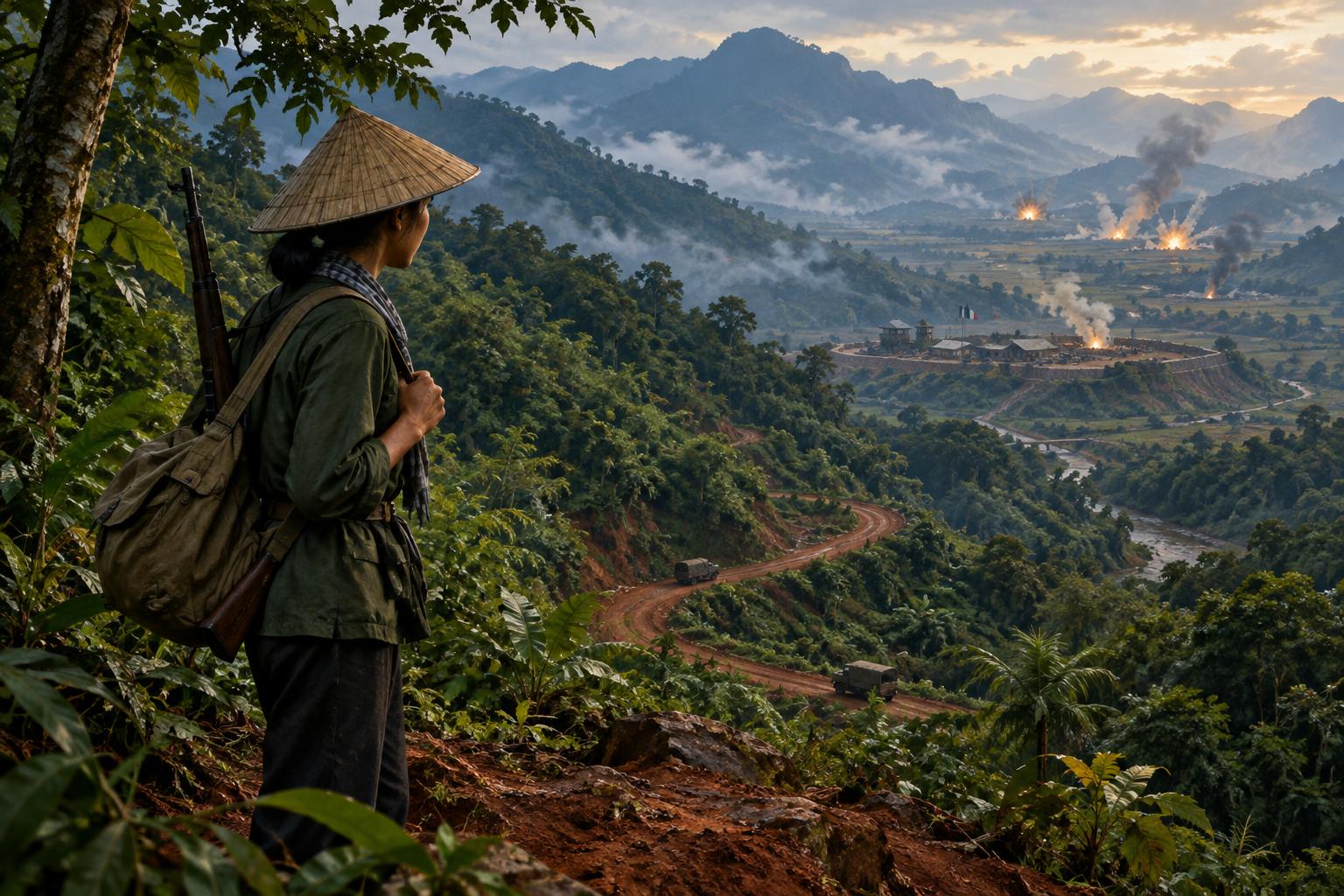
In November 1953, French forces established a fortified position at Điện Biên Phủ, a remote valley in northwestern Vietnam. French commanders hoped to draw Việt Minh forces into a battle they could supply and win with air power. Instead, the Việt Minh brought artillery and supplies into the surrounding hills and encircled the position. Moving heavy weapons through difficult terrain required extensive labor and logistics.
The siege began on 13 March 1954. Việt Minh artillery damaged the airstrip and isolated the garrison, making resupply increasingly difficult. Fighting continued for nearly two months. The position fell on 7 May. French soldiers were captured, and France’s ability to continue the war on its existing terms was badly weakened.
Điện Biên Phủ mattered both militarily and diplomatically. The Geneva Conference had opened the day after the battle began. The French defeat changed the atmosphere in which negotiators discussed a ceasefire and the region’s future. It did not by itself produce a complete political settlement, but it made continued French rule much harder to sustain.
The 1954 Geneva settlement
The Geneva Conference addressed Vietnam, Laos and Cambodia. The agreements of July 1954 arranged ceasefires and regrouping of forces. In Vietnam, a military demarcation line near the 17th parallel separated forces temporarily: the Việt Minh moved north, while French-associated forces regrouped in the south. The line was explicitly provisional and was not meant to be an international border.
The conference’s final declaration anticipated nationwide elections in 1956 to decide Vietnam’s political future. The United States did not endorse that declaration, and the planned elections did not occur. Laos and Cambodia received separate arrangements, with neutrality and limits on foreign military involvement among the stated goals. The settlement thus ended the First Indochina War without resolving the central question of Vietnamese unity and government.
France withdrew from the conflict, but the division of Vietnam persisted. The political disputes and international commitments that followed helped shape the later Vietnam War. The connection is clearest when the two wars are treated as distinct but linked: the first ended French colonial warfare; the second developed from the unresolved struggle over Vietnam’s future.
What exams ask
For world history and AP-style questions, keep the sequence clear: Japanese rule ended in 1945; France attempted to restore its position; the Việt Minh fought for independence; war began in 1946; the defeat at Điện Biên Phủ in 1954 preceded the Geneva settlement. Avoid calling the provisional line a permanent international border. The key cause was the unresolved conflict over sovereignty and unity, while the Cold War changed the outside support available to the competing sides.
A useful short answer is: the First Indochina War ended French rule in Indochina, but the 1954 settlement left Vietnam’s political unity unresolved. Then explain the evidence: the provisional military division and the unheld elections planned for 1956.
Read next
The Viet Minh and the August Revolution explains the movement and events that preceded the war. The Battle of Điện Biên Phủ follows the decisive 1954 siege in detail. The Geneva Accords and the 17th Parallel examines the settlement that ended the fighting while leaving Vietnam’s future unresolved.