In five minutes
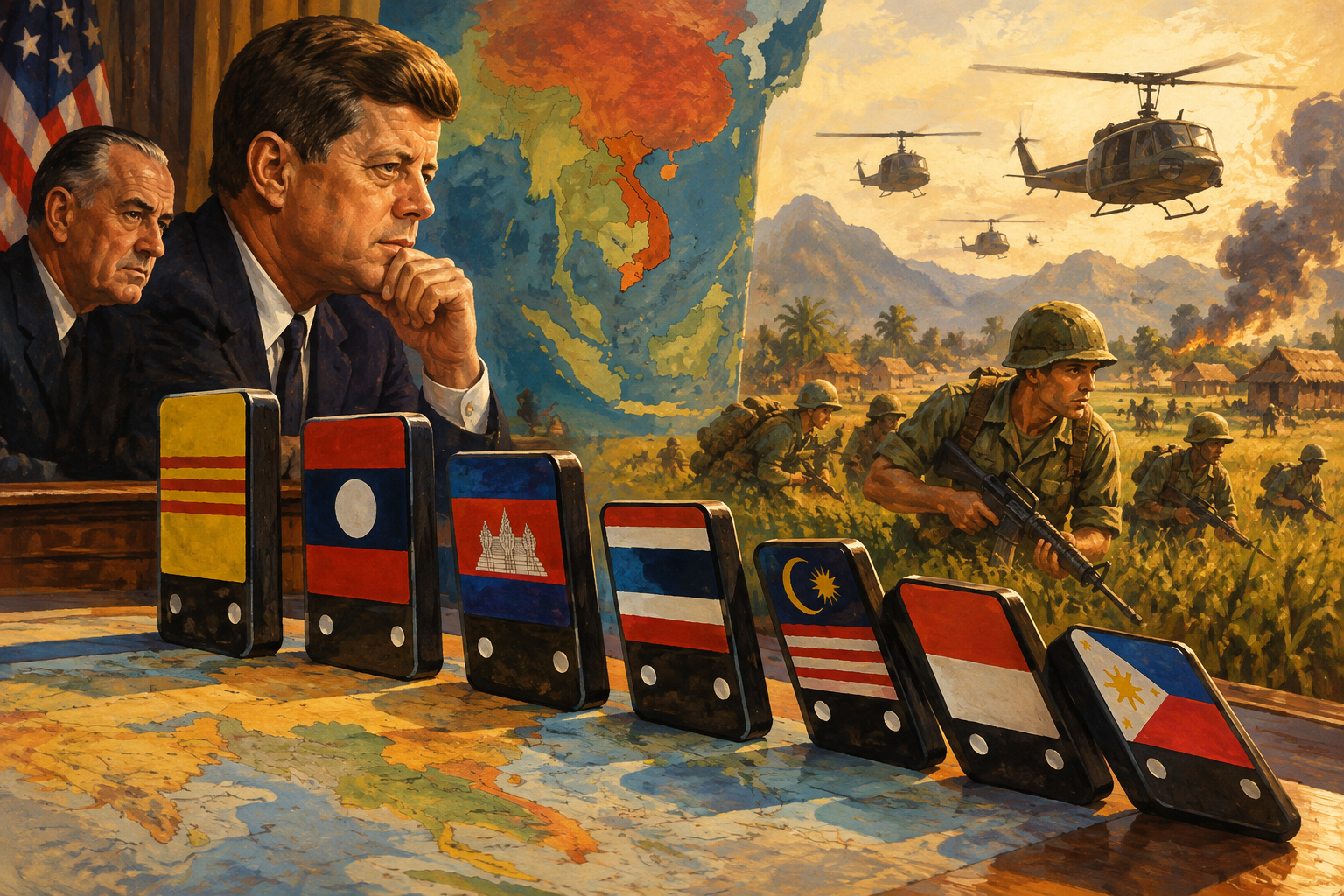
The domino theory was a Cold War argument: if one country became communist, its neighbors might follow. On April 7, 1954, President Dwight D. Eisenhower used the image of a row of falling dominoes to explain why a communist victory in Indochina could matter beyond Vietnam. France was then fighting the Viet Minh, and its position at Dien Bien Phu was under siege.
For US leaders, the concern was broader than who governed Vietnam. They feared that a communist victory might weaken American influence, unsettle allies, and encourage other governments or movements to move closer to communism. The theory helped explain why Washington supported South Vietnam and later deepened its involvement. It was a prediction about risk, however, not a law of politics. Southeast Asian countries had distinct histories, governments, and interests.
In 1975, North Vietnamese forces took Saigon, and Vietnam was later unified under communist rule. Communist governments also took power in Laos and Cambodia. Yet most of the region did not follow in a simple, automatic sequence. To understand the domino theory, separate its influence on US policy from how accurately it predicted events across Southeast Asia.
Why Vietnam looked like the first domino
After the Second World War, Vietnamese people fought to end French colonial rule. The Viet Minh, led by Ho Chi Minh, sought national independence and was organized around communist leadership. That combination shaped how officials in Washington viewed the conflict. US leaders increasingly saw anti-colonial struggles through the lens of the global Cold War, in which the United States sought to contain communist influence.
Events elsewhere made that lens more powerful. The People’s Republic of China was established in 1949, and the Korean War followed. US officials worried that communist movements might gain ground in Asia and that a change in one country could affect neighboring governments. The United States sent France financial and material aid, but it did not send its own combat forces to rescue the French position at Dien Bien Phu. The stronghold fell to the Viet Minh on May 7, 1954.
At the Geneva conference that year, participating governments agreed to a ceasefire and a temporary military division of Vietnam near the 17th parallel. National elections were planned for 1956, but the country was not unified through that process. Against this unsettled background, Eisenhower explained why he considered Indochina strategically important. His domino image connected Vietnam with a possible spread of influence toward Burma, Thailand, the Malay Peninsula, and Indonesia. A complicated regional question became an easy-to-picture chain.
For the longer background of the conflict, read What Caused the Vietnam War? It follows the colonial and political struggles that a simple domino image can obscure.
How a metaphor shaped policy
The theory connected decisions about Vietnam to a wider question: what would a US retreat mean to allies and rivals? Policymakers worried that if the United States abandoned South Vietnam, allies might question its promises and opposing forces might gain confidence. In this view, credibility was a strategic resource. A setback could matter even if neighboring governments did not immediately change.
This concern influenced policy across several administrations. The United States backed South Vietnam and gradually expanded its involvement. After the Gulf of Tonkin incident in 1964 and a subsequent congressional resolution, President Lyndon B. Johnson expanded military action. The domino theory helped justify resisting a communist victory, but it was not the only reason the war grew. Containment, alliance commitments, US domestic politics, and the political crisis in South Vietnam also shaped decisions.
In September 1954, the United States and seven other countries formed the Southeast Asia Treaty Organization, or SEATO. Despite its name, only Thailand and the Philippines joined from Southeast Asia. Burma and Indonesia remained neutral. Vietnam, Laos, and Cambodia could not join military alliances under the Geneva agreements, although SEATO treated the area as part of its protection zone. The organization had no standing army of its own. Its limited membership and powers show that governments in the region did not all share Washington’s view of the threat.
Leaders also considered the possible costs of withdrawal. They feared that defeat could damage US prestige and encourage other countries to move toward communist governments. Governments do take cues from allies, and regional developments can affect domestic choices. But the domino metaphor could make a possibility sound inevitable. It could also make conflicts rooted in different local histories look like one continuous struggle.
For the war’s full course, see The Vietnam War Explained. The Gulf of Tonkin Incident explains a turning point in the expansion of US military action.
What the theory got right, and what it missed
The theory captured one real feature of international politics: events in one country can affect its neighbors. Governments may reconsider alliances, change foreign policy, or face pressure from local rivals. A 1964 US intelligence assessment considered these possibilities. It judged a rapid chain of communist governments across Asia unlikely, even if Vietnam and Laos became communist. At the same time, it warned that US standing could suffer and that countries such as Thailand might shift their political position.
That distinction matters. The assessment did not claim that a communist victory in Vietnam would have no regional consequences. It treated those consequences as varied and dependent on what the United States and other governments did next. Indonesia, the Philippines, Japan, Thailand, and Burma had different interests and political conditions. Counting how many dominoes might fall could not tell policymakers what each country would choose.
Events after 1975 also showed the limits of a literal chain reaction. Vietnam was unified under communist rule, Laos established a communist government, and the Khmer Rouge took power in Cambodia in 1975. Thailand, Malaysia, Indonesia, and the Philippines did not quickly follow the same path. Regional change was real, but it was not uniform. Local histories and domestic politics mattered.
So was the theory wrong? Its strongest claim—that one communist victory would automatically bring a rapid sequence of neighboring revolutions—did not fit the varied outcomes. Its broader warning—that a conflict could affect alliances, credibility, and regional strategy—is harder to dismiss. The problem was that policymakers could use both claims together. A reasonable concern about influence could turn into a stronger assertion that defeat would trigger an unstoppable cascade.
Why it mattered to the United States
The domino theory gave US leaders a strategic language for explaining intervention. If South Vietnam fell, allies might doubt American commitments and opponents might gain ground. That fear helps explain why the United States continued its involvement even as the costs of war rose and South Vietnam remained politically unstable.
The same framework could narrow policymakers’ view. When stopping a chain reaction became the priority, the aims of people at the center of the conflict could receive less attention. Vietnam was not just a tile in a US–Soviet contest. Vietnamese people had their own political goals, disagreements, and experience of colonial rule. Treating the conflict mainly as a test of American credibility could make those realities harder to see.
When studying the theory, ask more than whether Eisenhower’s prediction came true. What did the metaphor help policymakers explain? What did it hide? Would the United States have made different choices if events had unfolded another way? The domino theory worked as a warning about influence between countries, but it also made a complex region look more predictable than it was.
What exams ask
For an AP-style answer or a world history exam, define the domino theory as the Cold War belief that a communist victory in one country could encourage neighboring countries to follow. Connect it to containment and US support for South Vietnam. Then place it in sequence: Eisenhower’s 1954 statement, the temporary division set out at Geneva, expanded US involvement in the 1960s, and Vietnam’s unification in 1975.
A stronger answer also evaluates the theory’s limits. It influenced US policy, but neighboring governments did not change automatically. Laos and Cambodia had communist governments after 1975, while many other Southeast Asian countries did not. Distinguish the theory’s effect on policymakers from its accuracy as a prediction.
Read next
What Caused the Vietnam War? explains the colonial and political roots of the conflict. The Gulf of Tonkin Incident traces a turning point in US escalation. Then read The Vietnam War Explained for the wider timeline, participants, and outcome.