In five minutes
Jean-Jacques Rousseau was a writer and thinker born in Geneva in 1712 who died in France in 1778. He argued that people are basically good by nature, that society and private property create inequality, and that legitimate political power rests on the general will of the people. His books made him famous across Europe, and in 1762 one of them forced him to flee France. He is one of the central figures of the Enlightenment, and also one of its most uncomfortable ones, because he attacked ideas that many of his fellow thinkers took for granted.
Early life in Geneva
Rousseau was born on 28 June 1712 in Geneva, an independent city-state with a strict Calvinist culture. His mother died nine days after his birth. He was raised by his father, Isaac, a watchmaker, and by relatives. As a boy he read Plutarch's lives of famous men and a great many novels, and he later described this reading as formative. It gave him a lasting sense that freedom and virtue mattered more than comfort. As a teenager he was apprenticed to an engraver, disliked the harsh treatment, and in 1728 left the city at about fifteen with no clear plan.
Years of wandering
For more than a decade after leaving Geneva, Rousseau moved from place to place. In Savoy, Madame de Warens became a patron and mentor, helping him continue his education. In 1742 he went to Paris with a new system of musical notation, hoping it would make his name. The system did not bring the success he wanted. In Paris, however, he met Denis Diderot, one of the editors of the Encyclopédie, and later wrote articles on music for that work. For a time he worked as secretary to the French ambassador in Venice.
Around 1745 Rousseau began a long relationship with Thérèse Levasseur, and the couple had five children. Rousseau gave the children up to a foundling home. The decision has been strongly criticised ever since, and it sits uneasily beside his later writing on education.
The First Discourse and the question of progress
In 1750 the Academy of Dijon set an essay question: has the revival of the arts and sciences improved morals? Rousseau said it had not. Art, learning and luxury, he argued, encouraged people to care about appearances and reputation, while honesty and simplicity declined. The essay won first prize and made him famous almost overnight. It also set a pattern for the rest of his career: he took a question that others thought was settled and argued that the accepted answer was wrong.
The Discourse on Inequality
Five years later, Rousseau published the Discourse on the Origin and Basis of Inequality Among Men, usually called the Second Discourse. It asks how people moved from simple, largely solitary lives to a world of masters and servants, rich and poor. Rousseau imagined a 'state of nature', a time before society, when humans were self-sufficient and not especially cruel. Inequality grew as people settled, depended on one another and began to compete.
The turning point in his account is private property. The first person who fenced off a piece of land and persuaded others to accept the claim laid the foundation of unequal society. Rousseau did not argue that humanity should return to the forest. He wanted readers to see that much inequality was made by society, not handed down by nature. The philosopher Voltaire replied with a mocking letter.
Julie, Émile and The Social Contract
In 1761 Rousseau published Julie, or the New Heloise, a long epistolary novel about love, duty and the moral life that became a bestseller. In 1762 came two works that defined both his reputation and his troubles.
The Social Contract
The Social Contract is a short book about political legitimacy. Rousseau asked how people can remain free while living under laws and rulers. His answer was that people give up some natural liberty to join a community, and in return gain civil freedom and the security of laws they help to make. Freedom, in this view, is not doing whatever one likes but obeying a law one has given oneself.
Legitimate laws, he argued, express the general will: what is best for the community as a whole. That is not the same as adding up everyone's private wishes. The idea that sovereignty belongs to the people rather than to a king passed on to later revolutionaries.
Émile, or On Education
Émile follows the imaginary upbringing of a boy named Émile, from infancy to adulthood, under the guidance of a tutor. Rousseau argued that children should learn through experience and their own senses, not through memorised rules and punishments. Each stage of childhood, he said, has its own needs, and children are not simply small adults. This child-centred approach was new and very influential.
The book also contained a section called the 'Profession of Faith of the Savoyard Vicar', which questioned revealed religion and offended the Church. In June 1762 the Parlement of Paris condemned Émile and ordered Rousseau's arrest. He fled to Switzerland, and the authorities in Paris and Geneva also condemned the book.
Exile and final years
Rousseau spent much of the following years in exile. In 1766 he accepted an invitation to England from the philosopher David Hume, but the friendship collapsed and the visit ended badly. He returned to France in 1767 and lived modestly, earning money partly by copying music. In this period he wrote the Confessions, an unusually frank autobiography, and the Reveries of the Solitary Walker, a set of reflections on solitude. Both were published after his death.
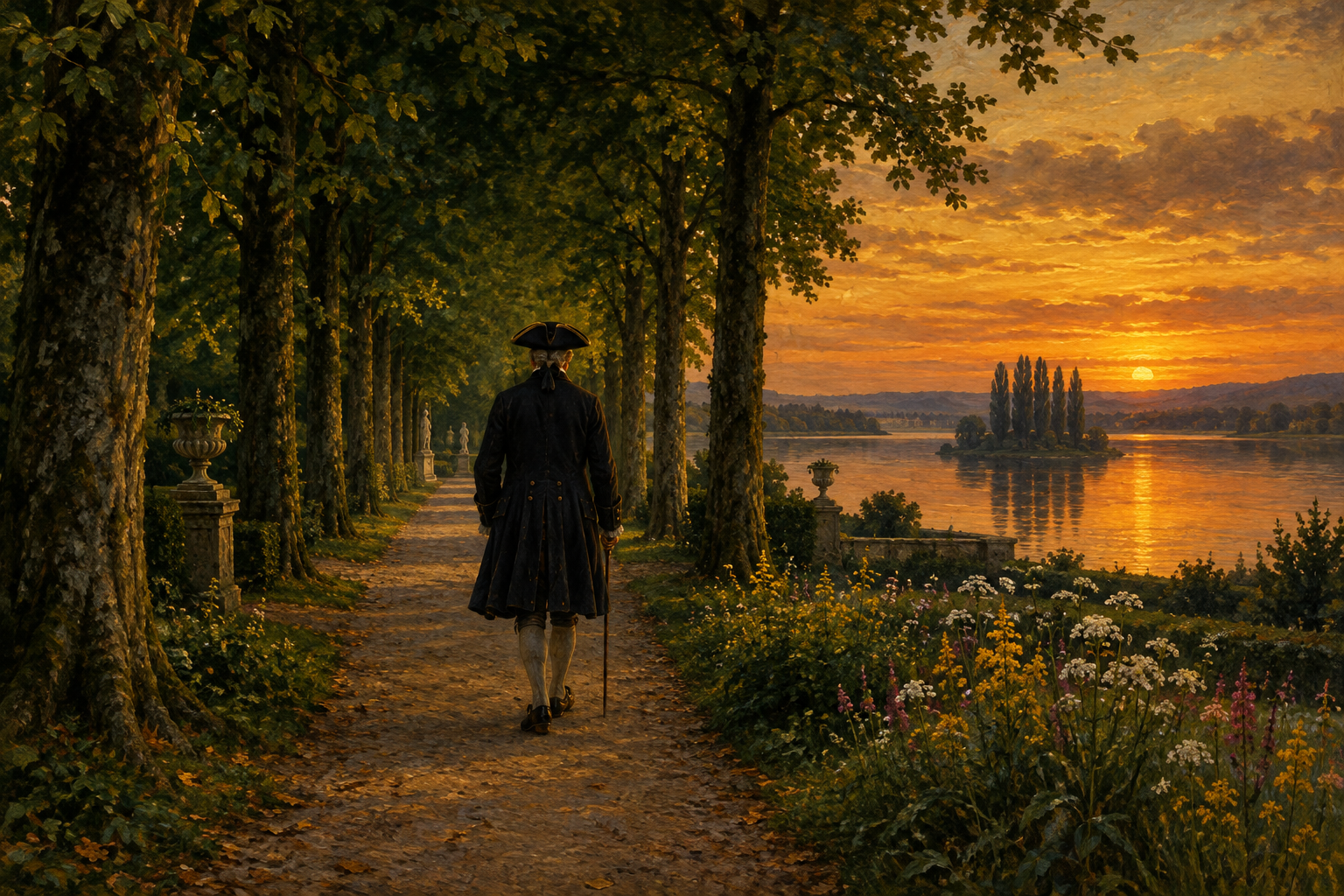
He died on 2 July 1778 at Ermenonville, a park north-east of Paris, aged 66. He was first buried on a small island of poplars in the park's lake. In 1794, during the French Revolution, his remains were moved to the Panthéon in Paris, a national honour.
Why his ideas still matter
- Politics: the idea that sovereignty rests with the people shaped the thinking of the French Revolution. Robespierre openly admired him.
- Education: learning by doing and respect for a child's stage of development became core ideas in modern teaching.
- Literature and feeling: his focus on emotion, nature and inner life influenced the Romantic writers who followed.
- Social critique: his argument that private property drives inequality still feeds debates about wealth and fairness.
Rousseau's ideas also drew sharp criticism. Later liberal thinkers warned that the general will could be used to justify forcing people to be free. The phrase 'noble savage' is often linked to him, but it is a later simplification of his views rather than his own term.
What exams ask
- Why did Rousseau argue that the arts and sciences did not improve morals, and which examples did he use?
- How does the Discourse on Inequality link private property to social inequality?
- What is the general will, and how does it differ from the will of all?
- How do Rousseau and John Locke differ on the origin and purpose of political authority?
Strong answers name the work, the key concept and one example from the text. For a closer look at Locke, see the John Locke page.
Read next
- Montesquieu: The Spirit of the Laws and the Separation of Powers: a contemporary whose work on law and power frames many of Rousseau's debates.
- Rousseau's Emile: Education According to Nature: a closer look at the book that made Rousseau a target of the authorities.
- Who Was John Locke? Life, Ideas and Influence: the earlier thinker of natural rights and government by consent.