In five minutes
Montesquieu was a French judge and writer who asked a practical question: what stops people with power from abusing it? His answer, set out in The Spirit of the Laws (1748), is to divide power. One body should make the laws, another should carry them out, and a third should judge disputes. Each should be able to check the others. This idea, known as the separation of powers, is one of the most influential in modern politics, and it is the reason his name still appears in courses on government and history.
If you remember one thing, remember this: Montesquieu argued that liberty survives when power is divided, not when rulers happen to be kind. For the wider movement he belonged to, see our Enlightenment hub.
Causes: why Montesquieu wrote about laws
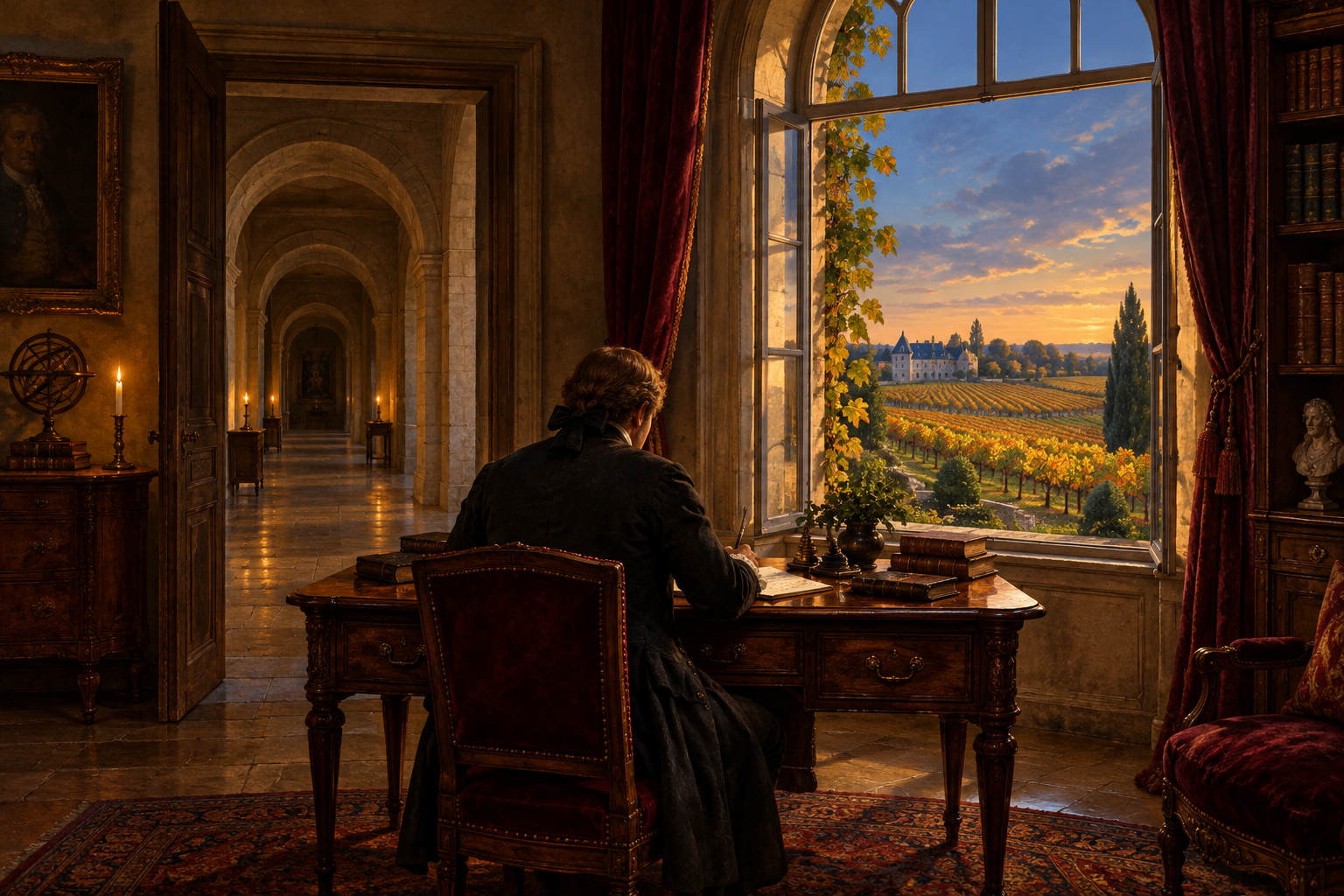
Montesquieu was born in 1689 at the château of La Brède, near Bordeaux, into a noble family with a long tradition of legal service. In 1716 he inherited a judge's seat in the Parlement of Bordeaux, along with the title baron de Montesquieu, from an uncle. He sold the post in 1726 and turned his energy to writing and to the intellectual life of Paris.
The France he lived in was an absolute monarchy. Louis XIV had died in 1715, but the crown still held enormous authority, and the law was a patchwork. Customs, courts and taxes differed from one province to another. Trained in law and curious about history, Montesquieu wanted to understand why laws varied so much and what kind of laws protect people's freedom.
His first major success came in 1721 with the Persian Letters, published anonymously. It used fictional letters from two Persian travellers in Paris to mock French manners, religious disputes and royal power. The satire made him famous and showed his method: compare societies, look for patterns, and question what people take for granted.
From about 1728 to 1731 he travelled through Europe, including England. There he observed a parliament and courts that were far from perfect but had a reputation for protecting freedom. That experience shaped the central argument of his later work.
What happened: Montesquieu's The Spirit of the Laws
The Spirit of the Laws appeared in 1748 after many years of work. It is long and covers politics, law, economics, religion and climate. Three ideas stand out.
Laws should fit their society. Montesquieu rejected the idea that good laws can simply be copied from one country to another. Laws, he argued, should suit the climate, land, religion, customs and economy of the people who live under them. He called the overall character of a nation its general spirit. The title points to this: the spirit of the laws is the web of relations between laws and everything else that shapes a society.
Governments come in three kinds. He sorted governments into republics, monarchies and despotisms. Each rests on a different principle, a human motive that keeps it working. Virtue sustains a republic, honour holds up a monarchy, and fear keeps a despotism in place. A despotism is run by one person's will, with no fixed laws to limit it.
Power must check power. The most famous part of the book is Book XI, chapter 6, where Montesquieu discusses the English constitution. He noticed that people who hold power tend to use it as far as it will go, so power has to be restrained by other power. He therefore split the authority of the state into three:
- The legislative power, which makes laws.
- The executive power, which carries laws out and handles foreign affairs, war and peace.
- The judicial power, which punishes crimes and settles disputes between individuals.
Take a simple case. A parliament passes a law, a government enforces it, and courts decide how it applies to a particular dispute. If the same group did all three, nobody inside the system could stop it going wrong. If one person or body held two of the powers, Montesquieu argued, liberty would be at risk. He also described judges as little more than the mouth that speaks the law, a view later readers would question.
Consequences: from Paris to Philadelphia
The book was a bestseller and a target at the same time. It went through more than twenty editions in about two years. In 1751, however, the Catholic Church placed it on the Index of Forbidden Books, largely because of its critical approach to religion and social traditions.
The idea of divided power travelled further than the book itself. When American leaders drafted the Constitution in 1787, they split federal power between Congress, the president and the federal courts. In Federalist No. 47, published in 1788, James Madison leaned heavily on Montesquieu as the authority on separating powers. Madison also noted that the state constitutions of his day did not keep their powers fully separate, a useful reminder that a principle on paper can be hard to apply.
In France, the Declaration of the Rights of Man and of the Citizen, adopted in August 1789, says in its sixteenth article that a society which does not guarantee rights or separate powers has no constitution. Separation of powers was thus treated as a condition of a real constitution.
Montesquieu's legacy also has a darker side. His chapters on slavery in Book XV are written as bitter irony against slave owners, yet some of his arguments linking climate with character were later borrowed by writers defending racist ideas. Modern readers should read him critically and in context.
What exams ask
Exam questions about Montesquieu tend to test four things. First, define the separation of powers and name the three branches with their roles. Second, explain why he thought power must check power, using the English example. Third, compare him with John Locke, who wrote about government by consent and natural rights, and with Jean-Jacques Rousseau, who placed the general will at the centre of politics. Montesquieu's distinct concern was the institutions and social conditions that keep liberty in place. Fourth, show how his ideas reached the US Constitution or the 1789 Declaration, using one specific example. Strong answers rely on concrete cases, not general praise.
Read next
Read Natural Rights: Life, Liberty and Property to see the rights that Montesquieu's system of divided power was meant to protect. Who Was John Locke? Life, Ideas and Influence explains the government-by-consent theory that shaped the same debates. For the rival idea of the general will, read Who Was Jean-Jacques Rousseau?