In five minutes
The French Revolution was a decade of upheaval that began in 1789 and reshaped France. A state close to bankruptcy, a society divided by birth into three estates, and a king who could not persuade the privileged orders to accept reform led to a chain of events. Within a few years the absolute monarchy was gone, feudal privileges had been abolished, and a declaration of universal rights had been written down. The revolution then turned violent, with the king executed in 1793 and the Reign of Terror that followed. Historians usually end it with Napoleon Bonaparte's seizure of power in 1799. This page is part of our World History 1700–1918 guide, which places the revolution alongside the other great upheavals of the period.
French Revolution causes: debt, unfair taxes and hunger
Three pressures built up in France during the 1780s, and they fed each other.
- Money. Years of war and the costs of the royal court had left the state deeply in debt. France had also helped the American colonists in their War of Independence, which added to the bill. Efforts to raise new taxes ran into resistance from privileged groups, and reform stalled.
- Unequal taxes. Society was divided into three estates: the clergy, the nobility and everyone else, known as the Third Estate. The clergy and nobility were exempt from many taxes, so most of the burden fell on the Third Estate, which included peasants, town workers, merchants and lawyers.
- Hunger. A poor harvest in 1788, followed by a severe hailstorm in the summer, sent bread prices up sharply. Bread was the staple food of the poor, and city workers and peasants spent much of their income on it, so higher prices meant real hardship.
In May 1789 Louis XVI summoned the Estates-General, a meeting of representatives of the three estates, for the first time since 1614. The central dispute was how votes would be counted. If each estate voted as a block, the clergy and nobility could outvote the commons two to one. The Third Estate demanded that each deputy count as one vote. The abbé Sieyès had already argued in a widely read pamphlet that the Third Estate was, in effect, the nation itself.
What happened: from reform to radicalism, 1789–1794
The deadlock broke in June 1789. Deputies of the Third Estate declared themselves the National Assembly on 17 June. Locked out of their meeting hall, they gathered in a nearby indoor tennis court and swore the Tennis Court Oath on 20 June, promising not to separate until France had a constitution. Some clergy and nobles soon joined them.
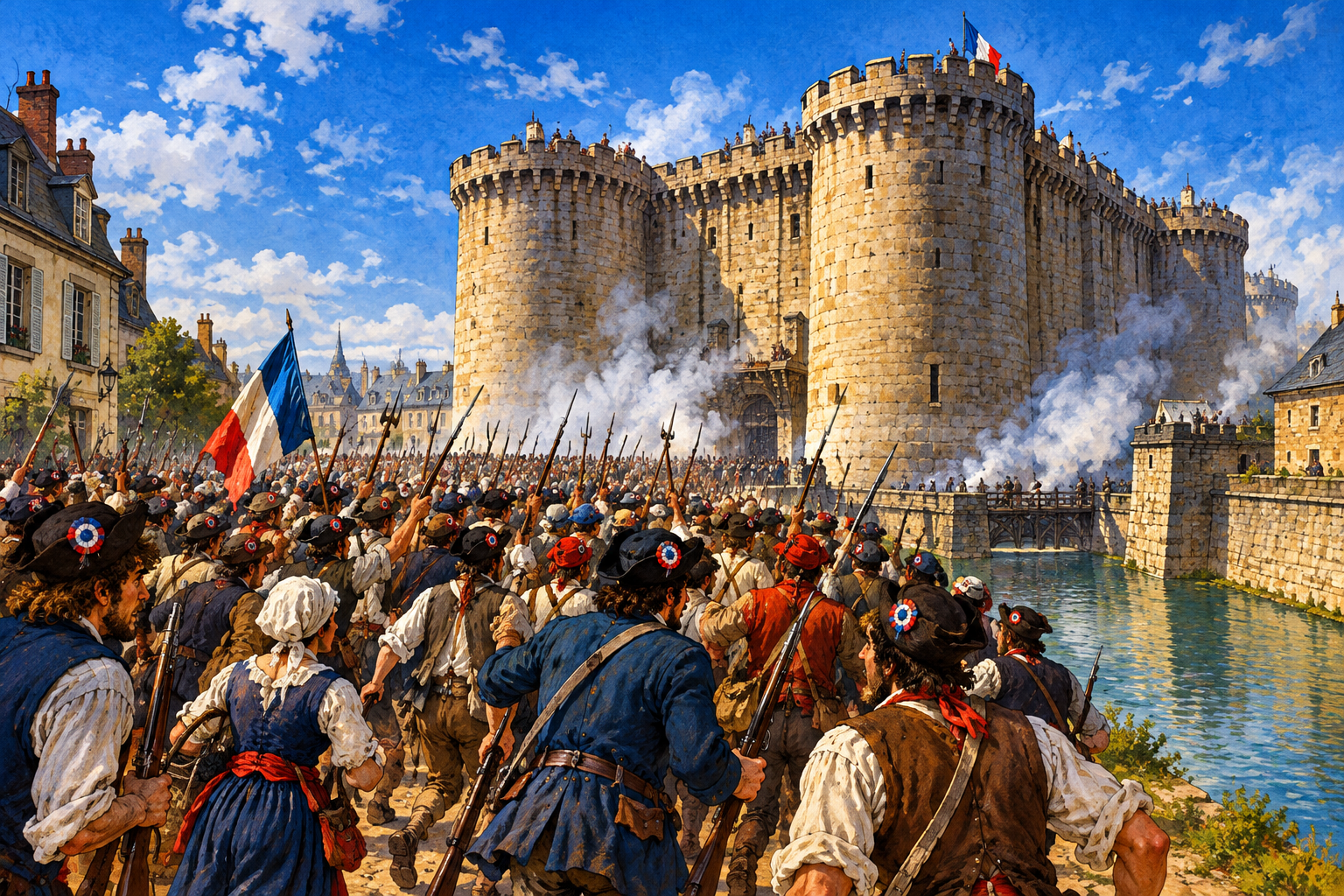
In Paris, rumours spread that the king was gathering troops to close the Assembly, and fear grew. On 14 July, crowds seeking gunpowder and weapons stormed the Bastille, a royal fortress that also served as a prison. The governor was killed. The fortress held only a handful of prisoners, but the event became a powerful symbol of popular power.
The revolution spread into the countryside that summer. Rumours of brigands and aristocratic plots set off peasant revolts known as the Great Fear, and many châteaux were attacked. On the night of 4 August, the Assembly voted to abolish feudal privileges, including many dues that peasants owed to lords. On 26 August it adopted the Declaration of the Rights of Man and of the Citizen. It stated that men are born free and equal in rights, and that sovereignty rests with the nation. It did not extend the same rights to women. Olympe de Gouges answered in 1791 with her own Declaration of the Rights of Woman and of the Female Citizen, and she was executed in 1793.
In October 1789, Parisian women marched to Versailles to demand bread, and the royal family was brought back to Paris. The Assembly then rebuilt the state. France was divided into departments, and the Civil Constitution of the Clergy of 1790 placed the Church under state control. Its demand that clergy swear loyalty split the clergy and angered many believers. In 1791 a constitution made the king a constitutional monarch with limited powers, and a new Legislative Assembly met that autumn.
In June 1791 the royal family tried to flee the country. They were recognised and stopped at Varennes. The failed escape badly damaged trust in the king.
In April 1792 France declared war on Austria, which was seen as the home of Queen Marie Antoinette and a centre of opposition to the revolution. The war went badly, and rumours of royal treason spread. On 10 August insurgents attacked the Tuileries palace, and the king was suspended and imprisoned. In early September, mobs killed prisoners in Paris prisons. On 21 September the new National Convention abolished the monarchy and declared France a republic.
Inside the Convention, the Girondins clashed with the radical Montagnards, who sat on the high benches and were closely linked to the Jacobin Club. The radicals gained control. Their street support came from the sans-culottes, urban artisans, small shopkeepers and workers who pressed for bread price controls and wider political participation. In January 1793, Louis XVI was tried for treason and executed by guillotine on 21 January. The Vendée revolt, foreign invasion and food shortages then pushed the government towards emergency measures.
Between about September 1793 and July 1794, the Reign of Terror targeted people suspected of opposing the Republic. Suspects were arrested, tried quickly and often executed. The guillotine was used across France, and Paris saw the most intense executions in mid-1794.
Estimates of the death toll vary. Historians generally count about 17,000 official executions, and the total number of deaths, including people killed without trial and those who died in prison, was higher. Exact figures are debated, so it is best to remember the range rather than a single number.
The Terror ended with the fall of Robespierre on 27 July 1794, known as 9 Thermidor. He was executed the next day. Earlier, in February 1794, the Convention had abolished slavery in the French colonies, a decision that Napoleon partly reversed in 1802. In 1795 a new constitution set up the Directory, a five-man executive that ruled until 1799.
Consequences: from republic to Napoleon
The revolution changed France in lasting ways. Feudal dues and noble privileges disappeared. Internal tolls were removed, and the old provinces were replaced by departments. Ideas about equality before the law spread, and La Marseillaise was adopted as the national anthem in 1795. Many of these changes were later written into Napoleon's Civil Code.
The Directory was weak. It faced royalist and radical plots, economic trouble and a war that dragged on. A general who had made his name in Italy and Egypt, Napoleon Bonaparte, overthrew it in a coup on 9 November 1799, known in the revolutionary calendar as 18 Brumaire. He became First Consul and in 1804 crowned himself Emperor. Some revolutionary ideals survived under his strong state, but political freedoms were narrowed.
The revolution's effects reached across Europe. Revolutionary armies carried new ideas into neighbouring lands, and the wars that began in 1792 continued, with breaks, until Napoleon's final defeat in 1815.
Historians still debate what the revolution meant. Some stress its contribution to ideas of citizenship and rights. Others focus on the violence, the failure of constitutional monarchy and the road to authoritarian rule. The best approach is to test both views against the sources and the sequence of events.
What exam questions ask
Exam questions often ask you to explain causes, to order events, or to compare the revolution with another event. Points worth knowing:
- Causes: link state debt, unequal taxes, food prices and Enlightenment ideas rather than listing them separately.
- Turning points: 1789 (Estates-General, Bastille, Declaration), 1791 (constitutional monarchy), 1792 (republic), 1793–1794 (Terror), 1799 (Napoleon's coup).
- Comparison: the American Revolution aimed at independence from a distant power. The French Revolution tried to remake the social order itself, which made it far more socially disruptive.
- Significance: explain how the end of feudal privileges, the language of rights and Napoleon's rise shaped later politics.
Read next
For background, read The American Revolution: Causes, War and Independence. It gives the context for the war that helped push France into debt.
To see what came after, read The Napoleonic Era (1799–1815): Empire, War and the Congress of Vienna, which follows Bonaparte from First Consul to the settlement of Europe.
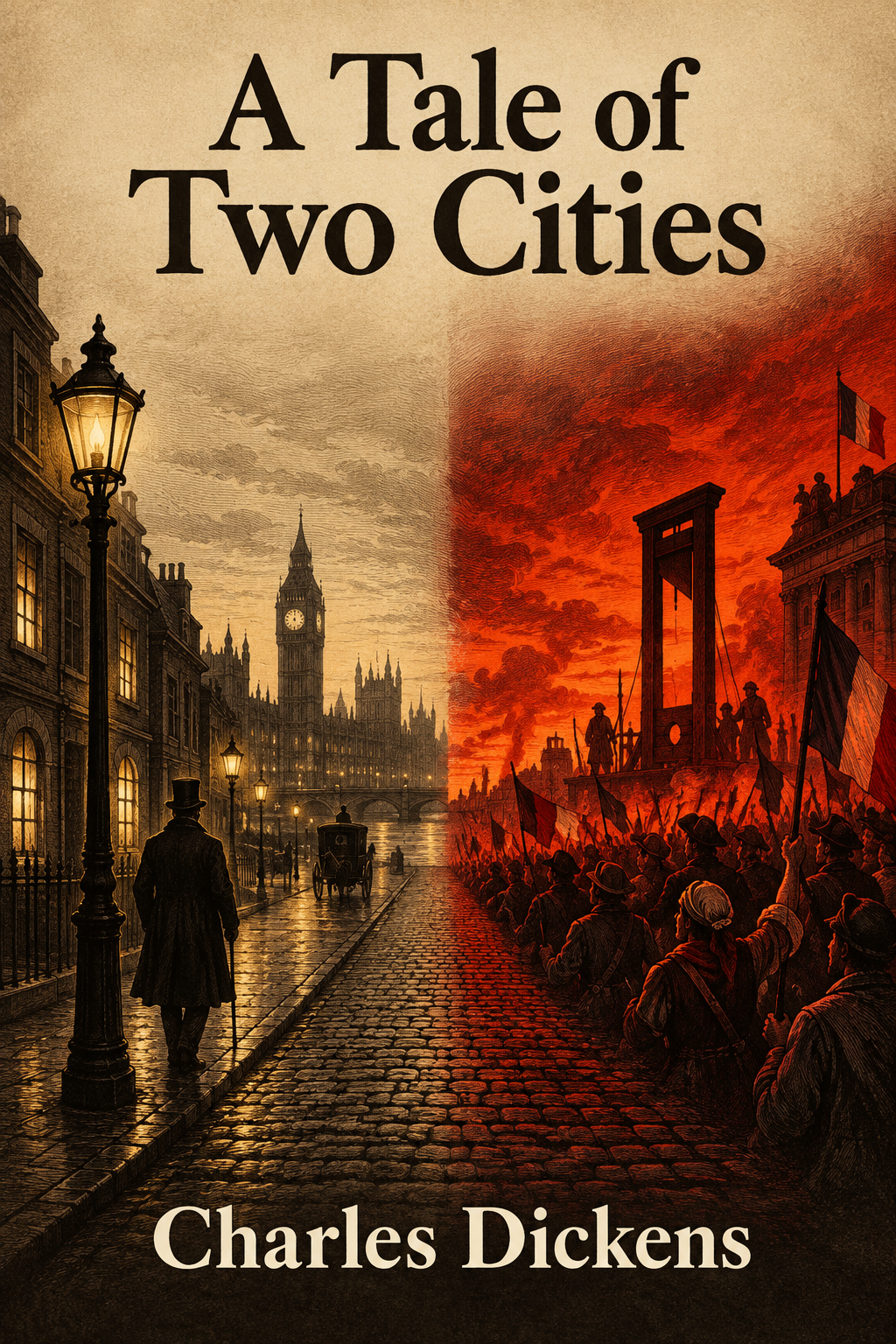
For a story set in the same years, try A Tale of Two Cities by Charles Dickens. Its London and Paris settings put ordinary lives in the path of the Terror.