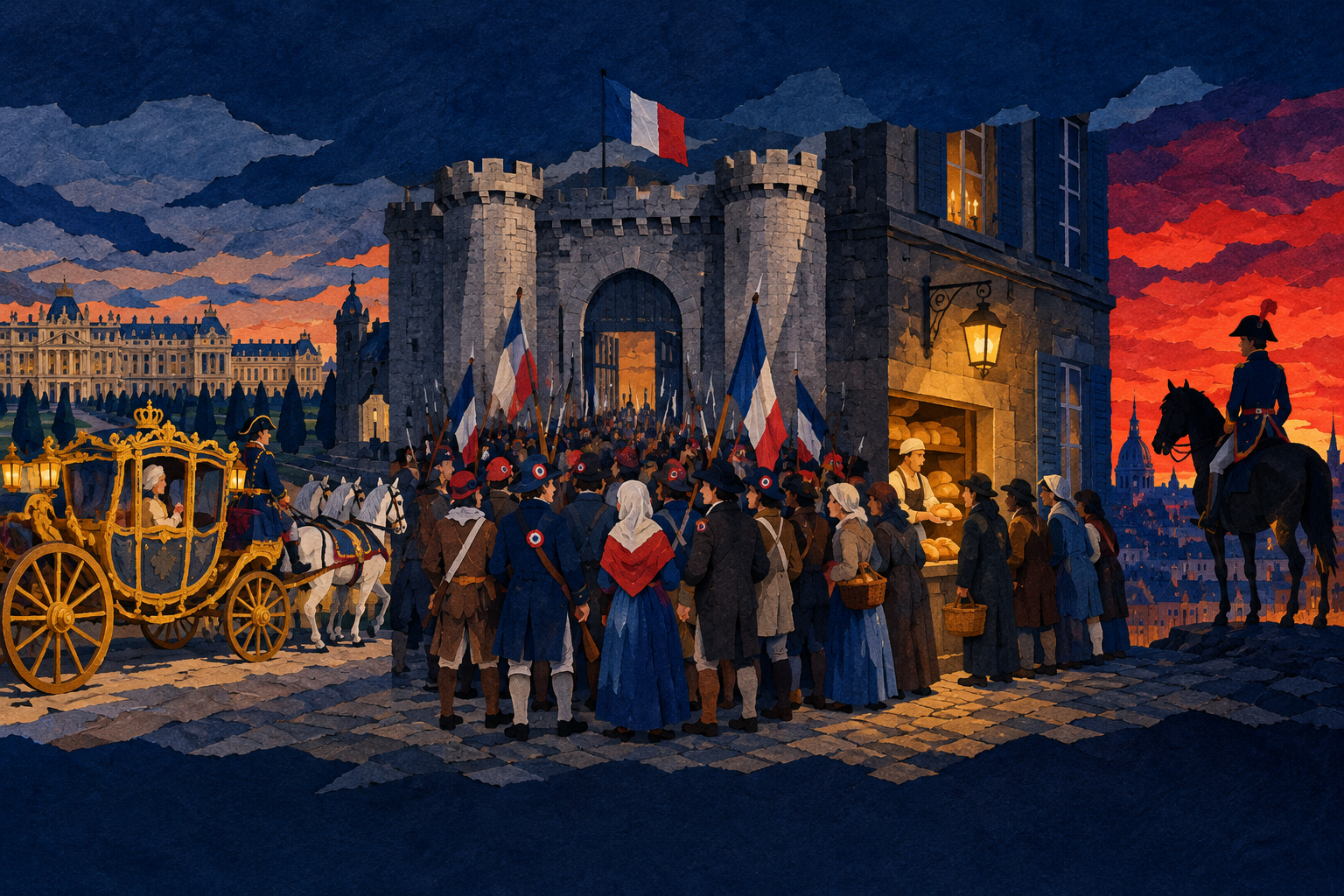
French Revolution timeline in five minutes
This French Revolution timeline covers the decade from 1789 to 1799. In those ten years France moved from absolute monarchy to constitutional monarchy, then to a republic, through the Terror, and finally under the Directory. Many historians date the end of the revolution to Napoleon Bonaparte's seizure of power in November 1799. For the wider story, start with our French Revolution hub, then use the dates below as anchors.
The short version is a simple chain. Money ran out, the king called an assembly to approve new taxes, the commoners turned that assembly into a revolutionary body, war radicalized politics, and the Terror followed. Keep that sequence in mind and the individual dates will fall into place.
Causes: debt, privilege and bread
By the late 1780s the French state was close to bankruptcy. Years of expensive wars, including France's support for the American colonists against Britain, had left huge debts. The tax system fell hardest on the Third Estate, the commoners who made up the vast majority of the population, while privileged clergy and nobles paid far less. The Estates-General had not met since 1614, so there was no regular forum for these grievances. Enlightenment ideas about rights and reason were also spreading among educated readers. Then a poor harvest in 1788 pushed bread prices up, and urban workers often spent much of their income on bread.
These pressures turned a money problem into a political one. For the full context, read Causes of the French Revolution.
1789 to 1792: from the Estates-General to a constitutional monarchy
Louis XVI opened the Estates-General at Versailles on May 5, 1789. The dispute quickly turned to voting. The Third Estate wanted each deputy to have one vote, while the other two estates wanted voting by order. In January 1789, the cleric Abbé Sieyès had published a pamphlet arguing that the Third Estate was, in effect, the whole nation, yet had almost no political voice. On June 17 the Third Estate declared itself the National Assembly. Three days later its members found their meeting hall locked, so they gathered in an indoor tennis court and swore not to separate until France had a constitution. This is known as the Tennis Court Oath.
On July 14, Parisians stormed the Bastille, a royal fortress and prison. It held only seven prisoners, but it stood for royal power in the capital and became the revolution's most famous symbol. In the countryside, the Great Fear of late July and early August brought rumors of brigands and aristocratic plots, and peasants attacked manors and burned feudal records. On the night of August 4, the Assembly abolished feudal privileges. On August 26 it adopted the Declaration of the Rights of Man and of the Citizen, a 17-article statement that people are born free and equal in rights. Yet it did not name women or enslaved people in the colonies as holders of those rights, a limit that exam questions often test. In October, a large crowd, many of them women, marched to Versailles, and the royal family was brought back to Paris.
In June 1791 the royal family tried to leave Paris in secret. They were recognized and stopped at Varennes on June 21, and the failed flight badly damaged the king's standing. In September the Assembly finished a constitution that made France a constitutional monarchy, and a new Legislative Assembly met in October. The king kept some executive power, but written law now limited it.
1792 to 1794: republic, war and the Terror
In April 1792 France declared war on Austria, and the early campaigns went badly. On August 10, insurgents attacked the Tuileries Palace, where the royal family was staying, and the king was suspended. In September, mobs in Paris killed many prisoners in what became known as the September Massacres. On September 20 the French army held its ground at Valmy against an invading Prussian-led force. The next day the newly elected National Convention abolished the monarchy. The new Republic counted its first year from September 22, 1792.
Louis XVI was tried by the Convention and guillotined in Paris on January 21, 1793. Marie Antoinette followed in October. In February France also declared war on Britain and the Dutch Republic, and in March a revolt broke out in the Vendée. In June the Convention expelled the Girondins, a more moderate group, and the Jacobins led by Robespierre took control. In August the Convention ordered a levée en masse that called citizens into the army. It also approved a new constitution by referendum, but that constitution was never put into effect, and the government stayed in emergency mode.
The Terror became official government policy in September 1793. The Law of Suspects of September 17 allowed the arrest of a broad range of people seen as enemies of the Republic, and revolutionary courts passed sentences quickly. Historians usually estimate about 17,000 official executions during the Terror, but estimates vary, and many more people died in prisons and in regional repression.
1794 to 1799: Thermidor, the Directory and Napoleon
On July 27, 1794 (9 Thermidor in the revolutionary calendar), the Convention turned against Robespierre. He was arrested that day and executed the next. Historians call this turning point the Thermidorian Reaction, and the Terror's most radical phase ended with it.
The Convention wrote a new constitution in 1795. It created a two-chamber legislature and an executive of five Directors, the Directory, which took office in November 1795. The Directory's problems were structural. Its legislature and executive often clashed, paper money had lost much of its value, and governments struggled to pay for the war. In November 1799 (18 Brumaire in the revolutionary calendar), General Napoleon Bonaparte staged a coup, dissolved the Directory and began the Consulate. Many historians date the end of the revolution to this moment.
The effects lasted far longer. Feudal privileges and the absolute monarchy were gone, and equality before the law remained. France abolished slavery in its colonies in February 1794, but Napoleon's government restored it in some colonies in 1802. His Civil Code of 1804 kept many revolutionary reforms, and the départements created during the revolution still organize France's local government.
What exams ask
Exam questions usually focus on causes, turning points and significance. Know the sequence from the Estates-General to Napoleon, and be ready to explain why the revolution turned radical after 1792. For the 1789 Declaration, give both its achievements and its limits. For the Terror, explain how the revolution moved from a fight for a constitution to a fight for survival, and then toward a military ruler.
Memorize five anchor years: 1789 for the Estates-General and the Declaration, 1792 for the end of the monarchy, 1793 for the king's execution and the Terror, 1794 for Robespierre's fall, and 1799 for Napoleon's coup. Practice one dated sentence for each, because short, precise answers are easier to reuse under time pressure.
Read next
Continue with Causes of the French Revolution for the pressures that built up before 1789, Effects of the French Revolution for the wider changes, and Who Was Louis XVI? for the king at the center of the crisis.