In five minutes: who was John Locke?
John Locke (1632–1704) was an English philosopher who argued that knowledge comes from experience and that governments are legitimate only when the people they rule consent. If you have heard of natural rights, or of government “by the consent of the governed,” you have met his ideas. He is one of the central figures of the Enlightenment, the early modern movement that put reason and evidence at the centre of thinking about the mind, society and politics.
Locke was born in 1632 in Wrington, a village in Somerset in south-west England. His father was a lawyer who had served with the Parliamentary side in the English Civil War, and the family’s politics would shape the son’s later choices. Locke studied at Christ Church, Oxford, where he became interested in medicine and the new experimental science. Around 1666 he met Anthony Ashley Cooper, later the first Earl of Shaftesbury, who became his patron. Locke served Shaftesbury’s household as a physician and political adviser, and he was drawn into the bitter politics of the 1670s and early 1680s.
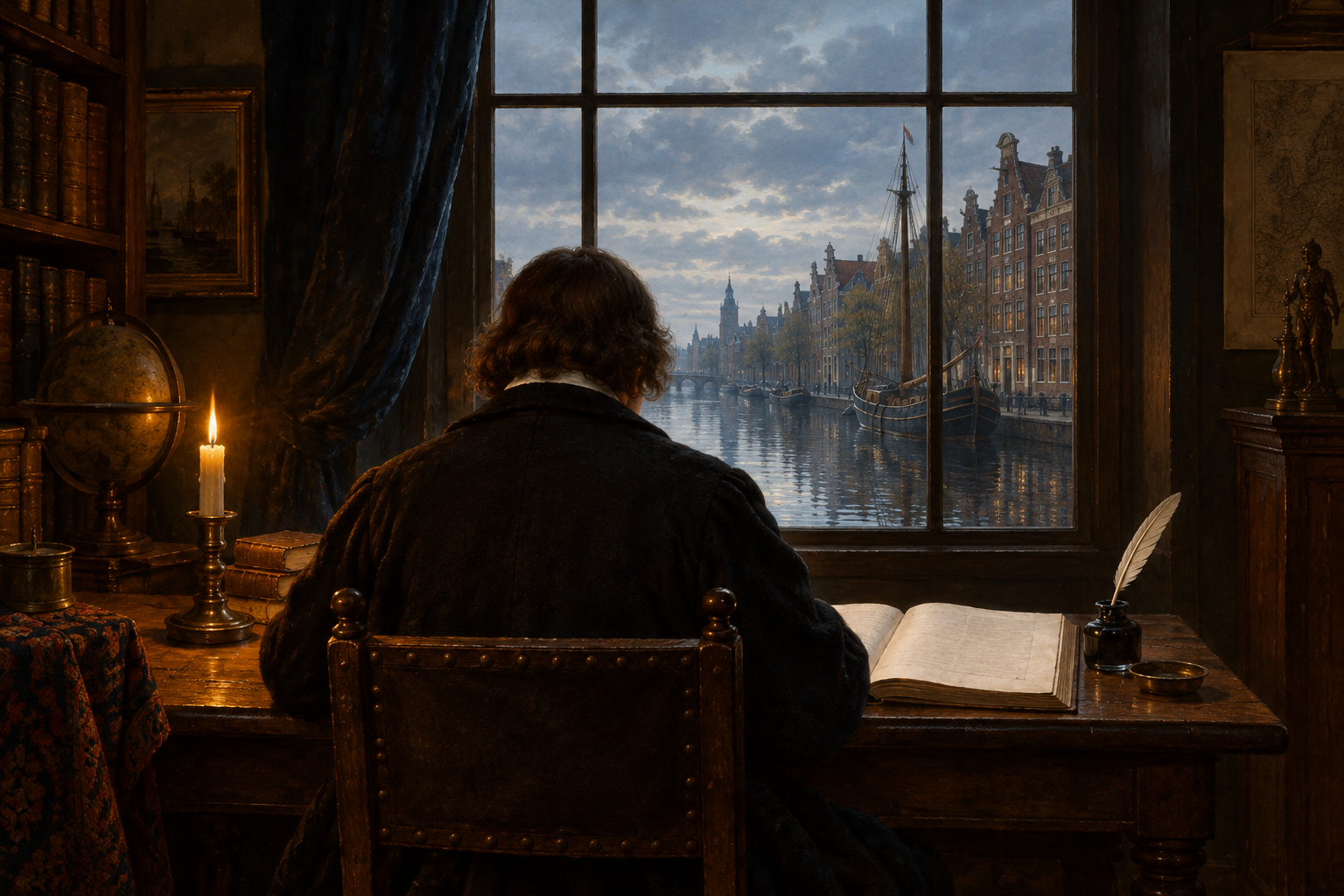
When Shaftesbury fell from favour, Locke’s position became dangerous. He left England in 1683 and spent about six years in the Dutch Republic, where many English dissidents lived. He came back in 1689, after the Glorious Revolution had placed William and Mary on the throne. In his last years he worked as a commissioner on trade and colonial affairs and wrote on religion and education. He died at Oates in Essex on 28 October 1704.
Ideas about the mind
Locke’s major philosophical work is An Essay Concerning Human Understanding, which he developed over many years and published in 1689. It starts from a simple question: where do our ideas come from? Locke rejected the view that people are born with fixed ideas already stamped on the mind. He argued instead that the mind starts out nearly empty, like a sheet of blank paper, and fills up through two sources. The first is sensation, the experience of seeing, hearing, tasting and touching. The second is reflection, in which the mind looks at its own activity, such as remembering, doubting or wanting.
This approach is usually called empiricism. Its basic lesson is that our knowledge should be built from experience, and that we should be honest about the limits of what we can know. Locke did not doubt everything, though. He believed reason could establish some truths, including the existence of God. The Essay is therefore less an attack on knowledge than a map of what the human mind can reach and where it runs out.
Ideas about government
Locke’s most influential political writing is the Two Treatises of Government, which appeared anonymously in late 1689. The First Treatise is a long attack on Robert Filmer’s Patriarcha, which argued that kings hold power directly from God, in the way a father rules his household. Locke’s reply is blunt. No one is born with the authority to rule others, and the scriptural case for Filmer’s view does not hold up.
The Second Treatise sets out Locke’s positive theory. He describes a state of nature, a condition before government in which people are free and equal and bound by a law of reason. In that state people have natural rights to life, liberty and property. The state of nature is insecure, however, because there is no common judge to settle disputes impartially. So people agree to form a society and set up a government. Its job is to protect their rights, and its authority rests on their consent.
Three further ideas stand out. First, Locke argued that property comes from labour: when a person works on land or resources, that work gives them a claim to what they produce. Second, he separated power into a legislature, which makes the laws, an executive, which carries them out, and a “federative” power that handles relations with other states. Third, if rulers betray the trust placed in them and repeatedly violate people’s rights, the people may replace the government. Historians often call this a right of resistance or revolution. Locke was careful to present it as a last resort against a long pattern of abuse, not an invitation to rebel over small grievances.
Toleration and education
In 1689 Locke also published A Letter Concerning Toleration, first in Latin, arguing that the state should not force people to accept a particular faith. Churches, in his view, should not use civil power to punish belief. He drew a line between the care of souls, which belongs to individuals and their consciences, and the duties of the magistrate, which concern civil matters such as life and property. The argument was radical for its time, yet it had limits. Locke excluded Catholics, whom he saw as owing loyalty to a foreign prince, and atheists, whom he thought could not be trusted to keep promises. Modern readers often treat this exclusion as one of the clearest weak points in his position.
In 1693 he published Some Thoughts Concerning Education, a practical book of advice on raising a gentleman’s son. Locke argued that children learn best through experience, play and good habits rather than harsh punishment or endless memorising. He linked a healthy body with a well-formed mind and stressed that virtue and good manners mattered more than learning for show. The book is less famous than the Essay, but it shows the same basic faith that people are shaped by what they experience.
Influence and criticism
Locke’s ideas travelled widely. French writers of the Enlightenment, including Voltaire, admired his arguments for tolerance and his suspicion of arbitrary power. In the American colonies, his language of natural rights became part of the political vocabulary that led to the Declaration of Independence in 1776. The Declaration lists life, liberty and the pursuit of happiness as rights, and Thomas Jefferson’s wording echoes Locke’s triad of life, liberty and property, though the last term changes. In philosophy, David Hume and Immanuel Kant both developed their thinking in response to the empiricist tradition that Locke had shaped, with Hume pushing it toward scepticism and Kant trying to answer it.
Criticism is part of the story too. Locke’s theory of property is often read alongside his own financial and colonial interests. He was a shareholder in the Royal African Company, which was central to the English slave trade, and in the late 1660s and 1670s he worked for the proprietors of Carolina, a colony that came to rely on enslaved labour. Historians debate how far these connections shaped his thinking, and how far they reveal a gap between his principles and his conduct. Some critics also argue that his idea of rights was written with property-owning men in mind and left out women, the poor and enslaved people. Readers can take Locke seriously as a thinker while still asking these hard questions.
Why it matters in exams
In exam questions, Locke usually appears in three forms. Expect a question on empiricism: the blank-paper picture of the mind, the difference between sensation and reflection, and his rejection of innate ideas. Expect a question on social contract theory, which asks you to link the state of nature, natural rights, consent and the right to resist. And expect a comparison with Thomas Hobbes. Hobbes saw the state of nature as so dangerous that people needed an absolute sovereign, while Locke saw it as a condition of freedom and equality made unstable by the lack of a common judge. A strong answer explains why each thinker reached a different conclusion, not just what each one argued.
Read next
To see how the social contract idea was pushed in a more radical direction, read Rousseau’s The Social Contract Explained. For a companion guide to Locke’s political argument, see Locke’s Two Treatises of Government. To see how the language of natural rights was later extended to women, read Who Was Mary Wollstonecraft?.