In five minutes: who was Robespierre?
Maximilien Robespierre was a lawyer from Arras who became one of the leading voices of the Jacobins during the French Revolution. From 1793 to 1794 he sat at the centre of the government and pushed the Reign of Terror forward, a period when courts and committees sent large numbers of people to the guillotine as enemies of the Republic. He was known as “The Incorruptible”, and his fall in July 1794 brought the Terror to an end. For the wider story, see The French Revolution Explained (1789–1799).
Textbooks usually describe him in one of two ways: an idealist who fought for equality, or a dictator who justified mass executions in the name of virtue. Both descriptions rest on real evidence from his career. The short answer to “who was Robespierre?” is that he was a principled speaker who became one of the faces of a government that sent many of its own citizens to the guillotine.
From lawyer to Estates-General deputy
Robespierre was born on 6 May 1758 in Arras, in northern France. He won a scholarship to study in Paris, then went home to practise law. In 1789 the king called the Estates-General to address a severe financial crisis, and Robespierre was elected to represent the region of Artois. He quickly became known for careful, forceful speeches once the debates began.
The Estates-General was an old assembly that voted by estate: the clergy, the nobility and the Third Estate, which made up the vast majority of the population. Voting by order meant the two privileged estates could always outvote the Third Estate. In June 1789 the Third Estate declared itself the National Assembly, and the crisis turned into a full political revolution. Robespierre was one of the voices in the new assembly who argued that ordinary people deserved a real say in government.
He argued against the death penalty in 1791, but the Assembly did not adopt his proposal. His reputation for personal honesty, a modest way of life and devotion to principle grew from these years and later earned him the nickname that still follows him.
Rise to the Committee of Public Safety
In September 1792 Robespierre was elected to the National Convention for Paris. In January 1793 he voted for the execution of Louis XVI. That spring and summer France faced revolts at home and wars abroad. In June 1793 the Convention expelled and arrested leading Girondin deputies, which left the Jacobins in control of the assembly. In late July, Robespierre joined the Committee of Public Safety, the body that ran the government during the crisis.
The Committee of Public Safety had been created in April 1793 to coordinate the war effort and deal with internal revolt. It was not a single-person government: it was a group of members who worked through the Convention and through subcommittees, and it grew steadily in power as the crisis deepened. Robespierre was never the only figure in government, but his speeches and standing made him the most influential voice in the group.
The Jacobins formed the radical wing of the Convention and were closely linked with deputies who sat on the high benches, known as the Mountain. Its members spoke of virtue and the public good, and they believed the Republic could only survive if its enemies were dealt with firmly.
The Reign of Terror and the laws behind it
The government used emergency powers. The Law of Suspects, passed in September 1793, widened the power to arrest anyone regarded as hostile to the Revolution. Revolutionary tribunals judged cases quickly, and many of the accused were condemned. Robespierre defended this system as a necessary protection for the Republic, arguing that swift, harsh justice was the price of survival.
The Terror was not only a matter of one law. In early September 1793 the Convention declared that terror would be the order of the day. Local committees compiled lists of suspects, and people who were accused were often arrested first and investigated later. The accused included former nobles, priests who had refused to take the oath to the state, merchants suspected of hoarding goods, and people from regions where revolt had broken out. The result was a climate in which a neighbour’s complaint could be enough to end a life.
In 1794 the circle of targets widened to former allies. Hébert and his followers were executed in March, and Danton was executed in early April. Each execution deepened the fear inside the Convention, where deputies began to ask who would be next.
Why was Robespierre executed?
Several moves in June 1794 pushed the Convention against him. On 8 June he presided over the Festival of the Supreme Being, a state ceremony meant to give the Republic a civic religion. Two days later, the Law of 22 Prairial simplified trial procedure and sharply limited the accused’s right to defend themselves. Under the law, moral proof could be enough to convict. Executions in Paris rose, and many deputies came to see the law as a threat to their own safety.
Robespierre also spent much less time at the committees in the weeks before the crisis, and his rivals had time to organise. On 26 July 1794 he gave a long speech to the Convention. He warned of enemies inside the Convention and the committees, but he named no one. For deputies who feared they might be on an unnamed list, that vagueness was itself alarming.
On 27 July 1794, which the revolutionary calendar called 9 Thermidor, the Convention declared him an outlaw. Robespierre had gathered supporters at the Paris town hall, and during his arrest he was shot in the jaw. Historians still do not agree whether he shot himself or was wounded in the struggle. Being outlawed meant he could be executed without a trial.
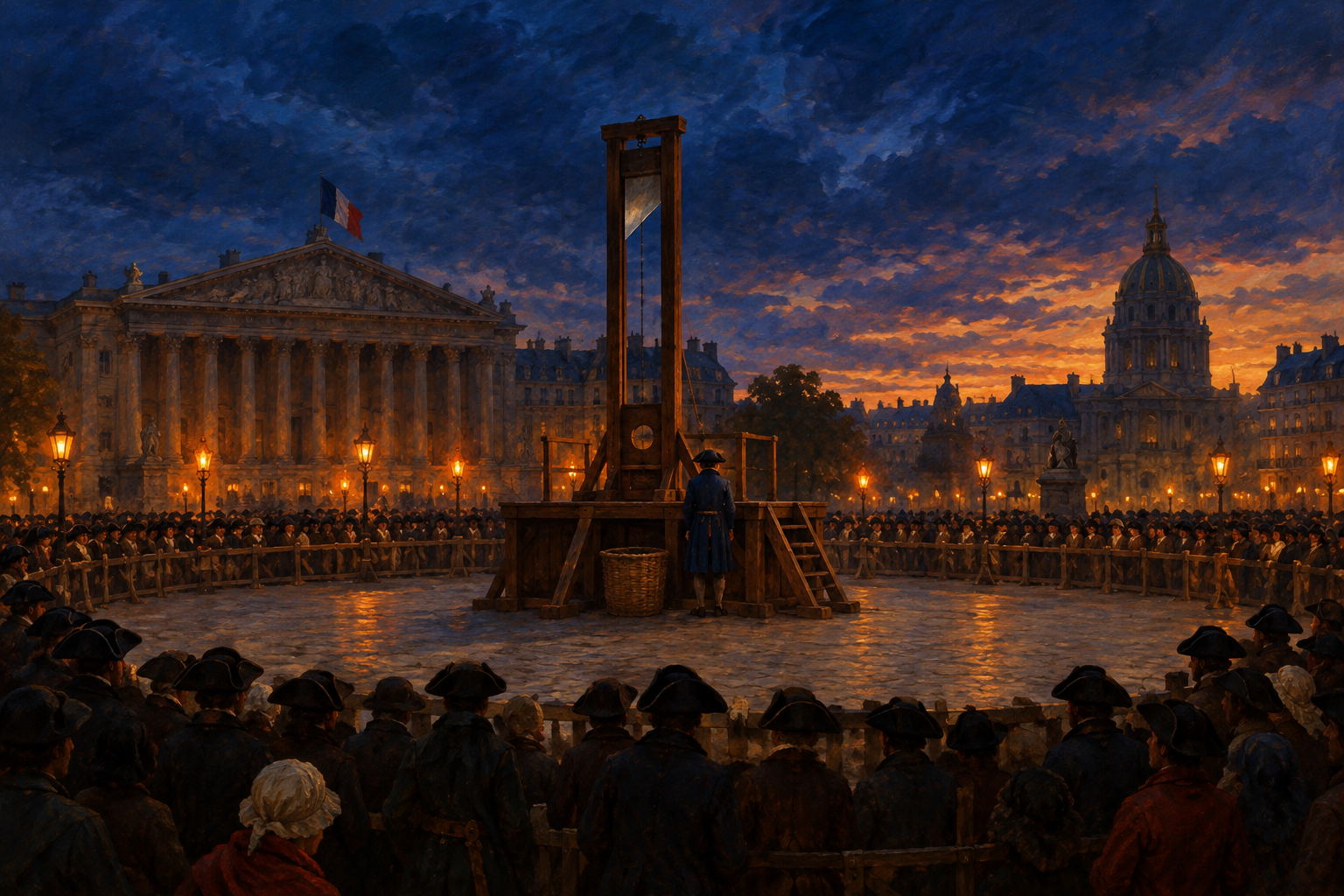
He was guillotined the next day, 28 July 1794 (10 Thermidor), at the Place de la Révolution, together with about twenty of his allies. Among them were his younger brother Augustin and Louis Antoine de Saint-Just, a close ally who had been one of the most energetic enforcers of the Terror. He was 36 years old. Historians often read the execution as a sign that the Revolution had begun to consume its own leaders.
What came next, and why opinions still differ
Robespierre’s fall ended the Terror. The period that followed, known as the Thermidorian Reaction, saw prisoners released, many former Jacobins punished and the Jacobin Club closed in November 1794.
Estimates of the death toll vary. Official executions are usually put at over ten thousand, but the wider toll, including deaths in prisons and outside legal process, is still debated. It is more useful to remember the system than a single number: laws that made suspicion enough to arrest, courts that moved quickly, and a government that saw enemies everywhere.
Opinions about Robespierre still divide historians and readers. Some see an idealist who fought for equality and for ordinary people against privilege, and who lived with a personal modesty that set him apart. Others see a leader who used the language of virtue to justify executions and to remove rivals.
Both views rest on real evidence. The useful question is not which label to pick, but how the ideals and the violence were connected in his own time, and how far he controlled the system he defended. Earlier writers often took one side or the other. Later scholars have worked with the records of the Convention and its committees, which give a more detailed picture of how decisions were made.
What exam questions ask
- Trace the path from the Estates-General of 1789 to the Committee of Public Safety, and explain why power moved there in 1793.
- Compare the Law of Suspects (1793) with the Law of 22 Prairial (1794) and explain how each widened the Terror.
- Assess Robespierre’s reputation: an idealist who wanted equality, or a leader who justified violence in its name. Use evidence for both sides.
Strong answers name both views, support each with evidence, and then argue for a conclusion rather than picking one side without evidence.
Read next
To see the court and the crisis that set the Revolution in motion, read Versailles and Marie Antoinette’s Court. For the institutions and events of the violent period, The Reign of Terror (1793–1794) is the next step. The king’s trial and death are covered in Who Was Louis XVI?, and the full timeline is in The French Revolution Explained (1789–1799).