The Estates-General of 1789 was France's national meeting of its three estates: the clergy, the nobility and the Third Estate, which covered everyone else. King Louis XVI called it to meet at Versailles to solve a serious debt crisis. After about six weeks of deadlock, the Third Estate declared itself the National Assembly. This event is part of our French Revolution hub, which follows the revolution from 1789 to 1799.
In five minutes
What was the Estates-General?
Think of the Estates-General as a national assembly organised by rank rather than by one vote per citizen. Clergy and nobles had long held privileges, including exemptions from many taxes. The Third Estate, made up of commoners, carried most of the tax burden but had few rights. When the state ran short of money in the 1780s, that arrangement became very hard to defend.
The meeting matters because it was the first time in about 175 years that France's three estates came together. The question of how votes would be counted then split them. Once the Third Estate chose to act on its own, the old system of separate orders could not be restored in its old form.
Why the king called it
France was deeply in debt. Part of that debt came from the war that helped the American colonies break away from Britain, and by the late 1780s the government was running a deficit of about 150 million livres a year. Ministers wanted a land tax that would also reach the privileged orders. The Assembly of Notables and the regional parlements argued that only the Estates-General could approve new taxes, and the king agreed to call it. The Estates-General had last met in 1614.
Before the meeting, electoral assemblies across France drew up cahiers de doléances, notebooks of grievances. Across all three estates, they asked for regular meetings of the Estates-General, fairer taxes, legal reform and Church reform. Many blamed ministerial waste and poor management rather than the king alone.
The problem of the Third Estate
In late 1788 the king agreed to double the Third Estate's representation. Commoners would have about 600 seats, while the clergy and nobility each had about 300. That sounded like fairness, but it did not settle the real question: how votes would be counted. If each estate voted as one block, the Third Estate still had only one vote in three. Doubling its seats was a real concession, but it left the central question unanswered.
In early 1789, the abbé Sieyès published a pamphlet titled What Is the Third Estate? It argued that the Third Estate was, in effect, the nation. It did most of the work and paid most of the taxes, he argued, yet had no real political voice. That argument shaped how many Third Estate deputies saw their role.
Who were the deputies?
The clergy included bishops and abbots as well as parish priests, and the nobility ranged from great court nobles to provincial landowners. The Third Estate's deputies were typically lawyers, merchants and other professionals, many with legal training. Their experience with argument and procedure helped them organise quickly once they acted together.
What happened
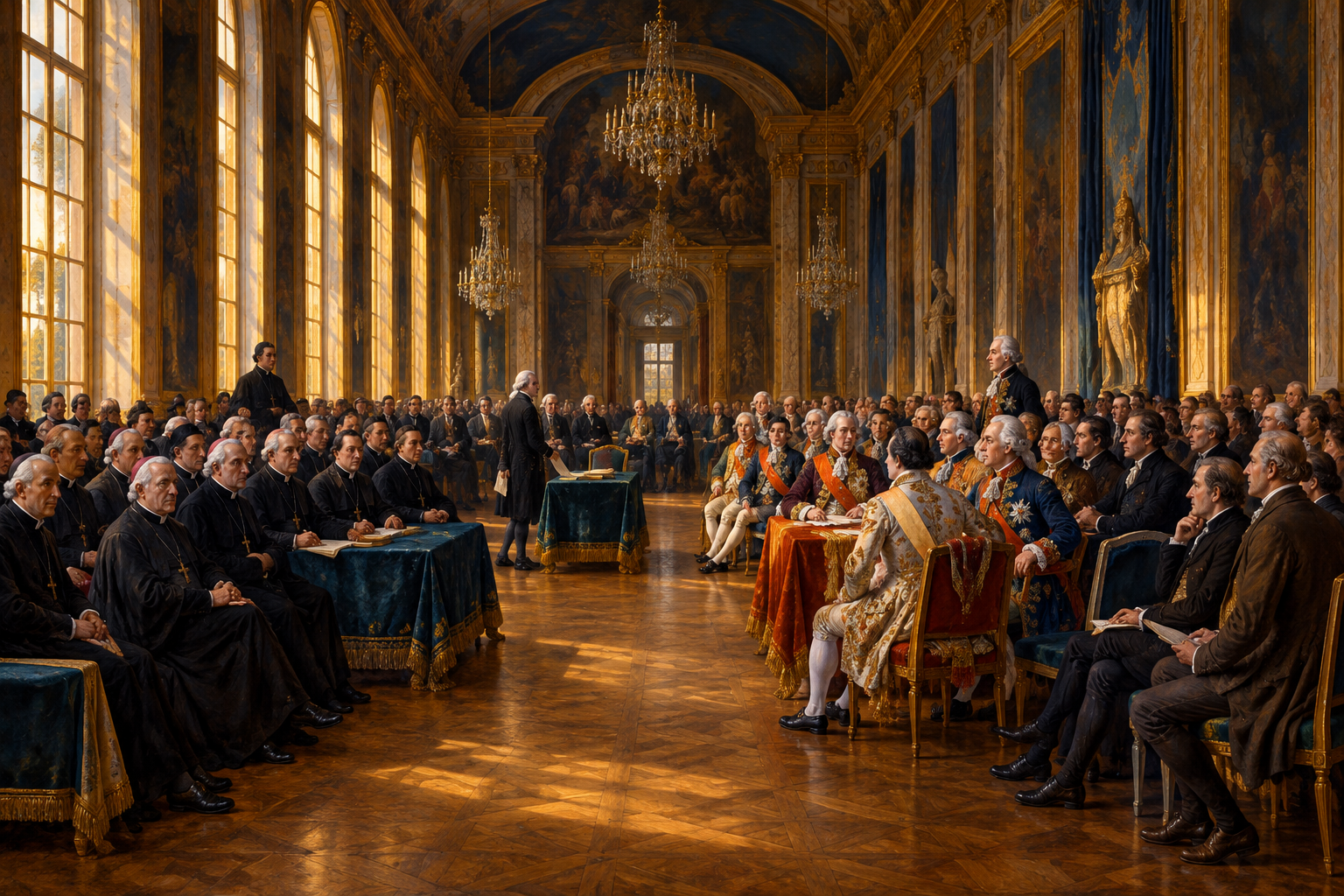
The Estates-General opened on 5 May 1789 in the Hôtel des Menus-Plaisirs at Versailles. Almost at once the deputies disagreed about how the meeting should run and how votes should be counted. The clergy and nobility wanted voting by order, which protected their privileges. The Third Estate wanted voting by head, which would give it a majority. For about six weeks, the meeting was stuck.
The deadlock was about more than arithmetic. The clergy and nobility saw voting by order as the way the meeting had always worked, and defending it meant defending their privileges. The Third Estate argued that every deputy should count equally. Each side saw the other as trying to change the rules unfairly, and neither was ready to give way.
Among the most vocal Third Estate deputies was Mirabeau, whose speeches made him one of the best-known figures of the early revolution.
On 17 June, the Third Estate declared itself the National Assembly by 491 votes to 89. The move claimed that the deputies spoke for the whole nation, not for one order. Three days later, on 20 June, the deputies found their meeting hall closed. They gathered at a nearby indoor tennis court and swore not to separate until France had a constitution. This became known as the Tennis Court Oath.
On 23 June, the king held a royal session. He presented a programme of reforms but ordered the three orders to meet separately again. The Third Estate stayed where it was. On 27 June, the king told the clergy and nobility to join the Third Estate. The old system of separate orders was effectively over.
What it led to
On 9 July, the assembly renamed itself the National Constituent Assembly and set to work on a constitution. Five days later, on 14 July, Parisians stormed the Bastille, a royal fortress and prison. The revolution had moved out of the meeting hall and into the streets, beyond the king's control.
Historians often describe June and July 1789 as one fast sequence: a dispute over voting, a new name for the assembly, a royal session and a popular uprising in Paris. For people living through it, the change felt sudden, even though its causes had been building for years.
On the night of 4 August, the assembly voted to abolish many feudal privileges. Later that month it adopted the Declaration of the Rights of Man and of the Citizen. The king's position weakened with each step: he tried to keep the old order while accepting some reforms, and each failure left the Third Estate stronger. The monarchy itself was abolished in September 1792. Many historians see the Estates-General as the turning point where the old system of orders broke down. The crisis also had deeper causes in money, ideas and social tension, which came together in 1789.
What exams ask
In AP European History, the Estates-General can come up in questions about the causes of the Revolution, or about the move from absolute monarchy toward constitutional government. Three points are worth remembering. First, the fiscal crisis was tied to privilege, because the privileged orders largely escaped the taxes the state needed. Second, the voting dispute showed that counting votes was itself a political battle. Third, the Third Estate's claim to speak for the nation carried the idea that sovereignty belonged to the people.
A good practice question is why the voting method mattered so much. A strong answer links the three-estate structure to population size, and explains how the Third Estate could be a majority of the nation yet still lose a vote counted by order.
A short exam answer can follow three steps: explain the fiscal crisis and the tax exemptions of the privileged orders, describe the dispute over voting, and show how the Third Estate's claim to speak for the nation changed the balance of power. Use the key dates as anchors: 5 May, 17 June, 20 June and 14 July will carry most of your timeline.
Students often mix up the Estates-General and the National Assembly. The Estates-General was the traditional meeting of the three estates, called by the king. The National Assembly was the name the Third Estate gave itself on 17 June 1789, and it later became the National Constituent Assembly. Keep the two apart in your notes, and remember that the first is the institution and the second is the new body that grew out of the deadlock.
Read next
To understand the system the Estates-General was built on, read The Ancien Régime and the Three Estates. For what the Third Estate did next, continue with The National Assembly of 1789. If you want the king's side of the story, Who Was Louis XVI? explains the monarch who called the meeting.