In five minutes
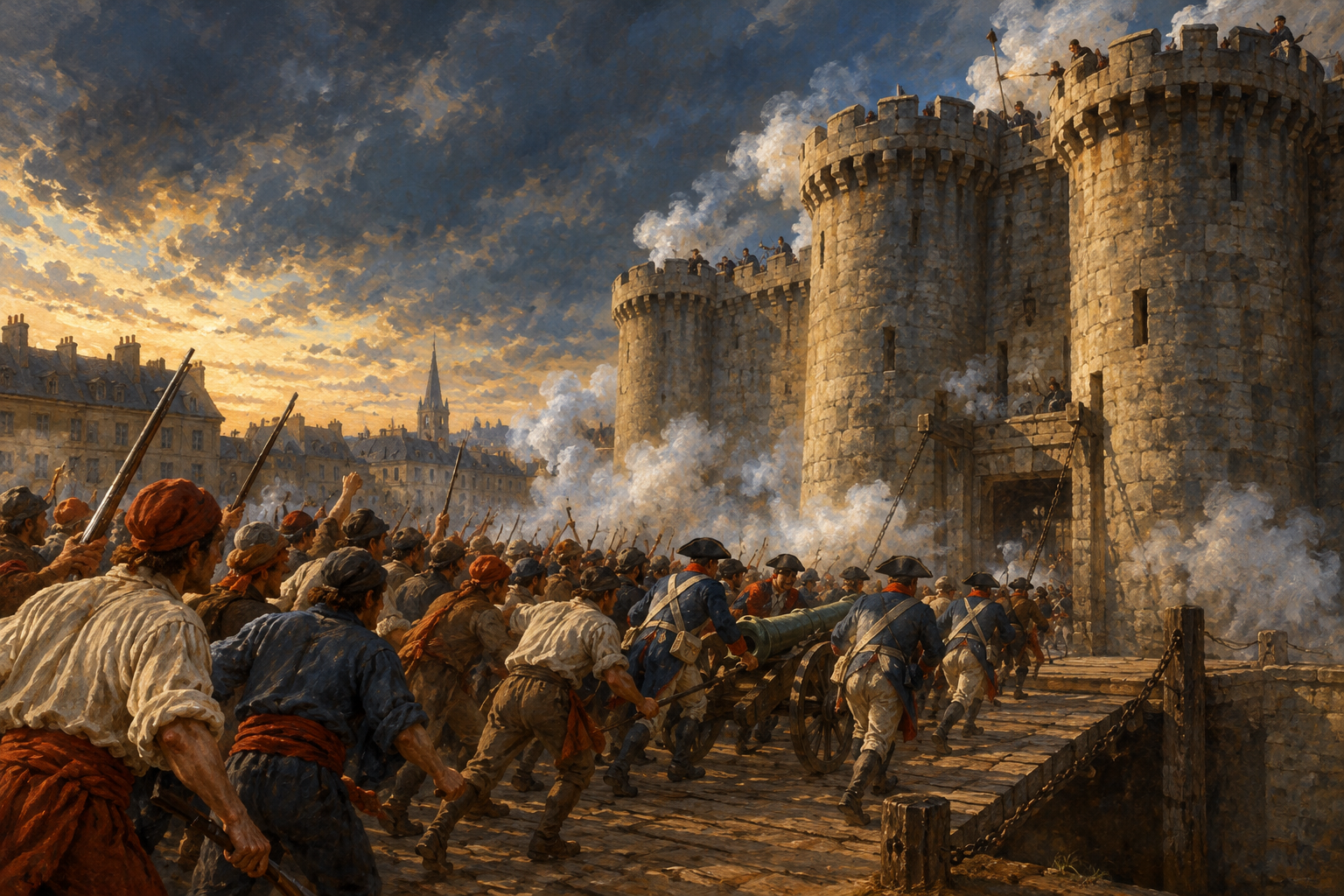
The storming of the Bastille took place on 14 July 1789, when a crowd in Paris attacked the Bastille, an old royal fortress in the east of the city that was also used as a state prison. By evening the garrison had surrendered, the commander had been killed, and the gunpowder stored inside was in the crowd's hands. Only seven prisoners were found there, so the event was never a mass prison break. Historians often present it as the moment when ordinary Parisians took the Revolution into their own hands, and France has marked the date as its national holiday ever since 1880.
For the wider story, read our guide to The French Revolution Explained (1789–1799). The storming is one of its turning points, because it moved the struggle out of the meeting halls and into the streets of Paris.
Why the crowd marched on the Bastille
The deeper causes were financial. Years of costly wars had left the French government deep in debt, and the tax system weighed most heavily on ordinary people. In May 1789 King Louis XVI summoned the Estates-General to find a way out. In June, deputies of the Third Estate declared themselves the National Assembly. The king and his advisers grew wary, and by July royal troops were gathering around Paris. Bread prices were high after poor harvests, so many Parisians were already angry and hungry before any single event set them off.
The immediate trigger came on 11 July 1789, when Louis XVI dismissed Jacques Necker, the finance minister who was popular with many Parisians for his reform ideas. News reached the city the next day. To many people, the dismissal looked like a sign that the king would use force against the Assembly and the capital. Rumours spread quickly, and the city was on edge.
The crowd also wanted weapons and gunpowder. On 13 July, the electors of Paris set up a citizen militia, and that militia needed arms. Rumours said the Bastille held a large store of gunpowder. That was partly true, because the Invalides' commander had moved gunpowder to the Bastille for safer storage.
The Bastille also stood for royal power. Under the old system, a royal order called a lettre de cachet could lock someone up without a trial, and the Bastille was the best-known prison of that system. By 1789 very few people were held there, yet the building still symbolised arbitrary rule. A popular belief holds that the crowd meant to free hundreds of political prisoners. That is a myth. Seven prisoners were inside on the day.
Taken together, three pressures explain the attack: anger at Necker's dismissal and fear that the king would use force, fear that royal troops were close, and a pressing need for weapons and powder. The crowd itself was mixed, made up of artisans, shopkeepers, labourers and soldiers, and that mix helped the revolt spread quickly.
What happened during the storming of the Bastille
The day began at the Hôtel des Invalides on the Left Bank, a home for veterans that also held a large arms store. The crowd broke in and took about 28,000 to 32,000 muskets, along with some cannon. Sources give different totals, but the scale of the seizure is clear. The gunpowder had already gone to the Bastille, so the crowd turned east across the city.
Late in the morning a delegation went to the Bastille and asked its commander, Bernard-René de Launay, to hand over the fortress and its gunpowder. He refused. Once the talks failed, firing began, and through the afternoon the fighting grew heavier. Soldiers from the French Guards, who had sided with the crowd, helped bring cannon forward against the walls. The garrison fired back from the towers.
The garrison was small, about 114 men. Most were invalides, veteran soldiers unfit for field service, and the rest were Swiss grenadiers who had arrived only a week earlier to reinforce the fortress. The attackers greatly outnumbered them. Estimates for attackers killed usually fall between about 80 and 100, depending on the source, and only a small number of defenders died in the fighting.
By evening the garrison gave up and the drawbridge was lowered. De Launay was seized and led towards the Hôtel de Ville, the seat of the city government. He was attacked and killed by the crowd on the way, and several other defenders were killed as well. The crowd also freed the seven prisoners: four men held for forging money, two men described as mentally ill, and a count held at his family's request.
The fall of the fortress in a single day shocked the government and encouraged Parisians to act again.
What followed
The fall of the Bastille changed Paris's politics within days. On 17 July Louis XVI came to the city, went to the Hôtel de Ville, and accepted a cockade in blue and red, the colours of Paris, from the new mayor, Jean-Sylvain Bailly. The king was acknowledging the new city leadership that had emerged from the revolt. For him, the visit was also a political move: it signalled that he would accept the new government rather than rely on troops alone. The citizen militia was reorganised as the National Guard, led by the Marquis de Lafayette, which gave armed Parisians a lasting role in public order.
The fortress itself did not last long. The Paris authorities gave the demolition work to the contractor Pierre-François Palloy, and workers pulled the Bastille down within about five months. A symbol of royal power had become an empty site, and that change of meaning fitted the revolution's wider goals.
The effects reached far beyond Paris. In the countryside, peasants attacked feudal records and dues in the so-called Great Fear. On 4 August 1789 the National Assembly voted to abolish feudal privileges. The events of one day in the capital had grown into a national programme of reform.
The following year, on 14 July 1790, the Fête de la Fédération celebrated the first anniversary of the fall with a festival of national unity in Paris. Much later, in 1880, France's Third Republic made 14 July the national holiday by a law promulgated on 6 July. The holiday honours both the 1789 storming and the 1790 festival. In English-speaking countries it is widely known as Bastille Day.
What exams ask
For AP European History and similar courses, questions usually focus on why the event matters, not just what happened. Expect to explain three things: the causes (the Necker dismissal, fear of royal troops, and shortages of bread and arms), the event itself (the seizure of weapons and the surrender of the fortress), and the significance (popular action pushed the Revolution further and weakened royal control). Strong answers connect the storming to the shift of power from the king to the National Assembly and the Paris city government.
Also consider who led the attack. Historians debate how far the event was spontaneous and how far it was organised by Paris's new leaders, so a balanced answer weighs both views. When you compare sources, note that casualty figures and musket counts differ between accounts. A strong answer uses words such as "about" or gives a range, and it avoids repeating the myth about hundreds of freed prisoners.
Read next
- The Tennis Court Oath (1789): how the Third Estate's deputies refused to disperse on royal orders just weeks before the Bastille fell.
- Who Was Louis XVI?: the king whose choices in July 1789 pushed Paris to the edge.
- Bastille Day: What 14 July Celebrates: how the anniversary became France's national holiday.