In five minutes
In August 1789, France's National Constituent Assembly adopted the Declaration of the Rights of Man and of the Citizen. In 17 short articles, it said that people are born free and equal in rights, and that sovereignty rests with the nation rather than with any single ruler. It was not a full constitution on its own, but it became one of the most influential political texts of the modern age. This page explains what the declaration says, why it was written and what it did not achieve. It is part of our French Revolution guide.
Why it was written
Before 1789, French society was organised by estates. The clergy and nobility held many privileges, including exemptions from much of the tax burden, while the Third Estate, which made up most of the population, paid most of the taxes. A financial crisis forced King Louis XVI to call the Estates-General in May 1789. When voting by order gave the clergy and nobility two votes to the Third Estate's one, its deputies broke away. In a pamphlet earlier that year, the writer Emmanuel-Joseph Sieyès had argued that the Third Estate was the nation in every real sense but had little political weight. In June, the Third Estate declared itself the National Assembly, and on 20 June its deputies swore the Tennis Court Oath not to separate until France had a constitution.
On 14 July, Parisians stormed the Bastille, and unrest was spreading in the countryside. On the night of 4 August, the Assembly abolished feudal dues and privileges. The old order was breaking apart, and the Assembly needed a statement of principles to put in its place. Lafayette, who had fought in the American War of Independence, prepared a first draft in July. Thomas Jefferson, the American minister in Paris, read the drafts and offered advice, although he never held a formal role. Ideas from the American Declaration of Independence (1776), the Virginia Declaration of Rights (1776) and Enlightenment writers such as Locke, Montesquieu and Rousseau shaped the wording.
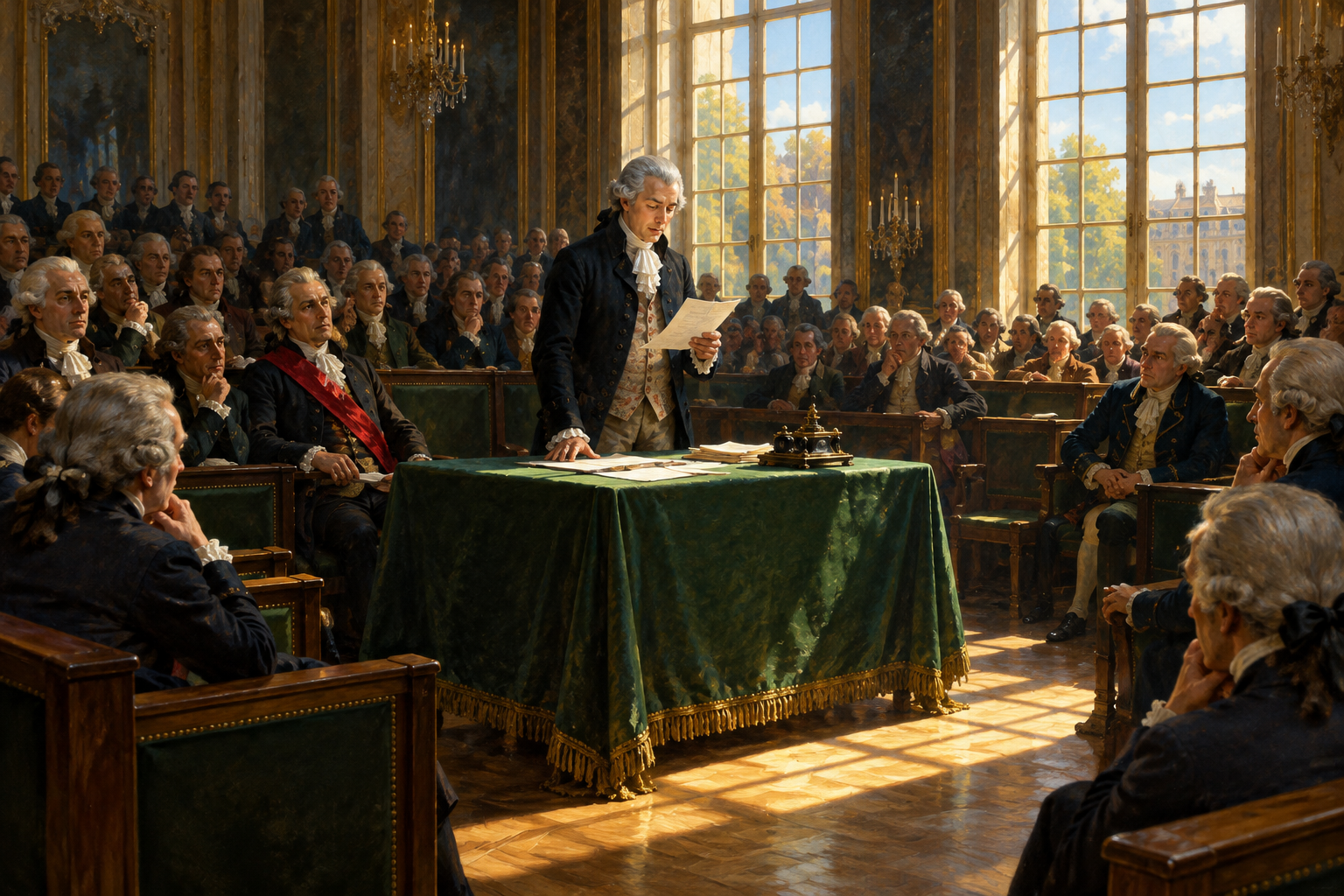
The Assembly then debated the text through August and reworked much of it. Abbé Sieyès and other deputies changed the wording during the debates, so the final text is best seen as the work of the Assembly rather than of one person. It adopted the declaration on 26 August 1789, before it had written a constitution, so the principles came first.
What the 17 articles of the declaration say
The text is short. It helps to group the articles by idea instead of reading them in order. The preamble states that ignorance, neglect or contempt of human rights are the sole causes of public misfortune and of government corruption.
- Equality and natural rights (Articles 1–2). People are born free and equal in rights, and social distinctions may rest only on common usefulness. Liberty, property, security and resistance to oppression are named as natural and permanent rights, and every political association exists to protect them.
- Sovereignty (Article 3). The source of all sovereignty is the nation. No body or individual may exercise authority that does not come from it. This was a break from the idea of a king who ruled by divine right.
- Liberty and the law (Articles 4–6). Liberty means being able to do anything that does not harm others. The law may forbid only harmful acts, and it must express the general will. All citizens are equal before it and may hold public office according to their abilities, not their birth.
- Justice (Articles 7–9). No one may be arrested or detained except as the law requires, and everyone is presumed innocent until found guilty.
- Opinion and expression (Articles 10–11). No one should be harassed for their opinions, including religious opinions, as long as they do not disturb the public order set by law. Free communication of thoughts is one of the most precious rights, which is why Article 11 is so often quoted.
- Taxes and accountability (Articles 13–15). Taxes must be shared fairly among citizens according to their ability to pay. Society has the right to ask any public official for an account of his administration.
- Constitution and property (Articles 16–17). A society that does not guarantee rights or separate powers has no constitution. Property is an inviolable and sacred right, which may be taken away only when public necessity clearly requires it and only with fair compensation.
Some abstract words need context. “General will” comes from Rousseau and means the common will of the community, not the sum of private interests. “Natural rights” were rights that people were thought to have by nature, not rights handed out by a king or a state. Knowing this makes the articles much easier to read.
The most quoted line is Article 1:
“Men are born and remain free and equal in rights.” (Article 1)
What happened next
The declaration did not settle the revolution's conflicts. King Louis XVI resisted the August decrees and gave in only after crowds from Paris marched on Versailles in early October 1789. The royal family was moved to Paris, and the Assembly followed and carried on its work there. In the 1791 constitution, the declaration was placed as the preamble, and France became a constitutional monarchy. Voting was limited to men who paid a certain amount of direct tax; they were known as active citizens.
The gap between principle and practice was wide. In 1791, Olympe de Gouges published her own Declaration of the Rights of Woman and of the Female Citizen, arguing that women were left out of a text that claimed to be universal. She was executed in 1793. French women were not given the vote until 1944. The declaration also did not address slavery in the colonies. The National Convention abolished it in 1794, but Napoleon restored it in 1802.
The ideas outlived the document's specific politics. A declaration of rights was attached to the 1793 constitution, which was never put into effect. Later French constitutions kept referring back to 1789, and the preamble of the 1958 constitution, which is still in force, lists the 1789 text among its reference documents. The 1948 Universal Declaration of Human Rights shares its language of universal rights, although that text drew on many sources.
What exams ask
Exam questions usually test three things: what the declaration says, how it differs from other rights documents, and where it fell short.
How it differs from other rights documents
- The American Declaration of Independence (1776). The American text announced independence from Britain. The French text set out the rights of individuals within a state and placed sovereignty in the nation.
- The English Bill of Rights (1689). The English document limited royal power and protected Parliament's position. The French declaration presented rights as natural and universal, not as privileges granted by a crown.
- The Universal Declaration of Human Rights (1948). Both use the idea of universal rights, but the 1948 text came out of the postwar international order and is a separate document.
- Explain the limits. Women, enslaved people in the colonies and men who did not pay the required tax were not fully included in practice. Naming these limits makes an answer stronger.
A common mistake is to treat the declaration as a constitution in its own right. It was a statement of principles that later became the preamble to the 1791 constitution.
Read next
- Bastille Day: What 14 July Celebrates, for the events that pushed the Assembly to act.
- Women in the French Revolution (Olympe de Gouges), for the fight over who the declaration included.
- Who Was Louis XVI?, for the king's resistance to the August decrees.