In five minutes
Marie Antoinette was an Austrian archduchess who became queen of France when she married Louis XVI. She shaped court fashion and was seen as a political force, and when the French monarchy collapsed she became a main target of revolutionary anger. She was tried for treason and guillotined in Paris in October 1793. The short answer to what she did is this: she lived at the centre of a court in crisis, and she paid the price when that crisis became a revolution.
This page covers who she was, what she did in France, and why her life is so often told as a tragedy. It is part of our French Revolution hub, which explains the whole period from 1789 to 1799.
Her story is usually told as glamorous court life followed by a sad ending. That picture is partly true, but a lot of it was shaped by pamphlets, caricatures and gossip written to damage her. The useful question is not only what she did, but also what was said about her and why people believed it.
Early life and a political marriage
Marie Antoinette was born on 2 November 1755 in Vienna. Her mother was Maria Theresa, the Habsburg ruler, and her father was Francis I, Holy Roman Emperor. She grew up in a court where marriages were tools of diplomacy. She was educated in music, dancing and languages, with the expectation that she would one day marry for her family's gain.
Her marriage came out of a major shift in European diplomacy. Austria and France had been rivals for centuries. In 1756 the two powers signed an alliance, and a marriage between a Habsburg archduchess and the French heir was a way to make it last. The plan depended on the bride, not on her wishes.
The proxy wedding took place in Vienna in April 1770, and the couple married in person at Versailles in May. She was 14 and her husband, Louis-Auguste, was 15. The French court did not welcome the Austrian bride warmly from the start. She had to learn court etiquette quickly, and she was watched closely by people who doubted her loyalty.
The early years were also a worry for her family and the court. The couple did not have children quickly, and her mother pressed her on the subject in letters. The first child, Marie-Thérèse, was born in 1778, and that strengthened her position at court.
Queen of France: court life, fashion and rumour
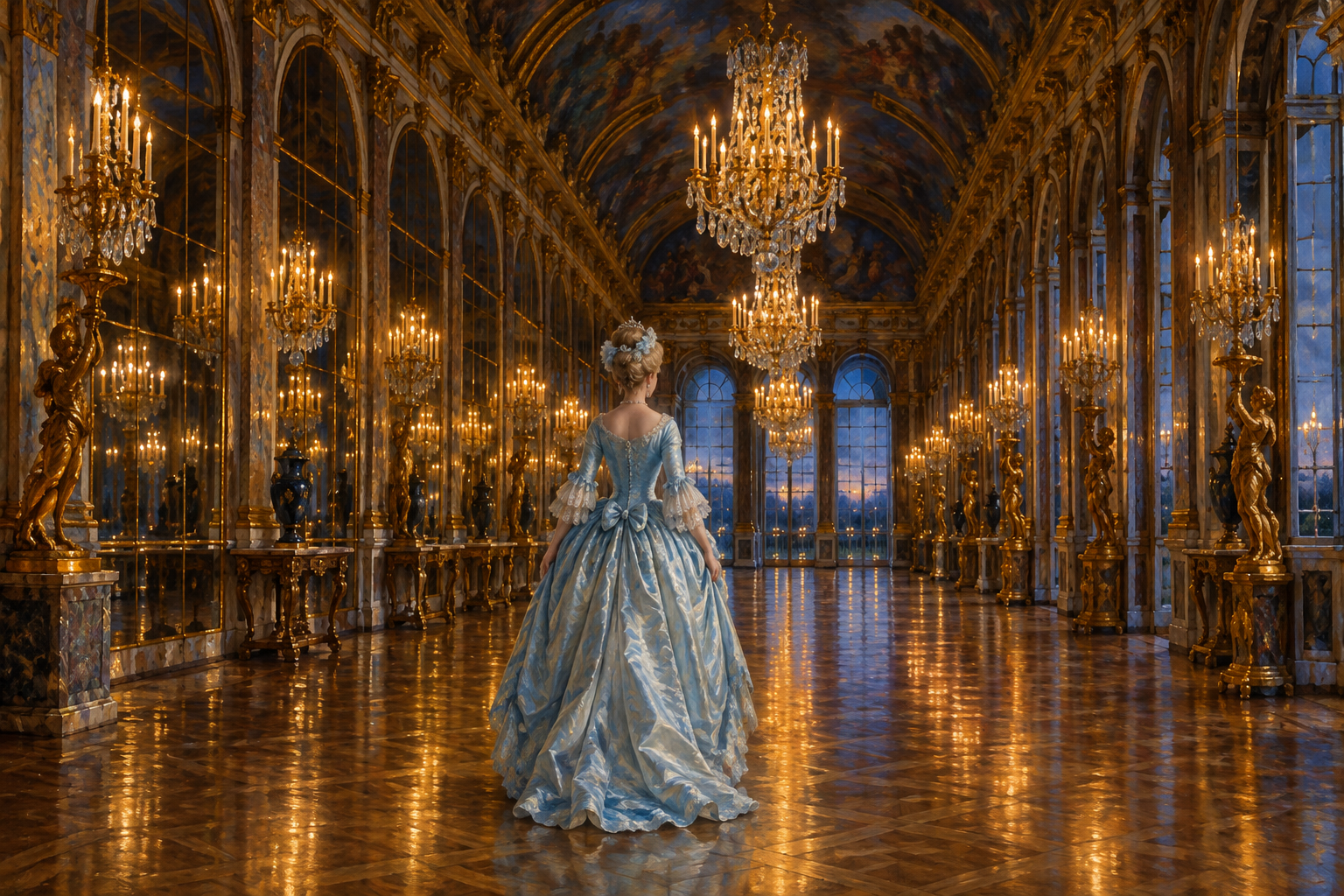
When Louis became king in May 1774, Marie Antoinette became queen at 18. At court she became a symbol of style. Her clothes, hairstyles and taste in interiors were widely copied, and the court was lively and expensive. Historians still describe her as a figure of fashion as much as of politics.
She spent much of her time at the Petit Trianon, a smaller palace in the grounds of Versailles. In the 1780s she had a model farm village built there, the Hameau de la Reine, where she could enjoy a rural retreat. The retreat was private, but critics treated it as proof of extravagance in a country with money problems.
Her political role has been argued over ever since. She had opinions about ministers and appointments, and she supported Austrian interests, which made her seem like an outsider. Many historians now think her influence was exaggerated by critics who wanted a villain.
Character and temperament
Contemporaries and later historians describe her as lively, sociable and fond of music, dancing and pleasure. She could be warm and loyal to friends, but she was also impulsive, and her critics seized on moments when emotion seemed to shape her political judgement. After 1789 her role changed, and she is often described as a mother fighting to protect her children.
In 1785 the Diamond Necklace Affair exploded into public view. A con artist used the queen's name to obtain a costly diamond necklace, and a cardinal was drawn into the scheme. Marie Antoinette was not involved, but the scandal fixed a picture of her as a spendthrift queen in the public mind.
Pamphlets, called libelles, and caricatures spread a flood of attacks. Some included sexual slander. Historians now treat much of this material as propaganda, and it is important to separate it from documented fact.
The most discussed rumour is that she had lovers. The name that comes up most often is Axel von Fersen, a Swedish count. Their letters have been studied closely and show deep affection. However, there is still no solid proof of a sexual affair, and scholars continue to debate how far the relationship went.
Did she really say “let them eat cake”?
The phrase is famous, but there is no evidence that she said it. It appears in Rousseau’s Confessions, which describes an unnamed princess who suggests that people with no bread should eat brioche. Rousseau wrote this before Marie Antoinette came to France. The link to her name was made decades after her death, so the line is best read as a myth about royal indifference.
A 1783 portrait by Élisabeth Vigée Le Brun also caused trouble. It showed the queen in a simple, light dress rather than formal court dress, and critics said it was unsuitable for a queen. The painting was withdrawn from public display, which shows how sensitive her image had become.
The Revolution and the flight to Varennes
The Revolution turned violent in July 1789, when Parisians stormed the Bastille. Bread prices were high, food was scarce, and anger at the court grew fast. The king and queen became symbols of the problem, even though the crisis had many causes, including government debt and the costs of earlier wars.
In October 1789 a crowd, including many women protesting about bread, marched to Versailles. The royal family was forced to move to the Tuileries Palace in Paris, where they lived under the watchful eye of the National Guard. For the queen, leaving Versailles marked the end of her life at the centre of court power.
Because she was Austrian by birth, she was suspected of working with foreign powers. Her family in Vienna was a real connection, and this suspicion fed the propaganda against her. The war that France declared on Austria in April 1792 made that suspicion more dangerous.
In June 1791 the royal family tried to escape Paris. The plan was to reach royalist troops near the eastern border, and Fersen helped organise much of the route. The coach was recognised in the small town of Varennes, and the family was stopped and brought back to Paris. The failed flight badly damaged public trust in the king and queen.
In September 1792 the National Convention abolished the monarchy and declared a republic. The royal family was now held as prisoners, and the queen's reputation as an enemy of the new France hardened.
Trial and execution
Louis XVI was executed on 21 January 1793. The queen was already held in prison, and in the summer of 1793 she was moved to the Conciergerie in Paris and separated from her son. Many of the accusations against her were political rather than legal.
Her trial began on 14 October 1793 before the Revolutionary Tribunal. She was charged with treason and other crimes against the Republic. Most historians describe it as a political show trial rather than a fair legal process. Some accusations, including false claims about her son, were designed to shock and to ruin her reputation further.
She was found guilty on 16 October and guillotined the same day at the Place de la Révolution, now the Place de la Concorde. She was 37 years old. Accounts say she kept her composure to the end, but those accounts were written by people with their own agendas, so they should be read with care.
Her son Louis-Charles was taken from her and died in prison in 1795, aged 10. Her execution was widely reported as a sign that the old order was ending, and it has been retold in novels, films and plays ever since.
What exams ask
Exam questions about the French Revolution often ask why the monarchy fell. Marie Antoinette is a useful example of three connected themes: court spending and money problems, the power of propaganda, and the loss of trust after the Varennes flight. A strong answer links these themes rather than treating her as the only cause.
Be precise about evidence. Separate what is documented, such as her marriage, her trial and her execution, from what is rumour, such as the “let them eat cake” line or claims about lovers. That kind of care is what strong answers need, and it is easy to show in a few sentences.
Read next
If you want to go deeper, three related pages in our history cluster fill in the picture. Louis XVI and Marie Antoinette: The Royal Marriage looks at how the couple's relationship and court politics fit together. Why Was Marie Antoinette Executed? goes further into the case against her and the reasons behind it. Who Was Louis XVI? explains the king whose fate was tied to hers.