In five minutes
The Napoleon empire was the French state that Napoleon Bonaparte built after he seized power in 1799. For the next sixteen years France was led by one man who rewrote its laws and government, won battle after battle and, at his height, controlled or influenced most of continental Europe. A hostile coalition, a failed invasion of Russia and a costly war in Spain eventually wore him down. He was exiled twice and died on a remote island in the South Atlantic.
Historians call the years from 1799 to 1815 the Napoleonic Era. The period is easiest to follow in three parts: how Napoleon rose, the wars that defined his rule and the peace settlement that tried to undo his work. This page is also part of our World History 1700–1918 guide.
Causes: how Napoleon came to power
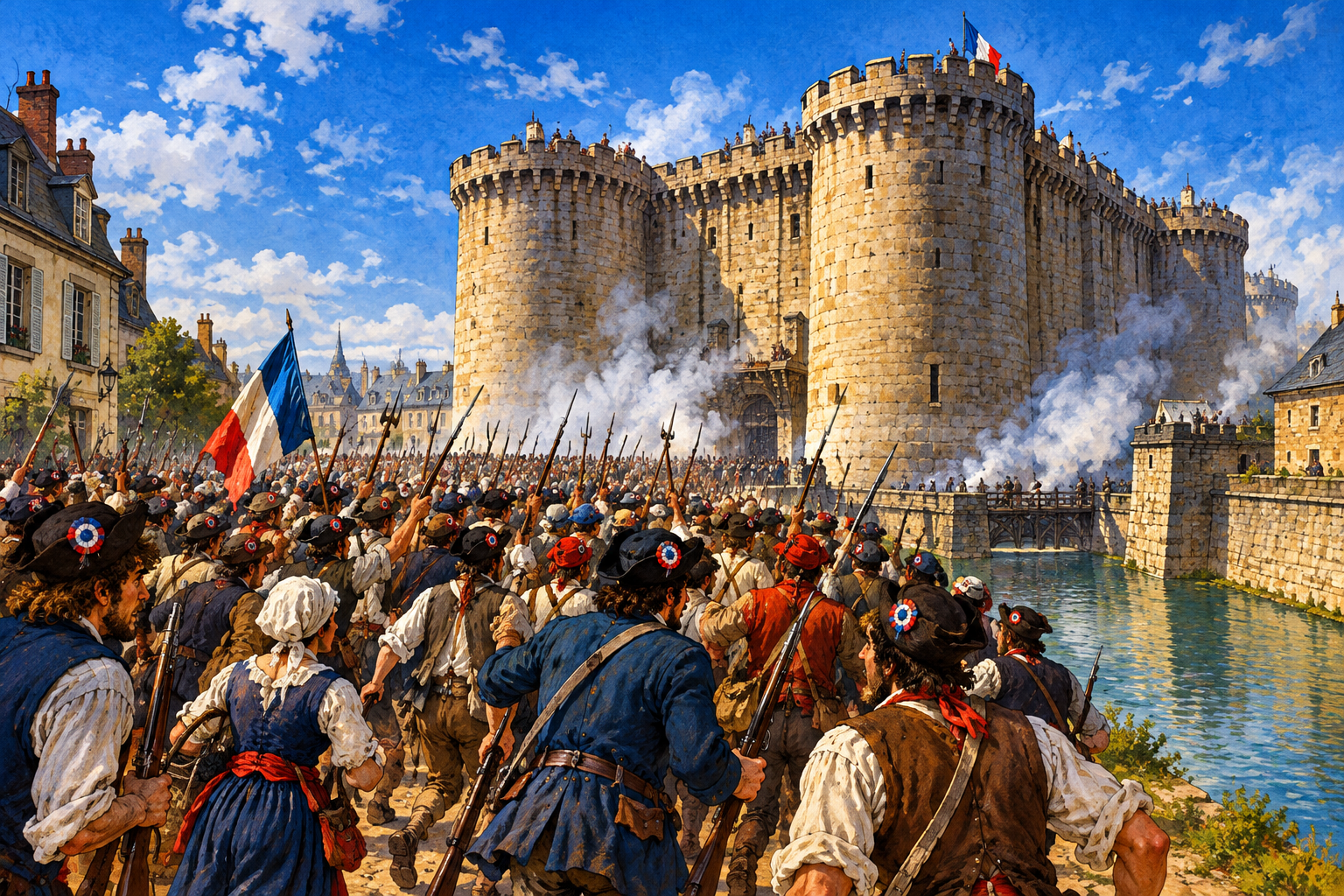
The Revolution of 1789 had ended the old monarchy, but by 1799 France had lived through a decade of upheaval. The Directory, a five-man government that had run the country since 1795, was unpopular. It faced money troubles, a long war against much of Europe and plots from both royalists and radicals. For the background, read our French Revolution explainer.
Napoleon was a young general who had won fame in Italy in 1796 and 1797 and then led an expedition to Egypt. In November 1799, in the coup known as 18 Brumaire, he used political allies and troops to end the Directory. He became First Consul, one of three consuls on paper, but he quickly made the post the real centre of power.
Once in control, he pushed through domestic reforms. The Bank of France was founded in 1800, and prefects were sent out to run the departments. In 1801 he signed a Concordat with the Pope to settle relations with the Catholic Church in France. The Peace of Amiens in 1802 paused the war with Britain, and that same year he created the Legion of Honour to reward ability and service. In 1803 he sold the Louisiana territory to the United States. The Civil Code of 1804, later known as the Napoleonic Code, set one body of civil law for much of the country and became a model for other states.
In 1804 the Senate proclaimed him Emperor of the French, and he was crowned at Notre-Dame in Paris that December. A general who had come to power as a republican leader now headed a hereditary dynasty. Historians often argue that the empire depended on constant military success to stay credible.
The Napoleon empire at war: from Austerlitz to Waterloo
Napoleon's power rested on the army. Conscription gave him large forces, and his commanders learned to move them quickly and strike hard. For years he beat shifting alliances of Austria, Prussia, Russia and Britain, and his rivals kept regrouping after each defeat and returning to the fight.
At sea, Britain was his main rival. A combined French and Spanish fleet lost to the Royal Navy at Trafalgar in October 1805, which ended any realistic plan to invade Britain. On land, Napoleon defeated Austrian and Russian forces at Austerlitz in December 1805, a battle often called the Battle of the Three Emperors. In 1806 the Holy Roman Empire came to an end.
Because Britain could not be beaten on land, Napoleon tried to strangle its economy. The Berlin Decree of November 1806 launched the Continental System, which closed European ports to British goods. Merchants across Europe lost money, smuggling spread, and the policy bred resentment in allies and conquered lands alike. Historians still debate how much it hurt Britain, but it certainly created friction, and Russia's decision to trade around it helped lead to the 1812 invasion.
Spain became a costly mistake. In 1808 Napoleon placed his brother Joseph on the Spanish throne. Spanish people rose up, and a British army under Wellington supported them. The Peninsular War lasted until 1814 and drained French manpower and money. The war became known as the Spanish ulcer, a name that reflects how slowly it wore the French down.
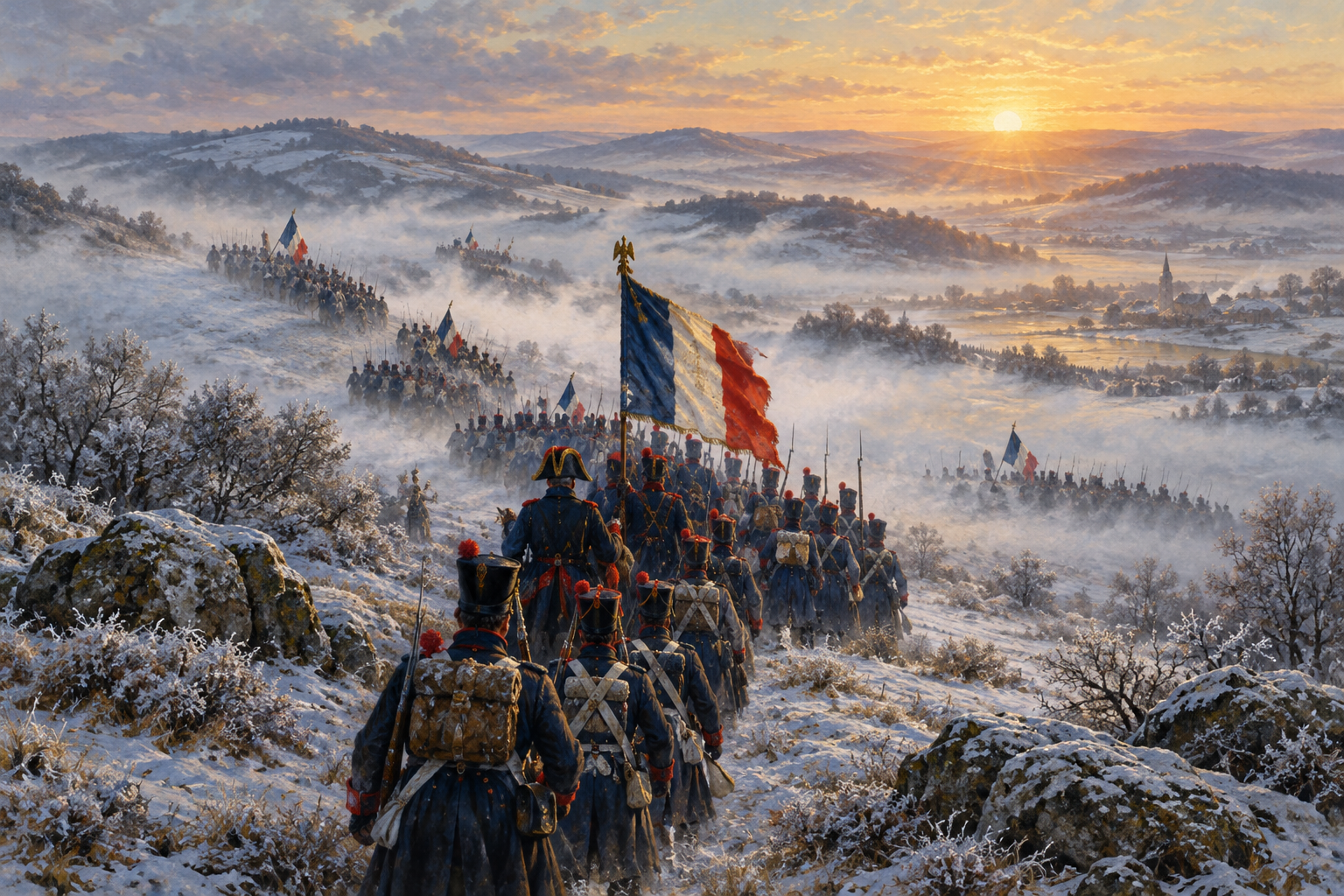
The invasion of Russia in June 1812 was the turning point. Napoleon crossed the Niemen with a huge force, the Grande Armée, drawn from France and many of its allies. Estimates of its size vary by source, but it is often given as about 600,000 men. The army reached Moscow in September, yet much of the city was burned and Tsar Alexander I refused to negotiate. The retreat through the Russian winter cost most of the army, and only a small fraction of those who crossed the river came back.
A new coalition of Russia, Prussia, Austria, Sweden and others defeated him at Leipzig in October 1813, a battle known as the Battle of the Nations. The Allies crossed into France and entered Paris at the end of March 1814. In April Napoleon abdicated and was sent to the small Mediterranean island of Elba. He kept the title of emperor and was allowed to rule Elba, while the Bourbon monarchy returned under Louis XVIII.
In February 1815 Napoleon escaped Elba, landed in France and reached Paris on 20 March. That return and the brief rule that followed are called the Hundred Days. On 18 June 1815, at Waterloo in Belgium, British and allied forces under Wellington, joined by Prussian troops under Blücher, defeated him. He abdicated for a second time and was sent to Saint Helena, a remote British island in the South Atlantic, where he died in 1821.
Consequences: the Congress of Vienna
The victorious powers gathered in Vienna from the autumn of 1814 to redraw the map. Austria's Metternich, Britain's Castlereagh, Russia's Alexander I and Prussia's Hardenberg shaped the talks, while Talleyrand represented France and worked to win back a voice for a defeated country. The final act was signed in June 1815.
The stated aim was a balance of power that would stop any single state from dominating Europe again. Vienna restored the Bourbons in France, created the Kingdom of the Netherlands as a buffer on France's northern border and grouped Germany's many states into a loose German Confederation. Much of Poland was placed under Russian rule. The settlement favoured stability and the old dynasties over national self-determination.
Vienna did not erase everything Napoleon had done. Many of his administrative and legal changes survived in parts of Europe, and the Napoleonic Code shaped legal systems far beyond France. The wars also left a political legacy. Many people had lived under foreign rule or been drafted into armies, and these experiences helped spread the idea that nations should govern themselves.
Economic change ran alongside the wars too. For the industrial side of the same century, see our Industrial Revolution explainer.
What exams ask
Exam questions about this period usually test cause and effect rather than dates alone. Expect questions on how Napoleon consolidated power after 1799, why the Continental System fell short, what the Russian campaign changed and why the Congress of Vienna aimed at a balance of power. A strong answer names one specific event, explains how it led to the next and gives a reason for each step.
Read next
- The French Revolution Explained (1789–1799): how the upheaval created the chaos that let Napoleon take power.
- The Industrial Revolution: What It Was and Why It Mattered: the economic changes that were happening at the same time as the wars.
- The Count of Monte Cristo: a novel that opens in 1815 as Napoleon returns from Elba and follows a sailor pulled into the politics of the moment.