In five minutes
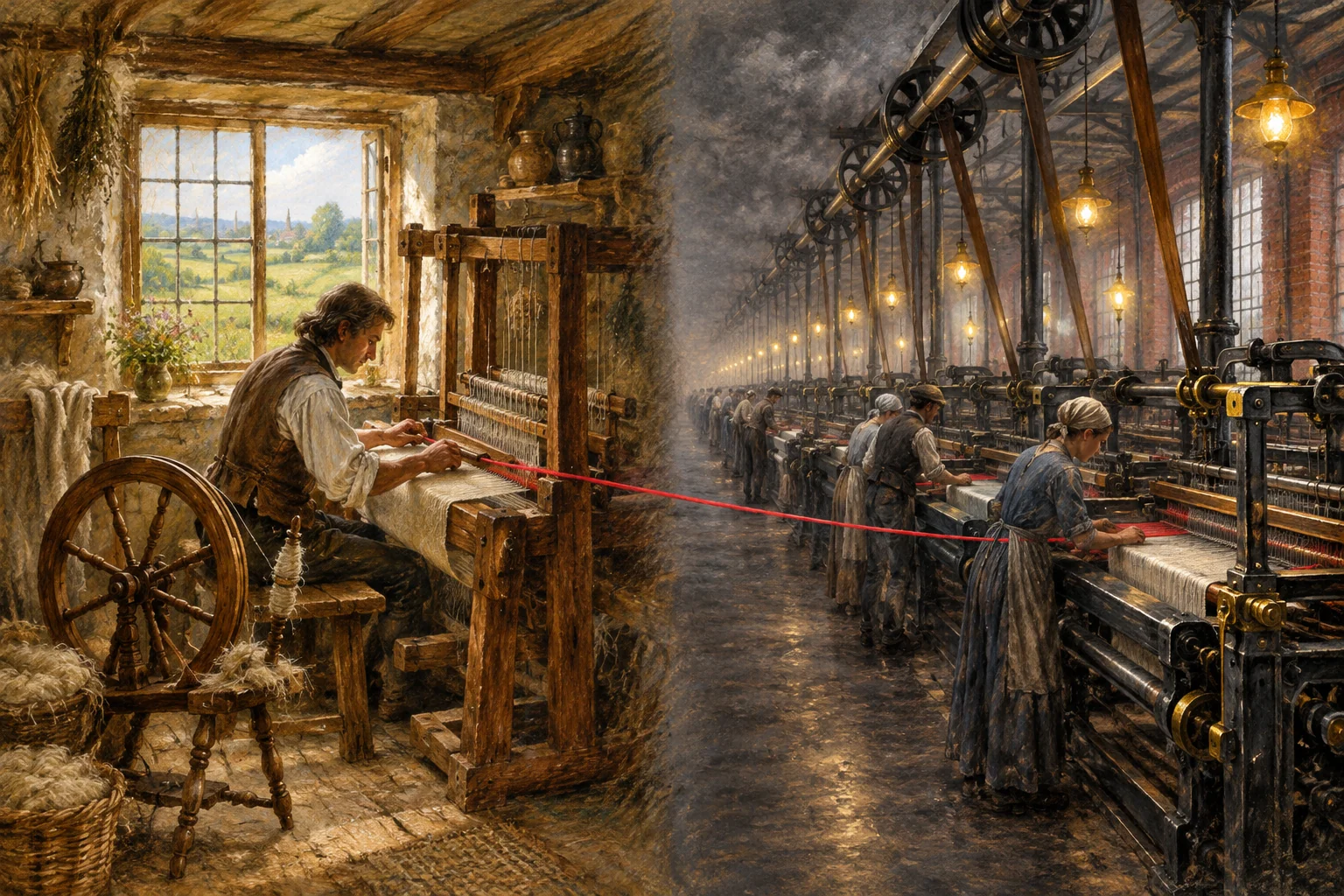
The Industrial Revolution was the shift from making goods by hand, at home or in small workshops, to making them with machines in factories. Those machines ran first on water wheels and then on steam engines burning coal.
It began in Great Britain in the 1760s, and its first phase lasted until about the 1840s. If it took some eighty years, why call it a revolution?
Because it broke a pattern that had held for thousands of years. Before it, economies grew so slowly that most people lived much as their grandparents had.
After it, the amount one worker could produce kept rising with every generation.
Three things changed together. Energy: coal and steam replaced muscle, wind and falling water.
Organisation: the factory brought workers and machines under one roof and ran them by the clock. Transport: canals and then railways moved coal, cotton and people faster and more cheaply than ever before.
This page is the hub for our Industrial Revolution topic. It is also part of our wider guide to world history from 1700 to 1918.
The name came later. French writers used the phrase in the early nineteenth century, setting Britain's machines beside France's political revolution.
The English historian Arnold Toynbee made it standard: his Lectures on the Industrial Revolution in England came out in 1884, the year after he died.
Causes: why Britain, and why then?
No single cause explains it. Several advantages came together in eighteenth-century Britain.
- Coal and iron. Britain had large coal seams, often close to iron ore, rivers and the coast. Cheap coal made it worth running machines that burned a lot of fuel.
- More food, more people. Enclosure of open fields and new crop rotations raised farm output. England and Wales grew from about 9 million people at the first census in 1801 to about 18 million in 1851, so factories had both workers and customers.
- Capital and markets. Overseas trade had made merchants rich and helped banks grow. Part of that wealth came from the Atlantic slave trade and from sugar and tobacco grown by enslaved people. Colonies and trade routes gave British goods a worldwide market.
- Stable government and patents. After 1688, Parliament protected property and trade, and patents let inventors profit from new machines.
- High wages, cheap energy. The economic historian Robert Allen argues that British labour was expensive and coal was cheap compared with other countries. That meant replacing workers with coal-powered machines paid off in Britain first.
- Transport. Few places in Britain are far from the sea or a river you can sail on. From 1761, when the Bridgewater Canal opened to carry coal into Manchester, a growing canal network cut the cost of moving heavy goods.
What happened: cotton, steam and iron
Cotton goes first
The textile inventions are easiest to follow as a chain of problems and fixes. John Kay's flying shuttle (1733) let weavers work faster, and spinners could not keep up.
James Hargreaves' spinning jenny (around 1764) let one worker spin many threads at once. Richard Arkwright's water frame (patented 1769) used water power to spin strong thread.
In 1771 he opened Cromford Mill in Derbyshire, often called the first modern factory, with set shifts and machines that kept running around the clock. Samuel Crompton's spinning mule (1779) made fine, strong yarn, and Edmund Cartwright's power loom (1785) began to mechanise weaving itself.
Raw cotton came first from the Caribbean and later mostly from the American South, where enslaved people picked it. Lancashire's mills turned it into cloth, and Manchester earned the nickname “Cottonopolis”.
Steam power
Steam power turned a cotton boom into a revolution. Thomas Newcomen's engine (1712) pumped water out of mines but burned huge amounts of coal.
James Watt's separate condenser, patented in 1769, made the engine far more efficient. Working with the Birmingham manufacturer Matthew Boulton, he built engines from the 1770s.
In the 1780s he added rotary motion, so an engine could turn factory machinery. Mills no longer had to sit beside fast rivers.
They could be built in towns, close to workers and coal.
Then steam went onto rails. Richard Trevithick ran a steam locomotive in South Wales in 1804.
The Stockton and Darlington Railway, engineered by George Stephenson, opened in 1825. The Liverpool and Manchester Railway of 1830 was the first intercity line where every train was pulled by a steam locomotive.
By 1850 Britain had about 6,000 miles of track.
Iron and coal
Machines, engines and rails needed iron. In 1709 Abraham Darby smelted iron with coke (coal baked to remove impurities) instead of charcoal at Coalbrookdale, so ironmaking no longer depended on shrinking forests.
Henry Cort's puddling and rolling process (1784) produced wrought iron in bulk. The Iron Bridge over the River Severn, built in 1779, showed off what the new material could do.
The Industrial Revolution and its consequences
Cities
People moved from villages to mill and mining towns. Manchester, Leeds, Birmingham and Glasgow grew fast, with cramped housing, poor drains and outbreaks of cholera.
The 1851 census found that more than half of Britain's people lived in towns. No large country had reached that point before.
Work and class
The factory bell and the clock replaced the rhythm of the farming year. Shifts of twelve hours or more were common, and children worked in mills and mines because they were cheap and small.
Two new groups took shape. One was an industrial working class that lived by selling its labour.
The other was a middle class of factory owners, engineers and merchants whose wealth came from industry rather than land.
Protest and reform
Some workers fought back. Between 1811 and 1816 the Luddites smashed machines in the Midlands and northern England.
Parliament stepped in slowly. The Factory Act of 1833 banned children under nine from textile mills, limited the hours of older children and appointed inspectors to enforce the rules.
Trade unions and the Chartist movement (1838–1848), which demanded votes for working men, also grew out of industrial life.
New ideas
Supporters of free trade and liberalism saw factories as progress. Critics saw exploitation.
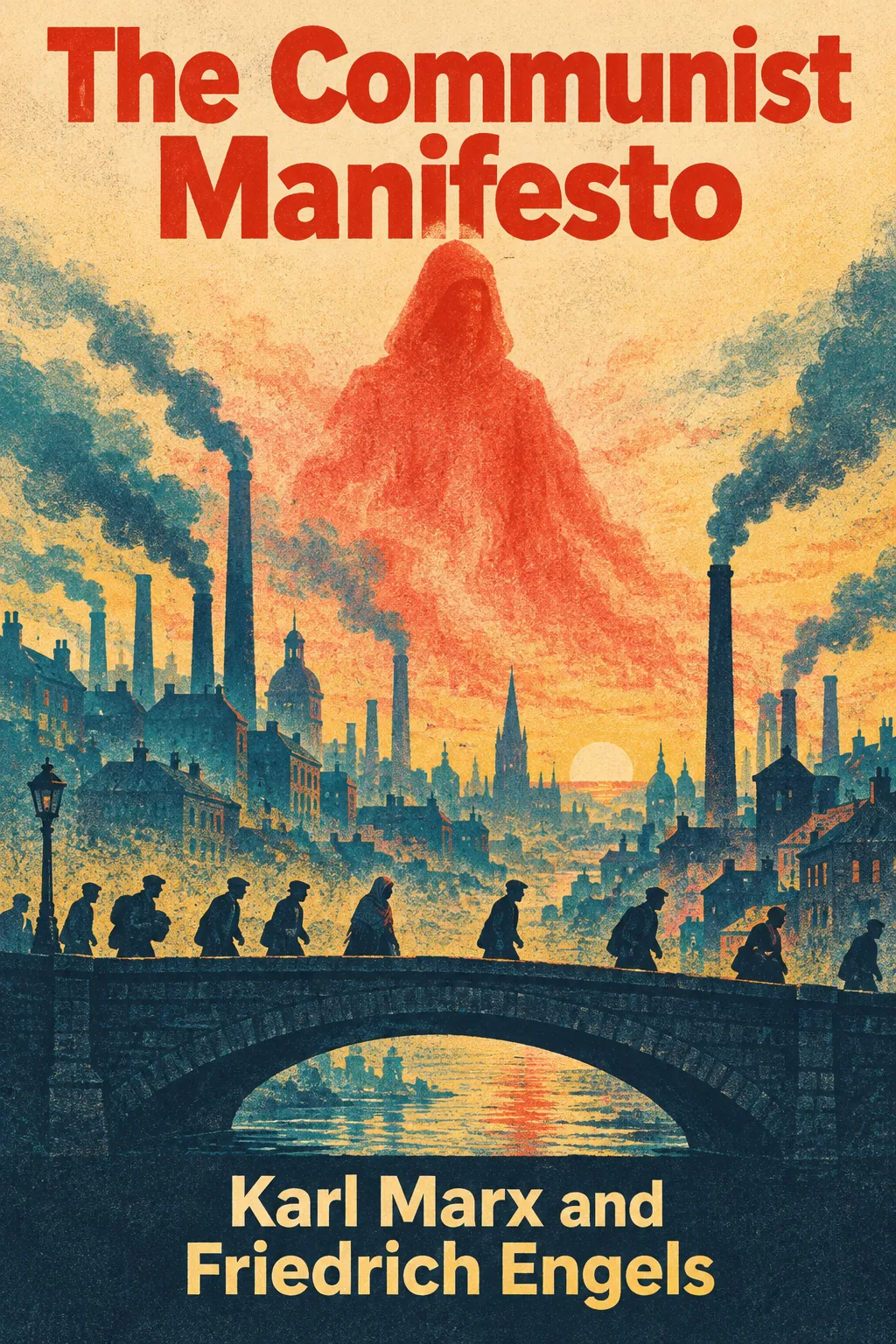
Friedrich Engels described Manchester's slums in The Condition of the Working Class in England (1845), and with Karl Marx he wrote The Communist Manifesto (1848). Historians still argue about how quickly ordinary workers' lives improved.
This is known as the standard-of-living debate, and many date clear gains to after about 1840.
The wider world
Britain became “the workshop of the world”. Cheap machine-made cloth undercut hand weavers in India, which had once been the world's leading maker of cotton cloth.
Factories needed raw materials and buyers, which fed the push for empire later in the century. Coal smoke blackened cities, and the burning of coal began the long rise in carbon emissions.
How it spread: the second Industrial Revolution
Britain tried to guard its lead by limiting the emigration of skilled workers and the export of machines, but the know-how spread anyway. Samuel Slater, who had trained in English mills, set up a water-powered spinning mill in Rhode Island in the early 1790s.
Belgium was the first country on the European mainland to industrialise, and France followed. In Germany, the customs union (Zollverein) of 1834 and fast railway building drove growth from the 1840s.
Earlier, during the Napoleonic era, Napoleon's Continental System of 1806 had tried to shut British goods out of Europe. British trade survived it, and Britain's head start grew.
From about 1870 to 1914 came a second wave, often called the Second Industrial Revolution. The Bessemer process (1856) made steel cheap, and electricity, chemicals, oil and the internal-combustion engine created whole new industries.
Germany and the United States led this wave and overtook Britain in steel output by the 1890s. Japan joined after the Meiji Restoration of 1868: cotton spinning boomed from the late 1880s, and the state-run Yawata Steel Works began production in 1901.
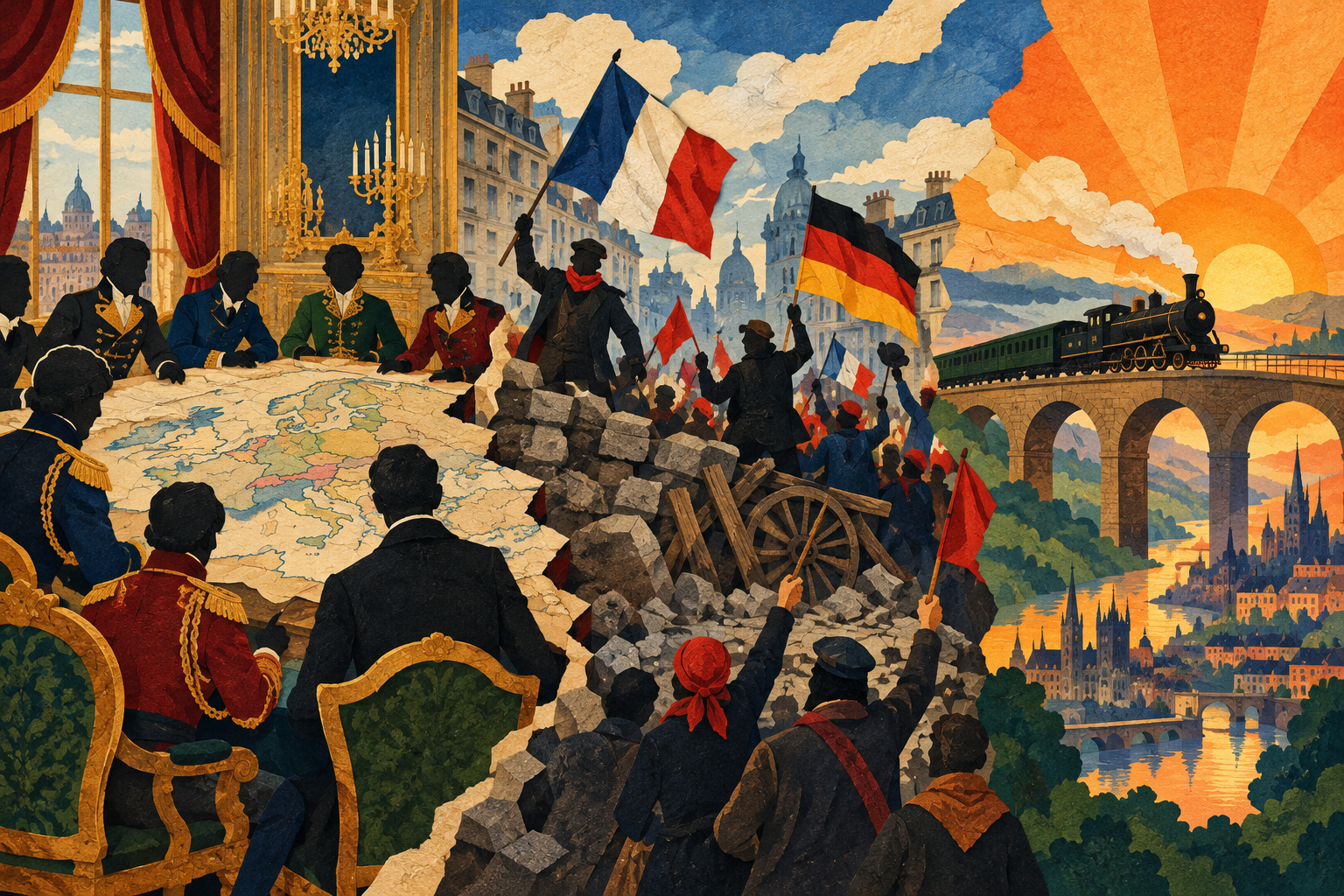
Our guide to 19th-century Europe shows how industry fed nationalism and unification.
What exams ask
- Why Britain first? Give several linked causes (coal, changes in farming, capital, markets, stable government), not just one.
- The textile chain. Know the order: flying shuttle (1733), spinning jenny (c. 1764), water frame (1769), mule (1779), power loom (1785). Explain each one as a fix for a bottleneck.
- Watt's real contribution. He did not invent the steam engine. He made Newcomen's design far more efficient and able to drive machines.
- Cause and effect. AP World History and AP European History questions often link industrialisation to urbanisation, labour reform, new ideologies (liberalism, socialism) and imperialism.
- First vs second wave. First: Britain, cotton, coal, iron, steam. Second: Germany and the US, steel, electricity, chemicals, oil.
Read next
- World History 1700–1918: the big picture of revolutions, industry, empire and war, showing where the Industrial Revolution fits.
- The Napoleonic Era (1799–1815): how war and the Continental System tested Britain's new industrial economy.
- 19th-Century Europe: how railways, factories and new social classes fed revolutions, nationalism and unification.