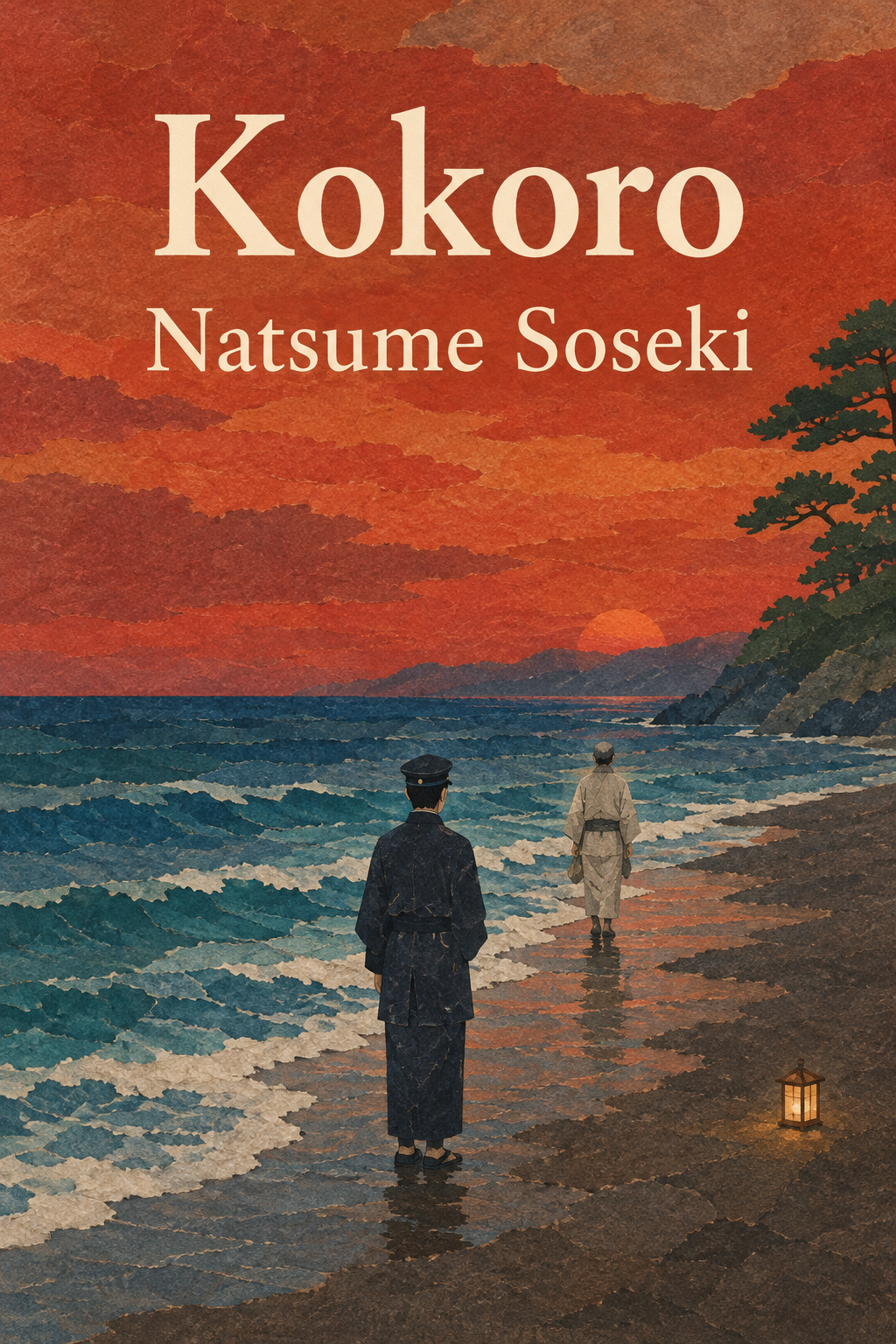
Kokoro
by Natsume Soseki
Kokoro is a 1914 novel by Natsume Soseki about a young student in Meiji-era Tokyo, called only “I”, who becomes devoted to an older man he calls Sensei. Sensei lives quietly with his wife, has no job, and visits a grave every month without saying whose it is. As the student gets closer, he senses a painful secret behind Sensei’s loneliness. The novel follows his search for the truth across three parts.
The Big Idea
"Kokoro asks how one mistake can shape a whole life when a person cannot trust others, or himself. A young student slowly learns why his teacher has withdrawn from the world."
Key Insights
Loneliness as the price of freedom
In a famous passage, Sensei tells the student that people born in an age of freedom, independence and self must all pay for it with loneliness. Soseki is writing about Meiji Japan, where old family and village ties were weakening and each person had to decide who to be. Freedom brings choice, but it also removes the comfort of belonging.
Sensei has a wife, a house and a loyal visitor, yet he stays apart from everyone. The student, too, is pulled between his family home and his new life in Tokyo.
How easily ordinary people turn selfish
Sensei believes most people are decent until a moment of temptation, and then they change at once. The novel does not blame one villain. It shows that fear, love and pride can push a good person to put himself first, and the question it keeps asking is whether the reader would act any differently.
Sensei’s uncle takes his inheritance. Later Sensei, still hurt by that betrayal, does something to his friend K that he can never forgive himself for.
Guilt kept in silence
Sensei never tells his wife what weighs on him, and the silence slowly eats away at both of them. Soseki shows that guilt hidden from the people closest to us does not disappear; it turns into distance. Telling his story to the student at the end is Sensei’s one attempt to share it.
Shizu knows only that her husband is sad and that he visits a grave she is never invited to. For years she wonders what she did wrong.
An era ending, a new generation
The story is set as the Meiji era closes. The Emperor’s death and General Nogi’s suicide make Sensei feel that his own age is ending too. The student belongs to the next generation, which may not carry the same burdens but may also lack the same deep ties. Soseki lets a private story carry the mood of a whole historical turning point.
The student’s father lies dying in the country while the nation mourns its Emperor. The dying father, the dying emperor and Sensei, who has chosen to die, echo each other.
Chapter Breakdown
Chapter-by-chapter summary
Spoiler warning: this section covers the whole plot, including the ending.
Part 1, Sensei and I: A stranger at Kamakura
One summer, the narrator, a university student, is at a beach in Kamakura. He notices a man swimming with a Westerner, and something about him draws the student in, though he cannot say what. A few days later they begin to talk. Back in Tokyo, the student visits the man’s house, where Sensei’s wife welcomes him, although Sensei is often out. The young man decides that this quiet, educated person is the teacher he has been looking for. Why it matters: the whole book grows from this pull toward someone who will not explain himself.
Part 1, Sensei and I: The grave and the warnings
The student keeps visiting. He learns that Sensei has no job and no children, and that he goes alone to a cemetery in Zoshigaya every month. Sensei does not say whose grave it is, and he never takes his wife. He also says strange things: that love is a sin and also something sacred, that ordinary people turn into villains when they are tempted, and that he is not a man worth respecting. When the student presses him about his past, Sensei promises to tell him one day, but not yet. Why it matters: these hints plant the question the rest of the novel answers.
Part 2, My Parents and I: A sick father
After graduating, the student goes home to his village. His father is gravely ill with kidney disease, and the house is tense. A party to celebrate the degree is called off when the Emperor falls ill. His parents and brother keep asking what job he will get, and they even wonder whether a man like Sensei could help. The student feels how far this plain, warm household is from the long, thoughtful talks he had with Sensei, and he keeps thinking of Sensei’s dark house. Why it matters: ordinary family life is set against Sensei’s loneliness, and the student is caught between the two.
Part 2, My Parents and I: The end of Meiji and the letter
In late July 1912 the Emperor Meiji dies, and even the village feels that an age is over. The father’s condition gets worse, and the student cannot leave. A telegram from Sensei arrives, then a very thick letter. It begins by saying that by the time it is read, Sensei will probably no longer be alive. The student leaves his dying father in the family’s hands, boards a train for Tokyo and starts reading on the way. Why it matters: two deaths, his father’s and Sensei’s, press on him at once, and he must choose where to be.
Part 3, Sensei and His Testament: An orphan betrayed
Sensei writes about his youth. His parents die of typhoid while he is still a student, and he leaves the family property in his uncle’s hands. The uncle cheats him. Sensei learns that even a relative can be changed by money. He sells what remains, leaves his hometown for good and never trusts people in the same way again. Why it matters: this is the root of his distrust. He believes that people are decent until the moment they are tempted, and this first betrayal teaches him so.
Part 3, Sensei and His Testament: The boarding house and K
In Tokyo, Sensei rents a room from the widow of a soldier, who lives with her daughter. He begins to love the daughter, whom he calls Ojosan, but he keeps this to himself. Meanwhile his friend K, from the same region, is struggling. K comes from a temple family, was adopted into a doctor’s family and chose his own studies against their wishes, so both families cut him off. Sensei wants to help, persuades the widow and brings K to live in the same house. Why it matters: Sensei’s kindness and his hidden feelings are now under one roof, and they will collide.
Part 3, Sensei and His Testament: K’s confession
Living with the family, K slowly softens. One day he confesses to Sensei that he loves the daughter. Sensei is shocked and jealous. He uses against K the very words K once said to him, that a person with no spiritual ambition is a fool, and he scolds K for his doubt. Then, without telling K, Sensei asks the widow for her daughter’s hand, and she agrees. Why it matters: this is the moral centre of the book, a choice made out of fear that can never be undone.
Part 3, Sensei and His Testament: K’s death and Sensei’s decision
The widow tells K about the engagement. Soon afterwards K takes his own life, leaving a short note that does not blame Sensei. Sensei tells no one and marries the daughter, Shizu, but he never tells her the truth. His guilt follows him for years. When the Emperor dies and General Nogi follows him in death, Sensei feels that his own age has ended. He decides to die and writes this letter so that one person will know his past, asking the student to keep it from his wife while she lives. The novel closes with the end of the letter. Why it matters: the ending turns a private guilt into a story told to the next generation.
Characters
- “I”, the narrator: A university student from the countryside and the narrator of Parts 1 and 2. He is never named. He admires Sensei, wants to understand him and becomes the one person Sensei trusts with his past. His sincerity is what makes Sensei open up.
- Sensei: The student’s older friend and teacher, also never named. He is educated but does not work, lives quietly with his wife and visits a friend’s grave every month. He distrusts people and, even more, himself. His long letter makes up Part 3.
- Shizu: Sensei’s wife, called Ojosan, “the young lady”, in his letter. She loves her husband and worries about his sadness, but she never learns its cause. Sensei insists on keeping it from her.
- The widow: Shizu’s mother, who runs the Tokyo boarding house after her soldier husband’s death. She welcomes Sensei and K almost like sons and gives her blessing to the marriage, unaware of the pain between the two young men.
- K: Sensei’s friend from his home region, born into a temple family and later adopted into a doctor’s family. He chooses his own studies against his family’s wishes and is cut off. Serious and disciplined, he values spiritual striving above comfort.
- Sensei’s uncle: After Sensei’s parents die, the uncle manages the family property and cheats him. His betrayal is the first blow to Sensei’s trust in people, even relatives. Money, Soseki suggests, can change anyone.
- The student’s father: The head of a respectable country household, gravely ill with kidney disease in Part 2. He is proud of his son’s degree and wants him settled in a good job. His slow decline mirrors the end of an era.
- The student’s mother: She nurses her husband and worries about her son’s future. She stands for ordinary family love, warm but a little far from Sensei’s inward world, and she wishes the student would hurry up and find work.
Writing about this book
Start with one question, not with the plot. Teachers usually want to see your own reading of the book, and three angles work well.
- Silence and secrets. Why does Sensei not tell the student, or his wife, what he carries? What does silence protect in the book, and what does it destroy?
- Choices under pressure. Compare K’s confession with Sensei’s reply. Which parts feel like selfishness and which like fear? Would you have acted differently?
- Old and new. What does the end of the Meiji era mean to Sensei, to the student’s father and to the student himself?
Choose one passage, such as the first line or the opening of the letter, and explain why it stays with you. Compare the student’s situation with a moment from your own life: a teacher you admired, or a time you kept something from someone close. Keep the comparison honest and specific. Avoid retelling the whole plot, because your reader already knows it. End by saying how the book changed the way you think, rather than judging whether the characters were good or bad.
Take Action
Practical steps you can implement today:
-
Read Part 3 slowly: the letter shows not only what happened but how Sensei explains it to himself.
-
Notice what each character leaves unsaid. Most of the tragedy in Kokoro comes from silence, not open conflict.
-
Ask whether Sensei’s guilt is fair. Your answer shapes how you read the whole novel.
-
Use the three-part structure when you write: the student’s view, the family’s view, then Sensei’s own account.
Notable Quotes
"“I always called that person Sensei. So here, too, I will just write ‘Sensei’ and not give his real name.” (Part 1, Sensei and I)"
— Natsume Soseki
"“Love is a sin. And it is also something sacred.” (Part 1, Sensei and I)"
— Natsume Soseki
"“A person with no spiritual ambition is a fool.” (Part 3, Sensei and His Testament)"
— Natsume Soseki
"“If my heart stops and a new life begins in yours, I will be content.” (Part 3, Sensei and His Testament)"
— Natsume Soseki
Who Should Read This
Suitable for high school students and above, especially those assigned Kokoro in Japanese literature class or reading Meiji-era fiction in translation. Good for adults who like quiet psychological novels about friendship, guilt and loneliness. It is slow and reflective rather than action-driven, and it deals with suicide, so younger readers may want a trusted adult to talk it through with.
Frequently Asked Questions
What is Kokoro about?
Kokoro follows a young student who befriends an older man he calls Sensei and slowly learns about the guilt that isolates him. Through the student’s eyes and then Sensei’s own long letter, Soseki explores friendship, love, betrayal and loneliness in Meiji-era Japan.
What does the title mean?
Kokoro is a Japanese word that means heart, mind and spirit all at once. It points to the inner life of people: their feelings, thoughts and conscience. The novel is about what happens in that inner life when someone feels he cannot trust others or himself.
Why are the narrator and Sensei never named?
The student is called only “I”, and the teacher only “Sensei”; the narrator says at the start that he will not give the real name. The choice keeps the focus on the relationship rather than on who the men were, and it lets readers see themselves in the student’s place.
How long is Kokoro, and is it hard to read?
It is a short novel of 110 brief chapters in three parts, first printed in a newspaper from April to August 1914. The language is clear, though the pace is slow and the meaning often sits in what characters do not say. Part 3, Sensei’s letter, is the most intense.
How does the Emperor’s death fit into the story?
It marks the end of an age. The Emperor Meiji dies in 1912 and General Nogi, a famous soldier, follows him in death. Sensei sees both events as signs that his own time is over. They tie his private decision to the history happening around him.
Check Your Understanding
Pick an answer for each question to see if you were right.
-
Who wrote Kokoro?
Natsume Soseki — Kokoro was written by Natsume Soseki and printed in the Asahi Shimbun in 1914.
-
Where does the student first meet Sensei?
On a beach at Kamakura — The student notices Sensei at a beach in Kamakura during the summer.
-
What does Sensei do every month without explaining it?
Visits a grave in Zoshigaya — Sensei visits a grave in Zoshigaya alone and does not say whose it is until his letter.
-
What makes the student leave his dying father’s bedside?
A thick letter from Sensei — Sensei’s long letter says he may soon be dead, so the student takes a train to Tokyo.
-
What does the end of the Meiji era mean to Sensei?
A sign that his own age has ended — The Emperor’s death and General Nogi’s suicide make Sensei feel that his time is over.
About Natsume Soseki
Natsume Soseki (1867–1916) is one of the most important novelists of modern Japan. A former English teacher who studied in London, he joined the Asahi Shimbun newspaper in 1907 and wrote I Am a Cat, Botchan and many other works. Kokoro ran in the paper two years before his death, and his portrait once appeared on the 1,000-yen note.
Summary Written By

Software Engineer & Writer
Software engineer with a passion for distilling complex ideas into actionable insights. Writes about finance, investment, entrepreneurship, and technology.
View all summaries →Reviews
No reviews yet. Be the first to share your thoughts!
Write a Review
Keep reading
Explore the topic: FictionSummaries

Out of My Mind
Sharon M. Draper
“Out of My Mind” by Sharon M. Draper is a poignant narrative that explores the life of Melody Brooks, a…

Ender’s Game
Orson Scott Card
“Ender’s Game” by Orson Scott Card is a riveting science fiction novel that transports readers into a future where humanity…

Pachinko
Min Jin Lee
“Pachinko”, a spellbinding multigenerational historical saga by Min Jin Lee, explores the lives of a Korean family trying to make…

The Perks of Being a Wallflower
Stephen Chbosky
The Perks of Being a Wallflower by Stephen Chbosky is a profound coming-of-age novel, told through the intimate letters of…
Articles

The Enlightenment Explained: Ideas, Thinkers and Legacy
The Enlightenment was an 18th-century European movement that trusted reason and evidence over tradition and authority. Its thinkers, from Locke…

World History 1700–1918: Revolutions, Industry, Empire and War
Between 1700 and 1918, revolutions, factories, empires and a world war reshaped societies across Europe, the Americas, Asia and Africa.…

A Christmas Carol themes: generosity, isolation and responsibility
Dickens's novella is usually read as a story about a man who changes his mind. Its themes are sharper than…