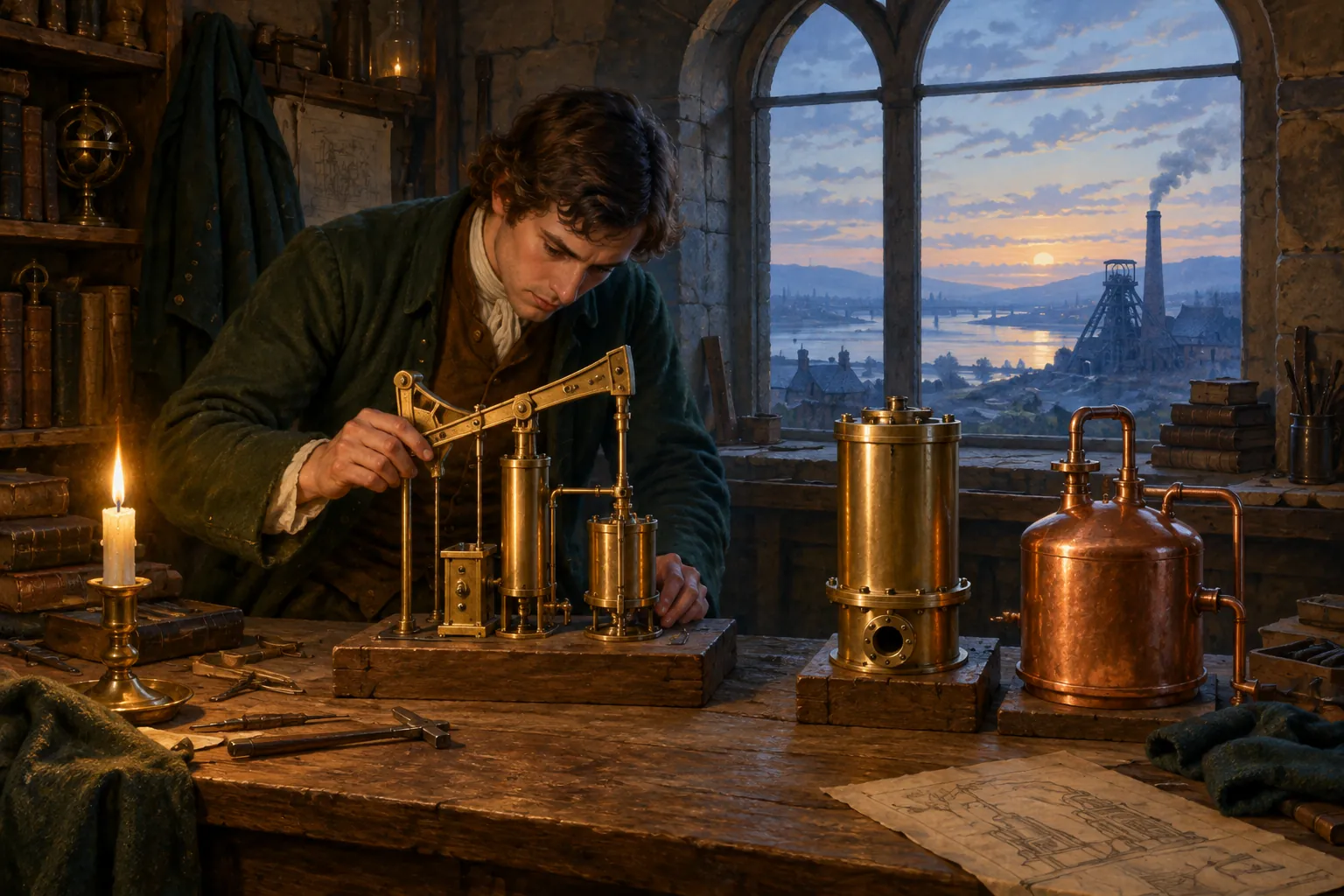
In five minutes
James Watt (1736–1819) was a Scottish instrument maker and engineer. He did not invent the steam engine. He made it efficient. Before Watt, steam engines pumped water out of mines, but they burned so much coal that only places with cheap coal could afford them. Watt's separate condenser cut that fuel use sharply, and his later inventions turned a simple up-and-down pump into a machine that could spin a shaft. That change helped industry move away from rivers and horses and into towns. It sits at the centre of the Industrial Revolution.
The short answer to "what did James Watt invent?" is this: the separate condenser (1765), a gear system that made the engine turn a wheel (the sun-and-planet gear, 1781), the double-acting engine (1782), a linkage called parallel motion (1784) and a governor that kept the speed steady (about 1788). He also popularised the idea of horsepower, and the unit of power, the watt, is named after him.
A Scottish instrument maker
Watt was born in Greenock, on the Firth of Clyde, in January 1736. His father worked in shipbuilding, trade and local government. James was often unwell as a child and learned a great deal at home, in a workshop full of tools and models. As a young man he spent about a year in London learning to make scientific instruments, then returned to Scotland.
In 1757 the University of Glasgow gave him a workshop on its grounds. There he made and repaired mathematical instruments for professors, and he met people who studied heat, including the chemist Joseph Black. That mix of craft skill and scientific curiosity is what made Watt unusual. He could think about why a machine wasted energy, and he could build the part that fixed it.
The problem with the Newcomen engine
Steam engines already existed. Thomas Savery patented a steam pump in 1698, and in 1712 Thomas Newcomen's engine began pumping water at a coal mine near Dudley Castle. Newcomen's design worked like this: steam filled a cylinder under a piston, then a spray of cold water condensed the steam inside the same cylinder. The vacuum that resulted let the weight of the air push the piston down, and a big beam lifted the pump rod.
The design had a built-in flaw. Every stroke, the cylinder was heated by steam and then cooled by water, so most of the heat in the coal was spent warming the metal again and again. Newcomen engines were useful at coal mines, where small, poor-quality coal cost almost nothing. Elsewhere, the coal bill was too high.
The separate condenser (1765)
In 1763–64 Watt was asked to repair a small working model of a Newcomen engine used for teaching. He saw how much steam it swallowed to do very little work. After months of experiments on how steam behaves, he reached the key idea in 1765: keep the cylinder hot all the time, and condense the steam in a different vessel that stays cold. A valve connects the two. Watt later recalled that the idea came to him on a walk across Glasgow Green.
Nothing changes in the basic principle of the engine, but the waste is mostly gone. Watt also closed the top of the cylinder and wrapped it in a steam jacket, so the cylinder stayed hot and steam pressure could help push the piston. He patented the invention in 1769 under the title "A New Method of Lessening the Consumption of Steam and Fuel in Fire Engines." In many installations, Watt engines used about a quarter of the coal that a Newcomen engine needed for the same job.
Turning a clever idea into a working engine was harder than having it. The first backer, the ironmaster John Roebuck, paid for trials in Scotland, but metalworkers of the time could not make a large cylinder round enough to hold steam. Roebuck went bankrupt in 1773, and Watt, who had been working as a surveyor and canal engineer to earn a living, nearly gave up.
Matthew Boulton and the Soho partnership
The rescue came from Birmingham. The manufacturer Matthew Boulton took over Roebuck's share in 1775, and the same year Parliament extended Watt's patent until 1800. That gave the partners 25 more years to build and sell engines without competition. Boulton had money, contacts and a large factory, the Soho Manufactory. Watt had the design.
The other missing piece was precision. The ironmaster John Wilkinson had developed a way to bore cannon barrels accurately, and the same machinery could bore engine cylinders. In 1776 the first commercial Boulton and Watt engines went to work: one pumping water at the Bloomfield colliery in Staffordshire, and another blowing air into the furnaces at Wilkinson's ironworks. Boulton and Watt then sold engines in a clever way. They charged a licence fee based on about one third of the coal the customer saved compared with a Newcomen engine, so customers paid only if they gained.
Making it turn: from pump to factory engine
Early Watt engines were still pumps. Mills and factories wanted a spinning shaft. A crank would have been the obvious answer, but a rival, James Pickard, patented one in 1780, so Watt designed a different mechanism. His sun-and-planet gear (patent 1781) used two gears to turn the beam's rocking motion into rotation.
Then came a run of improvements. In 1782 Watt patented the double-acting engine, in which steam pushes the piston in both directions, so the engine makes a power stroke twice per cycle. In 1784 he patented parallel motion, a set of rods that lets the piston rod move in a nearly straight line while attached to a swinging beam. About 1788 he fitted a centrifugal governor, a pair of spinning weights that open or close the steam valve to keep the speed even. A steady, rotating engine could drive spinning machines, flour mills, ironworks and breweries. Now factories could be built where the workers and markets were, not only beside fast rivers.
Horsepower and the watt
Many of Watt's early customers owned horses that turned mill wheels, so he needed a way to say how much work an engine could do in terms they understood. He estimated that a strong mill horse could do roughly 33,000 foot-pounds of work per minute, and he called that one horsepower. In today's units one British horsepower is about 746 watts.
The watt itself came later. In the 1880s scientists in Britain proposed naming the unit of power after him, and it was later built into the international metric system (SI). One watt is one joule of energy per second. That is why light bulbs and kettles are rated in watts.
Common mistakes about James Watt
- He did not invent the steam engine. Savery, Newcomen and others came first. Watt made the engine efficient and adaptable.
- He did not discover electricity. The search term "James Watt contribution to electricity" is popular, but his link to electricity is only the unit named after him. Electric power stations came after his death.
- The kettle story is a legend. The tale of a boy watching a kettle lid lift is not a documented fact. His real breakthrough came from experiments on heat.
- He was not a fan of high pressure. Watt distrusted high-pressure steam as dangerous. After his patent ended in 1800, engineers such as Richard Trevithick and Oliver Evans built smaller high-pressure engines, which made the steam locomotive possible.
Why Watt mattered, and the criticism
Watt's engines gave industry a source of power that did not depend on weather, rivers or muscle. They opened mines to deeper digging, helped ironworks grow and allowed cotton mills to move to towns. Watt became a Fellow of the Royal Society in 1785, and he retired in 1800. He died on 25 August 1819 at his home at Heathfield, near Birmingham.
Historians also point out the other side. Boulton and Watt defended their patents hard, and some engineers argued that this slowed progress. In Cornwall and elsewhere, rivals designed new engines the moment the monopoly ended. Both views can be true: the patent let a risky invention survive, and it also held back others for a quarter of a century.
What exams ask
- Name the improvement. The separate condenser is the answer in almost every question. Remember that it saved fuel by keeping the cylinder hot.
- Place him in the sequence. Newcomen (1712) came before Watt (patent 1769), and Trevithick's high-pressure engine came after.
- Explain significance. A good AP-style answer links cheaper power from coal to factories, urban growth and the rise of the factory system, and then to the railway age.
- Know the partnership. Boulton supplied capital and a factory, Watt the design, and Wilkinson the precision cylinders.
Read next
- The Steam Engine: Who Invented It and How It Worked: the full story from Savery and Newcomen to the machine Watt rebuilt.
- George Stephenson and the First Steam Locomotives: how high-pressure steam took engines onto rails after Watt's patent ended.
- Eli Whitney's Cotton Gin: another invention that changed the cotton trade that Watt's engines later powered.