In five minutes
The Dreyfus Affair was a legal and political crisis in France that ran from 1894 to 1906. Alfred Dreyfus, a Jewish artillery captain, was convicted of selling military secrets to Germany. He was innocent. When evidence of the real traitor appeared, army leaders chose to protect their institution instead of correcting the verdict, and the struggle to free Dreyfus became a national argument over justice, the army and antisemitism.
- 1894: Dreyfus is convicted on weak evidence and sent to Devil’s Island.
- 1896–1898: Colonel Picquart finds the likely real author, Major Esterhazy, but the army shields him, and Émile Zola publishes “J’accuse…!”.
- 1899: A second court-martial at Rennes convicts Dreyfus again, and the president pardons him.
- 1906: France’s highest appeal court clears him for good.
The affair is one of the sharpest moments in the story of nationalism told in our 19th-century Europe hub. It shows what happens when national pride, fear of enemies and old prejudice meet a state that claims to run on law.
Why it happened
Defeat and the lost provinces. France lost the Franco-Prussian War in 1870–71. The new German Empire, built around Prussia and steered by Bismarck, took Alsace and part of Lorraine. A deep fear of German spies and a wish for revenge followed. The rebuilt army became a symbol of national pride, and criticising it felt unpatriotic to many people.
A divided Republic. The Third Republic was born from that defeat and from the bloody civil conflict of the Paris Commune in 1871. In the 1890s it still faced monarchist, Catholic and nationalist opponents, and financial scandals had hurt trust in politicians. Conservatives tended to see the army as a pillar above party politics. Republicans and the left wanted it to answer to elected government.
Antisemitism. The journalist Édouard Drumont’s 1886 book La France juive and his newspaper La Libre Parole spread the idea that Jews were disloyal outsiders. Dreyfus came from an Alsatian Jewish family that had kept French nationality after 1871, and he was one of very few Jewish officers on the General Staff. For people already inclined to suspect Jews, he was an easy target.
What happened
1894: a torn note and a quick arrest
In September 1894 French counter-intelligence obtained an unsigned note, later called the bordereau. It listed military documents offered to the German military attaché in Paris. The army looked for the writer among General Staff officers, and suspicion fell on Dreyfus. His handwriting looked somewhat similar, and he was a Jewish outsider in a conservative circle. He was arrested on 15 October. Handwriting experts disagreed with each other, Dreyfus was wealthy, and investigators found no motive.
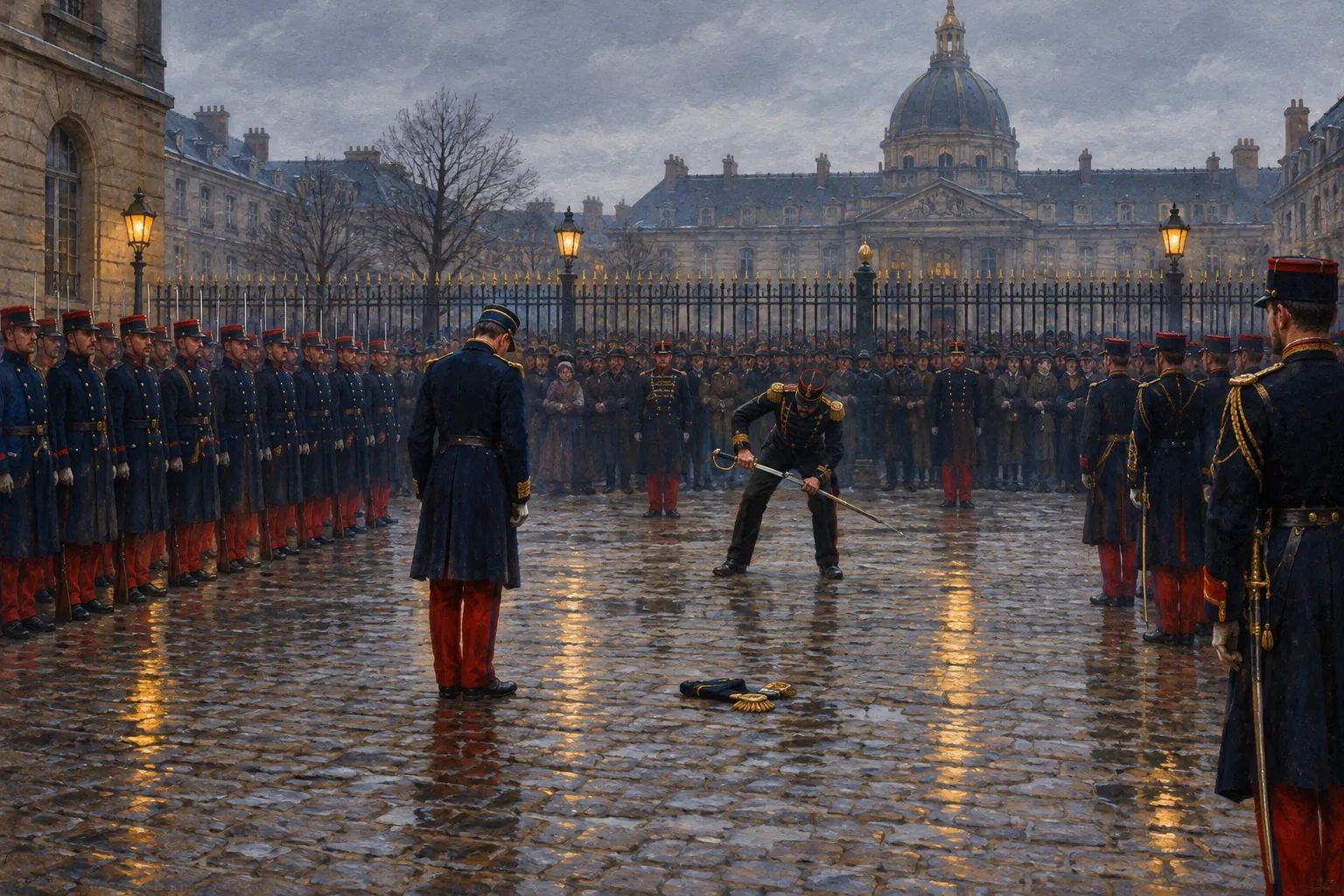
The court-martial in December 1894 found him guilty unanimously. The judges had also been shown a secret file that the defence never saw, which was a serious breach of fair trial. On 5 January 1895, Dreyfus was publicly stripped of his rank in the courtyard of the École Militaire in Paris, shouting that he was innocent. He was then sent to Devil’s Island, a small prison island off French Guiana, where he lived in harsh isolation for more than four years.
1896: Picquart finds a different suspect
In 1895 Lieutenant Colonel Georges Picquart took charge of the army’s intelligence section. In 1896 he came across evidence pointing to Major Ferdinand Walsin Esterhazy, an officer deep in debt who was in contact with the German attaché. Esterhazy’s handwriting matched the bordereau. Picquart told his superiors, but they did not want to reopen a case the army regarded as closed, and he was posted away to Tunisia. Meanwhile Major Hubert-Joseph Henry, who had worked on the original case, forged a letter to strengthen the file against Dreyfus.
1897–1898: the case breaks open
Dreyfus’s brother Mathieu never stopped campaigning. In November 1897 he publicly named Esterhazy, and the vice-president of the Senate, Auguste Scheurer-Kestner, took up the cause. A military court tried Esterhazy in January 1898 and acquitted him after a very short deliberation.
Two days later, on 13 January, the novelist Émile Zola published an open letter to President Félix Faure on the front page of the newspaper L’Aurore. Its headline, “J’accuse…!”, was chosen by the editor, Georges Clemenceau. Zola named officers who, he said, had hidden the truth, and he accused the military court of acquitting a guilty man on orders. He was prosecuted for libel, convicted in February 1898, and left for England to avoid prison. Writers, scientists and teachers signed petitions in support of a retrial, and the word “intellectuals” became part of political language. At the same time, antisemitic riots broke out in a number of French cities.
1898: the forger is exposed
In July 1898 the war minister, Godefroy Cavaignac, read documents to the Chamber of Deputies as proof of Dreyfus’s guilt. One of them was Henry’s forgery. An officer checking the file noticed the fake, and Henry confessed on 30 August. He was arrested and died by suicide the next day. The case against Dreyfus lost its main support. Esterhazy fled abroad and later admitted that he had written the bordereau.
1899: Rennes and a pardon
In June 1899 the Court of Cassation, France’s highest appeal court, cancelled the 1894 verdict and ordered a new court-martial at Rennes. Dreyfus came back from Devil’s Island thin and ill. In September, the Rennes judges again found him guilty, by five votes to two, but with “extenuating circumstances,” and sentenced him to ten years. The ruling was widely seen as unjust inside and outside France. President Émile Loubet pardoned Dreyfus ten days later. Exhausted, he accepted, and he went on working for full exoneration.
1906: his name is cleared
On 12 July 1906 the Court of Cassation annulled the Rennes verdict without ordering another trial, ruling that the accusation had no basis. Dreyfus was reinstated in the army as a major and received the Legion of Honour on 21 July. Picquart was also reinstated and promoted, and later served as war minister. Dreyfus returned to service in the First World War and died in 1935.
The main people
- Alfred Dreyfus (1859–1935): the artillery captain from Alsace who was wrongly convicted.
- Mathieu Dreyfus: his brother, who led the family’s campaign.
- Ferdinand Walsin Esterhazy: the officer later identified as the writer of the bordereau.
- Georges Picquart: the intelligence chief who found the evidence and was punished for it.
- Hubert-Joseph Henry: the officer who forged evidence and killed himself after confessing.
- Émile Zola: the novelist whose open letter pushed the case into public view.
- Georges Clemenceau: the editor of L’Aurore and later prime minister.
What changed
The affair split France into Dreyfusards, who put individual rights and truth first, and anti-Dreyfusards, who put army honour and national unity first. New organisations grew from the fight. The Human Rights League was founded in 1898 to defend civil liberties, while nationalist groups, including the circle around Action française, used the controversy to attack the Republic and Jews.
Republican politicians came out of the crisis determined to bring the army under civilian control. The Catholic Church was widely seen as sympathetic to the anti-Dreyfus side, and that feeling helped push through the 1905 law separating church and state. The case also showed how a state secret can be used to deny a fair trial, and it became a standard example of institutional cover-up and prejudice. Antisemitism did not disappear, but the Republic had shown that its courts could, in the end, correct an injustice.
What exams ask
- Dates and order: 1894 conviction, 1898 “J’accuse…!”, 1899 Rennes and pardon, 1906 full exoneration.
- Significance (AP-style): how the affair exposed tensions in the Third Republic between nationalism, the army, the Church and republican ideals.
- Causes: defeat in 1871, the loss of Alsace, spy fears and political antisemitism.
- Role of the press and intellectuals: Zola’s letter and the mass newspapers of the 1890s.
- Consequences: civilian control of the army, the 1905 church–state separation, and polarised politics.
Read next
- 19th-Century Europe: Revolutions, Nationalism and Unification: the wider picture of how nationalism reshaped the continent.
- The Paris Commune (1871): the civil conflict that marked the early Republic.
- Otto von Bismarck: The Iron Chancellor: the statesman who built the German Empire that France feared.
- Prussia: From Kingdom to Germany’s Core: the state that won the 1871 war and took Alsace.