In five minutes
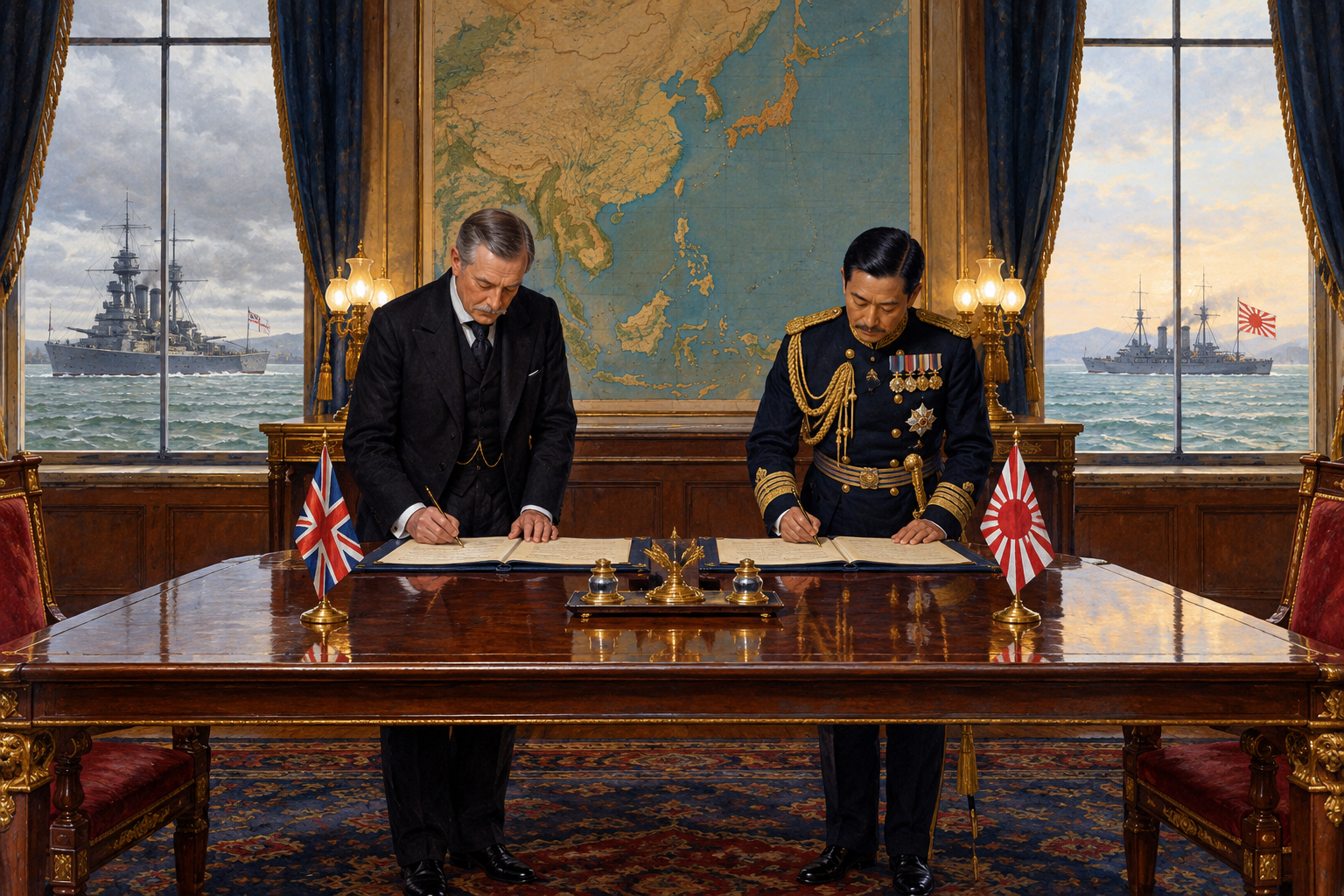
The Anglo-Japanese Alliance (日英同盟, Nichi-Ei Dōmei) was a military treaty signed in London on 30 January 1902 by the British foreign secretary, Lord Lansdowne, and Japan's minister in London, Hayashi Tadasu. Both sides wanted the same thing: a check on Russia in East Asia without having to stand alone. For Britain, it meant giving up “splendid isolation”, its habit of avoiding peacetime alliances. For Japan, it was the first treaty on equal terms with a Western great power.
The core promise was simple. If either country went to war with one enemy in East Asia, the other would stay neutral. If a second power joined that enemy, the partner would fight at its side. That promise mattered most in 1904, when Japan attacked Russia and Russia's ally France had every reason to keep out. This page belongs to the topic Qing China, Japan and the West (1793–1912).
Why Britain looked for a partner
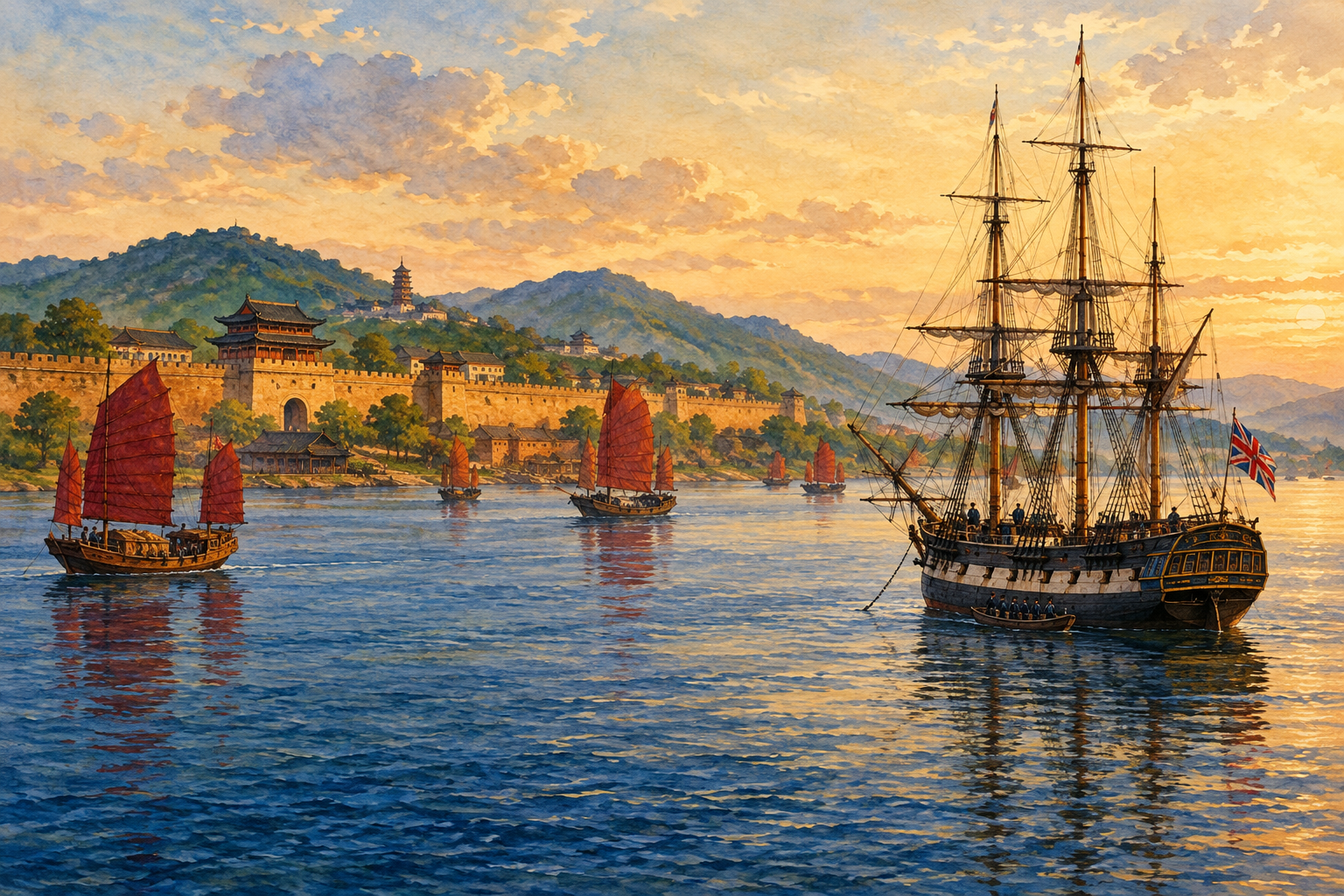
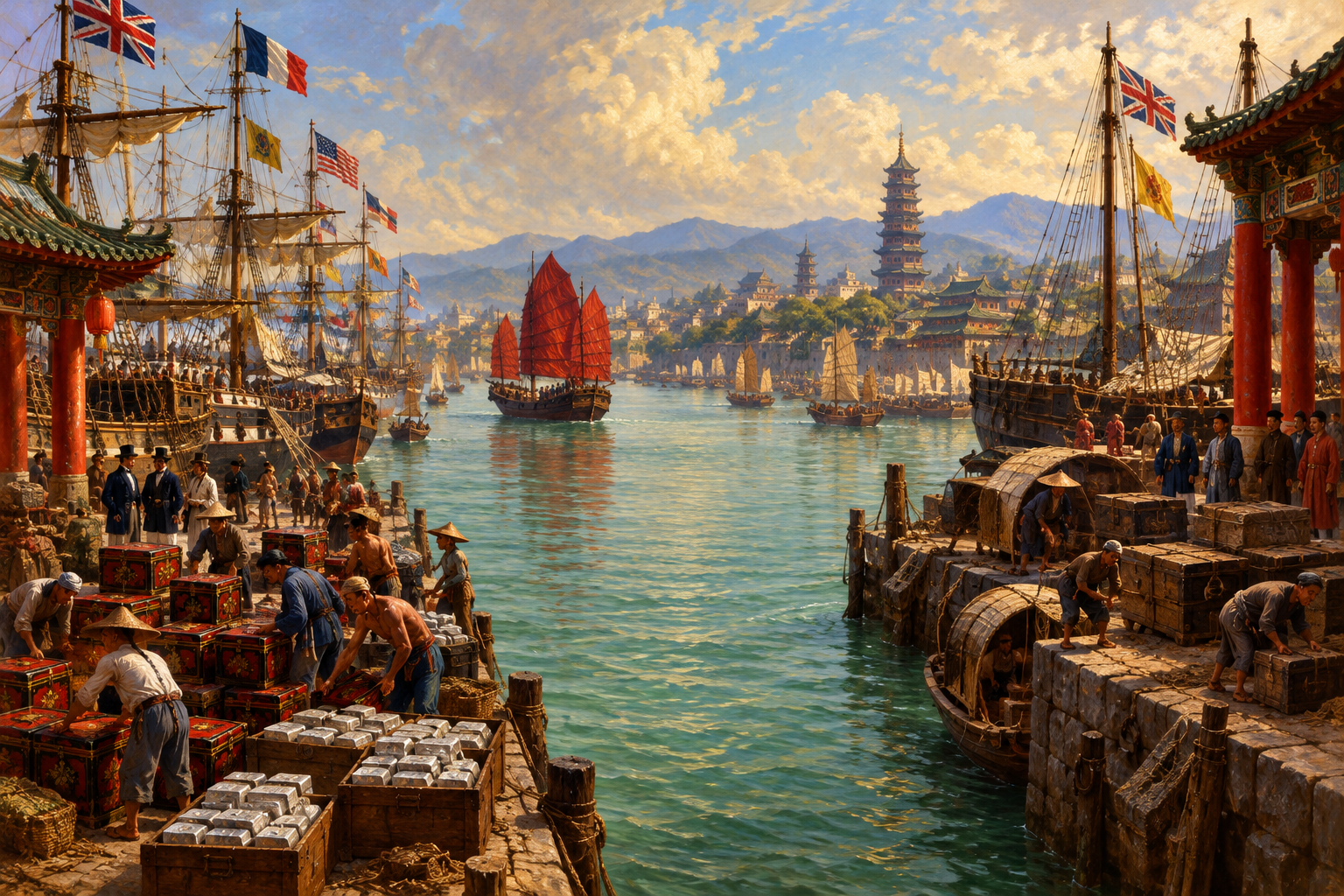
Around 1900 Britain had the largest empire and the largest navy in the world, but it was stretched thin. The Boer War in South Africa (1899–1902) tied up troops and brought a wave of criticism from other European countries. In China, British merchants had the biggest share of trade, especially along the Yangtze, and London feared that Russia would shut the door on that trade.
Britain had first tried Germany. Talks between 1898 and 1901 went nowhere, because each side wanted the other to take on more risk. A treaty with Japan looked cheaper. Japan had a modern fleet, much of it built in British yards, and it sat close to the places where Russia was pushing south. A Japanese navy on Britain's side meant the Royal Navy did not have to send so many ships east.
Why Japan wanted Britain
Japan's fear of Russia dated from 1895. After Japan won the first Sino-Japanese War, Russia, France and Germany forced it to hand back the Liaodong Peninsula (see The Triple Intervention (1895)). Three years later Russia leased Port Arthur on that same peninsula. In 1900, during the Boxer crisis, Russian troops entered Manchuria, and they did not leave when the crisis ended. Korea, only a short sea crossing from Japan, seemed next.
Tokyo was divided. Ito Hirobumi, a leading elder statesman, explored a deal with Russia that would recognise Russian influence in Manchuria and Japanese influence in Korea. Prime Minister Katsura Taro, Foreign Minister Komura Jutaro and Yamagata Aritomo preferred Britain, because a Russian deal could be broken and a British one gave Japan a powerful backer. By the end of 1901 the government chose to finish the British talks.
There was also a longer story. Britain had already signed a trade and navigation treaty with Japan in 1894, which ended British extraterritorial rights there from 1899. That made it easier for Japan to see Britain as a partner and not just a pressure from outside.
What the treaty said
The 1902 agreement was short. Its main points were these.
- Independence: both sides declared they had no aggressive aims in China or Korea and respected the independence of both countries.
- Special interests: Britain had special interests in China; Japan had special interests in China and, above all, in Korea. Each could act to protect them if threatened.
- One enemy: if one partner went to war with a third power over these interests, the other would stay neutral and try to stop other powers from joining the enemy.
- Two or more enemies: if another power joined the fight, the ally would come to its aid, make war together and make peace together.
- Length: five years.
The treaty did not promise help against any attack anywhere. It was aimed at one region and one problem. That is why historians call it a limited alliance, though the limits would be stretched later.
The alliance and the Russo-Japanese War
Russia agreed in 1902 to withdraw its troops from Manchuria in stages, then stopped. Talks with Japan dragged on, and in February 1904 Japan attacked Russian ships at Port Arthur (see The Russo-Japanese War (1904–1905)). Because Russia was the only enemy, Britain was not required to fight. Its job was to keep others out, and it did. Britain's April 1904 agreement with France, the Entente Cordiale, made France unwilling to risk a war with Britain on Russia's behalf.
Britain also helped in other ways. Japan's main battleships, including the flagship Mikasa, had been built in British shipyards. London banks, with New York banks, helped Japan raise the loans it needed. When Russia's Baltic Fleet steamed around the world in 1904–1905, Britain made coaling hard for it. In October 1904 the fleet even fired on British fishing boats in the North Sea, the Dogger Bank incident, which angered the British public. When the fleet reached the Tsushima Strait in May 1905, the Japanese navy destroyed it.
Renewals in 1905 and 1911
The alliance was renewed twice, each time with a wider reach. The 1905 version, signed on 12 August, before the Portsmouth peace talks ended the war, ran for ten years. It extended the area to India, so that Britain's most valued colony was covered. It also recognised Japan's right to guide and protect Korea. It turned the pact into a full defensive alliance: help was due if either partner was attacked by even one power. Japan and Britain also raised their legations to embassies.
The third version, signed on 13 July 1911, kept the alliance running another ten years. It added a clause that said neither side had to fight a country with which it had an arbitration treaty. In practice this removed the United States, which Britain did not want to fight. By then Russia was no longer the main fear, and the alliance served other needs.
The First World War
Japan declared war on Germany on 23 August 1914, citing the alliance, and took the German base at Tsingtao (Qingdao) in November. Japanese ships also patrolled the Pacific and Indian Oceans, and in 1917 a destroyer force based in Malta helped protect Allied shipping in the Mediterranean. But Britain grew uneasy. Japan's 1915 Twenty-One Demands on China looked like an attempt to gain control, and Britain's dominions and the United States were wary of Japan's rise.
Why it ended
After the war, the alliance began to look like a problem. The United States saw it as a possible tie that could draw it into a conflict with Japan. Canada pressed London to drop it. Britain wanted American goodwill more than a Japanese guarantee, and Japan's actions in China worried it. At the Washington Conference, the four powers (Britain, the United States, Japan and France) signed the Four-Power Treaty on 13 December 1921. It replaced the alliance with a pledge to consult one another about Pacific islands. When it came into force in August 1923, the Anglo-Japanese Alliance ended after more than twenty years.
Japanese leaders felt the loss. The alliance had made Japan a respected partner, and its end left Japan with a sense of isolation that later nationalists used. The alliance itself had helped Japan rise as a naval and diplomatic power.
What exams ask
- Date and parties: 30 January 1902, Britain and Japan, signed in London (Lansdowne and Hayashi).
- Cause: fear of Russian expansion in Manchuria and Korea after the Boxer crisis; Britain's loss of strength after the Boer War.
- Significance: the end of British “splendid isolation” and Japan's first equal alliance with a Western power.
- Effect: it helped Japan fight Russia in 1904–1905 by keeping other powers neutral.
- End: the Four-Power Treaty of 1921 (effective 1923) at the Washington Conference.
Read next
- The Triple Intervention (1895): the humiliation that pushed Japan to look for a strong partner.
- The Russo-Japanese War (1904–1905): the war in which the alliance was tested.
- The First Opium War (1839–1842): how Britain first built its position in China.