In five minutes
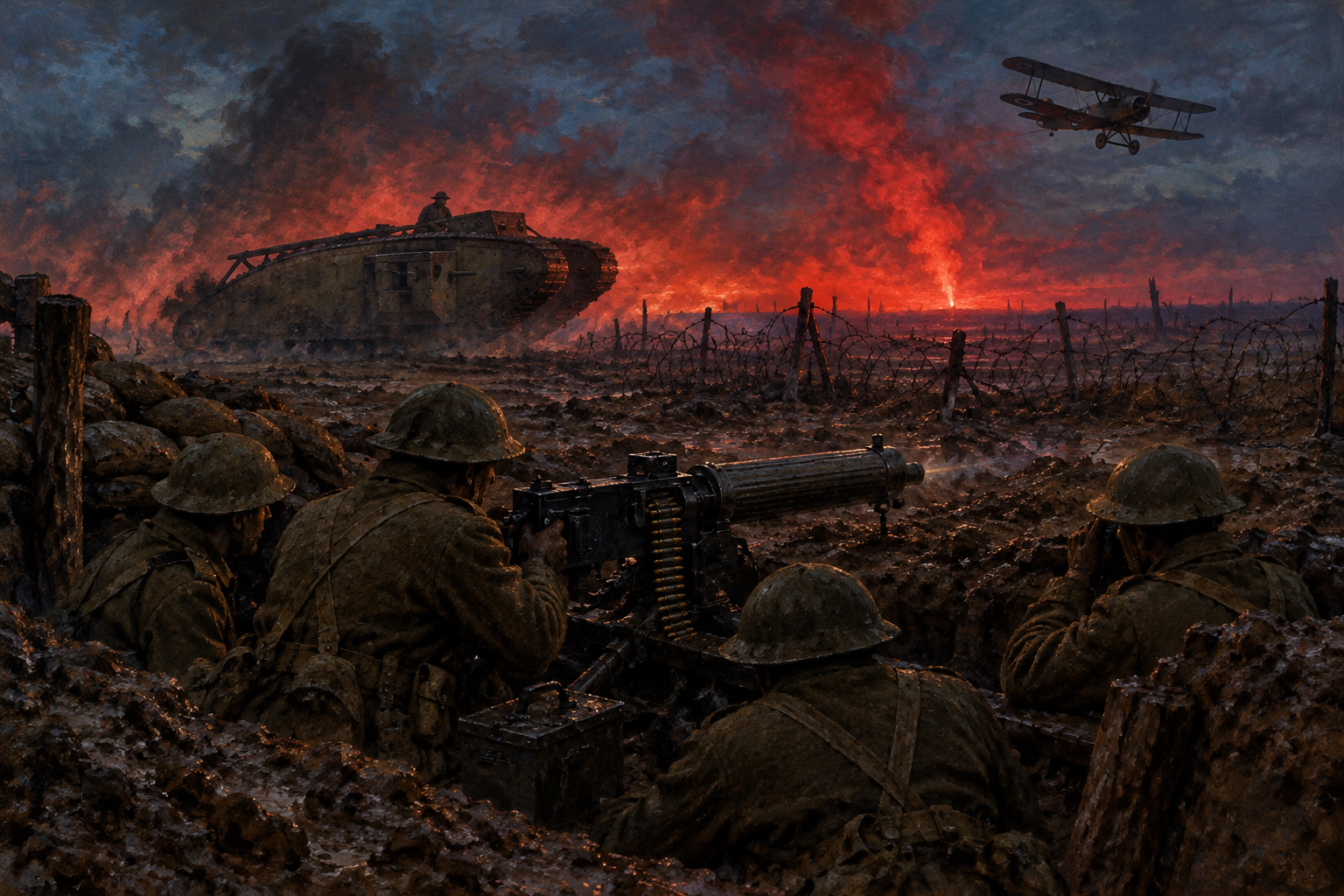
The new weapons of World War I did not make soldiers braver or generals crueller. They made defence stronger than attack. By 1914, machine guns, rapid-fire rifles and quick-firing artillery could hit anyone crossing open ground. Armies dug trenches to survive, and then spent four years looking for a way across the gap. Heavy shells, poison gas, tanks and aircraft were all attempts to solve that one problem.
This page is part of our guide to World War I (1914–1918): Causes, Course and Consequences. It starts with the machine gun, the weapon people search for most, and then follows the other inventions in the order they changed the fighting.
How the machine gun worked and why it mattered
A machine gun fires as long as the trigger is held down. The American-born inventor Hiram Maxim, working in Britain, patented a version in 1884 that used the force of its own recoil to eject each empty case and load the next round. Cartridges came on a belt, and a water jacket around the barrel kept it from overheating. It could fire several hundred rounds a minute. Britain's Vickers gun (adopted in 1912) and Germany's MG 08 were both developed from the Maxim design.
Colonial wars had already shown what such guns could do. At Omdurman in Sudan on 2 September 1898, a British and Egyptian force with Maxims faced an enemy that had almost none, and the losses were hugely one-sided. The Russo-Japanese War of 1904–05 gave a warning closer to Europe: at Port Arthur and elsewhere, machine guns and barbed wire made attacks very costly. Many European officers still believed that courage and a determined charge would carry the day.
In 1914 the standard machine gun was a heavy weapon. The MG 08, with its mount and cooling water, weighed around 60 kilograms and needed a crew to carry and serve it. That made it a defensive weapon. A crew would dig in, hide the gun, and sweep a chosen stretch of ground with fire from several hundred metres away. Two or three guns placed so their fire crossed could cover a whole field. Add barbed wire, which slowed attackers down inside that field of fire, and a frontal attack became close to suicidal.
The clearest example is the first day of the Battle of the Somme, 1 July 1916. The British army suffered about 57,000 casualties, including around 19,000 dead, mostly in a few hours. German machine guns and artillery were the main cause, and in some places the barbed wire had not been cut by the preparatory bombardment.
Light machine guns
Heavy guns suited defence, but armies also needed firepower that could move forward with the infantry. The Lewis gun, designed by the American Isaac Newton Lewis, weighed about 12 kilograms and fed from a round pan of ammunition. Britain used it widely from 1915, including on aircraft. France's Chauchat and Germany's lighter MG 08/15 followed. By 1918 small groups of soldiers could carry real firepower into an attack, which changed how infantry fought.
Machine guns were also used for indirect fire. Instead of aiming at a target they could see, crews fired over the heads of their own infantry at distant roads and trenches, in much the same way as artillery.
Artillery: the biggest killer
It may surprise you that most historians put artillery, not machine guns, at the top of the casualty list. Estimates vary, but shells are commonly said to have caused more than half of battlefield deaths and wounds. Shell fragments could hurt men hidden in a trench, and a long bombardment wore down the nerves of those who survived.
The key improvement was a recoil mechanism. The French 75 mm field gun of 1897 let the barrel slide back and return while the carriage stayed still, so the crew did not have to re-aim after every shot and could fire around fifteen rounds a minute. At the other end of the scale, Germany's giant Krupp 42 cm howitzers, nicknamed “Big Bertha”, smashed the forts at Liège and Namur in August 1914 far faster than expected. In 1918 the Paris Gun shelled the French capital from about 120 kilometres away.
Tactics changed too. Armies fired week-long bombardments before big attacks, as before the Somme. From 1916 the creeping barrage became common: a curtain of shells that moved forward a short distance at a time, just ahead of the advancing infantry, so that defenders had to stay under cover until the attackers were on top of them. Sound-ranging and aerial photographs helped each side find the other's guns.
Gas, flamethrowers and mortars
Germany launched the first large chlorine gas attack on 22 April 1915 near Ypres in Belgium. Phosgene followed, then mustard gas in July 1917. Gas masks arrived quickly, so gas killed far fewer people than shells did, but it injured many and spread fear. We cover it in detail in Poison Gas in World War I.
Flamethrowers, used by German troops from 1915, were meant to clear men out of trenches at close range. Their short reach and the danger to the operator limited them. Mortars and hand grenades mattered more: a mortar throws a shell in a high arc straight into a trench. Britain's Stokes mortar appeared in 1915, alongside the German Minenwerfer, and both became everyday trench weapons.
Tanks: a machine to cross the trench
The tank was designed to do what infantry could not: shrug off machine-gun bullets, crush barbed wire and cross trenches. The British Mark I first went into action on 15 September 1916 at Flers-Courcelette, part of the Somme campaign. It was slow, with a top speed of roughly 6 km/h, and it broke down often, so its first results were modest.
The turning point came at Cambrai on 20 November 1917, when the British used about 470 tanks together and advanced a long way in a few hours. They could not hold all the ground against the German counterattack, but the lesson was clear. On 8 August 1918, at Amiens, tanks, artillery, infantry and aircraft worked together and broke through. The French Renault FT of 1917, with a rotating turret, set the pattern for most later tanks. Germany built very few tanks of its own.
Aircraft and submarines
At the start of the war aircraft were scouts. They then began to spot where shells landed for the artillery and to drop bombs. In 1915 Germany's Fokker monoplanes carried a machine gun synchronised to fire between the propeller blades, which gave German pilots a short but real advantage. Fighter aircraft, air combat and strategic bombing grew from there. Read more in Aircraft and Air War in WWI.
At sea, German submarines (U-boats) tried to cut Britain's supplies. The sinking of the liner Lusitania on 7 May 1915 and the return to unrestricted submarine warfare in 1917 are two of the best-known moments, and the second helped bring the United States into the war.
How the stalemate was finally broken
No single weapon ended the deadlock. The solution was a mix. In March 1918 Germany used small assault groups, the stormtroopers, armed with light machine guns, grenades and flamethrowers, who followed a short, sharp bombardment and slipped past strong points. From August 1918 the Allies answered with tanks, creeping barrages, air reconnaissance and better infantry tactics. By then both sides had learned that war now needed factories, railways and whole societies, an idea historians call total war. Rising militarism before 1914 had helped make that arms race possible; see What Is Militarism? How It Led to WWI.
What exams ask
AP-style questions tend to focus on significance. A strong answer links the weapon to its effect:
- Machine guns and quick-firing artillery: made defence stronger, which produced trench warfare and huge casualties on the Western Front.
- Gas and flamethrowers: caused fear and injury but did not break the stalemate, because defences adapted.
- Tanks: first used in September 1916, effective only when combined with infantry, artillery and air power.
- Aircraft: moved from scouting to fighting and bombing, and pointed towards World War II.
- Total war: whole economies were turned towards making weapons.
A common mistake is to say that new weapons “made war more modern and so shorter”. In 1914–1917 they did the opposite.
Read next
- Aircraft and Air War in WWI: how the aeroplane went from scout to fighter and bomber.
- Poison Gas in World War I: the first gas attacks, the defences against them and why gas did not win the war.
- What Is Militarism? How It Led to WWI: the arms race and the thinking that put these weapons in the field.
- World War I (1914–1918): Causes, Course and Consequences: the full story of the war these weapons shaped.