In five minutes: how World War I ended
World War I ended on the Western Front at 11:00 a.m. on 11 November 1918. That was the moment an armistice, signed in a railway carriage in the forest of Compiègne, France, took effect and the guns stopped. If someone asks when WWI ended, this is the date and the hour to give.
An armistice is an agreement to stop fighting. It is not a peace treaty. The formal peace with Germany, the Treaty of Versailles, was signed on 28 June 1919 and came into force on 10 January 1920. So the fighting ended in 1918, and the war ended in law a little later.
As for who won WWI, the Allied side (chiefly Britain, France, the United States, Italy and Japan) defeated the Central Powers (Germany, Austria-Hungary, the Ottoman Empire and Bulgaria). This page is part of our guide to World War I (1914–1918): Causes, Course and Consequences. Below you will find why Germany asked for a ceasefire, what the terms said, and why people still argue about whether the war really ended that day.
Why Germany asked for an armistice
In March 1918 Germany made peace with Russia at Brest-Litovsk and threw everything at the Western Front in the Spring Offensive. It won ground, but it lost many of its best troops and could not replace them. Meanwhile American soldiers, in the war since April 1917, were arriving in France in large numbers.
The turning point came on 8 August 1918 at Amiens, where British and Allied forces used tanks, aircraft and artillery together. The German commander Erich Ludendorff is said to have called it the black day of the German army. The Allies kept up the pressure in what is called the Hundred Days Offensive, and at the end of September they broke through the Hindenburg Line, Germany's strongest defensive position.
Germany's partners were falling at the same time. Bulgaria signed an armistice on 29 September, the Ottoman Empire on 30 October and Austria-Hungary on 3 November. On 29 September Ludendorff told the leadership that the army needed a ceasefire. In early October the new chancellor, Prince Max of Baden, asked US President Woodrow Wilson for an armistice, hoping for peace on the basis of Wilson's Fourteen Points. Wilson answered that he would deal only with a more democratic Germany. Ludendorff resigned on 26 October.
At home, the British naval blockade had left people short of food. In late October sailors at Kiel refused orders to sail out for a last battle, and the mutiny grew into a revolution that spread across the country. On 9 November the Kaiser's abdication was announced and the Social Democrat Philipp Scheidemann proclaimed a republic. Wilhelm II left for the Netherlands the next day.
The armistice talks, 8 to 11 November
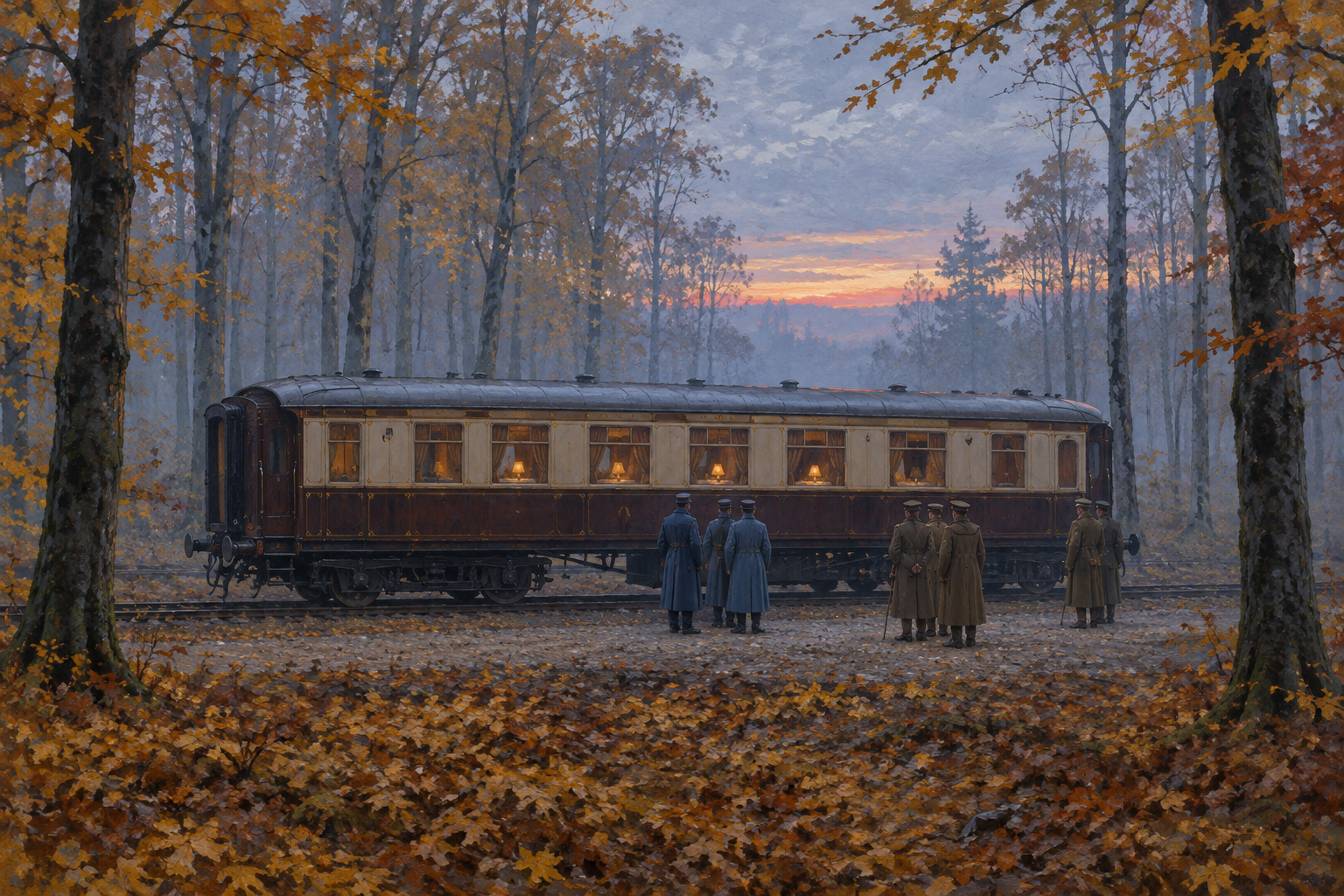
A German delegation led by the politician Matthias Erzberger crossed the lines and met the Allied supreme commander, Marshal Ferdinand Foch, on 8 November. The meeting took place in Foch's railway carriage, a restaurant car, in a clearing near Compiègne. Foch gave the Germans the terms and a deadline of 72 hours. He refused their request for an immediate ceasefire while talks went on.
The Germans had little choice. With revolution at home and a new government in Berlin, they accepted. The agreement was signed in the early hours of 11 November, at about 5 a.m., by Foch and the British naval officer Rosslyn Wemyss for the Allies and by Erzberger for Germany. It was set to take effect six hours later, at 11:00 a.m. Paris time.
Those six hours were not quiet. Some units kept attacking right up to the deadline. Estimates put the casualties on that last day at roughly 11,000, including about 2,700 deaths. The American private Henry Gunther is often named as one of the last soldiers killed, at 10:59 a.m.
What the armistice terms said
The terms were written to make sure Germany could not start fighting again. The main ones were:
- Germany had to leave Belgium, France, Luxembourg and Alsace-Lorraine within 15 days.
- Allied troops would occupy the left bank of the Rhine, with bridgeheads at Mainz, Koblenz and Cologne.
- Germany had to hand over large amounts of war material, including thousands of guns, machine guns, aircraft, locomotives and railway wagons.
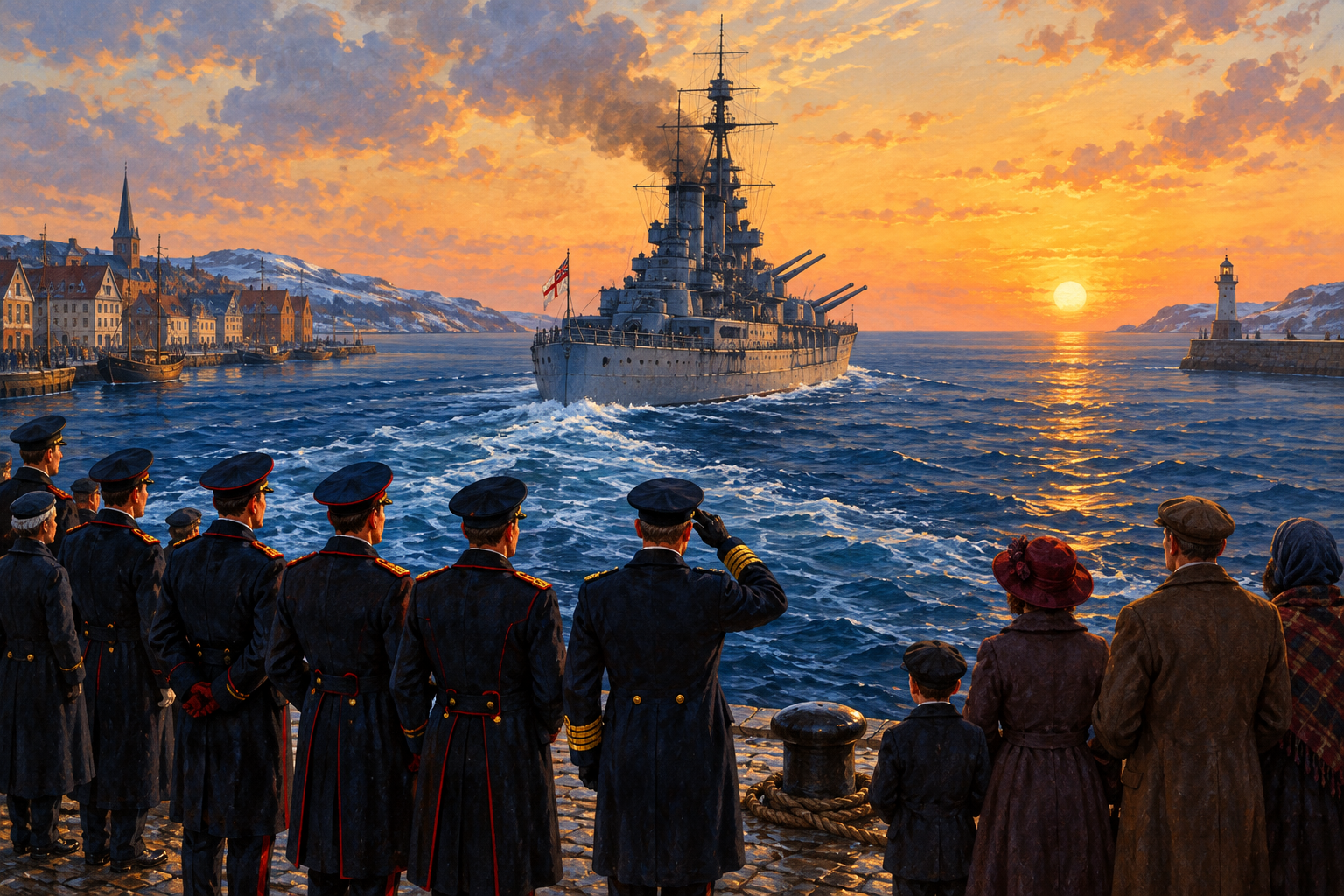
- The submarine fleet was surrendered and the main surface fleet was interned. Most of those ships were later scuttled by their own crews at Scapa Flow in June 1919.
- The treaties of Brest-Litovsk and Bucharest, which had given Germany large gains in the east, were cancelled.
- The Allied naval blockade stayed in place until a peace was signed, and prisoners of war held by Germany were to be sent home.
The armistice ran for 36 days at first and was renewed several times until the peace treaty was signed.
Was this the end of the war? Who won?
The fighting on the Western Front ended on 11 November, but the legal end took longer. Germany signed the Treaty of Versailles on 28 June 1919. The other Central Powers signed their own treaties: Saint-Germain with Austria (1919), Neuilly with Bulgaria (1919), Trianon with Hungary (1920) and Sèvres with the Ottoman government (1920), later replaced by the Treaty of Lausanne with Turkey (1923). The United States never ratified Versailles and made a separate peace with Germany in 1921.
The Allies won. Four empires, the German, Austro-Hungarian, Russian and Ottoman, had collapsed by the end of 1918 or soon after. Yet because the armistice came while German troops were still on foreign soil and no Allied army stood in Germany, a damaging story spread afterwards. The stab-in-the-back legend claimed that the army had not been beaten but was betrayed by politicians and revolutionaries at home. It was false: the army had been in retreat for months and its own leaders asked for the ceasefire. But the legend was used by German nationalists, including the Nazis, to attack the new republic.
The railway carriage became a symbol. In June 1940 Hitler made France sign its own armistice in the same carriage at the same spot.
What exams ask
- Date and place: 11 November 1918, 11:00 a.m., Compiègne. Know the difference between armistice (1918) and peace treaty (Versailles, 1919).
- Causes of German defeat: failure of the Spring Offensive, American arrival, the Hundred Days Offensive, collapse of allies, blockade and revolution at home.
- Significance: the end of four empires, the role of Wilson's Fourteen Points, and how the armistice fed the stab-in-the-back myth and resentment over Versailles.
Read next
- World War I (1914–1918): Causes, Course and Consequences: the full story of the war, of which this page covers the ending.
- How Many People Died in WWI?: the human cost of the war, with the figures historians use.
- The Christmas Truce of 1914: an earlier, unofficial pause in the fighting, four years before the armistice.
- What Is Militarism? How It Led to WWI: one of the long-term causes behind the war that the armistice finally stopped.