In five minutes
The World War I Christmas Truce of 1914 was an unofficial pause in fighting along parts of the Western Front on and around 24–25 December 1914. British and German soldiers stopped shooting, called out greetings, climbed out of their trenches and met in no man's land. It was not a peace deal, no general ordered it, and the war went on.
It matters because it shows two things at once: how much the ordinary men on both sides had in common, and how little that changed the machinery of war. This page is part of our guide to World War I (1914–1918): Causes, Course and Consequences.
Why it happened: the first winter in the trenches
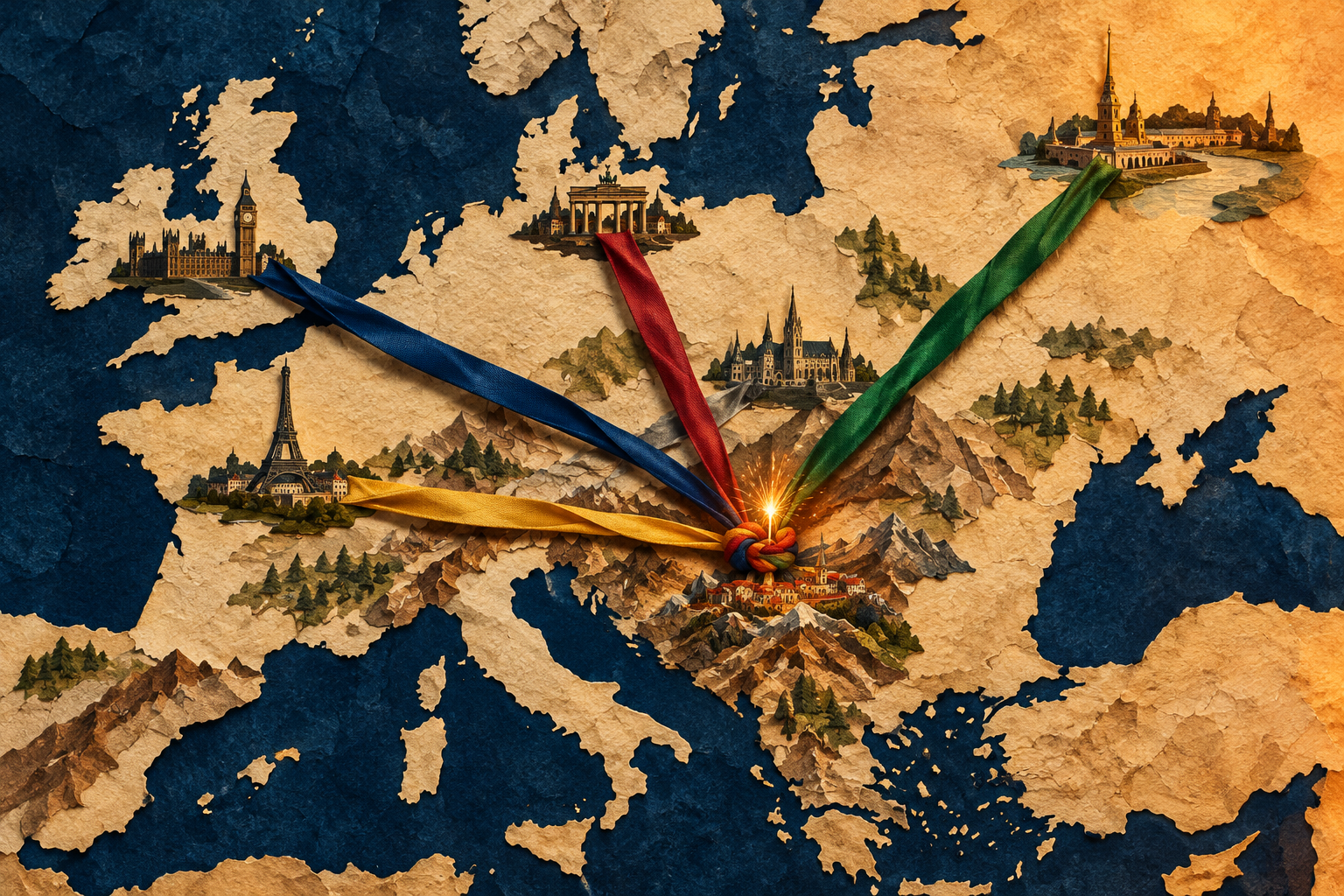
The war began in July and August 1914. Germany invaded Belgium and France, and Britain entered the war on 4 August. Many soldiers on both sides had been told it would be over by Christmas. Instead, the German advance was stopped at the Marne in September, and after the fighting around Ypres in October and November both armies dug in. By December a line of trenches ran from the Belgian coast to the Swiss border.
In some places the opposing trenches were less than 100 metres apart. Men could hear each other cough, talk and sing. They shared the same rain, mud, cold, lice and fear. Some German soldiers had worked in Britain before the war and spoke English, so a shouted conversation across the gap was possible.
On 7 December 1914 Pope Benedict XV asked the warring governments to agree a Christmas ceasefire. They refused. The soldiers, in a number of sectors, did something like it anyway. This kind of local, unspoken "live and let live" was already growing in quiet parts of the line, which made the Christmas pause easier to start.
What happened on 24–26 December
Christmas Eve
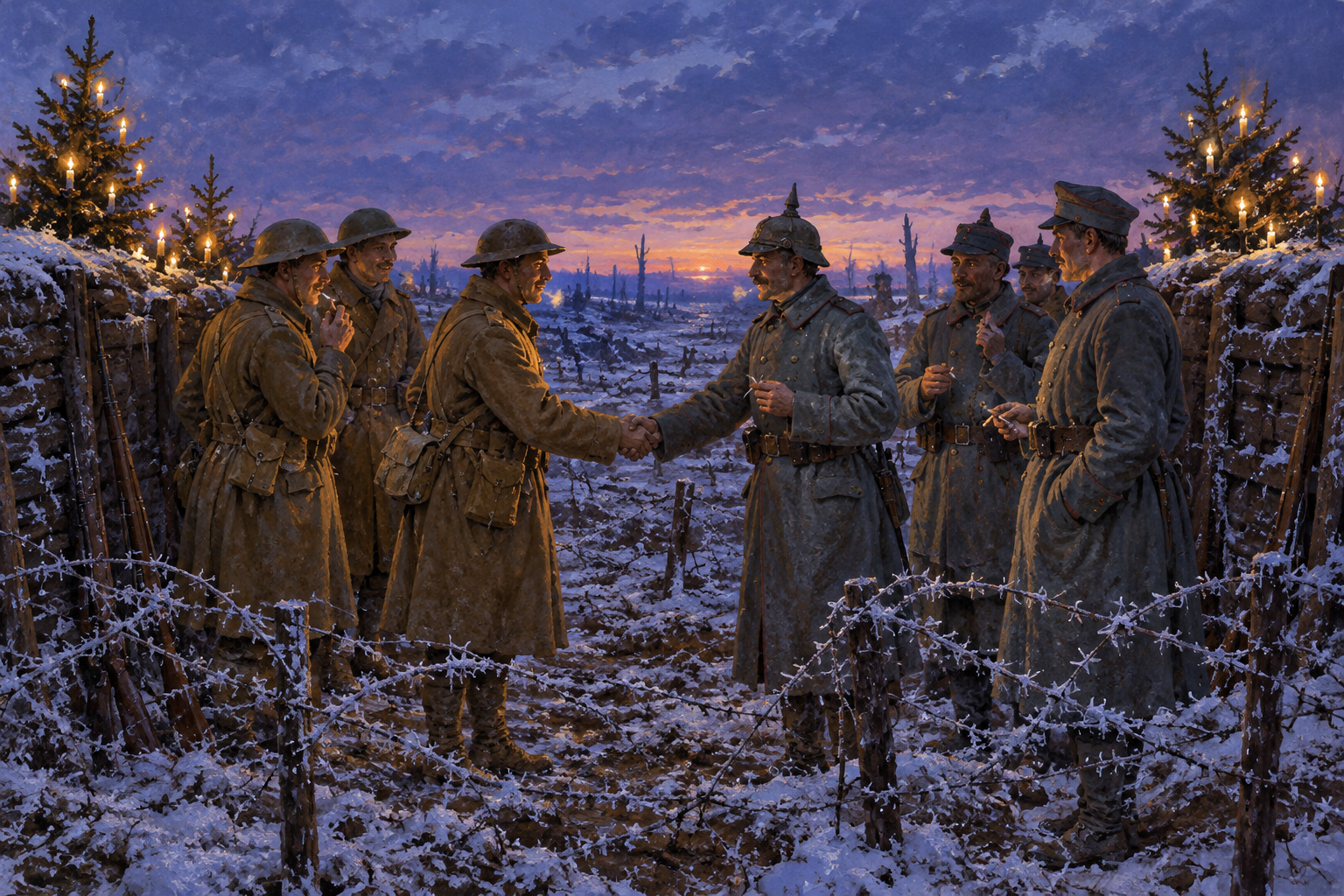
After weeks of rain, the weather turned cold and frosty. In several sectors German soldiers placed small Christmas trees, some with candles, on the edge of their trenches and sang carols, including "Stille Nacht" (Silent Night). British soldiers answered with carols of their own and applauded. Greetings in broken English and German crossed the gap.
Christmas Day
On the morning of 25 December, men on both sides began to climb out of their trenches, often unarmed, and walk towards the middle. They shook hands, swapped cigarettes, tobacco, food, drink, buttons and badges, and showed each other photographs of their families. Some had their picture taken together.
In many places the two sides agreed to collect and bury the dead who had lain between the lines for weeks, and held short joint services. Soldiers also used the quiet to repair trenches and wire. Several wrote home about impromptu kickabouts with a ball or a tin can. These were casual games, not organised matches.
After Christmas
The length of the truce varied from sector to sector. In some places it lasted only a day. In others it carried on to Boxing Day or even to the New Year. Where one side's officers insisted on ending it, they often warned the other side first so that nobody was shot while still standing in the open. Estimates suggest that as many as about 100,000 soldiers took part along the front.
What the truce was not
- Not the whole front. It happened mainly between British and German units in Flanders, around Ypres, Messines and Armentières. In many other places the fighting went on, and men were killed on Christmas Day.
- Not official. Governments and headquarters did not plan it. Senior officers, who had warned against fraternising, were angry when they heard about it.
- Less common on French and Belgian ground. Their armies were fighting to free land that Germany had occupied, and there were far fewer truces in their sectors.
- Not an organised football match. The football stories are real as informal kickabouts, but there is no proof of a formal game with teams and a score.
How we know what happened
Most of what we know comes from letters, diaries and regimental records written at the time. Many British soldiers wrote home to their families and to local newspapers, and editors printed these letters in the weeks after Christmas. German soldiers left letters and diaries too, though fewer of them reached English-language readers. Because the truce was local and unofficial, there is no single report that covers the whole front. Historians therefore put many small accounts together, and they treat later memoirs with more care than letters written on the day, since memory and retelling can polish a story.
This is also why the details vary. One account describes a carol, another a handshake, another a joint burial, and each describes only one stretch of trench. The overall pattern is clear, but the exact scene differed from place to place, and a claim that the whole front fell silent would be wrong.
Key terms
- No man's land: the open, shell-torn ground between two opposing trench lines.
- Fraternisation: friendly contact between soldiers of enemy armies, which commanders forbade.
- Western Front: the line of fighting in Belgium and France, from the North Sea to Switzerland.
- "Live and let live": the unspoken habit, in quiet sectors, of not attacking when the other side did not attack.
Why it did not happen again
After 1914, commanders moved to stop it. Orders banned fraternising, and at Christmas 1915 artillery was ordered to fire so that the quiet could not return. A few small local truces still happened in 1915, but the war itself had changed. Germany used poison gas on a large scale at Ypres in April 1915. The huge battles of 1916, Verdun and the Somme, killed vast numbers of men. Hatred grew, newspapers and propaganda hardened attitudes, and trench raids kept the front in constant contact. By 1916 truces of this kind had almost disappeared.
Why it matters
British newspapers printed soldiers' letters about the truce in January 1915, and the story became one of the best-known episodes of the war. It has been retold in books, songs, memorials and the 2005 French film Joyeux Noël.
Historians do not see it as proof that the war could have been stopped by the soldiers. It shows something narrower and still important: that men told to hate each other could, given a quiet night and a shared holiday, treat each other as people. It also shows how strong the structures of armies, states and total war were. Within days, the same men were back to shooting at each other.
The hundredth anniversary in 2014 brought new memorials and ceremonies, and the story is still used in schools to talk about how ordinary people live through war.
What exams ask
- Stalemate on the Western Front. Know why trench lines formed by late 1914 and why the war was not "over by Christmas".
- Local and unofficial. Be ready to explain that the truce was spontaneous, uneven and not ordered by governments.
- Limits and significance (AP-style). A strong answer says the truce showed shared humanity among soldiers and weak support for the war's hatred at the front in 1914, but that it did not change the course of the war, and that later propaganda, new weapons and orders made repeats rare.
- Comparisons. Link it to trench warfare, to the escalation into total war, and to the Pope's failed peace appeal of 7 December 1914.
Read next
- Trench Warfare in WWI: the mud, wire and short distances that made a pause like this possible.
- What Is Militarism? How It Led to WWI: why governments were ready to refuse a ceasefire.
- Effects and Consequences of WWI: what the war finally cost, long after the truce.
- How Did WWI End? The Armistice of 11 November 1918: the real ceasefire that came four years later.
- All Quiet on the Western Front: a novel that shows trench life from a German soldier's side.