In five minutes: who was Rasputin?
Grigori Yefimovich Rasputin (about 1869–1916) was a Siberian peasant and wandering pilgrim who became a trusted presence in the household of Tsar Nicholas II. He held no office and was never a priest, yet during the First World War his name became shorthand for everything Russians distrusted about their government. He was killed by a group of aristocrats on the night of 16–17 December 1916 (Old Style), about two months before the February Revolution. This page is part of our hub on The Russian Empire (1721–1917).
- Why he mattered: the Empress believed he could ease the bleeding attacks of her only son, Alexei.
- Why he was hated: rumours of drunkenness and scandal, and the belief that he influenced who ran the government.
- How he died: shot by conspirators led by Prince Felix Yusupov, and his body was put into a frozen river.
- What it changed: very little. The murder did not save the monarchy.
Where did Rasputin come from?
Rasputin was born around 1869 in the village of Pokrovskoye in Tobolsk province, Siberia. His family were peasants. He married, had children and worked the land, but as a young man he began to take long pilgrimages to monasteries and became known as a strannik, a lay holy wanderer. Followers later called him a starets, a respected spiritual elder. He was not a monk or an ordained priest, so the popular label “the Mad Monk” is wrong on both counts.
Around 1903–1905 he arrived in St Petersburg. Churchmen and society ladies, among them the Montenegrin princesses married into the Romanov family, were curious about this plain-spoken Siberian with intense eyes. Through them he came to the attention of the court.
How did Rasputin win the trust of the Tsar?
The answer is a medical one. Tsar Nicholas II and Empress Alexandra had four daughters and then, in 1904, a son, Alexei, the heir to the throne. Alexei had haemophilia, a blood disorder in which even small injuries can cause dangerous bleeding. The illness was kept quiet, and the doctors of the day could do little.
Rasputin met the imperial couple in autumn 1905. Alexandra became convinced that his prayers could help her son. The most famous episode came in October 1912 at the hunting lodge of Spała, when Alexei was close to death after a bleeding crisis. Rasputin sent a telegram saying the boy would live, and he recovered. Historians offer several explanations: the boy may have improved on his own, Rasputin’s calm may have eased the child’s panic, and keeping the doctors’ remedies away from the bedside may have helped. Whatever the cause, Alexandra drew the conclusion that Rasputin was essential to her family.
Why was Rasputin so hated?
Before the war, critics attacked him for drinking, for boasting of his access to the court and for his reputation with women. Some clergy accused him of false teaching. Newspapers repeated the stories, and the more the court protected him, the more the rumours grew. The popular belief that he was the Empress’s lover has never been supported by evidence; her letters show devotion to a “Friend” she saw as a holy man and a healer of her son.
The war made it far worse. In June 1914 a woman named Khioniya Guseva stabbed him in Pokrovskoye, and he nearly died. In September 1915 Nicholas took personal command of the army at the front, leaving Alexandra in the capital to watch over the government. Rasputin’s views on who should hold office reached the ministers through her, and ministers were replaced at a dizzying rate. Russia was losing men, food was short, and the public needed someone to blame. In November 1916 the liberal leader Pavel Milyukov gave a speech in the Duma, the parliament, listing the government’s failures and asking whether they were stupidity or treason. Rasputin had become the symbol of a court cut off from its people.
Historians stress one point. Rasputin did not rule Russia. The decisions belonged to the Tsar and Tsarina, and the empire’s deeper problems, such as the strains of total war and an overstretched state, would have existed without him. But his influence over appointments was real, and what mattered politically was that people believed it.
How did Rasputin die?
A small circle of aristocrats decided that the only way to end his influence was to kill him. The plot was led by Prince Felix Yusupov, who was married to the Tsar’s niece Irina, together with Grand Duke Dmitri Pavlovich, a cousin of the Tsar, and Vladimir Purishkevich, a right-wing member of the Duma. A doctor and an army officer also took part.
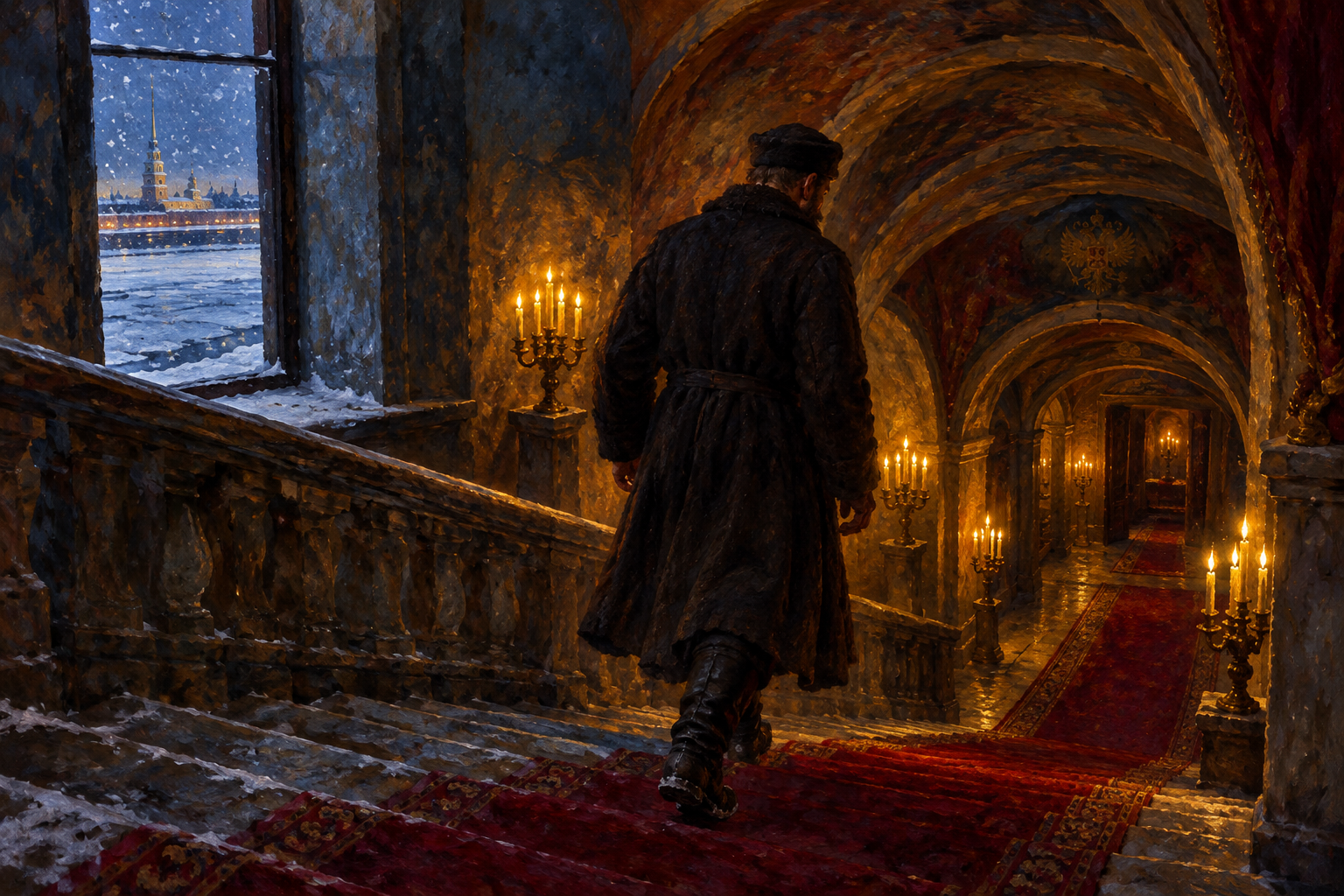
On the night of 16–17 December 1916 (Old Style; 29–30 December in the Western calendar) Yusupov invited Rasputin to the family’s Moika Palace in Petrograd, as St Petersburg had been renamed in 1914. Rasputin was lured to the cellar. He was shot, and the body was taken to the Neva delta and pushed under the ice of the Little Nevka river. It was found on 19 December (Old Style) by searchers who had been alerted by the disappearance.
The famous story of cakes and wine laced with poison that failed to work, and of a victim who rose again and ran into the courtyard, comes from the killers’ own memoirs, which were written later and contradict each other. The best-documented account is simpler: he died of gunshot wounds, and his body was hidden in the river.
What happened afterwards?
The crime did not bring the court to its senses. The Tsar was furious, and Yusupov and Dmitri were punished only with banishment from the capital, since Dmitri was sent to the Persian front and Yusupov to his estate. Many in Russian society quietly cheered. Alexandra had Rasputin buried in the grounds of the palace at Tsarskoye Selo.
Less than three months later the February Revolution broke out in Petrograd. Nicholas II abdicated on 2 March (Old Style), ending 300 years of Romanov rule. In March 1917 soldiers dug up Rasputin’s coffin, and the body was burned in a forest near the city. After the revolution, Soviet writers presented him as proof of how rotten the old regime had been, and later films, songs and novels turned him into a legend, often far from the facts. The fate of the imperial family is told in The Execution of the Romanov Family (1918).
What exams ask
In AP and other history courses, Rasputin is usually a case study in how a weak, isolated government loses legitimacy. Typical points to be ready for:
- Context: Alexei’s haemophilia explains why the Empress trusted him.
- Significance: he was a symptom of the monarchy’s crisis, not the main cause of its fall. His reputation damaged the dynasty’s prestige while Russia was losing the war.
- Link to events: Nicholas’s decision to take command at the front in 1915 left a political gap that Alexandra and, indirectly, Rasputin filled in the public imagination.
- Careful wording: say “influenced appointments,” not “ruled Russia”, and avoid calling him a monk.
Read next
- Nicholas II: The Last Tsar: the ruler Rasputin served, and why his decisions in wartime mattered.
- The Russian Revolution of 1917: what happened in the weeks after Rasputin’s death.
- The Execution of the Romanov Family (1918): how the story of the last imperial family ended.