In five minutes
The Boston Tea Party was a night-time protest in Boston on 16 December 1773. Dozens of colonists, by some counts well over a hundred, many of them linked to the Sons of Liberty, boarded three ships at Griffin's Wharf and tipped 342 chests of tea into the harbor. The tea belonged to the British East India Company. Nobody was killed, and the men were careful not to damage anything else on the ships.
The protest was not about the price of tea. It was about who had the right to tax the colonies. Parliament had passed the Tea Act earlier that year. It let the Company sell tea directly in America at a low price, but it kept a small import duty. Many colonists saw the cheap tea as bait: buy it, and you accept that Parliament can tax you without your consent.
Britain answered in 1774 with the Coercive Acts, which closed Boston's port and cut back self-government in Massachusetts. Instead of isolating Boston, these laws pulled the other colonies in. Within about sixteen months of the Tea Party, the first shots of the war were fired at Lexington and Concord. This page is part of our hub on The American Revolution: Causes, War and Independence.
Why did the Boston Tea Party happen?
Debt, taxes and a quarrel over consent
The Seven Years' War ended in 1763, and Britain was left with a huge debt. London decided that the American colonies, which had been defended in the war, should help pay for their own protection. Parliament passed new taxes, and the colonists objected because they elected no members of Parliament. Their slogan was “no taxation without representation.”
The Stamp Act of 1765 collapsed under boycotts and riots, and Parliament repealed it in 1766. On the same day it passed the Declaratory Act, which said Parliament could make laws for the colonies “in all cases whatsoever.” The principle had not been given up. In 1767 the Townshend duties taxed goods such as glass, paper and tea, and that set off new boycotts. In 1770 Parliament removed most of these duties but kept the one on tea, partly to show that it still held the right to tax. You can read the first stage of this story in our article on the Stamp Act of 1765.
A company in trouble
In 1773 the East India Company, which dominated British trade with Asia, was short of cash. Its London warehouses held a very large stock of unsold tea, often put at around 17 million pounds in weight. The British government did not want the Company to fail, so Parliament passed the Tea Act in May 1773.
The act let the Company ship tea directly to agents in the colonies. That skipped the London wholesalers and the colonial merchants who normally handled the trade. The only tax left on the tea was the Townshend duty of three pence per pound. The result was strange: the Company's tea would be cheaper than the smuggled Dutch tea that many colonists drank, even after the duty.
Why cheap tea felt like a trap
Colonial leaders argued that buying the cheap tea meant quietly accepting Parliament's right to tax. Merchants had a second fear. If the Company could sell tea straight to the public, the same monopoly might spread to other goods, and the merchants and smugglers who lived off the tea trade would be cut out.
Opposition grew through the autumn of 1773. In Philadelphia, pressure on the agents and the ship's captain led to the tea ship being sent home without unloading. In Charleston the tea was landed but stored in a warehouse, and it was not sold. In Boston the tea agents, who included relatives of Governor Thomas Hutchinson, refused to resign.
What happened on 16 December 1773?
The first tea ship, the Dartmouth, reached Boston on 28 November 1773. Two more, the Eleanor and the Beaver, followed soon after. Under customs rules, cargo that had not paid duty within 20 days could be seized by officials and landed, and the tea would then be sold. For the Dartmouth, that deadline fell on 17 December.
Boston's leaders, including Samuel Adams, called mass meetings at the Old South Meeting House. The colonists demanded that the ships leave with the tea still on board. But Governor Hutchinson would not give the ships a pass to sail out of the harbor unless the duty was paid, and the harbor was watched by warships. By 16 December the crowd in and around the meeting house numbered several thousand. The owner of the Dartmouth, Francis Rotch, was sent to ask Hutchinson one last time for permission to leave. When he came back with a refusal, the meeting broke up.
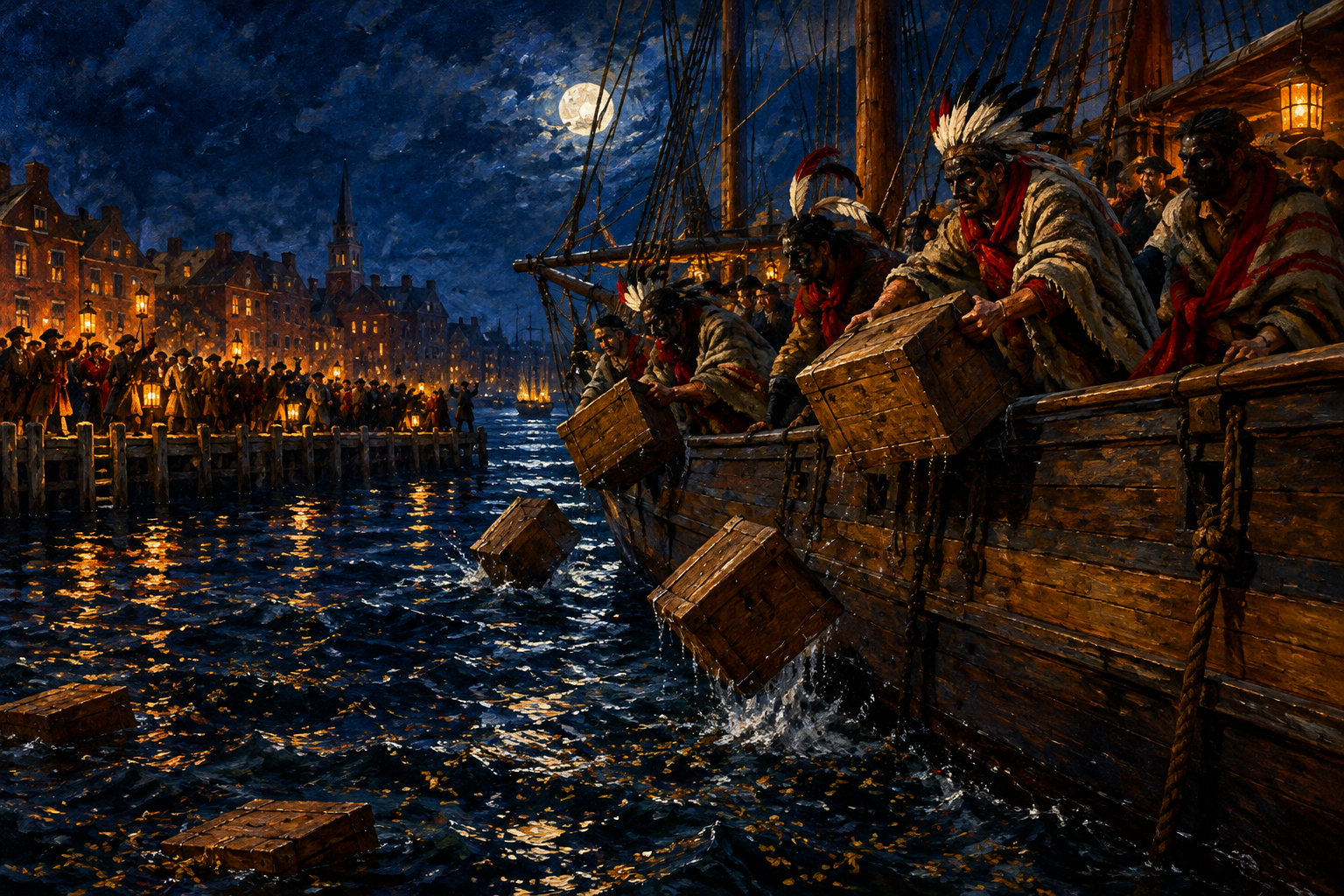
That evening a large group of men gathered and went to Griffin's Wharf. Many wore blankets and feathers and darkened their faces to look like Mohawk men, a disguise meant to hide who they were and to suggest that this was an American act, not an English riot. They boarded the three ships, lifted the chests out of the holds with tackle, split them open with hatchets and tipped the tea over the side. The work took about three hours. The tea was worth roughly £10,000 in 1773 money. The crowd on the wharf watched in near silence, and nobody was hurt.
The men who took part were never officially named, and many stayed quiet for decades. A few, such as the Boston shoemaker George Robert Twelves Hewes, gave their own accounts much later. The next day, John Adams wrote in his diary that it was a magnificent movement and that it would have important consequences.
Not everyone agreed. Some colonists, including Benjamin Franklin, thought destroying private property was wrong and said the East India Company should be repaid. But in Britain the reaction was fury, and that is what turned a local protest into a crisis.
What came next?
In the spring of 1774 Parliament passed a set of laws that Britain called the Coercive Acts and the colonists called the Intolerable Acts. The Boston Port Act closed the harbor to trade until the town paid for the tea. The Massachusetts Government Act cut back town meetings and put more power in the hands of the Crown's officials. The Administration of Justice Act allowed some trials of officials to be moved out of Massachusetts, and a new Quartering Act made it easier to house troops. General Thomas Gage was made governor, with soldiers behind him.
The effect was the opposite of what London intended. The other colonies saw Massachusetts being punished for a protest they, too, had supported, and they sent food and money to Boston. In September 1774, delegates from twelve colonies met in Philadelphia for the First Continental Congress and agreed to boycott British goods. On 19 April 1775 British troops and colonial militia fought at Lexington and Concord, which is the subject of our article on Lexington and Concord. In 1776 the colonies declared independence, as explained in The Declaration of Independence Explained.
Common misunderstandings
- It was not about high taxes. The Tea Act actually made tea cheaper. The dispute was about consent and about monopoly.
- The name came later. At the time, people spoke of “the destruction of the tea.” The phrase “Boston Tea Party” became common decades afterward.
- The men were not Mohawk. They were Boston colonists in disguise.
- It was not the whole colonies at once. Many colonists, especially merchants, disliked the destruction. The shared anger came after Britain's response.
What exams ask
AP-style questions usually ask you to place the Tea Party in a chain of cause and effect. Learn the order: the Stamp Act (1765), the Townshend duties (1767), the Tea Act (1773), the Tea Party (1773), the Coercive Acts (1774), the First Continental Congress (1774) and Lexington and Concord (1775).
- Cause: the Tea Act, which gave the East India Company a way to sell tea directly in America while the tax on tea stayed.
- Significance: it showed organised colonial resistance to taxation without representation, and it pushed Britain toward harsher punishment instead of compromise.
- Typical trap: the Tea Act did not raise the tax on tea. It lowered the price.
- Effect: the Coercive Acts, which united the colonies and led to the Continental Congress.
Read next
- The Stamp Act of 1765: the first big fight over taxation without representation, and the background to the Tea Party.
- Lexington and Concord: what happened when the crisis you just read about turned into fighting.
- The Declaration of Independence Explained: how the colonies explained their break with Britain.