In five minutes
The Declaration of Independence is the document in which the Second Continental Congress told the world, on 4 July 1776, that the thirteen American colonies were no longer part of the British Empire. It did two jobs. It announced a break, and it explained why. Its best-known sentence says that all men are created equal and have rights to life, liberty and the pursuit of happiness. Most of its length, though, is a list of complaints against King George III.
Thomas Jefferson wrote the first draft, and Congress edited it before approving it. The war was already more than a year old when the Declaration was adopted, and the document did not win independence. The fighting and the Treaty of Paris in 1783 did that. What the Declaration did was turn a quarrel over taxes and rights into a declared cause, and give the new United States a statement of its own ideals. It is one chapter of the larger story told in The American Revolution: Causes, War and Independence.
Why the colonies wrote it
After the Seven Years' War ended in 1763, Britain was deeply in debt and wanted the colonies to share the cost. The Stamp Act of 1765, the Townshend duties and the Tea Act of 1773 all asked colonists to pay taxes set by a Parliament in which they had no vote. “No taxation without representation” became their slogan. In December 1773 protesters dumped tea into Boston harbour (see the Boston Tea Party), and Britain answered in 1774 with harsh laws that colonists called the Intolerable Acts. The First Continental Congress met that September to organise a response.
Fighting began at Lexington and Concord on 19 April 1775. Even then, most colonists were not asking for independence. They wanted their rights as British subjects restored. In July 1775 Congress sent the Olive Branch Petition to the king, begging for a peaceful settlement. George III refused to receive it and in August declared the colonies to be in rebellion.
Opinion shifted quickly in 1776. In January Thomas Paine published Common Sense, a pamphlet that attacked monarchy in plain language and argued for independence. By spring, colony after colony was telling its delegates they could vote for a break. On 7 June Richard Henry Lee of Virginia moved that the colonies “are, and of right ought to be, free and independent states.” There was also a practical reason. To win help from France, the colonies had to deal as an independent country, not as rebellious subjects. The Declaration was written for two audiences: wavering colonists at home and governments abroad.
Who wrote it
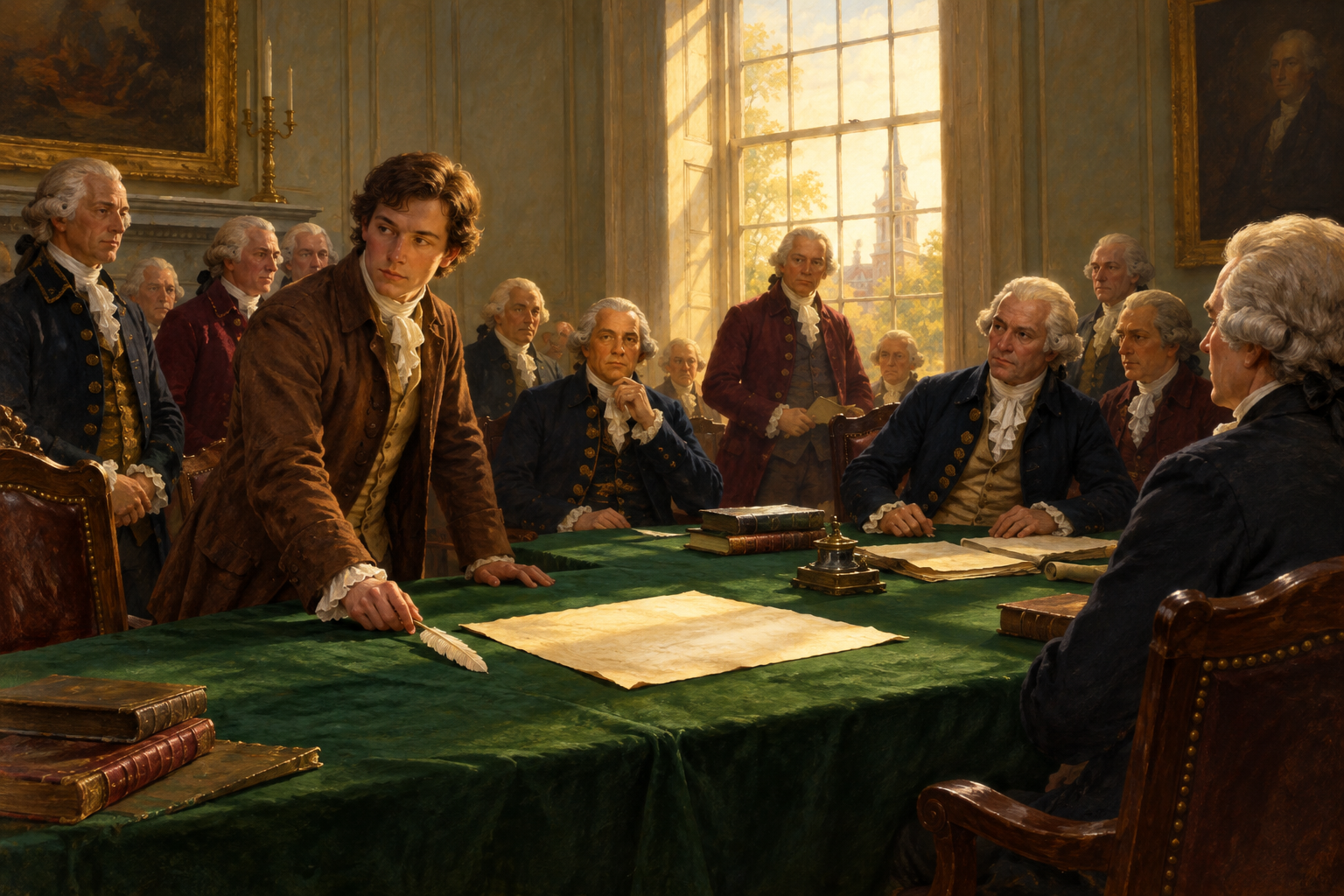
On 11 June 1776 Congress named a Committee of Five to draft a statement: Thomas Jefferson of Virginia, John Adams of Massachusetts, Benjamin Franklin of Pennsylvania, Roger Sherman of Connecticut and Robert R. Livingston of New York. The writing fell to Jefferson, a 33-year-old lawyer known for a clear, forceful style. He worked in rooms he rented in Philadelphia and finished a draft within a few weeks. Adams and Franklin suggested a few changes before the committee sent it to Congress.
Jefferson did not invent a new philosophy. He drew on the Enlightenment, especially John Locke's ideas of natural rights and government by consent, and on recent American texts such as the Virginia Declaration of Rights, drafted largely by George Mason in June 1776. Jefferson himself later said he was not hunting for originality but putting shared American views into plain words. The Declaration reads best as the work of one gifted writer giving voice to what many people of his time already believed.
What the Declaration says
The text has four parts, and it helps to read them in order.
1. The preamble
The opening says that when one people must break its political ties with another, it owes the world an explanation. From the first lines, the document presents itself as an argument, not just an announcement.
2. The statement of rights
This is the famous part. It holds as self-evident that all men are created equal and have rights that cannot be taken away, including life, liberty and the pursuit of happiness. Governments exist to secure those rights, and their just power comes from “the consent of the governed.” When a government keeps violating those rights, the people may change or abolish it. The text adds a caution: long-established governments should not be overthrown for minor reasons, only after a long run of abuses.
3. The list of grievances
This is the longest section, and it is aimed at King George III. Historians usually count about 27 charges. They include taxing the colonies without their consent, keeping armies among the people in peacetime, forcing households to house soldiers, cutting off trade, denying jury trials in many cases and sending foreign mercenaries to fight the colonists. Parliament is criticised too, but the king is the subject of nearly every sentence. The list works like evidence in a courtroom: it tries to show that independence was a last resort.
4. The conclusion
The delegates declare that the united colonies “are, and of right ought to be, free and independent states,” released from loyalty to the Crown, with the power to make war, form alliances and trade as any independent nation could. They end by pledging to each other their lives, their fortunes and their sacred honor.
From draft to adoption: 2 July and 4 July
Two dates matter, and they are often mixed up. Congress voted for independence itself on 2 July 1776, with twelve colonies in favour and New York abstaining. Over the next two days, delegates went through Jefferson's draft line by line and approved the final wording on 4 July. That is why the United States celebrates Independence Day on the 4th.
Congress cut roughly a quarter of the draft. The best-known deletion was a passage blaming the king for the slave trade. Delegates from South Carolina and Georgia objected strongly, and some northern merchants also profited from the trade. The cut shows a deep contradiction. Jefferson, who wrote that all men are created equal, held hundreds of people in slavery over his lifetime. In 1776 the phrase did not, in practice, cover enslaved people, most women or Native Americans.
Printing, signing and where it was signed
On the night of 4 July the Philadelphia printer John Dunlap set the text in type and ran off copies. About 26 of these “Dunlap broadsides” survive. The Declaration was read aloud in Philadelphia on 8 July. George Washington had it read to his army in New York on 9 July, the same day New York's delegates were authorised to approve it.
The large parchment copy people picture today was ordered on 19 July. Most delegates signed it on 2 August 1776, though others added their names later, so it is a myth that everyone signed on 4 July. Fifty-six men signed in all. John Hancock, president of Congress, wrote the largest signature. The signing took place in Philadelphia, in the Pennsylvania State House that is now Independence Hall. The parchment is kept at the National Archives in Washington, D.C. For the full story of who signed and when, see When and Who Signed the Declaration of Independence?
Why it still matters
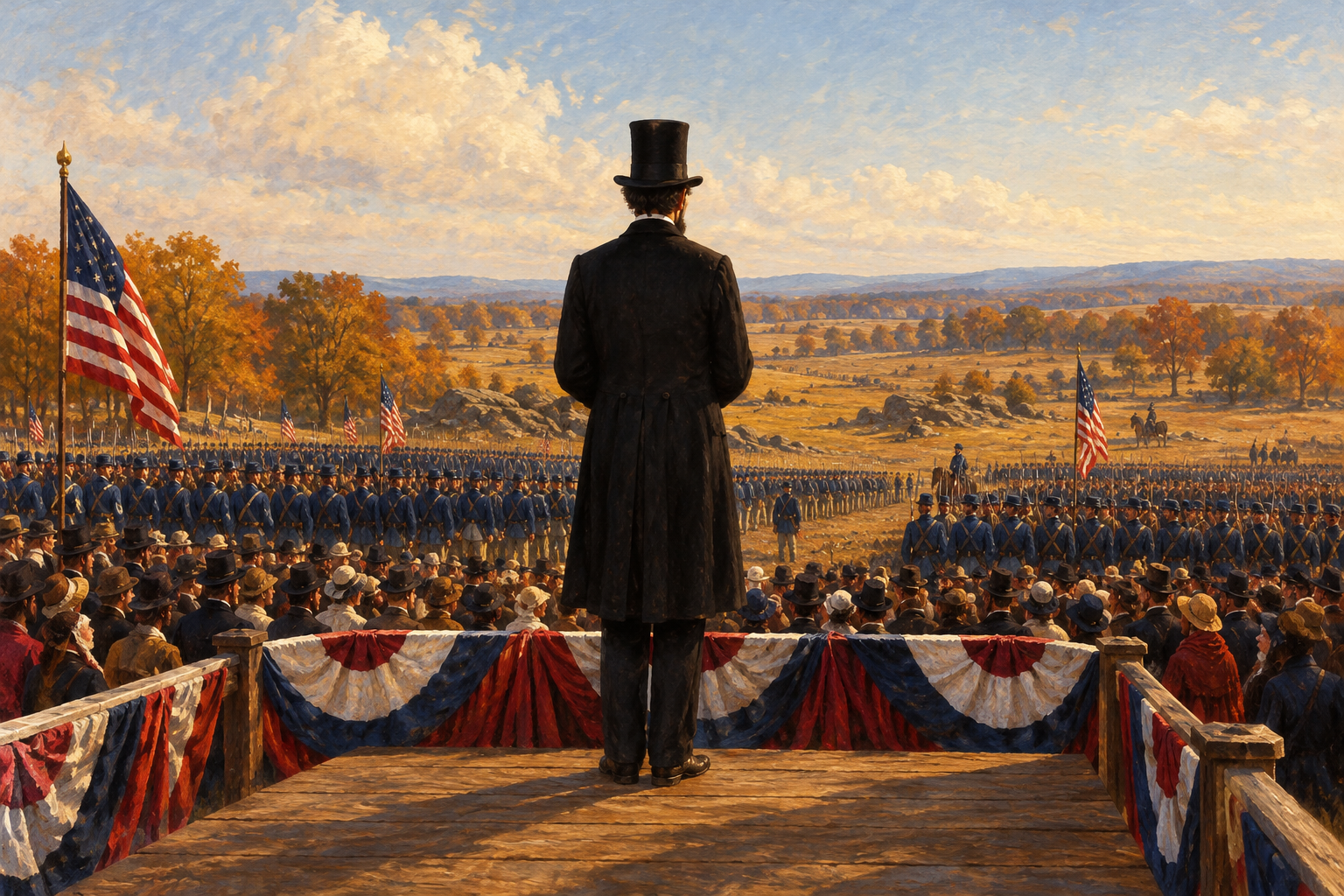
The Declaration is not a law and did not set up a government. That work came later, with the Articles of Confederation and the Constitution of 1787. Its lasting power lies in its language. The 1848 Seneca Falls convention modelled its Declaration of Sentiments on it and rewrote the line to say that all men and women are created equal. Abraham Lincoln opened the Gettysburg Address in 1863 by tracing the nation back to the proposition that all men are created equal. On 2 September 1945, Ho Chi Minh began Vietnam's own declaration of independence by quoting the American one. Those who were left out in 1776, including enslaved people and women, often used its words to claim what had been denied them. For one side of that story, read Women in the American Revolution.
What exams ask
In AP US History and similar courses, expect questions on these points:
- Purpose: to justify rebellion to colonists and to foreign powers, and to open the door to a French alliance.
- Ideas: natural rights, consent of the governed and the right to alter or abolish a harmful government. Be ready to link these to Locke and the Enlightenment.
- Structure: a statement of principles followed by a list of grievances against the king.
- Dates: independence voted on 2 July, text adopted on 4 July, parchment signed mostly on 2 August 1776.
- Contradiction: “all men are created equal” alongside slavery, and the deleted anti-slave-trade passage.
- Context: the Declaration came after Lexington and Concord and Common Sense, and before the Articles of Confederation, the victory at Saratoga in 1777 and the French alliance of 1778.
Do not confuse the Declaration with the Constitution. One announces independence and its reasons, and the other builds a government.
Read next
- The American Revolution: Causes, War and Independence: the full story from the first protests to the Treaty of Paris.
- When and Who Signed the Declaration of Independence?: who signed, when, and which parts of the popular story are myths.
- The Boston Tea Party (1773): the protest that pushed Britain and the colonies toward open conflict.
- Women in the American Revolution: what the war meant for women, who were left out of the Declaration's promise.