In five minutes: who was Abraham Lincoln?
Abraham Lincoln was the 16th president of the United States, in office from March 1861 until his death in April 1865. He is remembered for three things: he held the Union together during the Civil War, he turned the war into a fight against slavery, and he gave the country some of its most quoted speeches. Born into a poor frontier family, he taught himself law and rose in politics by arguing, calmly and in public, that slavery must not spread into new territory.
This page follows his life in order, then explains why historians still argue about him and what exams usually ask. It is part of our guide to 19th-Century America.
From a Kentucky cabin to the law
Lincoln was born on 12 February 1809 in a one-room log cabin in Hardin County, Kentucky. His father, Thomas, was a farmer who moved the family to Indiana in 1816 and later to Illinois. Lincoln had less than a year of formal schooling, by his own later account, and made up for it by reading everything he could borrow. His mother, Nancy, died in 1818, when he was nine.
As a young man he worked as a boatman, storekeeper, postmaster and surveyor in New Salem, Illinois. He won a seat in the Illinois legislature in 1834 as a member of the Whig Party, qualified as a lawyer in 1836, and moved to the state capital, Springfield, in 1837. In 1842 he married Mary Todd; they had four sons, though only the eldest, Robert, lived to adulthood. Law shaped his style: he broke big arguments into plain steps and spoke in short, clear sentences.
He served one term in the US House of Representatives (1847–1849). He criticised President Polk’s reasons for the Mexican–American War, which made him unpopular at home, and he did not run again. By the early 1850s he was a successful lawyer who seemed to have left politics behind.
Why a small-town lawyer became a national figure
What pulled him back was the Kansas–Nebraska Act of 1854, which opened new western territory to the possibility of slavery. Lincoln called slavery a moral and political wrong, and he helped build the new Republican Party. Its central aim was to stop slavery spreading into the territories, not to abolish it at once where it already existed.
In 1858 he ran for the US Senate in Illinois against the Democrat Stephen Douglas. Accepting the nomination, he said, “A house divided against itself cannot stand,” warning that the country could not stay half slave and half free. The seven Lincoln–Douglas debates that autumn were reported across the country. Lincoln lost the Senate seat, but he became widely known.
In February 1860 he gave a long, carefully researched speech at Cooper Union in New York, arguing that the founders had accepted limits on slavery. That helped him win the Republican nomination in May. Democrats split their vote in the election of 6 November 1860, and Lincoln won the presidency with about 40 percent of the popular vote, without winning a single Southern state.
Secession and the outbreak of war
Seven Southern states announced secession between December 1860 and February 1861, South Carolina first, before Lincoln even took office on 4 March 1861. They formed the Confederate States of America. In his first inaugural address Lincoln said he would not interfere with slavery where it already existed, but that he would hold federal property and defend the Union.
On 12 April 1861 Confederate guns opened fire on Fort Sumter in Charleston harbour, and the Civil War began. Lincoln called for 75,000 volunteers, and four more states (Virginia, Arkansas, Tennessee and North Carolina) seceded. Four slave states, Delaware, Maryland, Kentucky and Missouri, stayed in the Union, and Lincoln worked carefully to keep them there. This border-state politics explains many of his early decisions.
The first two years went badly for the Union in the east. Lincoln went through several commanders before settling on Ulysses S. Grant, whom he made general-in-chief in March 1864. He also took controversial wartime measures, including suspending habeas corpus in some areas, which critics called an abuse of power.
Emancipation and the Gettysburg Address
At first Lincoln described the war’s aim as saving the Union. As it dragged on, freeing enslaved people became both a moral goal and a military tool: it weakened the Confederacy’s labour force and let Black men join the Union army. After the battle of Antietam in September 1862 he issued a preliminary Emancipation Proclamation, and the final version took effect on 1 January 1863. It declared enslaved people in Confederate-held areas free. It did not cover the border states or areas already under Union control. About 180,000 Black soldiers served in the Union army, a force that mattered by 1864. Read more in The Emancipation Proclamation (1863).
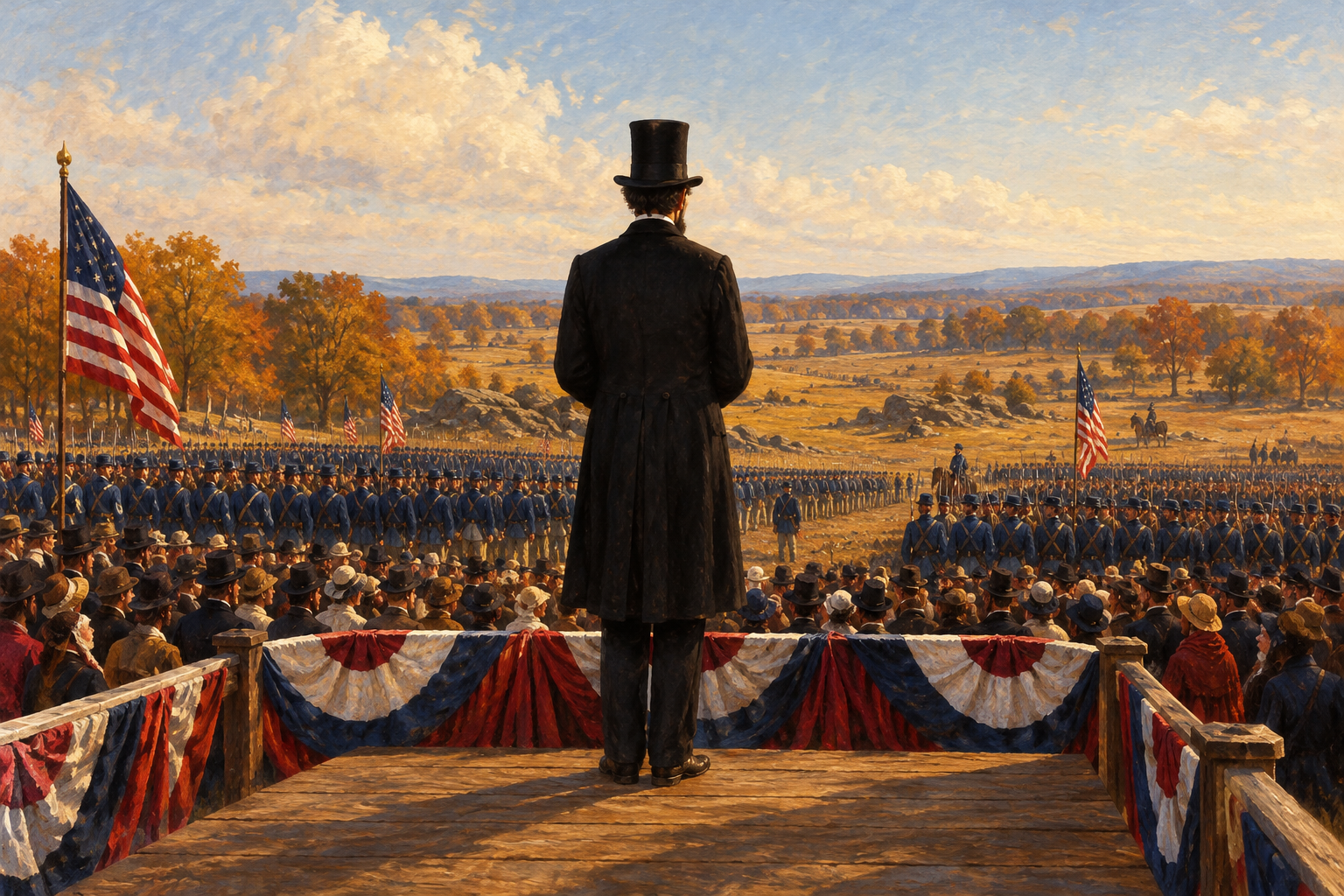
On 19 November 1863 he spoke at the dedication of the soldiers’ cemetery at Gettysburg, Pennsylvania, where the Union had won a huge battle in July. The speech lasted two or three minutes and ran to about 270 words. In it he described the nation as built on the idea that all men are created equal, and he called on listeners to make sure that “government of the people, by the people, for the people, shall not perish from the earth.” Few spoken texts in American history are quoted as often.
Re-election, the Thirteenth Amendment and assassination
In the summer of 1864 Lincoln expected to lose his bid for re-election. Union victories, above all the capture of Atlanta in September, turned opinion, and he beat General George McClellan in November. Lincoln pushed Congress to pass the Thirteenth Amendment abolishing slavery. The House approved it on 31 January 1865, and the states ratified it in December 1865, eight months after his death.
His Second Inaugural Address on 4 March 1865 was short and sombre. He named slavery as the cause of the war and urged the nation to move forward “with malice toward none, with charity for all.” On 9 April 1865 General Robert E. Lee surrendered the Army of Northern Virginia to Grant at Appomattox Court House.
On the evening of 14 April 1865 Lincoln attended a play at Ford’s Theatre in Washington. John Wilkes Booth, an actor who supported the Confederacy, shot him in the head. Lincoln died the next morning, 15 April, aged 56. He was the first US president to be assassinated. Soldiers killed Booth on 26 April. Lincoln’s funeral train travelled for nearly two weeks to Springfield, Illinois, where he was buried.
Why historians still debate him
Lincoln is usually ranked among the greatest presidents, but historians do not treat him as a simple hero. Before the war he said he would not touch slavery where it existed, and for a time he supported colonisation, the idea of resettling freed Black Americans abroad, which he later dropped. His wartime use of power remains controversial, including the habeas corpus suspensions and his approval of the execution of 38 Dakota men in December 1862, after a war in Minnesota; he reduced the list from 303 death sentences.
Many historians also see a leader who changed his views as events, and the actions of Black Americans themselves, pushed him forward. By April 1865 he had spoken publicly in favour of voting rights for some Black men. At home, the 1862 Homestead Act, Morrill Act and Pacific Railway Act laid foundations for western settlement, public universities and a transcontinental railroad.
What exams ask
AP-style questions focus on significance and cause and effect. Be ready to explain:
- Why the Kansas–Nebraska Act led to the Republican Party and Lincoln’s return to politics.
- How the 1860 election led to secession, and what Fort Sumter changed.
- What the Emancipation Proclamation did and did not do.
- Why the Gettysburg Address gave the war a wider purpose, equality and the survival of self-government.
- The 1862 laws: the Homestead Act, the Morrill Land-Grant Act and the Pacific Railway Act.
- How the Thirteenth Amendment (1865) differs from the Proclamation (1863).
Read next
Who Won the Civil War and Why? explains the military and economic reasons the Union prevailed. The Emancipation Proclamation (1863) looks closely at what the document said and how it changed the war. The Monroe Doctrine (1823) covers the foreign-policy idea that shaped how the United States answered European involvement in the Americas, including France’s intervention in Mexico during the Civil War.